
Jacques Tilly
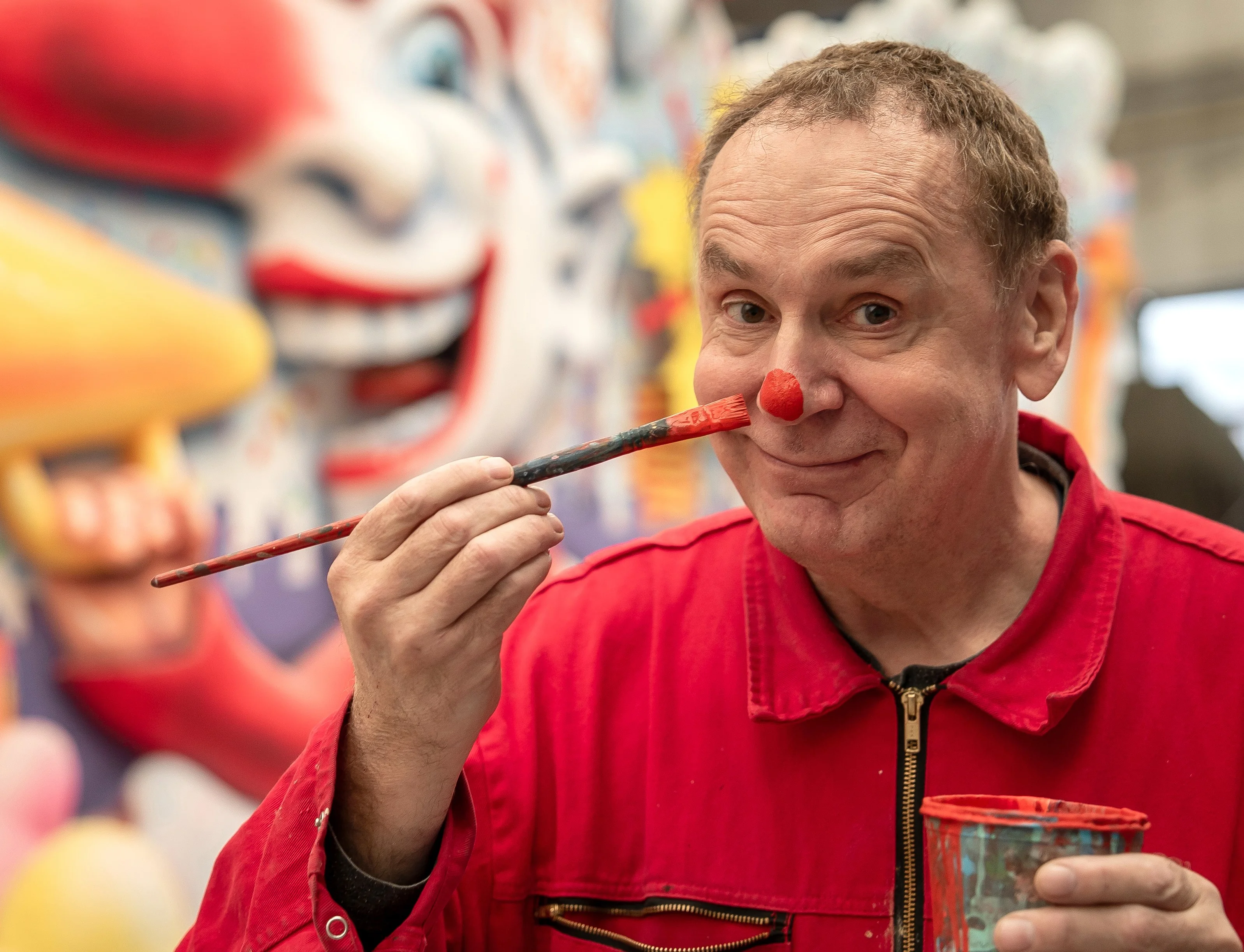
Image from Wikipedia
Image from Wikipedia
Jacques Tilly: The Satirical Sculptor Who Transforms Carnival into a Political Stage
An Artist Between Sculpture, Satire, and Public Commentary
Jacques Tilly, born on June 27, 1963, in Düsseldorf, is one of the most prominent German artists of his generation. He became known not through a classic studio oeuvre but through monumental, politically charged carnival floats and sculptural works that sharply address public debates with humor, craftsmanship, and visual impact. His name represents a form of sculpture that does not remain silent in a museum but actively makes an impact in public space.
As a sculptor, illustrator, and communication designer, Tilly combines creative power with political precision. His works are not mere decorative byproducts of tradition, but stand-alone commentaries on the present, often grotesque, exaggerated, and deliberately provocative. This is precisely where the appeal of his artistic development lies: Jacques Tilly has turned carnival into a stage where satire, craftsmanship, and media impact converge.
Early Years and Education: Düsseldorf as the Artistic Starting Point
Jacques Tilly grew up in Düsseldorf and attended Comenius Gymnasium. Early on, he evidently combined drawing with spatial imagination, as his later path led him to the University of Duisburg-Essen, where he studied graphic design and graduated in 1994. This academic foundation is crucial for understanding his work: Tilly works not only intuitively but with the trained eye of a communication designer who precisely calculates visual language, impact, and readability.
His biographical connection to Düsseldorf is central to his later career. There, carnival is not just folklore but a cultural infrastructure where art, public life, and regional identity intertwine. Tilly thus grew up in an environment that almost prepared him for his later specialized form of political sculpture.
The Path to Satirical Sculpture
Since 1983, Jacques Tilly has been designing figures and sculptures for Rosenmontag in Düsseldorf. From this long practice emerged a distinctive style: papier-mâché-based, often gigantic float figures that portray political power, religious authority, and social conflicts with bitter wit. The formal exaggeration is never an end in itself but part of a clear artistic program.
His carnival floats function like visual editorials. They react to current events, translate complex conflicts into unmistakable images, and utilize the stage of street carnival as a democratic resonance space. It is precisely this combination of timely commentary and handcrafted grandeur that makes Tilly an exceptional figure in the German-speaking cultural space.
Highlights of His Career: From Rosenmontag to International Attention
Jacques Tilly became widely known beyond Düsseldorf because his works repeatedly address international political figures and crises. In the late 2010s, his floats received particular attention, including representations of Donald Trump, Theresa May, Jarosław Kaczyński, and Angela Merkel. Brexit and the COVID-19 pandemic also found expression in his figures. Thus, Tilly's works have reached a scope that leaves classic carnival aesthetics far behind.
The media response to his work shows that Tilly is not perceived merely as a float builder but as a political artist. Reports in international and German media describe him as a shaping figure of the Rhineland carnival and as a designer whose floats do not just entertain but provoke, sharpen, and spark debates. His art generates friction, and this very friction is an essential part of its cultural significance.
Courage to Confront as a Trademark
A recurring motif in Tilly's work is the radical condensation of political statements. His works create an image from contradictions, a gesture from power dynamics, a visual indictment from current events. This became especially evident in works that target right-wing populist and authoritarian figures. Here, the artist's experience with public impact is apparent: he knows how to harness form, size, and visual wit to capture attention.
The fact that his works do not always receive unanimous approval is inherent to their nature. Tilly works at the intersection of carnival, political art, and satire, in a field where approval, irritation, and rejection often lie close together. His career proves that artistic relevance does not stem from pleasing, but from stance, consistency, and a strong visual language.
Style and Artistic Signature: Papier-Mâché, Exaggeration, and Visual Clarity
Formally, Jacques Tilly's works are unmistakable. He relies on large, often grotesque papier-mâché figures that employ caricatural exaggeration to transform political actors into symbolically charged images. This visual language is direct but never crude; it follows a dramaturgy aimed at readability, impact, and immediate comprehensibility. The result is a style that moves between sculpture, caricature, and public performance.
Tilly's artistic development demonstrates how closely technique and message are intertwined. His sculptures are created not only as handcrafted objects but as forms of communication. This is where his expertise lies: he masters the translation of complex themes into a visual language that is understood at a glance and still resonates long after.
Communication Design as an Aesthetic Discipline
Tilly's education in communication design is clearly evident in his works. The figures are not only sculpturally impressive but strategically composed. Every line, gesture, and color accent supports the message. As a result, his floats possess a rare dual function: they are artworks and at the same time precise media images.
This quality makes Jacques Tilly culturally and historically interesting. He operates within a tradition of political satire that spans from carnival to caricature to public sculpture. His works demonstrate that applied art and high culture need not be opposites when form and content intersect.
Cultural Influence: Carnival as a Political Resonance Space
Jacques Tilly has changed the perspective on carnival. Where lightness, humor, and local tradition often dominate, he introduces political sharpness, social analysis, and international attention. His floats have become symbols that tradition need not be apolitical. On the contrary: especially in carnival, power dynamics, social tensions, and collective moods can be effectively translated into images.
His significance thus extends far beyond Düsseldorf. Tilly represents an art form that relies on spontaneous reception while simultaneously demanding high design competence. His work influences the understanding of carnival as a form of cultural expression and shows how satire can operate in public space without losing its formal quality.
Public Controversies and International Perception
Because his works make political points, they regularly come into the public eye. Tilly's satirical representations have been not only praised but also attacked and threatened. It is from this that the societal relevance of his work can be inferred: art that contradicts remains visible. In a time of shortened debates, Tilly affirms the power of visual satire as an important cultural language.
Recent reports about legal disputes surrounding his works also underline how seriously his visual language is taken. The artist remains an example of art that aims not for harmony but for discourse. His presence in the cultural memory is based on this blend of craftsmanship and political steadfastness.
Current Projects and Continued Presence
The official site of Jacques Tilly continues to reference current projects by his team, including workshops, carnival floats, and various sculptural works for events, stages, and installations. This reflects an artistic practice that is not concluded but continuously explores new forms, contexts, and applications. Tilly remains an active creator of public imagery.
Particularly notable is that his team not only develops carnival floats but also backdrops, decorations, and further sculptural works for stage, film, and events. This reveals an expanded artistic production that transcends the Rhineland carnival and confirms Tilly's role as a versatile sculptor.
An Artist Between Workshop and World Politics
Jacques Tilly's career is a good example of an art that gains international visibility from local roots. His workshop is closely linked to Düsseldorf, yet his thematic horizon extends from municipal satire to geopolitical symbols. This range makes him an exceptionally relevant figure in European cultural life.
The combination of long-lasting practice, clear stance, and immediately recognizable visual language has secured Tilly a firm place in German art and carnival history. His work is accessible and sharp at the same time, popular and uncomfortable, craftfully precise and politically aware. It is from this that his enduring significance derives.
Conclusion: A Satirical Sculptor with Lasting Impact
Jacques Tilly is exciting because he understands art not as distance but as intervention. His sculptures present political questions in a form that can reach millions. Those who know his name know not only a sculptor but a precise observer of the present who proves with each figure how powerful satire can be in public spaces.
Anyone who experiences Jacques Tilly's work live immediately understands why his art generates so much attention. The size, energy, and thematic sharpness of his works have an immediate impact on-site. This is precisely why it is worthwhile to experience his works in public, at the carnival, or in exhibitions with all senses.
Official Channels of Jacques Tilly:
- Instagram: No official profile found
- Facebook: https://www.facebook.com/Jacques-Tilly-Team-201691756523590/
- YouTube: No official profile found
- Spotify: No official profile found
- TikTok: No official profile found
Sources:
Upcoming Events
Jaques Tilly: Who's Afraid of Paper Mâché?