
Bielefeld
Niedernstraße 4, 33602 Bielefeld, Deutschland
Altstädter Nicolaikirche | Photos & Events
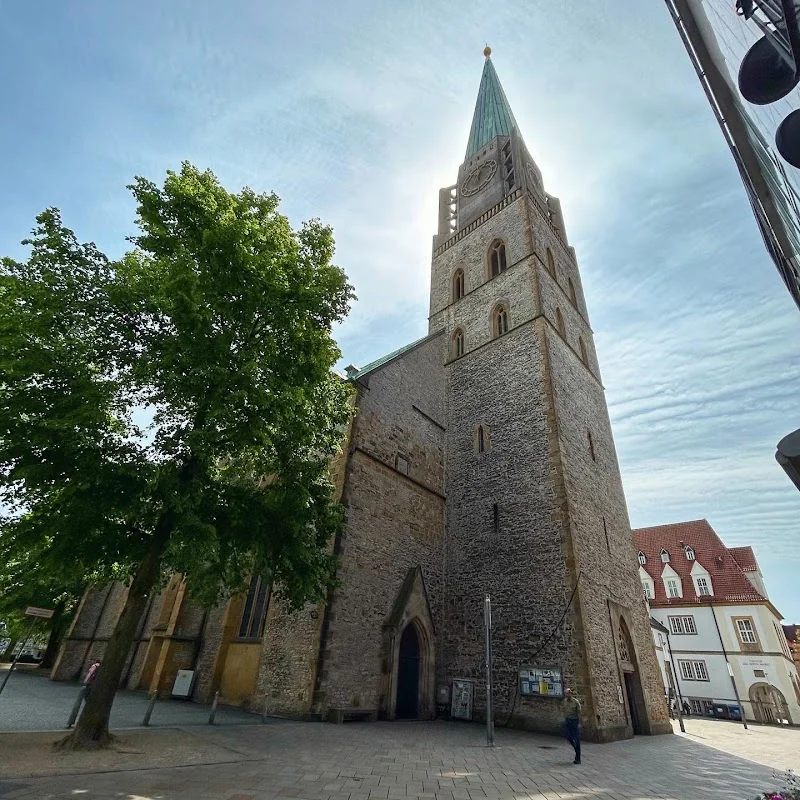
The Altstädter Nicolaikirche is one of the most prominent addresses in the Bielefeld old town and at the same time a place where history, faith, music, and urban life come together in a small space. Those looking for images, impressions, or inspiration for a visit will find not only a historic church here but a vibrant city church with daily opening hours, a central location, and an extraordinary cultural profile. The church is located at Niedernstraße 4, in close proximity to the Old Market and the Town Hall; it is considered the oldest city church in Bielefeld and is described by the city and the community as a historical market church. The current form is the result of a long history that dates back to 1236 and was shaped by the reconstruction after the destruction in World War II. It is precisely this mix of deeply rooted tradition and open presence that makes the Altstädter Nicolaikirche so exciting for visitors, culture enthusiasts, and people searching for special places in Bielefeld. ([kirche-bielefeld.de](https://www.kirche-bielefeld.de/auf-einen-blick/kirchen-in-bielefeld/evangelische-altstaedter-nicolaikirche-mitte))
Events, Services, and Organ Market Music
Visitors to the Altstädter Nicolaikirche experience much more than a classic church space. The official community describes it as an open church that is accessible daily from 10 AM to 6 PM and explicitly understands itself as open to conversation, dialogue, and a wide circle of people. At the same time, it is a central meeting point for services, church musical formats, and cultural events in the heart of the city. On the community and event level, it becomes clear that the church is not only a spiritual place but also a stage for various forms of encounter. For guest concerts, ticket sales points are communicated through posters and announcements, while tickets for concerts of the city cantorship are available at the box office; there are no concert tickets or information about concerts at the community office itself. This is important for visitors because it clearly distinguishes the visit path from the classic church community contact. ([kirche-bielefeld.de](https://www.kirche-bielefeld.de/auf-einen-blick/index.php?id=54))
The musical use of the space is particularly significant. The city cantorship and the municipal tourism site regularly perform organ market music in the Altstädter Nicolaikirche. The church music page lists current dates such as organ market music and other concert formats; the city of Bielefeld also describes the Saturday market music as a recurring format after the noon bell. Additionally, it is mentioned in the event notes that the organ market music usually takes place every second and fourth Saturday at 12:05 PM and lasts about 40 minutes. Thus, the Altstädter Nicolaikirche is not only a space for quiet reflection but also a place where regular musical tradition, liturgical form, and urban public life directly intersect. This connection of worship, concert, and open church is a key reason why many inquiries about programs, events, tickets, and market music target this location. ([kirche-bielefeld.de](https://www.kirche-bielefeld.de/auf-einen-blick/kirchen-in-bielefeld/evangelische-altstaedter-nicolaikirche-mitte))
Moreover, the church plays a special role in urban cultural events. According to Bielefeld Marketing, the Altstädter Nicolaikirche is a place where, in addition to services, concerts, exhibitions, and various events take place. This shows the range between ecclesiastical use and cultural use. Larger citywide formats also utilize the church, such as walk concerts as part of the Bielefeld Organ Summer, where several inner-city churches are played in succession. This is attractive for visitors because a single event often connects several musical and atmospheric levels. Therefore, those looking for a place for spiritual music, organ sound, choral works, or special city moments will find in the Altstädter Nicolaikirche an address that is firmly anchored in the event calendar of the city and the church district. ([bielefeld.jetzt](https://www.bielefeld.jetzt/node/206004))
History of a Bielefeld City Church with 750 Years of Tradition
The historical depth of the Altstädter Nicolaikirche is one of its greatest attractions. The official church and city information describes it as the oldest city church in Bielefeld; its roots go back to 1236 when it was detached from the parish of Heepen and elevated to an independent parish church by Bishop Bernhard of Paderborn. Thus, it is not only a sacred building but also a key location in urban development. Its location in the middle of the old town, in direct proximity to the Old Market and Town Hall, underscores its historical and urban significance. The city of Bielefeld also refers to the Altstädter Nicolaikirche from 1340 in the city district of Mitte as one of the most important witnesses of the historical old town core. The community itself calls it the oldest city church and at the same time a historical market church in the middle of the old town. ([kirche-bielefeld.de](https://www.kirche-bielefeld.de/auf-einen-blick/kirchen-in-bielefeld/evangelische-altstaedter-nicolaikirche-mitte))
However, the history of the church is not only medieval but also shaped by destruction and renewal. The old building from the 14th century was almost completely destroyed on September 30, 1944, during an English bombing raid. The current building was constructed between 1954 and 1963 in a significantly altered architecture. These time markers explain why the church today appears both historical and modern: it carries the memory of the Middle Ages, of war losses, and of the post-war reconstruction within it. This context is particularly exciting for visitors interested in urban history, architecture, or ecclesiastical identity. The Altstädter Nicolaikirche is thus not a frozen monument but a developed, still-used urban space whose appearance consists of several historical layers. ([kirche-bielefeld.de](https://www.kirche-bielefeld.de/auf-einen-blick/kirchen-in-bielefeld/evangelische-altstaedter-nicolaikirche-mitte))
The perception in the city is also significantly influenced by the church's open function since the post-war period. The community describes it as an open church that has been open daily for about 40 years; the synod report even mentions an open church shortly after the end of the war. This is crucial for an inner-city church because here not only liturgical use and concert use come together, but also visits in between, quiet moments, conversations, and spontaneous impressions. Thus, the Altstädter Nicolaikirche becomes a space that keeps the past visible while also enabling a contemporary urban community. The historical significance arises not only from numbers and construction phases but also from the continuous use as a central place in the middle of Bielefeld. ([kirche-bielefeld.de](https://www.kirche-bielefeld.de/auf-einen-blick/index.php?id=54))
Antwerp Carved Altar, Light Sculpture, and Carillon
Among the most impressive features of the Altstädter Nicolaikirche is the Antwerp carved altar. The official city website describes it as a precious altar from the workshop of the Antwerp Lucas Guild from 1524, which includes a total of 250 figures in scenes of biblical readings. The church district also emphasizes that this altar is one of the outstanding works of Antwerp carving and painting art from the early 16th century. The anniversary page additionally clarifies that the altar was installed in the church in 1524, during the Catholic period, and that it is now considered a defining work of art for the space. For SEO and visitor interest, this is an enormously strong factor, as historical art, religious imagery, and a clear anchor for culture enthusiasts seeking photos, detailed views, or art stories come together here. ([bielefeld.jetzt](https://www.bielefeld.jetzt/altstaedter-nicolaikirche))
Equally characteristic is the light sculpture by Bielefeld artist Maria Bernard. The tourism site of Bielefeld explicitly points out that this sculpture can be viewed daily during opening hours from 10 AM to 6 PM. Together with the carved altar, it shapes the visual impact of the church space and makes the visit interesting even for those who do not primarily come for a service but for art, light ambiance, and interior atmosphere. In this sense, the Altstädter Nicolaikirche is a place where sacred furnishings and contemporary artistic settings complement each other. Therefore, those looking for motifs for photos will find not only a historical facade here but also an interior with strong sightlines, a significant altar piece, and a modern light work that further characterizes the space. ([bielefeld.jetzt](https://www.bielefeld.jetzt/altstaedter-nicolaikirche))
Another characteristic feature is the carillon. The municipal tourism site mentions a carillon of 36 bells that rings daily at 9:58 AM, 12:58 PM, 3:58 PM, and 6:58 PM. Additionally, the official church music page highlights the organ market music and the large Beckerath organ. It states that the large Beckerath organ is an outstanding instrument, and occasionally the little sister on the side gallery also rings out. This creates a musical profile that is audible throughout the entire city center. Thus, the Altstädter Nicolaikirche is not just a static point of interest but a resonant place. The carillon, organ, and choral work are part of the everyday presence here. This is exactly what makes the place so appealing to visitors: it is open during the day, visually striking, and acoustically vibrant. ([bielefeld.jetzt](https://www.bielefeld.jetzt/altstaedter-nicolaikirche))
Access by Tram, Town Hall, and Parking in the Old Town
The Altstädter Nicolaikirche is very conveniently located in Bielefeld-Mitte. According to official information, it can be reached by tram via the Rathaus stop; from there, it is about 260 meters on foot, and lines 1, 2, 3, and 4 are mentioned. This makes traveling without a car particularly convenient, especially since the church is located right in the city center. Those who are exploring the city center on foot can easily reach the church in combination with a walk through the Old Market, through the old town, or after a visit to the Town Hall, shops, and restaurants. For guests specifically looking for information on access and public transport, this compact location is a clear advantage. ([kirche-bielefeld.de](https://www.kirche-bielefeld.de/auf-einen-blick/kirchen-in-bielefeld/evangelische-altstaedter-nicolaikirche-mitte))
The parking situation is also well explained. The official documents from the city cantorship note that parking spaces are available directly at the Altstädter Nicolaikirche, provided that city markets or similar events are not taking place there. Access is described via the Altstädter Kirchplatz or possibly through the pedestrian zone. This is important for visitors because the situation in the Bielefeld old town can vary significantly depending on the market day or event. Therefore, those arriving by car should not only know the address but also check the respective daily context. ([kirche-bielefeld.de](https://www.kirche-bielefeld.de/fileadmin/Dokumente/---Dienste/Stadtkantorat/Probenplaene/Probenplan_Vokalensemble_Stand_2026_02_07.pdf))
As nearby alternatives, the city of Bielefeld names several parking garages and underground garages in the city center, including the underground garage Neues Rathaus via Körnerstraße and the underground garage Altstadt-Carré via the access at Waldhof 19. In addition, the municipal parking directory lists other central offerings such as Parkhaus Centrum, Parkhaus Karstadt, Tiefgarage Welle, or Parkhaus Am Jahnplatz. For a visit to the Altstädter Nicolaikirche, this means: even if the church square is occupied or inaccessible due to a market, there are practical alternatives in the vicinity. Thus, the location remains easily accessible for both short visits and concert evenings. ([bielefeld.de](https://www.bielefeld.de/parken))
An additional advantage is the central location in the historic city center. The city describes the district of Mitte as an area where one walks in the footsteps of history, while around the old town, public facilities are centrally and conveniently accessible. For the Altstädter Nicolaikirche, this means: access, parking, and footpaths can be easily combined with other city center activities. Those wishing to take photos, attend a service, or listen to a concert can thus combine their visit with a stroll through the city, a café visit, or a tour of the old town. This connection between a cultural site and city location is one of the main reasons why the church frequently appears in inquiries about access, parking, and the city center. ([bielefeld.de](https://www.bielefeld.de/mitte?utm_source=openai))
Photos, Atmosphere, and the Open Church Space
Those specifically searching for photos of the Altstädter Nicolaikirche often seek more than just a single image. What is sought is an impression: how does the church appear inside and outside, how strong is the historical presence, how close is it to the old town, and is it a place that can be visited spontaneously? This is exactly where the open church shows its strength. The church is open daily from 10 AM to 6 PM, and the tourism site emphasizes that the light sculpture can be viewed during this time. Additionally, the church is atmospherically illuminated once a year during night views. These are strong visual occasions for photos and impressions because they show the space both in daylight and in special lighting. For visitors, this means: the place is not only historically interesting but also very accessible photographically and atmospherically. ([bielefeld.jetzt](https://www.bielefeld.jetzt/altstaedter-nicolaikirche))
The open church also has a social and spiritual dimension. The community understands openness spatially and conceptually and emphasizes dialogue, encounter, and new ways of proclamation. In the synod report, the Altstädter Nicolaikirche is described as a great treasure that should provide space for pastoral conversations, contact, and situational help in the middle of the city. This is more than a nice formulation: it shows that the space is not only intended for visitors with programs but also for people who simply seek peace or wish to retreat briefly. Thus, an atmosphere is created that is rare in the old town and is therefore very valuable for many. The combination of artwork, church space, and urban public life makes the church a place that looks good in photos and has an even stronger impact in reality. ([kirche-bielefeld.de](https://www.kirche-bielefeld.de/auf-einen-blick/index.php?id=54))
For the visit on-site, accessibility is also relevant. The municipal event page for the Altstädter Nicolaikirche points out a barrier-free entrance. This is a practical detail for many guests, but at the same time, it is also a signal that the church is consciously understood as an accessible urban space. Together with the central location, clear opening hours, and good accessibility, a convincing visit profile emerges: a brief entry for a quiet minute, specifically for the artwork, for an organ market music event, or for a concert, or simply for photos and impressions from the historic interior. It is precisely this versatility that makes the Altstädter Nicolaikirche so remarkable in the Bielefeld cityscape. ([bielefeld.jetzt](https://www.bielefeld.jetzt/node/206004))
Practical Information for Your Visit
For planning a visit, some clear facts are particularly helpful. The church is located at Niedernstraße 4 in 33602 Bielefeld, is open daily from 10 AM to 6 PM, and belongs to the Evangelical Altstädter Nicolaikirche community. The community describes itself as an open church and simultaneously points out that the Altstädter Nicolaikirche is understood as a community church and daily city church. For services, concerts, and events, it is worth taking a look at the current notices from the community and the city cantorship. If you specifically want to attend a concert, it is important to know that guest concerts are communicated through posters and announcements, and tickets for city cantorship concerts are available at the box office. ([bielefeld.jetzt](https://www.bielefeld.jetzt/altstaedter-nicolaikirche))
Those arriving by car should keep the old town context in mind at the Altstädter Nicolaikirche. Parking spaces directly at the church are possible, provided that no markets or city special formats are taking place. Nearby central parking garages and underground garages listed by the city of Bielefeld in the city center are good alternatives. Those using the tram are well advised with the Rathaus stop and lines 1 to 4. This combination of central location, good public transport connection, and flexible parking options makes the Altstädter Nicolaikirche an uncomplicated destination for visitors, concert guests, and people seeking a quiet place in the middle of the city center. ([kirche-bielefeld.de](https://www.kirche-bielefeld.de/fileadmin/Dokumente/---Dienste/Stadtkantorat/Probenplaene/Probenplan_Vokalensemble_Stand_2026_02_07.pdf))
In the end, it becomes clear: the Altstädter Nicolaikirche is not just a name for an address but a multifaceted place with history, sound, art, and open presence. It is the oldest city church, historical market church, concert venue, open church, art space, and orientation point in the Bielefeld old town at the same time. Those searching for photos, events, access, parking, services, or history will find here a location with very clear usage qualities and a strong emotional profile. That is why it remains relevant for visitors, search engines, and the city itself alike. ([bielefeld.jetzt](https://www.bielefeld.jetzt/altstaedter-nicolaikirche))
Sources:
- Bielefeld.JETZT - Altstädter Nicolaikirche
- Evangelical Church District Bielefeld - Evangelical Altstädter Nicolaikirche
- Evangelical Church District Bielefeld - Events of the City Cantorship
- Ev. Altstädter Nicolaikirchengemeinde - Events
- City of Bielefeld - City District Mitte
- City of Bielefeld - Parking Garages & Parking Spaces
Mehr anzeigenWeniger anzeigen
Altstädter Nicolaikirche | Photos & Events
The Altstädter Nicolaikirche is one of the most prominent addresses in the Bielefeld old town and at the same time a place where history, faith, music, and urban life come together in a small space. Those looking for images, impressions, or inspiration for a visit will find not only a historic church here but a vibrant city church with daily opening hours, a central location, and an extraordinary cultural profile. The church is located at Niedernstraße 4, in close proximity to the Old Market and the Town Hall; it is considered the oldest city church in Bielefeld and is described by the city and the community as a historical market church. The current form is the result of a long history that dates back to 1236 and was shaped by the reconstruction after the destruction in World War II. It is precisely this mix of deeply rooted tradition and open presence that makes the Altstädter Nicolaikirche so exciting for visitors, culture enthusiasts, and people searching for special places in Bielefeld. ([kirche-bielefeld.de](https://www.kirche-bielefeld.de/auf-einen-blick/kirchen-in-bielefeld/evangelische-altstaedter-nicolaikirche-mitte))
Events, Services, and Organ Market Music
Visitors to the Altstädter Nicolaikirche experience much more than a classic church space. The official community describes it as an open church that is accessible daily from 10 AM to 6 PM and explicitly understands itself as open to conversation, dialogue, and a wide circle of people. At the same time, it is a central meeting point for services, church musical formats, and cultural events in the heart of the city. On the community and event level, it becomes clear that the church is not only a spiritual place but also a stage for various forms of encounter. For guest concerts, ticket sales points are communicated through posters and announcements, while tickets for concerts of the city cantorship are available at the box office; there are no concert tickets or information about concerts at the community office itself. This is important for visitors because it clearly distinguishes the visit path from the classic church community contact. ([kirche-bielefeld.de](https://www.kirche-bielefeld.de/auf-einen-blick/index.php?id=54))
The musical use of the space is particularly significant. The city cantorship and the municipal tourism site regularly perform organ market music in the Altstädter Nicolaikirche. The church music page lists current dates such as organ market music and other concert formats; the city of Bielefeld also describes the Saturday market music as a recurring format after the noon bell. Additionally, it is mentioned in the event notes that the organ market music usually takes place every second and fourth Saturday at 12:05 PM and lasts about 40 minutes. Thus, the Altstädter Nicolaikirche is not only a space for quiet reflection but also a place where regular musical tradition, liturgical form, and urban public life directly intersect. This connection of worship, concert, and open church is a key reason why many inquiries about programs, events, tickets, and market music target this location. ([kirche-bielefeld.de](https://www.kirche-bielefeld.de/auf-einen-blick/kirchen-in-bielefeld/evangelische-altstaedter-nicolaikirche-mitte))
Moreover, the church plays a special role in urban cultural events. According to Bielefeld Marketing, the Altstädter Nicolaikirche is a place where, in addition to services, concerts, exhibitions, and various events take place. This shows the range between ecclesiastical use and cultural use. Larger citywide formats also utilize the church, such as walk concerts as part of the Bielefeld Organ Summer, where several inner-city churches are played in succession. This is attractive for visitors because a single event often connects several musical and atmospheric levels. Therefore, those looking for a place for spiritual music, organ sound, choral works, or special city moments will find in the Altstädter Nicolaikirche an address that is firmly anchored in the event calendar of the city and the church district. ([bielefeld.jetzt](https://www.bielefeld.jetzt/node/206004))
History of a Bielefeld City Church with 750 Years of Tradition
The historical depth of the Altstädter Nicolaikirche is one of its greatest attractions. The official church and city information describes it as the oldest city church in Bielefeld; its roots go back to 1236 when it was detached from the parish of Heepen and elevated to an independent parish church by Bishop Bernhard of Paderborn. Thus, it is not only a sacred building but also a key location in urban development. Its location in the middle of the old town, in direct proximity to the Old Market and Town Hall, underscores its historical and urban significance. The city of Bielefeld also refers to the Altstädter Nicolaikirche from 1340 in the city district of Mitte as one of the most important witnesses of the historical old town core. The community itself calls it the oldest city church and at the same time a historical market church in the middle of the old town. ([kirche-bielefeld.de](https://www.kirche-bielefeld.de/auf-einen-blick/kirchen-in-bielefeld/evangelische-altstaedter-nicolaikirche-mitte))
However, the history of the church is not only medieval but also shaped by destruction and renewal. The old building from the 14th century was almost completely destroyed on September 30, 1944, during an English bombing raid. The current building was constructed between 1954 and 1963 in a significantly altered architecture. These time markers explain why the church today appears both historical and modern: it carries the memory of the Middle Ages, of war losses, and of the post-war reconstruction within it. This context is particularly exciting for visitors interested in urban history, architecture, or ecclesiastical identity. The Altstädter Nicolaikirche is thus not a frozen monument but a developed, still-used urban space whose appearance consists of several historical layers. ([kirche-bielefeld.de](https://www.kirche-bielefeld.de/auf-einen-blick/kirchen-in-bielefeld/evangelische-altstaedter-nicolaikirche-mitte))
The perception in the city is also significantly influenced by the church's open function since the post-war period. The community describes it as an open church that has been open daily for about 40 years; the synod report even mentions an open church shortly after the end of the war. This is crucial for an inner-city church because here not only liturgical use and concert use come together, but also visits in between, quiet moments, conversations, and spontaneous impressions. Thus, the Altstädter Nicolaikirche becomes a space that keeps the past visible while also enabling a contemporary urban community. The historical significance arises not only from numbers and construction phases but also from the continuous use as a central place in the middle of Bielefeld. ([kirche-bielefeld.de](https://www.kirche-bielefeld.de/auf-einen-blick/index.php?id=54))
Antwerp Carved Altar, Light Sculpture, and Carillon
Among the most impressive features of the Altstädter Nicolaikirche is the Antwerp carved altar. The official city website describes it as a precious altar from the workshop of the Antwerp Lucas Guild from 1524, which includes a total of 250 figures in scenes of biblical readings. The church district also emphasizes that this altar is one of the outstanding works of Antwerp carving and painting art from the early 16th century. The anniversary page additionally clarifies that the altar was installed in the church in 1524, during the Catholic period, and that it is now considered a defining work of art for the space. For SEO and visitor interest, this is an enormously strong factor, as historical art, religious imagery, and a clear anchor for culture enthusiasts seeking photos, detailed views, or art stories come together here. ([bielefeld.jetzt](https://www.bielefeld.jetzt/altstaedter-nicolaikirche))
Equally characteristic is the light sculpture by Bielefeld artist Maria Bernard. The tourism site of Bielefeld explicitly points out that this sculpture can be viewed daily during opening hours from 10 AM to 6 PM. Together with the carved altar, it shapes the visual impact of the church space and makes the visit interesting even for those who do not primarily come for a service but for art, light ambiance, and interior atmosphere. In this sense, the Altstädter Nicolaikirche is a place where sacred furnishings and contemporary artistic settings complement each other. Therefore, those looking for motifs for photos will find not only a historical facade here but also an interior with strong sightlines, a significant altar piece, and a modern light work that further characterizes the space. ([bielefeld.jetzt](https://www.bielefeld.jetzt/altstaedter-nicolaikirche))
Another characteristic feature is the carillon. The municipal tourism site mentions a carillon of 36 bells that rings daily at 9:58 AM, 12:58 PM, 3:58 PM, and 6:58 PM. Additionally, the official church music page highlights the organ market music and the large Beckerath organ. It states that the large Beckerath organ is an outstanding instrument, and occasionally the little sister on the side gallery also rings out. This creates a musical profile that is audible throughout the entire city center. Thus, the Altstädter Nicolaikirche is not just a static point of interest but a resonant place. The carillon, organ, and choral work are part of the everyday presence here. This is exactly what makes the place so appealing to visitors: it is open during the day, visually striking, and acoustically vibrant. ([bielefeld.jetzt](https://www.bielefeld.jetzt/altstaedter-nicolaikirche))
Access by Tram, Town Hall, and Parking in the Old Town
The Altstädter Nicolaikirche is very conveniently located in Bielefeld-Mitte. According to official information, it can be reached by tram via the Rathaus stop; from there, it is about 260 meters on foot, and lines 1, 2, 3, and 4 are mentioned. This makes traveling without a car particularly convenient, especially since the church is located right in the city center. Those who are exploring the city center on foot can easily reach the church in combination with a walk through the Old Market, through the old town, or after a visit to the Town Hall, shops, and restaurants. For guests specifically looking for information on access and public transport, this compact location is a clear advantage. ([kirche-bielefeld.de](https://www.kirche-bielefeld.de/auf-einen-blick/kirchen-in-bielefeld/evangelische-altstaedter-nicolaikirche-mitte))
The parking situation is also well explained. The official documents from the city cantorship note that parking spaces are available directly at the Altstädter Nicolaikirche, provided that city markets or similar events are not taking place there. Access is described via the Altstädter Kirchplatz or possibly through the pedestrian zone. This is important for visitors because the situation in the Bielefeld old town can vary significantly depending on the market day or event. Therefore, those arriving by car should not only know the address but also check the respective daily context. ([kirche-bielefeld.de](https://www.kirche-bielefeld.de/fileadmin/Dokumente/---Dienste/Stadtkantorat/Probenplaene/Probenplan_Vokalensemble_Stand_2026_02_07.pdf))
As nearby alternatives, the city of Bielefeld names several parking garages and underground garages in the city center, including the underground garage Neues Rathaus via Körnerstraße and the underground garage Altstadt-Carré via the access at Waldhof 19. In addition, the municipal parking directory lists other central offerings such as Parkhaus Centrum, Parkhaus Karstadt, Tiefgarage Welle, or Parkhaus Am Jahnplatz. For a visit to the Altstädter Nicolaikirche, this means: even if the church square is occupied or inaccessible due to a market, there are practical alternatives in the vicinity. Thus, the location remains easily accessible for both short visits and concert evenings. ([bielefeld.de](https://www.bielefeld.de/parken))
An additional advantage is the central location in the historic city center. The city describes the district of Mitte as an area where one walks in the footsteps of history, while around the old town, public facilities are centrally and conveniently accessible. For the Altstädter Nicolaikirche, this means: access, parking, and footpaths can be easily combined with other city center activities. Those wishing to take photos, attend a service, or listen to a concert can thus combine their visit with a stroll through the city, a café visit, or a tour of the old town. This connection between a cultural site and city location is one of the main reasons why the church frequently appears in inquiries about access, parking, and the city center. ([bielefeld.de](https://www.bielefeld.de/mitte?utm_source=openai))
Photos, Atmosphere, and the Open Church Space
Those specifically searching for photos of the Altstädter Nicolaikirche often seek more than just a single image. What is sought is an impression: how does the church appear inside and outside, how strong is the historical presence, how close is it to the old town, and is it a place that can be visited spontaneously? This is exactly where the open church shows its strength. The church is open daily from 10 AM to 6 PM, and the tourism site emphasizes that the light sculpture can be viewed during this time. Additionally, the church is atmospherically illuminated once a year during night views. These are strong visual occasions for photos and impressions because they show the space both in daylight and in special lighting. For visitors, this means: the place is not only historically interesting but also very accessible photographically and atmospherically. ([bielefeld.jetzt](https://www.bielefeld.jetzt/altstaedter-nicolaikirche))
The open church also has a social and spiritual dimension. The community understands openness spatially and conceptually and emphasizes dialogue, encounter, and new ways of proclamation. In the synod report, the Altstädter Nicolaikirche is described as a great treasure that should provide space for pastoral conversations, contact, and situational help in the middle of the city. This is more than a nice formulation: it shows that the space is not only intended for visitors with programs but also for people who simply seek peace or wish to retreat briefly. Thus, an atmosphere is created that is rare in the old town and is therefore very valuable for many. The combination of artwork, church space, and urban public life makes the church a place that looks good in photos and has an even stronger impact in reality. ([kirche-bielefeld.de](https://www.kirche-bielefeld.de/auf-einen-blick/index.php?id=54))
For the visit on-site, accessibility is also relevant. The municipal event page for the Altstädter Nicolaikirche points out a barrier-free entrance. This is a practical detail for many guests, but at the same time, it is also a signal that the church is consciously understood as an accessible urban space. Together with the central location, clear opening hours, and good accessibility, a convincing visit profile emerges: a brief entry for a quiet minute, specifically for the artwork, for an organ market music event, or for a concert, or simply for photos and impressions from the historic interior. It is precisely this versatility that makes the Altstädter Nicolaikirche so remarkable in the Bielefeld cityscape. ([bielefeld.jetzt](https://www.bielefeld.jetzt/node/206004))
Practical Information for Your Visit
For planning a visit, some clear facts are particularly helpful. The church is located at Niedernstraße 4 in 33602 Bielefeld, is open daily from 10 AM to 6 PM, and belongs to the Evangelical Altstädter Nicolaikirche community. The community describes itself as an open church and simultaneously points out that the Altstädter Nicolaikirche is understood as a community church and daily city church. For services, concerts, and events, it is worth taking a look at the current notices from the community and the city cantorship. If you specifically want to attend a concert, it is important to know that guest concerts are communicated through posters and announcements, and tickets for city cantorship concerts are available at the box office. ([bielefeld.jetzt](https://www.bielefeld.jetzt/altstaedter-nicolaikirche))
Those arriving by car should keep the old town context in mind at the Altstädter Nicolaikirche. Parking spaces directly at the church are possible, provided that no markets or city special formats are taking place. Nearby central parking garages and underground garages listed by the city of Bielefeld in the city center are good alternatives. Those using the tram are well advised with the Rathaus stop and lines 1 to 4. This combination of central location, good public transport connection, and flexible parking options makes the Altstädter Nicolaikirche an uncomplicated destination for visitors, concert guests, and people seeking a quiet place in the middle of the city center. ([kirche-bielefeld.de](https://www.kirche-bielefeld.de/fileadmin/Dokumente/---Dienste/Stadtkantorat/Probenplaene/Probenplan_Vokalensemble_Stand_2026_02_07.pdf))
In the end, it becomes clear: the Altstädter Nicolaikirche is not just a name for an address but a multifaceted place with history, sound, art, and open presence. It is the oldest city church, historical market church, concert venue, open church, art space, and orientation point in the Bielefeld old town at the same time. Those searching for photos, events, access, parking, services, or history will find here a location with very clear usage qualities and a strong emotional profile. That is why it remains relevant for visitors, search engines, and the city itself alike. ([bielefeld.jetzt](https://www.bielefeld.jetzt/altstaedter-nicolaikirche))
Sources:
- Bielefeld.JETZT - Altstädter Nicolaikirche
- Evangelical Church District Bielefeld - Evangelical Altstädter Nicolaikirche
- Evangelical Church District Bielefeld - Events of the City Cantorship
- Ev. Altstädter Nicolaikirchengemeinde - Events
- City of Bielefeld - City District Mitte
- City of Bielefeld - Parking Garages & Parking Spaces
Upcoming Events
No events found
Frequently Asked Questions
Reviews
No reviews found