
Bielefeld
Dornberger Str. 82, 33619 Bielefeld, Deutschland
Bielefeld Farmhouse Museum gGmbH | Museumshof Bielefeld & Parking
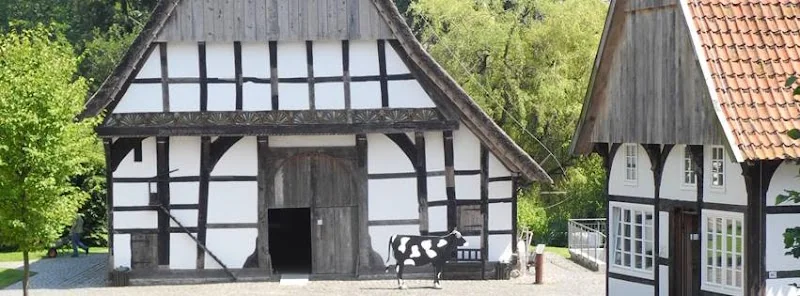
The Bielefeld Farmhouse Museum – officially Bielefeld Farmhouse Museum gGmbH – is a vibrant place where history can be experienced firsthand: In the Bielefeld city forest, not far from the Olderdissen Animal Park, the historic farm complex invites you on a journey into rural everyday life around 1850. Here, original farmhouse buildings, workshops, and agricultural buildings stand alongside gardens where historical useful and ornamental plants grow. Those who appreciate traditional building and living culture, old craftsmanship techniques, or regional cuisine will find both: authentic insights and enjoyable breaks in the café with Westphalian pickert and homemade cakes. For families, school classes, clubs, and companies, the site offers guided tours, programs, and well-suited spaces for celebrations and receptions; in summer, the meadow becomes a stage for markets and concerts. Thanks to good public transport connections (Bus line 24, stop Bauernhausmuseum) and the proximity to the large parking lot at the Olderdissen Animal Park, getting there is relaxed. This page consolidates the most important information about history, program, access, parking, and frequently searched terms like Museum Hülsmann and Museumshof Brackwede – so you can optimally plan your visit and make the most of your day at the Museumshof Bielefeld.
Museumshof Bielefeld: History and Special Features
The Bielefeld Farmhouse Museum is one of the oldest open-air museums in Westphalia and was opened on June 6, 1917. Its founding goes back to the initiative of the Historical Association for the County of Ravensberg; the city of Bielefeld provided funds and land. The goal was and is to vividly illustrate rural living, working, and farming in the 19th century with real objects in their original context. The complex unites several historical buildings, some of which were relocated from the region, making the farm as an economic unit tangible. The first main house came from the Meier farm in Ummeln (built in 1606). In 1995, it fell victim to a fire; the museum then reconstructed the main house of the Möllering farm from Rödinghausen (a three-post house from 1590) and reopened in 1999. Today, the path leads through the barn of the main house into rooms, chambers, and workspaces, where fireplace, smoke vent, cooking devices, spinning wheel, linen items, and furniture from the region create a concrete picture of life around 1850. The museum courtyard is complemented by distinctive individual buildings: The post mill (1686) conveys the efforts of grinding grain, while the Bokemühle (1826) illustrates the peeling and pounding of grain. The Spieker (1795) documents food storage, while the bakery (1764) brings regional bread traditions to life. A beehive from around 1900 refers to traditional beekeeping and the role of honey and beeswax. With the shipper and fisher house from 1568 (from Vlotho, now used as a children's house), the time span of the half-timbered buildings extends into the early modern period. A special feature is Olderdissens Kotten (1821), the only building on the site that stands in situ and has served as an exhibition and educational place since 2018. In the gardens, one encounters historical varieties and learns how ornamental and useful plants were combined in the past. For its educational work, the museum received a special recommendation in 2001 as part of the European Museum of the Year Award. Those searching for terms like Museumshof Bielefeld or Bielefelder Museumshof usually mean exactly this complex: an authentic place where architectural monuments, everyday culture, and nature-friendly outdoor space merge into a decelerating experience.
Access by Bus Line 24 and Parking at the Olderdissen Animal Park
Getting to the farmhouse museum is straightforward. From the city center, you can reach the museum courtyard directly with bus line 24 from Jahnplatz towards Dornberg to the Bauernhausmuseum stop; from there, a short, well-signposted footpath leads through the city forest to the entrance. The stop is located on Dornberger Straße, which also connects the Olderdissen Animal Park and the Botanical Garden as a central access axis in this section. If you are coming by car, you should not park along Dornberger Straße but use the large designated parking lot at the Olderdissen Animal Park (address: Dornberger Straße 149a). This parking lot is paid, but it offers the most comfortable option to park the car and then walk to the museum. Traffic authorities have previously taken measures against illegal parking along Dornberger Straße; therefore, it makes sense to use the designated parking spaces at the animal park. For cyclists, the city forest offers pleasant routes; check for parking options near the Bauernhausmuseum stop or at the animal park if needed. Tip for the combination: If you are planning a family outing, you can combine the visit to the farmhouse museum with a walk through the animal park or a detour to the botanical garden. Both destinations are in immediate proximity. Depending on the season, plan to wear sturdy shoes for forest paths; on rainy days, the paths are naturally soft. For groups, a brief phone coordination with the museum is advisable, especially when buses are arriving or departing, to ensure smooth boarding and alighting. For wheelchair users and strollers, it is worth looking at the path layout over the paved sections; the team on site will assist with orientation and recommend the best access according to the current situation of the day.
Program, Markets, and Café: Pickert and Events at the Farmhouse Museum
The farmhouse museum is not just an exhibition space but a versatile event and learning space. The calendar includes guided tours, workshops, holiday programs, evening formats, and thematic weekends. Particularly popular are the regular markets on the grounds: The spring market (usually on the first Sunday in May) and the farmers' market (on the first Sunday in September) offer crafts, regional products, and demonstrations in an atmospheric courtyard setting. Those who want to be active can book a guided tour of the houses, a seated tour for senior groups, or practical offerings from baking in the clay oven to cooking over an open fire. For children's birthdays, there are action-oriented programs; for school classes and families, courses on nutrition, gardening, craftsmanship, and everyday culture. The café in the farmhouse museum, housed in the historic barn, is a meeting point and culinary anchor. Westphalian specialties such as pickert – sweet or savory – are served, along with homemade cakes and pastries as well as hot and cold beverages. Typically, the café is open from Wednesday to Sunday and on public holidays, usually from 10 am to 6 pm; access is free and independent of the museum visit. The culinary accompaniment also makes the museum an event location: Rooms and outdoor areas can be rented for receptions, anniversaries, small meetings, or family celebrations. The barn in the main house accommodates up to about 80 people, depending on the seating arrangement, making it the largest indoor space on the site; the children's house or Olderdissens Kotten is suitable for up to around 40 people. In good weather, the outdoor area expands options for buffets, drink, and seating stands. Civil weddings are also possible: According to the museum announcement, couples can marry on Mondays between May and September in a time window in the afternoon; for appointments, the registry office of the city of Bielefeld coordinates. Those wishing for professional support can coordinate the concept, process, equipment, and catering directly with the museum café and the team on site. For better orientation, the museum provides digital and printed programs; there are also audio offerings via museum apps, which allow for independent exploration of the exhibition. Thus, a walk in the city forest becomes a day full of discoveries – from the mill to the beehive, from the oven to the garden shed.
Bielefeld Museum Hülsmann and Museum Landscape in Ravensberger Park: Difference and Combined Visit
Those who enter Bielefeld Museum Hülsmann in the search will end up at a house with a completely different profile than the farmhouse museum: The Museum Hülsmann is centrally located in Ravensberger Park (address: Ravensberger Park 3). Its collection focuses on artisanal and decorative objects from the 19th and 20th centuries and is housed in two historic villas of the former Ravensberger spinning mill. Characteristic are furniture, glass, porcelain, silver, and design – thus a thematic emphasis that clearly differs from the rural everyday and economic museum in the city forest. For access, public transport is recommended: From Jahnplatz, bus lines 21, 22, and 29 go to the Ravensberger Park stop; parking is available along Bleichstraße and at Hermann-Delius-Straße (parking deck). The opening hours of the Museum Hülsmann are usually Wednesday to Saturday in the afternoon and Sunday and public holidays during the day; details and current information can be found on the museum's website. Right next door in Ravensberger Park is the Historical Museum Bielefeld (Ravensberger Park 2) with a focus on urban history and its own program. Therefore, a combination is appealing: explore the Hülsmann and Historical Museum houses in the park in the morning or afternoon, then – depending on the weather and desire – take bus line 24 or drive to the city forest and conclude the visit at the farmhouse museum along with the café. It is important to clearly distinguish the locations: The farmhouse museum is located in the Gadderbaum district on the edge of the city forest, while Museum Hülsmann and the Historical Museum are situated in the former spinning mill complex of Ravensberger Park in the city center. Both worlds complement each other: Here design and urban history in an industrial setting, there an open-air museum with agricultural farm economy and nature experience – together, they create a diverse cultural weekend in Bielefeld.
Museumshof Brackwede: What is being searched for – and which addresses are meant?
The search term Museumshof Brackwede often appears, but usually does not refer to its own, official open-air museum like the farmhouse museum. It usually refers to two addresses: First, the Heimathaus in Brackwede (Heimat- und Fahrradmuseum im Heimathaus Brackwede, Cherusker Straße 1). There, the local history association maintains collections on local history and – new – an exhibition on the bicycle tradition of the Strickerwerke. The Heimathaus is primarily a museum meeting point and archive location with changing openings and events. Secondly, in this context, the Museumshof Senne in Bielefeld-Sennestadt is often mentioned: a historic farm complex that serves as a restaurant and event location and is used for celebrations, weddings, and catering. It is not a municipal museum but a gastronomic operation in historical architecture. Also significant in Brackwede was the Kulbrock farm, a remarkable farmhouse from the 18th century, which was long discussed as a monument but ultimately was not preserved. These distinctions help avoid misunderstandings: Those looking for an open museum courtyard with collections, regular exhibitions, and educational programs are in the right place at the Bielefeld farmhouse museum. However, those wanting to learn about local history in Brackwede should visit the Heimathaus. And those wishing to eat or celebrate in a historic setting should check the Museumshof Senne as a gastronomic address. With this clarity, travel planning becomes easier – and misunderstandings between open-air museum, local history museum, and restaurant operation can be avoided.
Practical Information: Opening Hours, Admission, and Season
For planning your visit, it is worth taking a look at the seasonal information of the museum. According to the official flyer (valid from February 2023), the complex is open from February to December: Wednesday to Friday from 10 am to 6 pm and Saturday, Sunday, and public holidays from 11 am to 6 pm. Access to the café is free; children and teenagers have free admission (except for events). The admission prices are very family-friendly: Adults pay 4 euros, reduced 2 euros; the family ticket costs 8 euros. For regular guests, there is an annual ticket (20 euros) and a family annual ticket (35 euros). The office is reachable on weekdays to coordinate group tours, rentals, or educational programs. The event calendar lists markets, special exhibitions, courses, and themed tours; particularly atmospheric are formats that demonstrate historical techniques over an open fire, in the bakery, or in the workshops. Those planning parties will find space for up to around 80 people in the barn of the main house; the children's house and Olderdissens Kotten are suitable for up to about 40 people. In good weather, outdoor areas expand capacity; pavilions or light coverings can be integrated. For weddings, the museum provides time slots on Mondays in May to September in the early afternoon; appointments are coordinated by the registry office of the city. Tip for families: The combination of museum, café, and nearby destinations like the animal park and botanical garden makes the outing varied; play and seating options are numerous in the grounds and surroundings. It is best to discuss accessibility aspects in advance with the team, which recommends the most favorable access and path layout on the site. Thus, the search interest in Museumshof Bielefeld, Bielefeld Museum Hülsmann, or Museumshof Brackwede becomes a concretely planned day – with short travel, secure parking, and a program that combines culture, nature, and culinary delights.
Sources:
- Bielefeld Farmhouse Museum – Wikipedia (History, Buildings, Awards)
- Bielefeld Farmhouse Museum – Buildings of the Complex
- Bielefeld Farmhouse Museum – Olderdissens Kotten (in situ, in use since 2018)
- Café at the Bielefeld Farmhouse Museum – Opening Hours and Offer (Pickert, Cakes)
- Bielefeld Farmhouse Museum – Flyer Living Like 150 Years Ago (Opening Hours, Prices, Bus Line 24, Rental Capacities)
- Museum Hülsmann – Official Website (Address, Opening Hours, Accessibility)
- Historical Museum Bielefeld – Official Website (Ravensberger Park, Program)
- Heimatarchiv/Heimathaus Brackwede – Locations and Museum Profile
- Museumshof Senne – Gastronomy and Event Location in Historical Farm Complex
- Streets.NRW – Announcement regarding Dornberger Straße and Stop Bauernhausmuseum (Parking/Access Reference)
- Heimat-Tierpark Olderdissen – Wikipedia (Location, Parking Address, Neighboring Farmhouse Museum)
Show moreShow less
Bielefeld Farmhouse Museum gGmbH | Museumshof Bielefeld & Parking
The Bielefeld Farmhouse Museum – officially Bielefeld Farmhouse Museum gGmbH – is a vibrant place where history can be experienced firsthand: In the Bielefeld city forest, not far from the Olderdissen Animal Park, the historic farm complex invites you on a journey into rural everyday life around 1850. Here, original farmhouse buildings, workshops, and agricultural buildings stand alongside gardens where historical useful and ornamental plants grow. Those who appreciate traditional building and living culture, old craftsmanship techniques, or regional cuisine will find both: authentic insights and enjoyable breaks in the café with Westphalian pickert and homemade cakes. For families, school classes, clubs, and companies, the site offers guided tours, programs, and well-suited spaces for celebrations and receptions; in summer, the meadow becomes a stage for markets and concerts. Thanks to good public transport connections (Bus line 24, stop Bauernhausmuseum) and the proximity to the large parking lot at the Olderdissen Animal Park, getting there is relaxed. This page consolidates the most important information about history, program, access, parking, and frequently searched terms like Museum Hülsmann and Museumshof Brackwede – so you can optimally plan your visit and make the most of your day at the Museumshof Bielefeld.
Museumshof Bielefeld: History and Special Features
The Bielefeld Farmhouse Museum is one of the oldest open-air museums in Westphalia and was opened on June 6, 1917. Its founding goes back to the initiative of the Historical Association for the County of Ravensberg; the city of Bielefeld provided funds and land. The goal was and is to vividly illustrate rural living, working, and farming in the 19th century with real objects in their original context. The complex unites several historical buildings, some of which were relocated from the region, making the farm as an economic unit tangible. The first main house came from the Meier farm in Ummeln (built in 1606). In 1995, it fell victim to a fire; the museum then reconstructed the main house of the Möllering farm from Rödinghausen (a three-post house from 1590) and reopened in 1999. Today, the path leads through the barn of the main house into rooms, chambers, and workspaces, where fireplace, smoke vent, cooking devices, spinning wheel, linen items, and furniture from the region create a concrete picture of life around 1850. The museum courtyard is complemented by distinctive individual buildings: The post mill (1686) conveys the efforts of grinding grain, while the Bokemühle (1826) illustrates the peeling and pounding of grain. The Spieker (1795) documents food storage, while the bakery (1764) brings regional bread traditions to life. A beehive from around 1900 refers to traditional beekeeping and the role of honey and beeswax. With the shipper and fisher house from 1568 (from Vlotho, now used as a children's house), the time span of the half-timbered buildings extends into the early modern period. A special feature is Olderdissens Kotten (1821), the only building on the site that stands in situ and has served as an exhibition and educational place since 2018. In the gardens, one encounters historical varieties and learns how ornamental and useful plants were combined in the past. For its educational work, the museum received a special recommendation in 2001 as part of the European Museum of the Year Award. Those searching for terms like Museumshof Bielefeld or Bielefelder Museumshof usually mean exactly this complex: an authentic place where architectural monuments, everyday culture, and nature-friendly outdoor space merge into a decelerating experience.
Access by Bus Line 24 and Parking at the Olderdissen Animal Park
Getting to the farmhouse museum is straightforward. From the city center, you can reach the museum courtyard directly with bus line 24 from Jahnplatz towards Dornberg to the Bauernhausmuseum stop; from there, a short, well-signposted footpath leads through the city forest to the entrance. The stop is located on Dornberger Straße, which also connects the Olderdissen Animal Park and the Botanical Garden as a central access axis in this section. If you are coming by car, you should not park along Dornberger Straße but use the large designated parking lot at the Olderdissen Animal Park (address: Dornberger Straße 149a). This parking lot is paid, but it offers the most comfortable option to park the car and then walk to the museum. Traffic authorities have previously taken measures against illegal parking along Dornberger Straße; therefore, it makes sense to use the designated parking spaces at the animal park. For cyclists, the city forest offers pleasant routes; check for parking options near the Bauernhausmuseum stop or at the animal park if needed. Tip for the combination: If you are planning a family outing, you can combine the visit to the farmhouse museum with a walk through the animal park or a detour to the botanical garden. Both destinations are in immediate proximity. Depending on the season, plan to wear sturdy shoes for forest paths; on rainy days, the paths are naturally soft. For groups, a brief phone coordination with the museum is advisable, especially when buses are arriving or departing, to ensure smooth boarding and alighting. For wheelchair users and strollers, it is worth looking at the path layout over the paved sections; the team on site will assist with orientation and recommend the best access according to the current situation of the day.
Program, Markets, and Café: Pickert and Events at the Farmhouse Museum
The farmhouse museum is not just an exhibition space but a versatile event and learning space. The calendar includes guided tours, workshops, holiday programs, evening formats, and thematic weekends. Particularly popular are the regular markets on the grounds: The spring market (usually on the first Sunday in May) and the farmers' market (on the first Sunday in September) offer crafts, regional products, and demonstrations in an atmospheric courtyard setting. Those who want to be active can book a guided tour of the houses, a seated tour for senior groups, or practical offerings from baking in the clay oven to cooking over an open fire. For children's birthdays, there are action-oriented programs; for school classes and families, courses on nutrition, gardening, craftsmanship, and everyday culture. The café in the farmhouse museum, housed in the historic barn, is a meeting point and culinary anchor. Westphalian specialties such as pickert – sweet or savory – are served, along with homemade cakes and pastries as well as hot and cold beverages. Typically, the café is open from Wednesday to Sunday and on public holidays, usually from 10 am to 6 pm; access is free and independent of the museum visit. The culinary accompaniment also makes the museum an event location: Rooms and outdoor areas can be rented for receptions, anniversaries, small meetings, or family celebrations. The barn in the main house accommodates up to about 80 people, depending on the seating arrangement, making it the largest indoor space on the site; the children's house or Olderdissens Kotten is suitable for up to around 40 people. In good weather, the outdoor area expands options for buffets, drink, and seating stands. Civil weddings are also possible: According to the museum announcement, couples can marry on Mondays between May and September in a time window in the afternoon; for appointments, the registry office of the city of Bielefeld coordinates. Those wishing for professional support can coordinate the concept, process, equipment, and catering directly with the museum café and the team on site. For better orientation, the museum provides digital and printed programs; there are also audio offerings via museum apps, which allow for independent exploration of the exhibition. Thus, a walk in the city forest becomes a day full of discoveries – from the mill to the beehive, from the oven to the garden shed.
Bielefeld Museum Hülsmann and Museum Landscape in Ravensberger Park: Difference and Combined Visit
Those who enter Bielefeld Museum Hülsmann in the search will end up at a house with a completely different profile than the farmhouse museum: The Museum Hülsmann is centrally located in Ravensberger Park (address: Ravensberger Park 3). Its collection focuses on artisanal and decorative objects from the 19th and 20th centuries and is housed in two historic villas of the former Ravensberger spinning mill. Characteristic are furniture, glass, porcelain, silver, and design – thus a thematic emphasis that clearly differs from the rural everyday and economic museum in the city forest. For access, public transport is recommended: From Jahnplatz, bus lines 21, 22, and 29 go to the Ravensberger Park stop; parking is available along Bleichstraße and at Hermann-Delius-Straße (parking deck). The opening hours of the Museum Hülsmann are usually Wednesday to Saturday in the afternoon and Sunday and public holidays during the day; details and current information can be found on the museum's website. Right next door in Ravensberger Park is the Historical Museum Bielefeld (Ravensberger Park 2) with a focus on urban history and its own program. Therefore, a combination is appealing: explore the Hülsmann and Historical Museum houses in the park in the morning or afternoon, then – depending on the weather and desire – take bus line 24 or drive to the city forest and conclude the visit at the farmhouse museum along with the café. It is important to clearly distinguish the locations: The farmhouse museum is located in the Gadderbaum district on the edge of the city forest, while Museum Hülsmann and the Historical Museum are situated in the former spinning mill complex of Ravensberger Park in the city center. Both worlds complement each other: Here design and urban history in an industrial setting, there an open-air museum with agricultural farm economy and nature experience – together, they create a diverse cultural weekend in Bielefeld.
Museumshof Brackwede: What is being searched for – and which addresses are meant?
The search term Museumshof Brackwede often appears, but usually does not refer to its own, official open-air museum like the farmhouse museum. It usually refers to two addresses: First, the Heimathaus in Brackwede (Heimat- und Fahrradmuseum im Heimathaus Brackwede, Cherusker Straße 1). There, the local history association maintains collections on local history and – new – an exhibition on the bicycle tradition of the Strickerwerke. The Heimathaus is primarily a museum meeting point and archive location with changing openings and events. Secondly, in this context, the Museumshof Senne in Bielefeld-Sennestadt is often mentioned: a historic farm complex that serves as a restaurant and event location and is used for celebrations, weddings, and catering. It is not a municipal museum but a gastronomic operation in historical architecture. Also significant in Brackwede was the Kulbrock farm, a remarkable farmhouse from the 18th century, which was long discussed as a monument but ultimately was not preserved. These distinctions help avoid misunderstandings: Those looking for an open museum courtyard with collections, regular exhibitions, and educational programs are in the right place at the Bielefeld farmhouse museum. However, those wanting to learn about local history in Brackwede should visit the Heimathaus. And those wishing to eat or celebrate in a historic setting should check the Museumshof Senne as a gastronomic address. With this clarity, travel planning becomes easier – and misunderstandings between open-air museum, local history museum, and restaurant operation can be avoided.
Practical Information: Opening Hours, Admission, and Season
For planning your visit, it is worth taking a look at the seasonal information of the museum. According to the official flyer (valid from February 2023), the complex is open from February to December: Wednesday to Friday from 10 am to 6 pm and Saturday, Sunday, and public holidays from 11 am to 6 pm. Access to the café is free; children and teenagers have free admission (except for events). The admission prices are very family-friendly: Adults pay 4 euros, reduced 2 euros; the family ticket costs 8 euros. For regular guests, there is an annual ticket (20 euros) and a family annual ticket (35 euros). The office is reachable on weekdays to coordinate group tours, rentals, or educational programs. The event calendar lists markets, special exhibitions, courses, and themed tours; particularly atmospheric are formats that demonstrate historical techniques over an open fire, in the bakery, or in the workshops. Those planning parties will find space for up to around 80 people in the barn of the main house; the children's house and Olderdissens Kotten are suitable for up to about 40 people. In good weather, outdoor areas expand capacity; pavilions or light coverings can be integrated. For weddings, the museum provides time slots on Mondays in May to September in the early afternoon; appointments are coordinated by the registry office of the city. Tip for families: The combination of museum, café, and nearby destinations like the animal park and botanical garden makes the outing varied; play and seating options are numerous in the grounds and surroundings. It is best to discuss accessibility aspects in advance with the team, which recommends the most favorable access and path layout on the site. Thus, the search interest in Museumshof Bielefeld, Bielefeld Museum Hülsmann, or Museumshof Brackwede becomes a concretely planned day – with short travel, secure parking, and a program that combines culture, nature, and culinary delights.
Sources:
- Bielefeld Farmhouse Museum – Wikipedia (History, Buildings, Awards)
- Bielefeld Farmhouse Museum – Buildings of the Complex
- Bielefeld Farmhouse Museum – Olderdissens Kotten (in situ, in use since 2018)
- Café at the Bielefeld Farmhouse Museum – Opening Hours and Offer (Pickert, Cakes)
- Bielefeld Farmhouse Museum – Flyer Living Like 150 Years Ago (Opening Hours, Prices, Bus Line 24, Rental Capacities)
- Museum Hülsmann – Official Website (Address, Opening Hours, Accessibility)
- Historical Museum Bielefeld – Official Website (Ravensberger Park, Program)
- Heimatarchiv/Heimathaus Brackwede – Locations and Museum Profile
- Museumshof Senne – Gastronomy and Event Location in Historical Farm Complex
- Streets.NRW – Announcement regarding Dornberger Straße and Stop Bauernhausmuseum (Parking/Access Reference)
- Heimat-Tierpark Olderdissen – Wikipedia (Location, Parking Address, Neighboring Farmhouse Museum)
Bielefeld Farmhouse Museum gGmbH | Museumshof Bielefeld & Parking
The Bielefeld Farmhouse Museum – officially Bielefeld Farmhouse Museum gGmbH – is a vibrant place where history can be experienced firsthand: In the Bielefeld city forest, not far from the Olderdissen Animal Park, the historic farm complex invites you on a journey into rural everyday life around 1850. Here, original farmhouse buildings, workshops, and agricultural buildings stand alongside gardens where historical useful and ornamental plants grow. Those who appreciate traditional building and living culture, old craftsmanship techniques, or regional cuisine will find both: authentic insights and enjoyable breaks in the café with Westphalian pickert and homemade cakes. For families, school classes, clubs, and companies, the site offers guided tours, programs, and well-suited spaces for celebrations and receptions; in summer, the meadow becomes a stage for markets and concerts. Thanks to good public transport connections (Bus line 24, stop Bauernhausmuseum) and the proximity to the large parking lot at the Olderdissen Animal Park, getting there is relaxed. This page consolidates the most important information about history, program, access, parking, and frequently searched terms like Museum Hülsmann and Museumshof Brackwede – so you can optimally plan your visit and make the most of your day at the Museumshof Bielefeld.
Museumshof Bielefeld: History and Special Features
The Bielefeld Farmhouse Museum is one of the oldest open-air museums in Westphalia and was opened on June 6, 1917. Its founding goes back to the initiative of the Historical Association for the County of Ravensberg; the city of Bielefeld provided funds and land. The goal was and is to vividly illustrate rural living, working, and farming in the 19th century with real objects in their original context. The complex unites several historical buildings, some of which were relocated from the region, making the farm as an economic unit tangible. The first main house came from the Meier farm in Ummeln (built in 1606). In 1995, it fell victim to a fire; the museum then reconstructed the main house of the Möllering farm from Rödinghausen (a three-post house from 1590) and reopened in 1999. Today, the path leads through the barn of the main house into rooms, chambers, and workspaces, where fireplace, smoke vent, cooking devices, spinning wheel, linen items, and furniture from the region create a concrete picture of life around 1850. The museum courtyard is complemented by distinctive individual buildings: The post mill (1686) conveys the efforts of grinding grain, while the Bokemühle (1826) illustrates the peeling and pounding of grain. The Spieker (1795) documents food storage, while the bakery (1764) brings regional bread traditions to life. A beehive from around 1900 refers to traditional beekeeping and the role of honey and beeswax. With the shipper and fisher house from 1568 (from Vlotho, now used as a children's house), the time span of the half-timbered buildings extends into the early modern period. A special feature is Olderdissens Kotten (1821), the only building on the site that stands in situ and has served as an exhibition and educational place since 2018. In the gardens, one encounters historical varieties and learns how ornamental and useful plants were combined in the past. For its educational work, the museum received a special recommendation in 2001 as part of the European Museum of the Year Award. Those searching for terms like Museumshof Bielefeld or Bielefelder Museumshof usually mean exactly this complex: an authentic place where architectural monuments, everyday culture, and nature-friendly outdoor space merge into a decelerating experience.
Access by Bus Line 24 and Parking at the Olderdissen Animal Park
Getting to the farmhouse museum is straightforward. From the city center, you can reach the museum courtyard directly with bus line 24 from Jahnplatz towards Dornberg to the Bauernhausmuseum stop; from there, a short, well-signposted footpath leads through the city forest to the entrance. The stop is located on Dornberger Straße, which also connects the Olderdissen Animal Park and the Botanical Garden as a central access axis in this section. If you are coming by car, you should not park along Dornberger Straße but use the large designated parking lot at the Olderdissen Animal Park (address: Dornberger Straße 149a). This parking lot is paid, but it offers the most comfortable option to park the car and then walk to the museum. Traffic authorities have previously taken measures against illegal parking along Dornberger Straße; therefore, it makes sense to use the designated parking spaces at the animal park. For cyclists, the city forest offers pleasant routes; check for parking options near the Bauernhausmuseum stop or at the animal park if needed. Tip for the combination: If you are planning a family outing, you can combine the visit to the farmhouse museum with a walk through the animal park or a detour to the botanical garden. Both destinations are in immediate proximity. Depending on the season, plan to wear sturdy shoes for forest paths; on rainy days, the paths are naturally soft. For groups, a brief phone coordination with the museum is advisable, especially when buses are arriving or departing, to ensure smooth boarding and alighting. For wheelchair users and strollers, it is worth looking at the path layout over the paved sections; the team on site will assist with orientation and recommend the best access according to the current situation of the day.
Program, Markets, and Café: Pickert and Events at the Farmhouse Museum
The farmhouse museum is not just an exhibition space but a versatile event and learning space. The calendar includes guided tours, workshops, holiday programs, evening formats, and thematic weekends. Particularly popular are the regular markets on the grounds: The spring market (usually on the first Sunday in May) and the farmers' market (on the first Sunday in September) offer crafts, regional products, and demonstrations in an atmospheric courtyard setting. Those who want to be active can book a guided tour of the houses, a seated tour for senior groups, or practical offerings from baking in the clay oven to cooking over an open fire. For children's birthdays, there are action-oriented programs; for school classes and families, courses on nutrition, gardening, craftsmanship, and everyday culture. The café in the farmhouse museum, housed in the historic barn, is a meeting point and culinary anchor. Westphalian specialties such as pickert – sweet or savory – are served, along with homemade cakes and pastries as well as hot and cold beverages. Typically, the café is open from Wednesday to Sunday and on public holidays, usually from 10 am to 6 pm; access is free and independent of the museum visit. The culinary accompaniment also makes the museum an event location: Rooms and outdoor areas can be rented for receptions, anniversaries, small meetings, or family celebrations. The barn in the main house accommodates up to about 80 people, depending on the seating arrangement, making it the largest indoor space on the site; the children's house or Olderdissens Kotten is suitable for up to around 40 people. In good weather, the outdoor area expands options for buffets, drink, and seating stands. Civil weddings are also possible: According to the museum announcement, couples can marry on Mondays between May and September in a time window in the afternoon; for appointments, the registry office of the city of Bielefeld coordinates. Those wishing for professional support can coordinate the concept, process, equipment, and catering directly with the museum café and the team on site. For better orientation, the museum provides digital and printed programs; there are also audio offerings via museum apps, which allow for independent exploration of the exhibition. Thus, a walk in the city forest becomes a day full of discoveries – from the mill to the beehive, from the oven to the garden shed.
Bielefeld Museum Hülsmann and Museum Landscape in Ravensberger Park: Difference and Combined Visit
Those who enter Bielefeld Museum Hülsmann in the search will end up at a house with a completely different profile than the farmhouse museum: The Museum Hülsmann is centrally located in Ravensberger Park (address: Ravensberger Park 3). Its collection focuses on artisanal and decorative objects from the 19th and 20th centuries and is housed in two historic villas of the former Ravensberger spinning mill. Characteristic are furniture, glass, porcelain, silver, and design – thus a thematic emphasis that clearly differs from the rural everyday and economic museum in the city forest. For access, public transport is recommended: From Jahnplatz, bus lines 21, 22, and 29 go to the Ravensberger Park stop; parking is available along Bleichstraße and at Hermann-Delius-Straße (parking deck). The opening hours of the Museum Hülsmann are usually Wednesday to Saturday in the afternoon and Sunday and public holidays during the day; details and current information can be found on the museum's website. Right next door in Ravensberger Park is the Historical Museum Bielefeld (Ravensberger Park 2) with a focus on urban history and its own program. Therefore, a combination is appealing: explore the Hülsmann and Historical Museum houses in the park in the morning or afternoon, then – depending on the weather and desire – take bus line 24 or drive to the city forest and conclude the visit at the farmhouse museum along with the café. It is important to clearly distinguish the locations: The farmhouse museum is located in the Gadderbaum district on the edge of the city forest, while Museum Hülsmann and the Historical Museum are situated in the former spinning mill complex of Ravensberger Park in the city center. Both worlds complement each other: Here design and urban history in an industrial setting, there an open-air museum with agricultural farm economy and nature experience – together, they create a diverse cultural weekend in Bielefeld.
Museumshof Brackwede: What is being searched for – and which addresses are meant?
The search term Museumshof Brackwede often appears, but usually does not refer to its own, official open-air museum like the farmhouse museum. It usually refers to two addresses: First, the Heimathaus in Brackwede (Heimat- und Fahrradmuseum im Heimathaus Brackwede, Cherusker Straße 1). There, the local history association maintains collections on local history and – new – an exhibition on the bicycle tradition of the Strickerwerke. The Heimathaus is primarily a museum meeting point and archive location with changing openings and events. Secondly, in this context, the Museumshof Senne in Bielefeld-Sennestadt is often mentioned: a historic farm complex that serves as a restaurant and event location and is used for celebrations, weddings, and catering. It is not a municipal museum but a gastronomic operation in historical architecture. Also significant in Brackwede was the Kulbrock farm, a remarkable farmhouse from the 18th century, which was long discussed as a monument but ultimately was not preserved. These distinctions help avoid misunderstandings: Those looking for an open museum courtyard with collections, regular exhibitions, and educational programs are in the right place at the Bielefeld farmhouse museum. However, those wanting to learn about local history in Brackwede should visit the Heimathaus. And those wishing to eat or celebrate in a historic setting should check the Museumshof Senne as a gastronomic address. With this clarity, travel planning becomes easier – and misunderstandings between open-air museum, local history museum, and restaurant operation can be avoided.
Practical Information: Opening Hours, Admission, and Season
For planning your visit, it is worth taking a look at the seasonal information of the museum. According to the official flyer (valid from February 2023), the complex is open from February to December: Wednesday to Friday from 10 am to 6 pm and Saturday, Sunday, and public holidays from 11 am to 6 pm. Access to the café is free; children and teenagers have free admission (except for events). The admission prices are very family-friendly: Adults pay 4 euros, reduced 2 euros; the family ticket costs 8 euros. For regular guests, there is an annual ticket (20 euros) and a family annual ticket (35 euros). The office is reachable on weekdays to coordinate group tours, rentals, or educational programs. The event calendar lists markets, special exhibitions, courses, and themed tours; particularly atmospheric are formats that demonstrate historical techniques over an open fire, in the bakery, or in the workshops. Those planning parties will find space for up to around 80 people in the barn of the main house; the children's house and Olderdissens Kotten are suitable for up to about 40 people. In good weather, outdoor areas expand capacity; pavilions or light coverings can be integrated. For weddings, the museum provides time slots on Mondays in May to September in the early afternoon; appointments are coordinated by the registry office of the city. Tip for families: The combination of museum, café, and nearby destinations like the animal park and botanical garden makes the outing varied; play and seating options are numerous in the grounds and surroundings. It is best to discuss accessibility aspects in advance with the team, which recommends the most favorable access and path layout on the site. Thus, the search interest in Museumshof Bielefeld, Bielefeld Museum Hülsmann, or Museumshof Brackwede becomes a concretely planned day – with short travel, secure parking, and a program that combines culture, nature, and culinary delights.
Sources:
- Bielefeld Farmhouse Museum – Wikipedia (History, Buildings, Awards)
- Bielefeld Farmhouse Museum – Buildings of the Complex
- Bielefeld Farmhouse Museum – Olderdissens Kotten (in situ, in use since 2018)
- Café at the Bielefeld Farmhouse Museum – Opening Hours and Offer (Pickert, Cakes)
- Bielefeld Farmhouse Museum – Flyer Living Like 150 Years Ago (Opening Hours, Prices, Bus Line 24, Rental Capacities)
- Museum Hülsmann – Official Website (Address, Opening Hours, Accessibility)
- Historical Museum Bielefeld – Official Website (Ravensberger Park, Program)
- Heimatarchiv/Heimathaus Brackwede – Locations and Museum Profile
- Museumshof Senne – Gastronomy and Event Location in Historical Farm Complex
- Streets.NRW – Announcement regarding Dornberger Straße and Stop Bauernhausmuseum (Parking/Access Reference)
- Heimat-Tierpark Olderdissen – Wikipedia (Location, Parking Address, Neighboring Farmhouse Museum)
Frequently Asked Questions
Reviews
Matthäus Hase
8. February 2026
Since this year it seems that management decided to sell mostly frozen cake. This is a huge disappointment considering the handmade cake from this place was the only reason for me to visit the usually lovely place. Cannot recommend anymore. I hope they fire whoever is responsible for this stupidity!
CAROL & TOMMY
22. June 2019
You have to come if you are around, is very important to know, how things were before the technology, before you born maybe interesting for your kids. Price 4€.
Patrick Albus
10. June 2025
Nice little place and worth a visit
calvin camacho
5. July 2019
The place is very nice and great history however had a bad experience with a waitress at the cafe, took over 10m to serve us with no one else there and in general rude behaviour. Would rate higher if didn't have this bad encounter
fun with Mustafa
26. August 2023
Amazing place ... loved it