
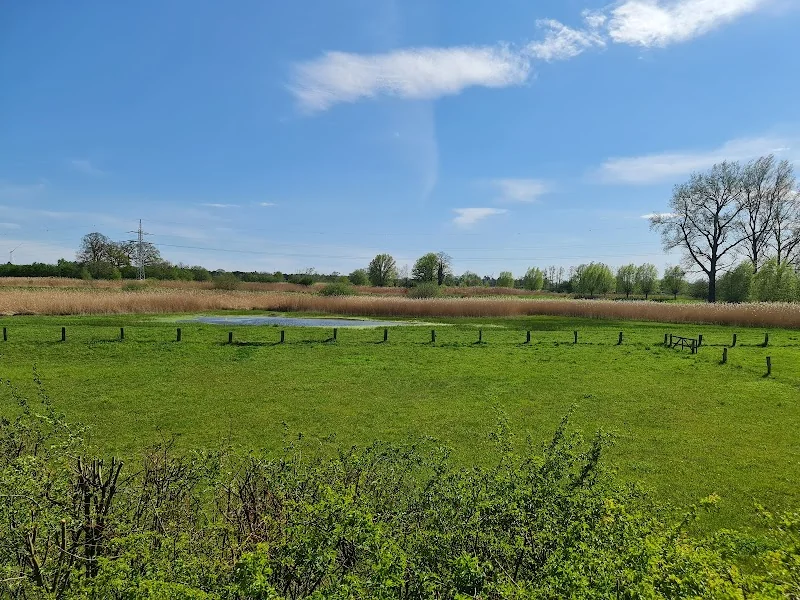
Niederheide 63, Bielefeld
Niederheide 63, 33659 Bielefeld, Germany
Biological Station Gütersloh / Bielefeld e.V. | Directions & Tours
The Biological Station Gütersloh/Bielefeld e.V. is the natural history heart of the Rieselfelder Windel in Bielefeld-Senne. Located directly at Niederheide 63, it combines research, area management, and environmental education with concrete nature experiences on-site. Here, visitors encounter a mosaic of wet meadows, ponds, marshes, hedges, and the meandering Reiherbach – a private nature reserve of about 60 hectares that has been developed in its current form since the 1990s with the support of regional partners and has been partially designated as a nature reserve since 2014. The information center at Niederheide serves as a starting point for tours, excursions, and self-guided walks, while viewpoints – including a prominent observation tower – provide insights into the habitats of rare and endangered species. Whether as a family, school class, club, or nature-interested individual: In the Rieselfelder Windel, nature becomes tangible, knowledge accessible, and species protection visible. Thanks to clear path guidance, practical visitor information, and a continuously updated annual program, you can easily find the right access to the landscape between Windelsbleiche and Windflöte – right in the south of Bielefeld and yet surprisingly quiet.
Directions, Public Transport, and Car Access to Niederheide: How to Reach the Station Comfortably
The Biological Station is located in Bielefeld-Senne directly at the information center of the Rieselfelder Windel. For those arriving by public transport, there are two comfortable options: On the one hand, bus line 94 connects Bielefeld and Gütersloh with the Windelsbleiche bus station. From there, you can reach Niederheide and the information center on foot. On the other hand, the Sennebahn takes you from Bielefeld main station towards Paderborn to Windelsbleiche station; a short walk from here also leads into the reserve. These public transport connections are explicitly mentioned on the information pages of the Rieselfelder Windel Foundation as recommended travel routes and are particularly suitable if you want to combine the nature experience with a short walk. For car access, it is important to know: The access to Niederheide is only possible from the eastern direction via Buschkampstraße, as the passage is interrupted just before Postheide. Please follow the signs to Niederheide and the information center; a parking lot is available at Niederheide. This traffic peculiarity – the interrupted passage – ensures that excessive vehicle traffic is kept out of the area and that sensitive habitats are less burdened. Allow sufficient time, especially on weekends and in good weather, when many nature enthusiasts are out and about. If you want to incorporate the journey into a small excursion, you can choose the combination of Sennebahn or bus line 94 and a quiet walk along Niederheide – this way, you can already tune into the nature experience. For cyclists, the flat topography in the Senne offers relaxed conditions; remember to bring a lock if you want to park your bike near the information center.
Experience Rieselfelder Windel: Circular Routes, Viewpoints, and Nature Observation Throughout the Year
The area of the Rieselfelder Windel is accessible via two official circular routes: a northern loop and a southern loop, both clearly marked with lapwing plaques. The paths are kept close to nature, lead over sandy or earthy ground, and are largely covered with wood chips. Therefore, sturdy, weather-appropriate footwear is explicitly recommended. The circular routes have been described in a detailed illustrated guide with 27 stations; additionally, the foundation provides a current brochure on the nature reserve. However, not all guests have the same mobility. Unfortunately, the natural circular paths are not suitable for wheelchair users, families with strollers, or visitors with limited mobility. There is good news, however: From the paved road Niederheide, which connects both circular routes as a central axis, large parts of the area can be well overviewed, and at selected points, the observation tower and other viewpoints allow for impressive observations – without crossing the paths of breeding and resting birds. The landscape character ranges from open wet meadows to reed belts and small still waters with reed banks; in between, hedges and individual old trees structure the areas. Throughout the year, phases of intense activity alternate: While in wet periods, water surfaces fill with ponds and attract amphibians, in summer, flowering edge structures and the calls of typical meadow and field birds dominate. The foundation points out that many of the reeds and ponds are still artificially irrigated with cleaned water from the neighboring sewage treatment plant; the pump energy comes from a photovoltaic system on the roof of the Biological Station. Entering sensitive areas off the marked paths is prohibited to protect wildlife, and dogs must be kept on a leash. If you want to orient yourself in advance, you can find the most important visitor tips in the brochure for the nature reserve as well as in the circular route guide. On-site, information boards and the distinctive lapwing plaques help you stay on course. A pair of binoculars increases the chances of impressive observations – and just a few quiet minutes at the observation tower are often enough to experience the coexistence of water surfaces, reeds, and meadows as a vibrant ecosystem.
Tours, Events, and Environmental Education: Program, Registration, and Offers for Groups
The Biological Station offers a diverse annual program with excursions, practical seminars, thematic tours, and family events. The event program for 2026 has been published and is continuously updated on the station's website. Registration is straightforward: via email at info@biostation-gt-bi.de or by phone at 05209/980101. For hikes and outdoor activities, the station requests weather-appropriate clothing and sturdy footwear. Participation is generally at your own risk. Additionally, the team points out that the station building itself is not barrier-free; however, individual solutions are possible upon request, and observations can also be made along the paved Niederheide without entering the natural circular paths. For groups of ten or more, the Biological Station provides its own formats. These include slide presentations for adults – for example, on native owls, birds of prey, meadow birds, or the station's conservation projects – as well as guided tours along the official circular route. According to the current program, a guideline fee of €80 applies for group tours of up to 25 people; for larger groups, additional tours or a surcharge will be agreed upon. Educational institutions also benefit from the nature education offerings: Under the motto “Active in Nature,” kindergarten groups and school classes can research, experience, and learn in the reserve. The event program, the nature education program for daycare centers and schools, and the children's birthday program are available as brochures; on-site, informational materials are available in the mailboxes under the observation tower and at the information center. In addition to fixed-term offers, thematic tours appear throughout the year, such as a “Rieselfelder Tour” or seasonal excursions for amphibians or woodpeckers. Spots are in high demand – therefore, timely registration is worthwhile.
Tasks, Projects, and Conservation Work: Making Species Protection Visible in the City and District
As an acknowledged partner in regional nature conservation, the Biological Station combines practical area management, scientific support, and educational work. A focus is on the care and further development of the Rieselfelder Windel in close collaboration with the foundation, the city of Bielefeld, and other stakeholders. At the same time, the team manages and studies habitats in the Gütersloh district and the city area of Bielefeld. Examples of current projects show the thematic breadth: Since 2005, a field bird monitoring program has been running with mapping of typical meadow and field birds; the EU-LIFE project “Meadow Birds NRW” strengthens the protection of species in wet meadow landscapes; reptile populations in the Gütersloh district were systematically recorded from 2022 to 2024 and evaluated in collaboration with the Natural Science Association for Bielefeld and Surroundings e.V.; in the FFH area “Eastern Teutoburg Forest,” surveys focus on bats; additionally, projects for the protection of kingfishers, swallows, house martins, crested newts, and other species are underway. The station thus directly addresses local challenges – from the loss of extensive wet meadows to disturbances in breeding areas to invasive species such as raccoons. Another field is raising public awareness: Information offerings and tours convey how valuable small biotopes are right at your doorstep and what role care, mowing rhythms, or hydrological optimizations play for biodiversity. The Rieselfelder themselves are a showcase of modern nature conservation practice: Numerous bodies of water and reeds have been created since 1996 on behalf of the foundation, partly based on an old distribution system; today, water from the neighboring sewage treatment plant is re-cleaned and fed into sections to stabilize habitats. The interplay of research, care plans, and visitor management – including clear path guidance, viewpoints, and leash requirements for dogs – protects disturbance-sensitive species and simultaneously makes nature conservation tangible. Even supra-regional sponsors such as the NRW Foundation or the LWL Nature Fund support the station's projects to strengthen species knowledge, biodiversity, and landscape resilience in the long term.
History, Location, and Special Features: From Industrial Biotope to Nature Reserve
The Rieselfelder Windel tells a surprising story: For decades, wastewater was infiltrated or cleaned here through reed beds between Windelsbleiche and Windflöte – traces of this industrial use are still visible in the area today. In the mid-1970s, large-scale reed bed complexes were created according to the KICKUTH system as root space treatment plants. With the cessation of infiltration in the early 1980s, a unique window opened: The area did not revert to intensive use but gradually transformed into a nature reserve. Since 1996, new bodies of water, ponds, and reeds have been created on behalf of the foundation and with strong support from the NRW Foundation; the Reiherbach, which flows through the area, has also been renatured in sections. The result is an open, water-dominated landscape with high habitat and structural diversity – a lesson in how valuable habitats for wetland species can emerge from a technically influenced area. Today, the private nature reserve covers about 60 hectares; in 2014, the Rieselfelder Windel was designated as a nature reserve along with surrounding areas. In official representations of the city of Bielefeld, the Rieselfelder Windel are among the largest and best-known legally protected biotopes in the city; at the same time, the maintenance of the area remains a continuous task, as wet meadows, reeds, and ponds require coordinated water and care management. Visitors benefit from this development: On the circular paths marked with lapwing signs and at viewpoints – including the observation tower at the information center – the dynamics and species richness can be observed in all seasons. The traffic peculiarity of Niederheide – access only via Buschkampstraße, interruption of the passage before Postheide – creates additional tranquility in the area. The availability of informational materials directly at the information center and in the mailboxes under the observation tower facilitates independent exploration. Those who want to delve deeper can take advantage of tours offered by the Biological Station or browse the annual program, which continues many tried-and-true formats and adds current topics.
Service, Behavior Tips, and Planning: The Most Important Information for Your Visit at a Glance
A successful nature visit begins with good preparation. Check the current event program of the Biological Station in advance and register early for your desired dates. For groups of ten or more, guided tours and presentations are available upon request; the station mentions a guideline fee of €80 for guided tours for up to 25 people. If you come by public transport, bus line 94 (stop at Windelsbleiche bus station) or the Sennebahn to Windelsbleiche station are the simplest ways. By car, you can reach Niederheide exclusively from the eastern direction via Buschkampstraße; a parking lot is available at Niederheide. Remember to wear sturdy footwear – the circular paths are natural, covered with wood chips, and can be slippery depending on the weather. The paths are not barrier-free; however, from the paved Niederheide, you have a good view of central areas. Keep dogs on a leash and stay on marked paths – disturbances in reeds, shallow water zones, or meadow areas threaten breeding and resting birds as well as amphibians. A pair of binoculars, weatherproof clothing, and a small seat cushion for observation breaks are practical companions. If you want to build a deeper understanding of the landscape, use the circular route guide with 27 stations or the current brochure for the nature reserve. Informational materials are available at the information center and in the mailboxes under the observation tower. Useful for personal contact are the contact details of the Biological Station (Tel. 05209/980101; Email: info@biostation-gt-bi.de). For organizational matters – such as a group inquiry, a cancellation, or questions about accessibility – prior consultation is recommended. Additionally, it is worth checking the overarching information pages of the city of Bielefeld on biotope protection as well as partner pages such as the NRW Foundation or the LWL Nature Fund, which support projects in the region. This way, your visit will be safe, environmentally friendly, and enlightening – and you will contribute with careful behavior to ensure that this special mosaic of water, meadows, and reeds remains vibrant in the future.
Sources:
- Biological Station Gütersloh/Bielefeld – Events & Program
- Foundation Rieselfelder Windel – Circular Routes, Lapwing Marking, and Visitor Tips
- Foundation Rieselfelder Windel – The Rieselfelder Windel: Area Description, Access, History
- Foundation Rieselfelder Windel – Access by Bus Line 94 and Sennebahn
- NRW Foundation – Biological Station Gütersloh/Bielefeld e. V. (Address, Short Profile)
- City of Bielefeld – Biotope Protection and Biotope Network (Classification of Rieselfelder Windel)
- Teutoburger Wald Tourism – Nature Reserve Rieselfelder Windel (Car Access and Parking via Buschkampstraße)
Show moreShow less
Biological Station Gütersloh / Bielefeld e.V. | Directions & Tours
The Biological Station Gütersloh/Bielefeld e.V. is the natural history heart of the Rieselfelder Windel in Bielefeld-Senne. Located directly at Niederheide 63, it combines research, area management, and environmental education with concrete nature experiences on-site. Here, visitors encounter a mosaic of wet meadows, ponds, marshes, hedges, and the meandering Reiherbach – a private nature reserve of about 60 hectares that has been developed in its current form since the 1990s with the support of regional partners and has been partially designated as a nature reserve since 2014. The information center at Niederheide serves as a starting point for tours, excursions, and self-guided walks, while viewpoints – including a prominent observation tower – provide insights into the habitats of rare and endangered species. Whether as a family, school class, club, or nature-interested individual: In the Rieselfelder Windel, nature becomes tangible, knowledge accessible, and species protection visible. Thanks to clear path guidance, practical visitor information, and a continuously updated annual program, you can easily find the right access to the landscape between Windelsbleiche and Windflöte – right in the south of Bielefeld and yet surprisingly quiet.
Directions, Public Transport, and Car Access to Niederheide: How to Reach the Station Comfortably
The Biological Station is located in Bielefeld-Senne directly at the information center of the Rieselfelder Windel. For those arriving by public transport, there are two comfortable options: On the one hand, bus line 94 connects Bielefeld and Gütersloh with the Windelsbleiche bus station. From there, you can reach Niederheide and the information center on foot. On the other hand, the Sennebahn takes you from Bielefeld main station towards Paderborn to Windelsbleiche station; a short walk from here also leads into the reserve. These public transport connections are explicitly mentioned on the information pages of the Rieselfelder Windel Foundation as recommended travel routes and are particularly suitable if you want to combine the nature experience with a short walk. For car access, it is important to know: The access to Niederheide is only possible from the eastern direction via Buschkampstraße, as the passage is interrupted just before Postheide. Please follow the signs to Niederheide and the information center; a parking lot is available at Niederheide. This traffic peculiarity – the interrupted passage – ensures that excessive vehicle traffic is kept out of the area and that sensitive habitats are less burdened. Allow sufficient time, especially on weekends and in good weather, when many nature enthusiasts are out and about. If you want to incorporate the journey into a small excursion, you can choose the combination of Sennebahn or bus line 94 and a quiet walk along Niederheide – this way, you can already tune into the nature experience. For cyclists, the flat topography in the Senne offers relaxed conditions; remember to bring a lock if you want to park your bike near the information center.
Experience Rieselfelder Windel: Circular Routes, Viewpoints, and Nature Observation Throughout the Year
The area of the Rieselfelder Windel is accessible via two official circular routes: a northern loop and a southern loop, both clearly marked with lapwing plaques. The paths are kept close to nature, lead over sandy or earthy ground, and are largely covered with wood chips. Therefore, sturdy, weather-appropriate footwear is explicitly recommended. The circular routes have been described in a detailed illustrated guide with 27 stations; additionally, the foundation provides a current brochure on the nature reserve. However, not all guests have the same mobility. Unfortunately, the natural circular paths are not suitable for wheelchair users, families with strollers, or visitors with limited mobility. There is good news, however: From the paved road Niederheide, which connects both circular routes as a central axis, large parts of the area can be well overviewed, and at selected points, the observation tower and other viewpoints allow for impressive observations – without crossing the paths of breeding and resting birds. The landscape character ranges from open wet meadows to reed belts and small still waters with reed banks; in between, hedges and individual old trees structure the areas. Throughout the year, phases of intense activity alternate: While in wet periods, water surfaces fill with ponds and attract amphibians, in summer, flowering edge structures and the calls of typical meadow and field birds dominate. The foundation points out that many of the reeds and ponds are still artificially irrigated with cleaned water from the neighboring sewage treatment plant; the pump energy comes from a photovoltaic system on the roof of the Biological Station. Entering sensitive areas off the marked paths is prohibited to protect wildlife, and dogs must be kept on a leash. If you want to orient yourself in advance, you can find the most important visitor tips in the brochure for the nature reserve as well as in the circular route guide. On-site, information boards and the distinctive lapwing plaques help you stay on course. A pair of binoculars increases the chances of impressive observations – and just a few quiet minutes at the observation tower are often enough to experience the coexistence of water surfaces, reeds, and meadows as a vibrant ecosystem.
Tours, Events, and Environmental Education: Program, Registration, and Offers for Groups
The Biological Station offers a diverse annual program with excursions, practical seminars, thematic tours, and family events. The event program for 2026 has been published and is continuously updated on the station's website. Registration is straightforward: via email at info@biostation-gt-bi.de or by phone at 05209/980101. For hikes and outdoor activities, the station requests weather-appropriate clothing and sturdy footwear. Participation is generally at your own risk. Additionally, the team points out that the station building itself is not barrier-free; however, individual solutions are possible upon request, and observations can also be made along the paved Niederheide without entering the natural circular paths. For groups of ten or more, the Biological Station provides its own formats. These include slide presentations for adults – for example, on native owls, birds of prey, meadow birds, or the station's conservation projects – as well as guided tours along the official circular route. According to the current program, a guideline fee of €80 applies for group tours of up to 25 people; for larger groups, additional tours or a surcharge will be agreed upon. Educational institutions also benefit from the nature education offerings: Under the motto “Active in Nature,” kindergarten groups and school classes can research, experience, and learn in the reserve. The event program, the nature education program for daycare centers and schools, and the children's birthday program are available as brochures; on-site, informational materials are available in the mailboxes under the observation tower and at the information center. In addition to fixed-term offers, thematic tours appear throughout the year, such as a “Rieselfelder Tour” or seasonal excursions for amphibians or woodpeckers. Spots are in high demand – therefore, timely registration is worthwhile.
Tasks, Projects, and Conservation Work: Making Species Protection Visible in the City and District
As an acknowledged partner in regional nature conservation, the Biological Station combines practical area management, scientific support, and educational work. A focus is on the care and further development of the Rieselfelder Windel in close collaboration with the foundation, the city of Bielefeld, and other stakeholders. At the same time, the team manages and studies habitats in the Gütersloh district and the city area of Bielefeld. Examples of current projects show the thematic breadth: Since 2005, a field bird monitoring program has been running with mapping of typical meadow and field birds; the EU-LIFE project “Meadow Birds NRW” strengthens the protection of species in wet meadow landscapes; reptile populations in the Gütersloh district were systematically recorded from 2022 to 2024 and evaluated in collaboration with the Natural Science Association for Bielefeld and Surroundings e.V.; in the FFH area “Eastern Teutoburg Forest,” surveys focus on bats; additionally, projects for the protection of kingfishers, swallows, house martins, crested newts, and other species are underway. The station thus directly addresses local challenges – from the loss of extensive wet meadows to disturbances in breeding areas to invasive species such as raccoons. Another field is raising public awareness: Information offerings and tours convey how valuable small biotopes are right at your doorstep and what role care, mowing rhythms, or hydrological optimizations play for biodiversity. The Rieselfelder themselves are a showcase of modern nature conservation practice: Numerous bodies of water and reeds have been created since 1996 on behalf of the foundation, partly based on an old distribution system; today, water from the neighboring sewage treatment plant is re-cleaned and fed into sections to stabilize habitats. The interplay of research, care plans, and visitor management – including clear path guidance, viewpoints, and leash requirements for dogs – protects disturbance-sensitive species and simultaneously makes nature conservation tangible. Even supra-regional sponsors such as the NRW Foundation or the LWL Nature Fund support the station's projects to strengthen species knowledge, biodiversity, and landscape resilience in the long term.
History, Location, and Special Features: From Industrial Biotope to Nature Reserve
The Rieselfelder Windel tells a surprising story: For decades, wastewater was infiltrated or cleaned here through reed beds between Windelsbleiche and Windflöte – traces of this industrial use are still visible in the area today. In the mid-1970s, large-scale reed bed complexes were created according to the KICKUTH system as root space treatment plants. With the cessation of infiltration in the early 1980s, a unique window opened: The area did not revert to intensive use but gradually transformed into a nature reserve. Since 1996, new bodies of water, ponds, and reeds have been created on behalf of the foundation and with strong support from the NRW Foundation; the Reiherbach, which flows through the area, has also been renatured in sections. The result is an open, water-dominated landscape with high habitat and structural diversity – a lesson in how valuable habitats for wetland species can emerge from a technically influenced area. Today, the private nature reserve covers about 60 hectares; in 2014, the Rieselfelder Windel was designated as a nature reserve along with surrounding areas. In official representations of the city of Bielefeld, the Rieselfelder Windel are among the largest and best-known legally protected biotopes in the city; at the same time, the maintenance of the area remains a continuous task, as wet meadows, reeds, and ponds require coordinated water and care management. Visitors benefit from this development: On the circular paths marked with lapwing signs and at viewpoints – including the observation tower at the information center – the dynamics and species richness can be observed in all seasons. The traffic peculiarity of Niederheide – access only via Buschkampstraße, interruption of the passage before Postheide – creates additional tranquility in the area. The availability of informational materials directly at the information center and in the mailboxes under the observation tower facilitates independent exploration. Those who want to delve deeper can take advantage of tours offered by the Biological Station or browse the annual program, which continues many tried-and-true formats and adds current topics.
Service, Behavior Tips, and Planning: The Most Important Information for Your Visit at a Glance
A successful nature visit begins with good preparation. Check the current event program of the Biological Station in advance and register early for your desired dates. For groups of ten or more, guided tours and presentations are available upon request; the station mentions a guideline fee of €80 for guided tours for up to 25 people. If you come by public transport, bus line 94 (stop at Windelsbleiche bus station) or the Sennebahn to Windelsbleiche station are the simplest ways. By car, you can reach Niederheide exclusively from the eastern direction via Buschkampstraße; a parking lot is available at Niederheide. Remember to wear sturdy footwear – the circular paths are natural, covered with wood chips, and can be slippery depending on the weather. The paths are not barrier-free; however, from the paved Niederheide, you have a good view of central areas. Keep dogs on a leash and stay on marked paths – disturbances in reeds, shallow water zones, or meadow areas threaten breeding and resting birds as well as amphibians. A pair of binoculars, weatherproof clothing, and a small seat cushion for observation breaks are practical companions. If you want to build a deeper understanding of the landscape, use the circular route guide with 27 stations or the current brochure for the nature reserve. Informational materials are available at the information center and in the mailboxes under the observation tower. Useful for personal contact are the contact details of the Biological Station (Tel. 05209/980101; Email: info@biostation-gt-bi.de). For organizational matters – such as a group inquiry, a cancellation, or questions about accessibility – prior consultation is recommended. Additionally, it is worth checking the overarching information pages of the city of Bielefeld on biotope protection as well as partner pages such as the NRW Foundation or the LWL Nature Fund, which support projects in the region. This way, your visit will be safe, environmentally friendly, and enlightening – and you will contribute with careful behavior to ensure that this special mosaic of water, meadows, and reeds remains vibrant in the future.
Sources:
- Biological Station Gütersloh/Bielefeld – Events & Program
- Foundation Rieselfelder Windel – Circular Routes, Lapwing Marking, and Visitor Tips
- Foundation Rieselfelder Windel – The Rieselfelder Windel: Area Description, Access, History
- Foundation Rieselfelder Windel – Access by Bus Line 94 and Sennebahn
- NRW Foundation – Biological Station Gütersloh/Bielefeld e. V. (Address, Short Profile)
- City of Bielefeld – Biotope Protection and Biotope Network (Classification of Rieselfelder Windel)
- Teutoburger Wald Tourism – Nature Reserve Rieselfelder Windel (Car Access and Parking via Buschkampstraße)
Biological Station Gütersloh / Bielefeld e.V. | Directions & Tours
The Biological Station Gütersloh/Bielefeld e.V. is the natural history heart of the Rieselfelder Windel in Bielefeld-Senne. Located directly at Niederheide 63, it combines research, area management, and environmental education with concrete nature experiences on-site. Here, visitors encounter a mosaic of wet meadows, ponds, marshes, hedges, and the meandering Reiherbach – a private nature reserve of about 60 hectares that has been developed in its current form since the 1990s with the support of regional partners and has been partially designated as a nature reserve since 2014. The information center at Niederheide serves as a starting point for tours, excursions, and self-guided walks, while viewpoints – including a prominent observation tower – provide insights into the habitats of rare and endangered species. Whether as a family, school class, club, or nature-interested individual: In the Rieselfelder Windel, nature becomes tangible, knowledge accessible, and species protection visible. Thanks to clear path guidance, practical visitor information, and a continuously updated annual program, you can easily find the right access to the landscape between Windelsbleiche and Windflöte – right in the south of Bielefeld and yet surprisingly quiet.
Directions, Public Transport, and Car Access to Niederheide: How to Reach the Station Comfortably
The Biological Station is located in Bielefeld-Senne directly at the information center of the Rieselfelder Windel. For those arriving by public transport, there are two comfortable options: On the one hand, bus line 94 connects Bielefeld and Gütersloh with the Windelsbleiche bus station. From there, you can reach Niederheide and the information center on foot. On the other hand, the Sennebahn takes you from Bielefeld main station towards Paderborn to Windelsbleiche station; a short walk from here also leads into the reserve. These public transport connections are explicitly mentioned on the information pages of the Rieselfelder Windel Foundation as recommended travel routes and are particularly suitable if you want to combine the nature experience with a short walk. For car access, it is important to know: The access to Niederheide is only possible from the eastern direction via Buschkampstraße, as the passage is interrupted just before Postheide. Please follow the signs to Niederheide and the information center; a parking lot is available at Niederheide. This traffic peculiarity – the interrupted passage – ensures that excessive vehicle traffic is kept out of the area and that sensitive habitats are less burdened. Allow sufficient time, especially on weekends and in good weather, when many nature enthusiasts are out and about. If you want to incorporate the journey into a small excursion, you can choose the combination of Sennebahn or bus line 94 and a quiet walk along Niederheide – this way, you can already tune into the nature experience. For cyclists, the flat topography in the Senne offers relaxed conditions; remember to bring a lock if you want to park your bike near the information center.
Experience Rieselfelder Windel: Circular Routes, Viewpoints, and Nature Observation Throughout the Year
The area of the Rieselfelder Windel is accessible via two official circular routes: a northern loop and a southern loop, both clearly marked with lapwing plaques. The paths are kept close to nature, lead over sandy or earthy ground, and are largely covered with wood chips. Therefore, sturdy, weather-appropriate footwear is explicitly recommended. The circular routes have been described in a detailed illustrated guide with 27 stations; additionally, the foundation provides a current brochure on the nature reserve. However, not all guests have the same mobility. Unfortunately, the natural circular paths are not suitable for wheelchair users, families with strollers, or visitors with limited mobility. There is good news, however: From the paved road Niederheide, which connects both circular routes as a central axis, large parts of the area can be well overviewed, and at selected points, the observation tower and other viewpoints allow for impressive observations – without crossing the paths of breeding and resting birds. The landscape character ranges from open wet meadows to reed belts and small still waters with reed banks; in between, hedges and individual old trees structure the areas. Throughout the year, phases of intense activity alternate: While in wet periods, water surfaces fill with ponds and attract amphibians, in summer, flowering edge structures and the calls of typical meadow and field birds dominate. The foundation points out that many of the reeds and ponds are still artificially irrigated with cleaned water from the neighboring sewage treatment plant; the pump energy comes from a photovoltaic system on the roof of the Biological Station. Entering sensitive areas off the marked paths is prohibited to protect wildlife, and dogs must be kept on a leash. If you want to orient yourself in advance, you can find the most important visitor tips in the brochure for the nature reserve as well as in the circular route guide. On-site, information boards and the distinctive lapwing plaques help you stay on course. A pair of binoculars increases the chances of impressive observations – and just a few quiet minutes at the observation tower are often enough to experience the coexistence of water surfaces, reeds, and meadows as a vibrant ecosystem.
Tours, Events, and Environmental Education: Program, Registration, and Offers for Groups
The Biological Station offers a diverse annual program with excursions, practical seminars, thematic tours, and family events. The event program for 2026 has been published and is continuously updated on the station's website. Registration is straightforward: via email at info@biostation-gt-bi.de or by phone at 05209/980101. For hikes and outdoor activities, the station requests weather-appropriate clothing and sturdy footwear. Participation is generally at your own risk. Additionally, the team points out that the station building itself is not barrier-free; however, individual solutions are possible upon request, and observations can also be made along the paved Niederheide without entering the natural circular paths. For groups of ten or more, the Biological Station provides its own formats. These include slide presentations for adults – for example, on native owls, birds of prey, meadow birds, or the station's conservation projects – as well as guided tours along the official circular route. According to the current program, a guideline fee of €80 applies for group tours of up to 25 people; for larger groups, additional tours or a surcharge will be agreed upon. Educational institutions also benefit from the nature education offerings: Under the motto “Active in Nature,” kindergarten groups and school classes can research, experience, and learn in the reserve. The event program, the nature education program for daycare centers and schools, and the children's birthday program are available as brochures; on-site, informational materials are available in the mailboxes under the observation tower and at the information center. In addition to fixed-term offers, thematic tours appear throughout the year, such as a “Rieselfelder Tour” or seasonal excursions for amphibians or woodpeckers. Spots are in high demand – therefore, timely registration is worthwhile.
Tasks, Projects, and Conservation Work: Making Species Protection Visible in the City and District
As an acknowledged partner in regional nature conservation, the Biological Station combines practical area management, scientific support, and educational work. A focus is on the care and further development of the Rieselfelder Windel in close collaboration with the foundation, the city of Bielefeld, and other stakeholders. At the same time, the team manages and studies habitats in the Gütersloh district and the city area of Bielefeld. Examples of current projects show the thematic breadth: Since 2005, a field bird monitoring program has been running with mapping of typical meadow and field birds; the EU-LIFE project “Meadow Birds NRW” strengthens the protection of species in wet meadow landscapes; reptile populations in the Gütersloh district were systematically recorded from 2022 to 2024 and evaluated in collaboration with the Natural Science Association for Bielefeld and Surroundings e.V.; in the FFH area “Eastern Teutoburg Forest,” surveys focus on bats; additionally, projects for the protection of kingfishers, swallows, house martins, crested newts, and other species are underway. The station thus directly addresses local challenges – from the loss of extensive wet meadows to disturbances in breeding areas to invasive species such as raccoons. Another field is raising public awareness: Information offerings and tours convey how valuable small biotopes are right at your doorstep and what role care, mowing rhythms, or hydrological optimizations play for biodiversity. The Rieselfelder themselves are a showcase of modern nature conservation practice: Numerous bodies of water and reeds have been created since 1996 on behalf of the foundation, partly based on an old distribution system; today, water from the neighboring sewage treatment plant is re-cleaned and fed into sections to stabilize habitats. The interplay of research, care plans, and visitor management – including clear path guidance, viewpoints, and leash requirements for dogs – protects disturbance-sensitive species and simultaneously makes nature conservation tangible. Even supra-regional sponsors such as the NRW Foundation or the LWL Nature Fund support the station's projects to strengthen species knowledge, biodiversity, and landscape resilience in the long term.
History, Location, and Special Features: From Industrial Biotope to Nature Reserve
The Rieselfelder Windel tells a surprising story: For decades, wastewater was infiltrated or cleaned here through reed beds between Windelsbleiche and Windflöte – traces of this industrial use are still visible in the area today. In the mid-1970s, large-scale reed bed complexes were created according to the KICKUTH system as root space treatment plants. With the cessation of infiltration in the early 1980s, a unique window opened: The area did not revert to intensive use but gradually transformed into a nature reserve. Since 1996, new bodies of water, ponds, and reeds have been created on behalf of the foundation and with strong support from the NRW Foundation; the Reiherbach, which flows through the area, has also been renatured in sections. The result is an open, water-dominated landscape with high habitat and structural diversity – a lesson in how valuable habitats for wetland species can emerge from a technically influenced area. Today, the private nature reserve covers about 60 hectares; in 2014, the Rieselfelder Windel was designated as a nature reserve along with surrounding areas. In official representations of the city of Bielefeld, the Rieselfelder Windel are among the largest and best-known legally protected biotopes in the city; at the same time, the maintenance of the area remains a continuous task, as wet meadows, reeds, and ponds require coordinated water and care management. Visitors benefit from this development: On the circular paths marked with lapwing signs and at viewpoints – including the observation tower at the information center – the dynamics and species richness can be observed in all seasons. The traffic peculiarity of Niederheide – access only via Buschkampstraße, interruption of the passage before Postheide – creates additional tranquility in the area. The availability of informational materials directly at the information center and in the mailboxes under the observation tower facilitates independent exploration. Those who want to delve deeper can take advantage of tours offered by the Biological Station or browse the annual program, which continues many tried-and-true formats and adds current topics.
Service, Behavior Tips, and Planning: The Most Important Information for Your Visit at a Glance
A successful nature visit begins with good preparation. Check the current event program of the Biological Station in advance and register early for your desired dates. For groups of ten or more, guided tours and presentations are available upon request; the station mentions a guideline fee of €80 for guided tours for up to 25 people. If you come by public transport, bus line 94 (stop at Windelsbleiche bus station) or the Sennebahn to Windelsbleiche station are the simplest ways. By car, you can reach Niederheide exclusively from the eastern direction via Buschkampstraße; a parking lot is available at Niederheide. Remember to wear sturdy footwear – the circular paths are natural, covered with wood chips, and can be slippery depending on the weather. The paths are not barrier-free; however, from the paved Niederheide, you have a good view of central areas. Keep dogs on a leash and stay on marked paths – disturbances in reeds, shallow water zones, or meadow areas threaten breeding and resting birds as well as amphibians. A pair of binoculars, weatherproof clothing, and a small seat cushion for observation breaks are practical companions. If you want to build a deeper understanding of the landscape, use the circular route guide with 27 stations or the current brochure for the nature reserve. Informational materials are available at the information center and in the mailboxes under the observation tower. Useful for personal contact are the contact details of the Biological Station (Tel. 05209/980101; Email: info@biostation-gt-bi.de). For organizational matters – such as a group inquiry, a cancellation, or questions about accessibility – prior consultation is recommended. Additionally, it is worth checking the overarching information pages of the city of Bielefeld on biotope protection as well as partner pages such as the NRW Foundation or the LWL Nature Fund, which support projects in the region. This way, your visit will be safe, environmentally friendly, and enlightening – and you will contribute with careful behavior to ensure that this special mosaic of water, meadows, and reeds remains vibrant in the future.
Sources:
- Biological Station Gütersloh/Bielefeld – Events & Program
- Foundation Rieselfelder Windel – Circular Routes, Lapwing Marking, and Visitor Tips
- Foundation Rieselfelder Windel – The Rieselfelder Windel: Area Description, Access, History
- Foundation Rieselfelder Windel – Access by Bus Line 94 and Sennebahn
- NRW Foundation – Biological Station Gütersloh/Bielefeld e. V. (Address, Short Profile)
- City of Bielefeld – Biotope Protection and Biotope Network (Classification of Rieselfelder Windel)
- Teutoburger Wald Tourism – Nature Reserve Rieselfelder Windel (Car Access and Parking via Buschkampstraße)
Frequently Asked Questions
Reviews
Aykut ÖN
17. September 2023
Hshdh
Pedder D.
28. June 2024
It wasn't worth it! The WDR (West German Broadcasting Corporation) touted how beautiful it was and how many birds there were. I was able to spot blackbirds, crows, pigeons, a grey heron, and two mallards there, despite using binoculars. There are two routes, the north and south loops, totaling about 5.5 km, with 30% of the route being on road. Of the three observation towers, only one is still intact. The trail signposts are absolutely poor.
Raul C. Rodrigues
29. May 2023
A beautiful environmental reserve with two observation towers for wild birds. The structures, as is common in such facilities, show signs of vandalism. But this doesn't stop the fun in the reserve, it just diminishes it a bit.
HoRi Son
13. May 2021
Here you can take short circular hikes and observe nesting bird species in May. Bring binoculars. There are a few observation towers; one appears to be disused, but it still shows up on the map. This should be updated.
Anja Wilson
4. February 2023
Unfortunately, the area is currently only partially accessible due to the restoration/naturalization of the existing reed beds and sewage fields. It's worth a stroll in good weather, but it can get quite busy, especially with cyclists. Mutual consideration is advised. There are observation hides for watching the birds on and around the ponds. Benches are also available for resting. Anyone wanting to escape the stresses of everyday life for a while can take one of the circular paths. I always enjoy a walk there.