
Bielefeld
Niederheide 63, 33659 Bielefeld, Deutschland
Biological Station Gütersloh/Bielefeld | Program & Tickets
The Biological Station Gütersloh/Bielefeld e.V. is not a classic event arena, but a nature conservation, education, and research station located in the nature reserve Rieselfelder Windel in Bielefeld-Senne. From here, the team manages 36 nature conservation areas in the region, supports conservation measures, and makes nature tangible through guided tours, excursions, and environmental education. The area itself is closely linked to the history of the Rieselfelder, which were used for wastewater irrigation by the company Windel for decades and are now protected as a large habitat for rare animals and plants. Those who come here are therefore looking less for a big show and more for authentic nature experiences, exciting learning locations, and an annual program with regularly updated dates. Particularly practical: The site offers observation towers, a circular path, and a barrier-free platform, while the office is located directly at the information center. ([biostationgt-bi.de](https://biostationgt-bi.de/index.php?page=4))
Events, Program 2026 and Tickets
Those looking for events or tickets will find that the Biological Station operates differently than a concert or exhibition hall. For 2026, the Biostation has once again put together a diverse program of new and proven excursions, practical seminars, family events, and an Easter holiday workshop for children. The website also emphasizes that under the menu item Events, the latest information on the offerings can always be found. This is important for visitors because dates can be postponed, canceled, or fully booked, and the platform is therefore dynamically maintained. This creates not a rigid seasonal program but a lively calendar with nature-related dates that are oriented towards seasons, species occurrences, and current projects. ([biostationgt-bi.de](https://www.biostationgt-bi.de/index.php?auswahl=1704188009&page=3))
The term tickets is therefore more fitting for the search intent than for a classic sales system. The Biostation requests registration for events via email or phone; names, addresses, phone numbers, and the number of participants should be provided. The team also points out registration deadlines and minimum age for children. The participation fee is paid in cash at the beginning of the event. If participation is not possible at short notice, the cancellation should be communicated as soon as possible so that waiting lists can be accommodated. In case of unexcused absence, an invoice for the participation fee may be issued. For groups of ten or more, additional offers for adults with slide presentations and guided tours along the circular path of the Rieselfelder Windel are available. This targets people who want to experience nature but also learn, understand, and delve deeper into the content. ([biostationgt-bi.de](https://www.biostationgt-bi.de/index.php?auswahl=1704188009&page=3))
Environmental Education for Daycares, Schools, and Families
Environmental education is one of the most important focus areas of the Biological Station Gütersloh/Bielefeld. The offerings are primarily aimed at kindergarten groups, school classes, youth groups, and families. According to its own description, the station aims to inspire children and young people for nature, encourage sustainable thinking, and promote the discovery of native animals and plants. The focus is on nature experiences, species knowledge, habitats, and ecological connections. For this reason, the Rieselfelder Windel are considered an ideal extracurricular learning location: The landscape is diverse, lively, and versatile enough to combine observation, movement, and education. The station sees itself as a place where nature is not abstract but can be experienced directly. This makes the educational offerings particularly valuable for groups seeking practical experiences in the field rather than just theoretical instruction. ([biostationgt-bi.de](https://biostationgt-bi.de/index.php?page=4))
Organizationally, the program is clearly structured. For daycare groups and school classes, there are offerings according to age groups, including for kindergarten, grades 1 and 2, grades 3 and 4, grades 5 and 6, and grades 7 to 13. Fixed dates are also offered for families, supplemented by special programs during the holidays. The offerings are conducted by staff members of the Biostation and are made known through a brochure and regular press releases. Particularly interesting is that the environment is not only thought of as a learning location but also as a project and experience space: A project funded by the LWL Nature Fund aims to reach new target groups over three years and further strengthen the themes of biodiversity, species knowledge, and species protection. The brochures are available under the observation tower and at the information center and can be ordered or viewed online as a PDF. This transforms environmental education into a well-accessible, regionally anchored educational offering with a high practical relevance. ([biostationgt-bi.de](https://biostationgt-bi.de/index.php?page=13))
Guided Tours, Excursions, and Field Tours
Another strong area of interest is guided tours and excursions. The Biostation offers slide presentations and field tours for adults and groups of ten or more, which are closely related to the landscape of the Rieselfelder Windel. The presentations cover topics such as nature conservation in the Rieselfelder Windel, native owls, birds of prey, meadow birds in the Gütersloh district, or nature conservation projects in East Africa. The field tours follow the circular path and combine nature observation with regional history. This includes topics such as the industrial history and wastewater treatment of the Windel company, the optimization concept for the industrial biotope and its implementation, as well as the habitat for endangered species. This is particularly appealing to visitors because not only is nature shown, but it is also explained how a former usage area became a valuable refuge. ([biostationgt-bi.de](https://www.biostationgt-bi.de/index.php?auswahl=1704188009&page=3))
The practical conditions are also transparent: Slide presentations for adults cost a fee of 150 euros plus travel expenses, field tours cost 80 euros for up to 25 people; for larger groups, a second tour or an additional fee is required. This quickly makes it clear that the Biostation is not an event location with hall bookings, but a professionally shaped learning and nature site. This is precisely what makes it appealing, as the program remains close to the landscape, the species, and the tasks of nature conservation. Those who register a group receive content that is oriented towards location, season, and target group. The combination of knowledge transfer, movement in the field, and immediate observation creates an experience that goes far beyond a standard tour. For nature-interested associations, school classes, businesses, or private groups, this is a rare offering that is both informative and atmospheric. ([biostationgt-bi.de](https://www.biostationgt-bi.de/index.php?auswahl=1704188009&page=3))
Directions, Public Transport, and Practical Visitor Information
The directions to the Biological Station are clearly described and oriented towards public transport. The address is Niederheide 63, 33659 Bielefeld; the station is located directly at the information center Rieselfelder Windel. For visitors from Bielefeld, the official site recommends taking the city train line 1 towards Senne to Brackwede Kirche, then transferring to bus line 94 towards Gütersloh or Senne/Vormbrock to the stop Windelsbleiche Busbahnhof. From there, it is a 15-minute walk via Riekestraße, Toppmannsweg, and finally Niederheide. Alternatively, one can take the Sennebahn RB 74 from Bielefeld main station towards Paderborn to Bielefeld-Senne and from there use bus 94 or a walking route. From Gütersloh, bus line 94 runs from the ZOB towards Brackwede Kirche to the stop Windelsbleiche Busbahnhof. The Biostation explicitly recommends checking current departure times and transfers for longer journeys, as connections may change seasonally. ([biostationgt-bi.de](https://www.biostationgt-bi.de/index.php?page=6))
There are also important notes for visiting on-site. The event page openly states that the building is not barrier-free, but the grounds can be flexibly used in consultation, and solutions are possible. At the same time, the area description points out that there is a barrier-free platform in the nature reserve itself. For hikes and outdoor activities, the station recommends weather-appropriate clothing and sturdy footwear. Those looking for brochures or program booklets can find them under the observation tower at the Biostation and at the information center of the Rieselfelder Windel; they can also be ordered or downloaded as a PDF. This combination of good public transport connections, honest information about accessibility, and concrete preparation tips makes the visit planable. This is particularly helpful for families, groups, and educational institutions, as the journey, meeting point, and expectations for the area can be well assessed in advance. ([biostationgt-bi.de](https://www.biostationgt-bi.de/index.php?auswahl=1704188009&page=3))
Rieselfelder Windel, Nature Conservation, and Special Features
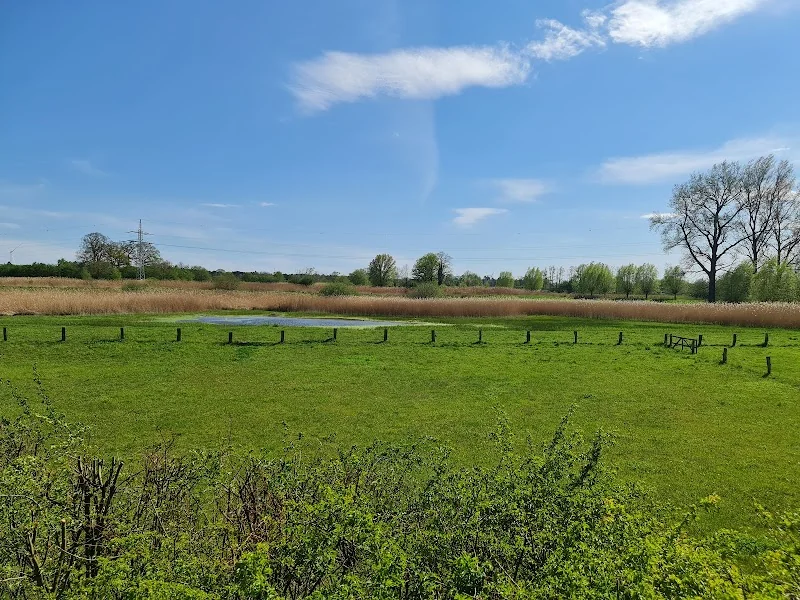
The special aura of the Biological Station cannot be understood without the Rieselfelder Windel. The nature reserve is located south of Bielefeld-Senne, covers 102 hectares with Kampeters Kolk, and was placed under protection in spring 2014. Previously, the Rieselfelder were used for decades by the textile finishing company Windel for wastewater irrigation. When this form of use ended due to a new clarification process, large parts of the area were threatened with drying out. At the last minute, areas could be transferred and secured before additional bodies of water, observation towers, and a circular path were created in recent years. Today, 19 new bodies of water, three observation towers, a barrier-free platform, and a five-kilometer circular path are among the most defining features of the area. The Biostation is responsible for the professional management, cultivation, and maintenance of the entire area. This combination of historical development, active landscape maintenance, and modern visitor guidance makes the Rieselfelder Windel an extraordinary nature conservation area. ([biostationgt-bi.de](https://biostationgt-bi.de/index.php?content=1313351497&page=12))
Ecologically, the area is also remarkably rich in species. The official description mentions more than 380 vascular plant species, including numerous endangered species on the Red List, as well as 160 species of fungi, over 70 breeding bird species, and twice as many migratory bird species. Additionally, there are 30 species of dragonflies, 16 species of grasshoppers, and numerous day and night butterflies. Visitors therefore experience not a static landscape but a space full of change, dynamics, and biodiversity. The Biological Station uses this diversity not only for protection and research but also for maintenance: In the Rieselfelder, White Horned Heidschnucken are used to maintain the alternating wet grassland, as grazing represents an environmentally friendly method of agriculture. Furthermore, the station works on species protection projects for the tawny owl, skylark, tree frog, reptiles, bats, and other endangered species. This connection between natural space, maintenance work, research, and environmental education makes the location unique: it is a place of learning, a refuge, and a starting point for concrete nature conservation work at the same time. ([biostationgt-bi.de](https://biostationgt-bi.de/index.php?content=1313351497&page=12))
Sources:
- Biological Station Gütersloh/Bielefeld - Homepage ([biostationgt-bi.de](https://biostationgt-bi.de/))
- Biological Station Gütersloh/Bielefeld - Events ([biostationgt-bi.de](https://www.biostationgt-bi.de/index.php?auswahl=1704188009&page=3))
- Biological Station Gütersloh/Bielefeld - Directions ([biostationgt-bi.de](https://www.biostationgt-bi.de/index.php?page=6))
- Biological Station Gütersloh/Bielefeld - Environmental Education ([biostationgt-bi.de](https://biostationgt-bi.de/index.php?page=13))
- Biological Station Gütersloh/Bielefeld - Areas and Rieselfelder Windel ([biostationgt-bi.de](https://biostationgt-bi.de/index.php?content=1313351497&page=12))
- District Gütersloh - Network Environmental Education in the District Gütersloh ([kreis-guetersloh.de](https://www.kreis-guetersloh.de/themen/umwelt/portal-der-umweltbildung/netzwerk-naturpaedagogik-im-kreis-guetersloh/))
Mehr anzeigenWeniger anzeigen
Biological Station Gütersloh/Bielefeld | Program & Tickets
The Biological Station Gütersloh/Bielefeld e.V. is not a classic event arena, but a nature conservation, education, and research station located in the nature reserve Rieselfelder Windel in Bielefeld-Senne. From here, the team manages 36 nature conservation areas in the region, supports conservation measures, and makes nature tangible through guided tours, excursions, and environmental education. The area itself is closely linked to the history of the Rieselfelder, which were used for wastewater irrigation by the company Windel for decades and are now protected as a large habitat for rare animals and plants. Those who come here are therefore looking less for a big show and more for authentic nature experiences, exciting learning locations, and an annual program with regularly updated dates. Particularly practical: The site offers observation towers, a circular path, and a barrier-free platform, while the office is located directly at the information center. ([biostationgt-bi.de](https://biostationgt-bi.de/index.php?page=4))
Events, Program 2026 and Tickets
Those looking for events or tickets will find that the Biological Station operates differently than a concert or exhibition hall. For 2026, the Biostation has once again put together a diverse program of new and proven excursions, practical seminars, family events, and an Easter holiday workshop for children. The website also emphasizes that under the menu item Events, the latest information on the offerings can always be found. This is important for visitors because dates can be postponed, canceled, or fully booked, and the platform is therefore dynamically maintained. This creates not a rigid seasonal program but a lively calendar with nature-related dates that are oriented towards seasons, species occurrences, and current projects. ([biostationgt-bi.de](https://www.biostationgt-bi.de/index.php?auswahl=1704188009&page=3))
The term tickets is therefore more fitting for the search intent than for a classic sales system. The Biostation requests registration for events via email or phone; names, addresses, phone numbers, and the number of participants should be provided. The team also points out registration deadlines and minimum age for children. The participation fee is paid in cash at the beginning of the event. If participation is not possible at short notice, the cancellation should be communicated as soon as possible so that waiting lists can be accommodated. In case of unexcused absence, an invoice for the participation fee may be issued. For groups of ten or more, additional offers for adults with slide presentations and guided tours along the circular path of the Rieselfelder Windel are available. This targets people who want to experience nature but also learn, understand, and delve deeper into the content. ([biostationgt-bi.de](https://www.biostationgt-bi.de/index.php?auswahl=1704188009&page=3))
Environmental Education for Daycares, Schools, and Families
Environmental education is one of the most important focus areas of the Biological Station Gütersloh/Bielefeld. The offerings are primarily aimed at kindergarten groups, school classes, youth groups, and families. According to its own description, the station aims to inspire children and young people for nature, encourage sustainable thinking, and promote the discovery of native animals and plants. The focus is on nature experiences, species knowledge, habitats, and ecological connections. For this reason, the Rieselfelder Windel are considered an ideal extracurricular learning location: The landscape is diverse, lively, and versatile enough to combine observation, movement, and education. The station sees itself as a place where nature is not abstract but can be experienced directly. This makes the educational offerings particularly valuable for groups seeking practical experiences in the field rather than just theoretical instruction. ([biostationgt-bi.de](https://biostationgt-bi.de/index.php?page=4))
Organizationally, the program is clearly structured. For daycare groups and school classes, there are offerings according to age groups, including for kindergarten, grades 1 and 2, grades 3 and 4, grades 5 and 6, and grades 7 to 13. Fixed dates are also offered for families, supplemented by special programs during the holidays. The offerings are conducted by staff members of the Biostation and are made known through a brochure and regular press releases. Particularly interesting is that the environment is not only thought of as a learning location but also as a project and experience space: A project funded by the LWL Nature Fund aims to reach new target groups over three years and further strengthen the themes of biodiversity, species knowledge, and species protection. The brochures are available under the observation tower and at the information center and can be ordered or viewed online as a PDF. This transforms environmental education into a well-accessible, regionally anchored educational offering with a high practical relevance. ([biostationgt-bi.de](https://biostationgt-bi.de/index.php?page=13))
Guided Tours, Excursions, and Field Tours
Another strong area of interest is guided tours and excursions. The Biostation offers slide presentations and field tours for adults and groups of ten or more, which are closely related to the landscape of the Rieselfelder Windel. The presentations cover topics such as nature conservation in the Rieselfelder Windel, native owls, birds of prey, meadow birds in the Gütersloh district, or nature conservation projects in East Africa. The field tours follow the circular path and combine nature observation with regional history. This includes topics such as the industrial history and wastewater treatment of the Windel company, the optimization concept for the industrial biotope and its implementation, as well as the habitat for endangered species. This is particularly appealing to visitors because not only is nature shown, but it is also explained how a former usage area became a valuable refuge. ([biostationgt-bi.de](https://www.biostationgt-bi.de/index.php?auswahl=1704188009&page=3))
The practical conditions are also transparent: Slide presentations for adults cost a fee of 150 euros plus travel expenses, field tours cost 80 euros for up to 25 people; for larger groups, a second tour or an additional fee is required. This quickly makes it clear that the Biostation is not an event location with hall bookings, but a professionally shaped learning and nature site. This is precisely what makes it appealing, as the program remains close to the landscape, the species, and the tasks of nature conservation. Those who register a group receive content that is oriented towards location, season, and target group. The combination of knowledge transfer, movement in the field, and immediate observation creates an experience that goes far beyond a standard tour. For nature-interested associations, school classes, businesses, or private groups, this is a rare offering that is both informative and atmospheric. ([biostationgt-bi.de](https://www.biostationgt-bi.de/index.php?auswahl=1704188009&page=3))
Directions, Public Transport, and Practical Visitor Information
The directions to the Biological Station are clearly described and oriented towards public transport. The address is Niederheide 63, 33659 Bielefeld; the station is located directly at the information center Rieselfelder Windel. For visitors from Bielefeld, the official site recommends taking the city train line 1 towards Senne to Brackwede Kirche, then transferring to bus line 94 towards Gütersloh or Senne/Vormbrock to the stop Windelsbleiche Busbahnhof. From there, it is a 15-minute walk via Riekestraße, Toppmannsweg, and finally Niederheide. Alternatively, one can take the Sennebahn RB 74 from Bielefeld main station towards Paderborn to Bielefeld-Senne and from there use bus 94 or a walking route. From Gütersloh, bus line 94 runs from the ZOB towards Brackwede Kirche to the stop Windelsbleiche Busbahnhof. The Biostation explicitly recommends checking current departure times and transfers for longer journeys, as connections may change seasonally. ([biostationgt-bi.de](https://www.biostationgt-bi.de/index.php?page=6))
There are also important notes for visiting on-site. The event page openly states that the building is not barrier-free, but the grounds can be flexibly used in consultation, and solutions are possible. At the same time, the area description points out that there is a barrier-free platform in the nature reserve itself. For hikes and outdoor activities, the station recommends weather-appropriate clothing and sturdy footwear. Those looking for brochures or program booklets can find them under the observation tower at the Biostation and at the information center of the Rieselfelder Windel; they can also be ordered or downloaded as a PDF. This combination of good public transport connections, honest information about accessibility, and concrete preparation tips makes the visit planable. This is particularly helpful for families, groups, and educational institutions, as the journey, meeting point, and expectations for the area can be well assessed in advance. ([biostationgt-bi.de](https://www.biostationgt-bi.de/index.php?auswahl=1704188009&page=3))
Rieselfelder Windel, Nature Conservation, and Special Features
The special aura of the Biological Station cannot be understood without the Rieselfelder Windel. The nature reserve is located south of Bielefeld-Senne, covers 102 hectares with Kampeters Kolk, and was placed under protection in spring 2014. Previously, the Rieselfelder were used for decades by the textile finishing company Windel for wastewater irrigation. When this form of use ended due to a new clarification process, large parts of the area were threatened with drying out. At the last minute, areas could be transferred and secured before additional bodies of water, observation towers, and a circular path were created in recent years. Today, 19 new bodies of water, three observation towers, a barrier-free platform, and a five-kilometer circular path are among the most defining features of the area. The Biostation is responsible for the professional management, cultivation, and maintenance of the entire area. This combination of historical development, active landscape maintenance, and modern visitor guidance makes the Rieselfelder Windel an extraordinary nature conservation area. ([biostationgt-bi.de](https://biostationgt-bi.de/index.php?content=1313351497&page=12))
Ecologically, the area is also remarkably rich in species. The official description mentions more than 380 vascular plant species, including numerous endangered species on the Red List, as well as 160 species of fungi, over 70 breeding bird species, and twice as many migratory bird species. Additionally, there are 30 species of dragonflies, 16 species of grasshoppers, and numerous day and night butterflies. Visitors therefore experience not a static landscape but a space full of change, dynamics, and biodiversity. The Biological Station uses this diversity not only for protection and research but also for maintenance: In the Rieselfelder, White Horned Heidschnucken are used to maintain the alternating wet grassland, as grazing represents an environmentally friendly method of agriculture. Furthermore, the station works on species protection projects for the tawny owl, skylark, tree frog, reptiles, bats, and other endangered species. This connection between natural space, maintenance work, research, and environmental education makes the location unique: it is a place of learning, a refuge, and a starting point for concrete nature conservation work at the same time. ([biostationgt-bi.de](https://biostationgt-bi.de/index.php?content=1313351497&page=12))
Sources:
- Biological Station Gütersloh/Bielefeld - Homepage ([biostationgt-bi.de](https://biostationgt-bi.de/))
- Biological Station Gütersloh/Bielefeld - Events ([biostationgt-bi.de](https://www.biostationgt-bi.de/index.php?auswahl=1704188009&page=3))
- Biological Station Gütersloh/Bielefeld - Directions ([biostationgt-bi.de](https://www.biostationgt-bi.de/index.php?page=6))
- Biological Station Gütersloh/Bielefeld - Environmental Education ([biostationgt-bi.de](https://biostationgt-bi.de/index.php?page=13))
- Biological Station Gütersloh/Bielefeld - Areas and Rieselfelder Windel ([biostationgt-bi.de](https://biostationgt-bi.de/index.php?content=1313351497&page=12))
- District Gütersloh - Network Environmental Education in the District Gütersloh ([kreis-guetersloh.de](https://www.kreis-guetersloh.de/themen/umwelt/portal-der-umweltbildung/netzwerk-naturpaedagogik-im-kreis-guetersloh/))
Frequently Asked Questions
Reviews
Aykut ÖN
17. September 2023
Hshdh
Pedder D.
28. June 2024
It wasn't worth it! The WDR advertised how beautiful it should be there and how many birds there were. I managed to spot blackbirds, crows, pigeons, a gray heron, and two mallards, even with binoculars. There are two routes, the North and South loops, totaling about 5.5 km, with 30% of it on the road. Of the 3 observation towers, only one is still intact. The route signs are absolutely modest.
HoRi Son
13. May 2021
You can take small circular walks here and observe breeding bird species in May. Bring binoculars. There are a few observation towers, one seems to be out of service, but it still appears on the maps. That should be updated.
Raul C. Rodrigues
29. May 2023
A beautiful environmental reserve area with two observation points for wild birds. The structures, as is common in such facilities, show signs of vandalism. But this doesn't stop the fun in the reserve, it just diminishes it a bit.
Anja Wilson
4. February 2023
Unfortunately, it's currently only partially accessible due to the renovation/naturalization of the existing reed and filtration fields. It's worth a walk in nice weather, but it can get quite busy, including with cyclists. Mutual consideration is advisable. There are observation huts to watch the feathered life around the ponds. There are also benches to sit and relax. If you want to escape everyday stress for a while, you can take one of the circular paths. For me, it's always worth a walk.