
Bielefeld
Germanenstraße 22, 33647 Bielefeld-Brackwede, Deutschland
Brackwede Town Hall Pavilion | Opening Hours & Exhibitions
The Brackwede Town Hall Pavilion is not an ordinary event venue, but a clearly defined cultural and exhibition space in the vicinity of the Brackwede District Office at Germanenstraße 22 in Bielefeld. Therefore, those looking for the Brackwede Town Hall Pavilion usually mean a place that connects administration, art, and community life. On the official page of the cultural office, the space is referred to as Pavilion Brackwede, and the city describes it as a place for exhibitions and small music events. Particularly important for orientation is a point that answers many search queries: The pavilion is explicitly not available for private events, but is intended for public or community-related exhibitions. At the same time, the city's representation shows that this place has played a fixed role in the cultural life of the district for decades and is not just a space in the administrative building, but a visible part of the local identity. Those who want to inform themselves before a visit should therefore not only search for the building but also for the Brackwede District Office, for exhibitions, and for the current opening hours. This makes the location interesting for users who have a specific goal and want to quickly know how to get there, when they can take care of something on-site, and what kind of cultural program they can expect. In this sense, the pavilion is a meeting point between everyday life and culture, between citizen services and artistic presentation. ([kulturamt-bielefeld.de](https://kulturamt-bielefeld.de/kultur-service/raeumlichkeiten/pavillon-brackwede/))
Opening Hours of the Brackwede District Office and Appointment Scheduling
The frequent search query for the opening hours of the Brackwede Town Hall is primarily a question about the Brackwede District Office, as the pavilion is organizationally embedded there. The official city page states the opening hours as Monday to Friday from 8 AM to 12 PM and additionally on Thursdays from 2:30 PM to 6 PM. At the same time, it is important that personal visits are only possible by prior appointment. This is relevant for visitors because the location, while appearing publicly accessible, operates clearly according to appointment logic. Therefore, anyone wishing to combine a visit to the exhibition with an official visit, an inquiry, or a viewing should not plan the appointment spontaneously but check in advance whether the desired contact is actually possible within the mentioned time frames. The city's service portal adds this information and states that for telephone availability, it is even Monday to Friday from 7:30 AM to 6 PM. This makes it clear that while the location is not a classic free public venue, it remains well accessible and service-oriented. For SEO and user intent, this is a central pattern: Many people search for opening hours not only to understand the pavilion concept but primarily to know when they can reach the district office, the pavilion, or the contact regarding exhibitions, registration, or local services. The official communication from the city provides a clear and reliable basis for this. Therefore, those planning a visit should orient themselves to the administrative hours and take the appointment status seriously, as this is precisely the practical difference between an open cultural house and a municipal space with regulated use. ([bielefeld.de](https://www.bielefeld.de/ba-brackwede))
For seekers, it is also helpful that the Brackwede District Office not only appears as an address on the map but also serves as a functional anchor in the district. In the official information, it is mentioned as responsible for several administrative tasks, including district representation, lost property office, business matters, regulatory matters, community events, and the allocation of municipal spaces. This also clarifies why the opening hours are so often searched in connection with the pavilion: The space is not isolated but part of an administrative structure that organizes and culturally accompanies the district. Therefore, anyone wishing to visit an exhibition is not only interested in art but often also in whether a conversation, consultation, or registration is possible at the same time. The city of Bielefeld makes this connection transparent by describing the location with appointment scheduling, public accessibility, and clear time frames. This combination of reliable administration and cultural use ensures that the Brackwede Town Hall Pavilion repeatedly appears in search results with terms like opening hours, appointment scheduling, and district office. In practice, this means: It is better to check the official times shortly before than to stand in front of a closed door spontaneously. ([bielefeld.de](https://www.bielefeld.de/ba-brackwede))
Exhibitions and Small Music Events at the Town Hall Pavilion
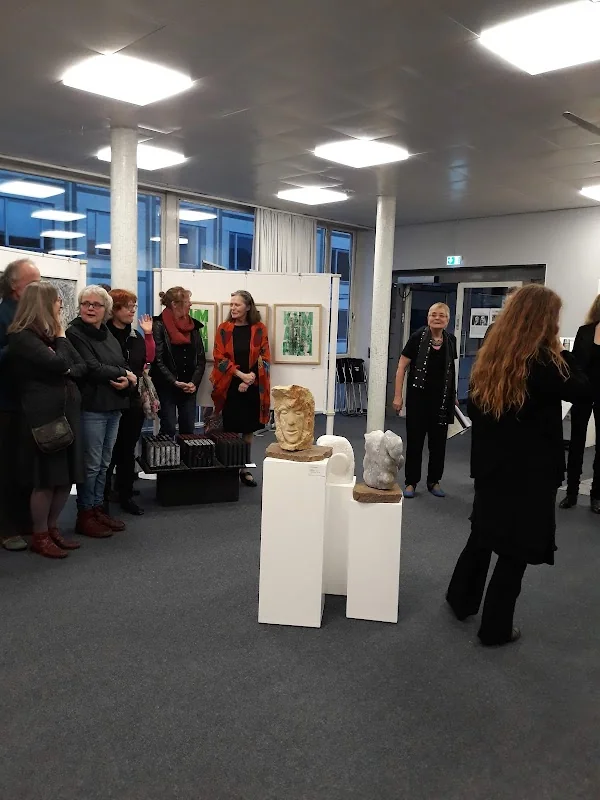
The strongest cultural identity of the Brackwede Town Hall Pavilion lies in its use as an exhibition space. The cultural office explicitly describes the space as a place for exhibitions; the city adds that small music events are also possible. Even more important for the profile is the historical note from the city: For 42 years now, the Brackwede District Office has been offering talented artists the valuable opportunity to exhibit their works in the Brackwede Town Hall Pavilion free of charge. This sentence says a lot about the role of the place, as it is not about large event productions but about local and regional visibility, about low-threshold access to art, and about the idea that administration can also be cultural promotion. For search queries like Brackwede exhibitions or Brackwede art exhibitions, this is particularly relevant because it precisely frames the expectations for the location: Those who visit the pavilion encounter changing presentations, artists from the area, and a format that is consciously designed to be public and accessible. The city also states that the decision on the allocation of exhibition spaces lies with the district office and that attention is paid to a diverse, varied selection. This indicates curated diversity rather than randomness. Art in the pavilion is therefore not a casual byproduct but a city-supported form of community culture that has grown over the years. The connection with the name Brackweder Kulisse reinforces this impression, as theater guest performances, art exhibitions, and cultural encounters also play a role in the wider district. The pavilion itself remains a rather concentrated, quiet, and functional place where art becomes visible without having the character of a large theater or concert hall. This mixture makes it interesting for visitors who prefer to experience a clear, local, and personal form of culture rather than a mass event. ([bielefeld.de](https://www.bielefeld.de/brackweder-kulisse))
For user intent, it is also important that the pavilion is not a private rental location. This clear restriction prevents misunderstandings and explains why the place often appears in search queries together with art, exhibition openings, or small musical settings. The space is suitable for formats that rely on clarity, proximity, and an administratively well-embedded framework. There is a kitchen and bar area, Wi-Fi, a screen, windows, heating, and blackout, making the space practical for presentations, small openings, or manageable musical contributions. At the same time, use remains deliberately limited: personal staffing is not provided, and staff is only provided for own events, such as exhibition openings. This makes the pavilion a functional cultural venue with clear rules. Therefore, anyone looking for a creative but not arbitrary space will find exactly that here: a municipal exhibition space with a fixed framework, without private event logic. The openness lies in the art, not in the rental freedom. This combination of municipal responsibility, cultural political continuity, and local reference is typical for the Brackwede district and explains why the location has lasted for decades. For visitors, this means: It is not the size of a program that is decisive here, but the reliability of the cultural idea and the proximity to the people on-site. ([kulturamt-bielefeld.de](https://kulturamt-bielefeld.de/kultur-service/raeumlichkeiten/pavillon-brackwede/))
Access by Light Rail and Bus as well as Parking at the District Office
Those looking for the Brackwede Town Hall Pavilion will find it very clearly at Germanenstraße 22 in 33647 Bielefeld. The official information makes the journey easy to follow: For guests, there is the parking lot of the Brackwede District Office, and the public transport connection is directly named. The light rail line 1 goes to the stop Hauptstraße, and additionally, the bus lines 28, 36, and 121 serve the stop Bezirksamt. This combination of parking availability and public transport connection is particularly practical for the location because the pavilion is anchored in the administrative and district context and should therefore be easily accessible for both motorized visitors and those coming by bus and train. In search engines, the connection between Brackwede parking, Brackwede access, and light rail line 1 Hauptstraße is therefore obvious. Those coming from the center of Bielefeld can conveniently reach the location via public transport; those traveling from the immediate district environment can use the parking lot of the district office. Even though the city does not formulate extensive travel descriptions, the official data is sufficient for clear orientation. The bus and light rail stops are logically chosen as they connect the district office directly with the regional transport network. This is particularly important for exhibitions, as visitors often come at fixed times, such as for openings, and need a location that is easily reachable without detours. The transport connection thus supports not only the cultural space but also the entire function of the district office as a public contact point. The address, the stops, and the parking lot are therefore not just practical information but belong to the usage profile of the place. ([kulturamt-bielefeld.de](https://kulturamt-bielefeld.de/kultur-service/raeumlichkeiten/pavillon-brackwede/))
For planning the visit, it is also helpful that the official information provides a clear procedure. Anyone visiting an exhibition should first check whether there is a parallel appointment at the district office, as the location is used for both administration and culture. This reduces misunderstandings when searching for the entrance or the parking lot. The city names the parking lot of the district office as guest parking, indicating a simple, local solution. At the same time, the location is attractive for public transport because the light rail line 1 and several bus lines are mentioned, providing a relatively tightly scheduled and direct access. For visitors from outside, this is a plus point because the pavilion is thus not only well known in Brackwede but also easily findable from outside. Those interested in an exhibition or a small music event can therefore combine their journey as needed: directly by car to the district office or by light rail to Hauptstraße and then continue on foot or by bus. This dual accessibility is particularly sensible for a district location where administrative use, culture, and everyday citizen traffic intersect. This also explains why terms like parking, access, and district office repeatedly appear in search queries. The official location description provides a good and reliable basis for these questions. ([kulturamt-bielefeld.de](https://kulturamt-bielefeld.de/kultur-service/raeumlichkeiten/pavillon-brackwede/))
Room Size, Equipment, and Use of the Pavilion
The Brackwede Pavilion is officially designated with a room size of 196 m². This number is important for classification because it describes the location not as a large hall but as a well-overviewed, clearly structured space. Additionally, the official information states that a kitchen or bar area is available. The rest of the equipment also shows that the space is designed for exhibition situations and small formats: Wi-Fi, a screen, windows, heating, and blackout are listed, as well as carpet flooring. Together, this creates a functional profile suitable for presentations, openings, and small musical contributions. The space is therefore not sterile in the sense of a pure office room but is technically equipped so that cultural events can take place meaningfully. At the same time, the use remains deliberately limited, as the city points out that personal staffing is not possible and staff is only provided for own events, such as exhibition openings. This shows that the space is organizationally supervised and not intended as a self-service location. For the search intent Brackwede Pavilion or Pavilion Brackwede, this is central information because many users initially only seek the size or possible capacity. However, the city does not specify a fixed maximum visitor number on the room page. Instead of inventing a number, the official room size remains the most reliable reference point. Those wishing to infer a rather compact, controllable audience from the size may do so as a cautious estimate, but the reliable public information remains with the area. This clarity is important for serious location texts. The pavilion thus acts as a space that combines practical functionality, cultural visibility, and official organization without tipping into the logic of a freely bookable event space. ([kulturamt-bielefeld.de](https://kulturamt-bielefeld.de/kultur-service/raeumlichkeiten/pavillon-brackwede/))
The restriction to exhibitions and small music events is also crucial in evaluating the equipment. The combination of a screen, Wi-Fi, and blackout suggests that presentations, picture hangings, small lectures, or accompanying media formats are possible. The heating supports use throughout the year, windows provide daylight, and the carpet flooring contributes to a quieter, less echoey room feel. All these details come directly from the official room page and should therefore not be romanticized but read factually: The pavilion is not an elaborately staged event hall but a practical, culturally usable space with good basic equipment. This makes it interesting for the district because it does not rely on spectacular size but on reliability. The available kitchen and bar area facilitate exhibition openings, receptions, or small accompanying formats. That staff is only provided for own events also shows how closely the use is tied to municipal organization. Visitors are not meant to be left to their own devices here but to arrive in a structured framework. For the SEO perspective, this is an important point because seekers looking for capacity, equipment, or room plans usually do not expect a generic hall profile but concrete hints about what is actually feasible on-site. The Brackwede Town Hall Pavilion meets exactly this expectation: It is clearly described, functionally equipped, and consciously reduced to the cultural core. ([kulturamt-bielefeld.de](https://kulturamt-bielefeld.de/kultur-service/raeumlichkeiten/pavillon-brackwede/))
Brackwede as a District: History, District Profile, and Cultural Context
The Brackwede Town Hall Pavilion does not stand isolated in space but in a district with its own history and strong local profile. The city of Bielefeld points out that Brackwede was first mentioned in a document in 1151. With the onset of industrialization, numerous companies were founded there, making the district one of the largest industrial and craft locations in Bielefeld. In 1956, Brackwede was granted city rights, in 1970 Quelle, Holtkamp, and Ummeln were incorporated, and since the territorial reform in 1973, Brackwede has been part of Bielefeld as a district. This historical context is relevant for the pavilion because it explains why the district still has a strong identity today and why cultural places have a special function here. According to city information, the district includes the neighborhoods of Brackwede, Ummeln, Quelle, and Holtkamp and is an area where living, business, administration, and culture are closely intertwined. In the context of INSEK-Brackwede, it is also described that the district has about 42,000 inhabitants over approximately 38.25 km² and is considered a mix of urban structures and nature-close landscapes. This also shapes the pavilion: It is not an isolated art entity but a part of a district that is continuously evolving and where public space, community events, and cultural offerings are closely linked. Therefore, when the city offers exhibitions in the pavilion, it happens in an environment with a rich social and historical density. This is precisely why search queries like Brackweder Rathaus or Brackweder Rathaus-Pavillon often also touch on general Brackwede topics. The place stands for a district that connects tradition, administration, and public life. ([bielefeld.de](https://www.bielefeld.de/brackwede?utm_source=openai))
The cultural context also includes that the Brackwede District Office not only performs administrative tasks but also explicitly organizes community events, Brackweder Kulisse, art exhibitions, holiday games, the weekly market, and the allocation of municipal spaces. These functions make it understandable why the pavilion is so firmly anchored in public life in Brackwede. The Brackweder Kulisse, in turn, shows that the district offers more culturally than just the pavilion: touring theater, art exhibitions, and other events create a framework in which the exhibition space can unfold its role. For visitors, this results in a coherent overall picture. They do not simply enter an arbitrary space but a district where cultural offerings, citizen services, and community care are consciously brought together. The city's communication also emphasizes the decades-long free exhibition activity in the pavilion, which underscores local continuity. This makes the place interesting for people looking for authentic community culture: no event facade, but a functioning, publicly anchored space that has given art a place for many years. In an SEO context, this is particularly valuable as it covers both the informational needs and the cultural added value. Those searching for Brackwede often seek not just an address but access to the district. The Brackwede Town Hall Pavilion provides exactly this access by connecting the administrative side of the district with its cultural side, thus forming a small but significant place in Bielefeld's urban life. ([bielefeld.de](https://www.bielefeld.de/ba-brackwede))
Sources:
Mehr anzeigenWeniger anzeigen
Brackwede Town Hall Pavilion | Opening Hours & Exhibitions
The Brackwede Town Hall Pavilion is not an ordinary event venue, but a clearly defined cultural and exhibition space in the vicinity of the Brackwede District Office at Germanenstraße 22 in Bielefeld. Therefore, those looking for the Brackwede Town Hall Pavilion usually mean a place that connects administration, art, and community life. On the official page of the cultural office, the space is referred to as Pavilion Brackwede, and the city describes it as a place for exhibitions and small music events. Particularly important for orientation is a point that answers many search queries: The pavilion is explicitly not available for private events, but is intended for public or community-related exhibitions. At the same time, the city's representation shows that this place has played a fixed role in the cultural life of the district for decades and is not just a space in the administrative building, but a visible part of the local identity. Those who want to inform themselves before a visit should therefore not only search for the building but also for the Brackwede District Office, for exhibitions, and for the current opening hours. This makes the location interesting for users who have a specific goal and want to quickly know how to get there, when they can take care of something on-site, and what kind of cultural program they can expect. In this sense, the pavilion is a meeting point between everyday life and culture, between citizen services and artistic presentation. ([kulturamt-bielefeld.de](https://kulturamt-bielefeld.de/kultur-service/raeumlichkeiten/pavillon-brackwede/))
Opening Hours of the Brackwede District Office and Appointment Scheduling
The frequent search query for the opening hours of the Brackwede Town Hall is primarily a question about the Brackwede District Office, as the pavilion is organizationally embedded there. The official city page states the opening hours as Monday to Friday from 8 AM to 12 PM and additionally on Thursdays from 2:30 PM to 6 PM. At the same time, it is important that personal visits are only possible by prior appointment. This is relevant for visitors because the location, while appearing publicly accessible, operates clearly according to appointment logic. Therefore, anyone wishing to combine a visit to the exhibition with an official visit, an inquiry, or a viewing should not plan the appointment spontaneously but check in advance whether the desired contact is actually possible within the mentioned time frames. The city's service portal adds this information and states that for telephone availability, it is even Monday to Friday from 7:30 AM to 6 PM. This makes it clear that while the location is not a classic free public venue, it remains well accessible and service-oriented. For SEO and user intent, this is a central pattern: Many people search for opening hours not only to understand the pavilion concept but primarily to know when they can reach the district office, the pavilion, or the contact regarding exhibitions, registration, or local services. The official communication from the city provides a clear and reliable basis for this. Therefore, those planning a visit should orient themselves to the administrative hours and take the appointment status seriously, as this is precisely the practical difference between an open cultural house and a municipal space with regulated use. ([bielefeld.de](https://www.bielefeld.de/ba-brackwede))
For seekers, it is also helpful that the Brackwede District Office not only appears as an address on the map but also serves as a functional anchor in the district. In the official information, it is mentioned as responsible for several administrative tasks, including district representation, lost property office, business matters, regulatory matters, community events, and the allocation of municipal spaces. This also clarifies why the opening hours are so often searched in connection with the pavilion: The space is not isolated but part of an administrative structure that organizes and culturally accompanies the district. Therefore, anyone wishing to visit an exhibition is not only interested in art but often also in whether a conversation, consultation, or registration is possible at the same time. The city of Bielefeld makes this connection transparent by describing the location with appointment scheduling, public accessibility, and clear time frames. This combination of reliable administration and cultural use ensures that the Brackwede Town Hall Pavilion repeatedly appears in search results with terms like opening hours, appointment scheduling, and district office. In practice, this means: It is better to check the official times shortly before than to stand in front of a closed door spontaneously. ([bielefeld.de](https://www.bielefeld.de/ba-brackwede))
Exhibitions and Small Music Events at the Town Hall Pavilion
The strongest cultural identity of the Brackwede Town Hall Pavilion lies in its use as an exhibition space. The cultural office explicitly describes the space as a place for exhibitions; the city adds that small music events are also possible. Even more important for the profile is the historical note from the city: For 42 years now, the Brackwede District Office has been offering talented artists the valuable opportunity to exhibit their works in the Brackwede Town Hall Pavilion free of charge. This sentence says a lot about the role of the place, as it is not about large event productions but about local and regional visibility, about low-threshold access to art, and about the idea that administration can also be cultural promotion. For search queries like Brackwede exhibitions or Brackwede art exhibitions, this is particularly relevant because it precisely frames the expectations for the location: Those who visit the pavilion encounter changing presentations, artists from the area, and a format that is consciously designed to be public and accessible. The city also states that the decision on the allocation of exhibition spaces lies with the district office and that attention is paid to a diverse, varied selection. This indicates curated diversity rather than randomness. Art in the pavilion is therefore not a casual byproduct but a city-supported form of community culture that has grown over the years. The connection with the name Brackweder Kulisse reinforces this impression, as theater guest performances, art exhibitions, and cultural encounters also play a role in the wider district. The pavilion itself remains a rather concentrated, quiet, and functional place where art becomes visible without having the character of a large theater or concert hall. This mixture makes it interesting for visitors who prefer to experience a clear, local, and personal form of culture rather than a mass event. ([bielefeld.de](https://www.bielefeld.de/brackweder-kulisse))
For user intent, it is also important that the pavilion is not a private rental location. This clear restriction prevents misunderstandings and explains why the place often appears in search queries together with art, exhibition openings, or small musical settings. The space is suitable for formats that rely on clarity, proximity, and an administratively well-embedded framework. There is a kitchen and bar area, Wi-Fi, a screen, windows, heating, and blackout, making the space practical for presentations, small openings, or manageable musical contributions. At the same time, use remains deliberately limited: personal staffing is not provided, and staff is only provided for own events, such as exhibition openings. This makes the pavilion a functional cultural venue with clear rules. Therefore, anyone looking for a creative but not arbitrary space will find exactly that here: a municipal exhibition space with a fixed framework, without private event logic. The openness lies in the art, not in the rental freedom. This combination of municipal responsibility, cultural political continuity, and local reference is typical for the Brackwede district and explains why the location has lasted for decades. For visitors, this means: It is not the size of a program that is decisive here, but the reliability of the cultural idea and the proximity to the people on-site. ([kulturamt-bielefeld.de](https://kulturamt-bielefeld.de/kultur-service/raeumlichkeiten/pavillon-brackwede/))
Access by Light Rail and Bus as well as Parking at the District Office
Those looking for the Brackwede Town Hall Pavilion will find it very clearly at Germanenstraße 22 in 33647 Bielefeld. The official information makes the journey easy to follow: For guests, there is the parking lot of the Brackwede District Office, and the public transport connection is directly named. The light rail line 1 goes to the stop Hauptstraße, and additionally, the bus lines 28, 36, and 121 serve the stop Bezirksamt. This combination of parking availability and public transport connection is particularly practical for the location because the pavilion is anchored in the administrative and district context and should therefore be easily accessible for both motorized visitors and those coming by bus and train. In search engines, the connection between Brackwede parking, Brackwede access, and light rail line 1 Hauptstraße is therefore obvious. Those coming from the center of Bielefeld can conveniently reach the location via public transport; those traveling from the immediate district environment can use the parking lot of the district office. Even though the city does not formulate extensive travel descriptions, the official data is sufficient for clear orientation. The bus and light rail stops are logically chosen as they connect the district office directly with the regional transport network. This is particularly important for exhibitions, as visitors often come at fixed times, such as for openings, and need a location that is easily reachable without detours. The transport connection thus supports not only the cultural space but also the entire function of the district office as a public contact point. The address, the stops, and the parking lot are therefore not just practical information but belong to the usage profile of the place. ([kulturamt-bielefeld.de](https://kulturamt-bielefeld.de/kultur-service/raeumlichkeiten/pavillon-brackwede/))
For planning the visit, it is also helpful that the official information provides a clear procedure. Anyone visiting an exhibition should first check whether there is a parallel appointment at the district office, as the location is used for both administration and culture. This reduces misunderstandings when searching for the entrance or the parking lot. The city names the parking lot of the district office as guest parking, indicating a simple, local solution. At the same time, the location is attractive for public transport because the light rail line 1 and several bus lines are mentioned, providing a relatively tightly scheduled and direct access. For visitors from outside, this is a plus point because the pavilion is thus not only well known in Brackwede but also easily findable from outside. Those interested in an exhibition or a small music event can therefore combine their journey as needed: directly by car to the district office or by light rail to Hauptstraße and then continue on foot or by bus. This dual accessibility is particularly sensible for a district location where administrative use, culture, and everyday citizen traffic intersect. This also explains why terms like parking, access, and district office repeatedly appear in search queries. The official location description provides a good and reliable basis for these questions. ([kulturamt-bielefeld.de](https://kulturamt-bielefeld.de/kultur-service/raeumlichkeiten/pavillon-brackwede/))
Room Size, Equipment, and Use of the Pavilion
The Brackwede Pavilion is officially designated with a room size of 196 m². This number is important for classification because it describes the location not as a large hall but as a well-overviewed, clearly structured space. Additionally, the official information states that a kitchen or bar area is available. The rest of the equipment also shows that the space is designed for exhibition situations and small formats: Wi-Fi, a screen, windows, heating, and blackout are listed, as well as carpet flooring. Together, this creates a functional profile suitable for presentations, openings, and small musical contributions. The space is therefore not sterile in the sense of a pure office room but is technically equipped so that cultural events can take place meaningfully. At the same time, the use remains deliberately limited, as the city points out that personal staffing is not possible and staff is only provided for own events, such as exhibition openings. This shows that the space is organizationally supervised and not intended as a self-service location. For the search intent Brackwede Pavilion or Pavilion Brackwede, this is central information because many users initially only seek the size or possible capacity. However, the city does not specify a fixed maximum visitor number on the room page. Instead of inventing a number, the official room size remains the most reliable reference point. Those wishing to infer a rather compact, controllable audience from the size may do so as a cautious estimate, but the reliable public information remains with the area. This clarity is important for serious location texts. The pavilion thus acts as a space that combines practical functionality, cultural visibility, and official organization without tipping into the logic of a freely bookable event space. ([kulturamt-bielefeld.de](https://kulturamt-bielefeld.de/kultur-service/raeumlichkeiten/pavillon-brackwede/))
The restriction to exhibitions and small music events is also crucial in evaluating the equipment. The combination of a screen, Wi-Fi, and blackout suggests that presentations, picture hangings, small lectures, or accompanying media formats are possible. The heating supports use throughout the year, windows provide daylight, and the carpet flooring contributes to a quieter, less echoey room feel. All these details come directly from the official room page and should therefore not be romanticized but read factually: The pavilion is not an elaborately staged event hall but a practical, culturally usable space with good basic equipment. This makes it interesting for the district because it does not rely on spectacular size but on reliability. The available kitchen and bar area facilitate exhibition openings, receptions, or small accompanying formats. That staff is only provided for own events also shows how closely the use is tied to municipal organization. Visitors are not meant to be left to their own devices here but to arrive in a structured framework. For the SEO perspective, this is an important point because seekers looking for capacity, equipment, or room plans usually do not expect a generic hall profile but concrete hints about what is actually feasible on-site. The Brackwede Town Hall Pavilion meets exactly this expectation: It is clearly described, functionally equipped, and consciously reduced to the cultural core. ([kulturamt-bielefeld.de](https://kulturamt-bielefeld.de/kultur-service/raeumlichkeiten/pavillon-brackwede/))
Brackwede as a District: History, District Profile, and Cultural Context
The Brackwede Town Hall Pavilion does not stand isolated in space but in a district with its own history and strong local profile. The city of Bielefeld points out that Brackwede was first mentioned in a document in 1151. With the onset of industrialization, numerous companies were founded there, making the district one of the largest industrial and craft locations in Bielefeld. In 1956, Brackwede was granted city rights, in 1970 Quelle, Holtkamp, and Ummeln were incorporated, and since the territorial reform in 1973, Brackwede has been part of Bielefeld as a district. This historical context is relevant for the pavilion because it explains why the district still has a strong identity today and why cultural places have a special function here. According to city information, the district includes the neighborhoods of Brackwede, Ummeln, Quelle, and Holtkamp and is an area where living, business, administration, and culture are closely intertwined. In the context of INSEK-Brackwede, it is also described that the district has about 42,000 inhabitants over approximately 38.25 km² and is considered a mix of urban structures and nature-close landscapes. This also shapes the pavilion: It is not an isolated art entity but a part of a district that is continuously evolving and where public space, community events, and cultural offerings are closely linked. Therefore, when the city offers exhibitions in the pavilion, it happens in an environment with a rich social and historical density. This is precisely why search queries like Brackweder Rathaus or Brackweder Rathaus-Pavillon often also touch on general Brackwede topics. The place stands for a district that connects tradition, administration, and public life. ([bielefeld.de](https://www.bielefeld.de/brackwede?utm_source=openai))
The cultural context also includes that the Brackwede District Office not only performs administrative tasks but also explicitly organizes community events, Brackweder Kulisse, art exhibitions, holiday games, the weekly market, and the allocation of municipal spaces. These functions make it understandable why the pavilion is so firmly anchored in public life in Brackwede. The Brackweder Kulisse, in turn, shows that the district offers more culturally than just the pavilion: touring theater, art exhibitions, and other events create a framework in which the exhibition space can unfold its role. For visitors, this results in a coherent overall picture. They do not simply enter an arbitrary space but a district where cultural offerings, citizen services, and community care are consciously brought together. The city's communication also emphasizes the decades-long free exhibition activity in the pavilion, which underscores local continuity. This makes the place interesting for people looking for authentic community culture: no event facade, but a functioning, publicly anchored space that has given art a place for many years. In an SEO context, this is particularly valuable as it covers both the informational needs and the cultural added value. Those searching for Brackwede often seek not just an address but access to the district. The Brackwede Town Hall Pavilion provides exactly this access by connecting the administrative side of the district with its cultural side, thus forming a small but significant place in Bielefeld's urban life. ([bielefeld.de](https://www.bielefeld.de/ba-brackwede))
Sources:
Upcoming Events
No events found
Frequently Asked Questions
Reviews
Martin Fleitmann -McFly
25. January 2021
Detailed report to follow! Best, your McFly. I can't say much personally because, understandably, it's difficult to reach the caseworkers! But due to Corona, you can only enter the building with a mask! Attention: From today, only with an FFP2 mask! At the entrance, you are immediately greeted by security! They are very friendly and provide information on how everything works! For example, anyone with an appointment now has to fill out a self-disclosure form! But there is also hand sanitizer available! From what I saw, everything was very clean! Currently, there's only the front entrance! You can find all other info in the photos! Best, your McFly.
Rita Niemann
23. March 2019
Everything is very nice. Ideal venue. Bright.
fabio magnifico
8. February 2022
Pavilion: Ideal for art exhibitions.
Nikolas Roehr
9. October 2019
Appointment at 08:30. No. 1020. I'm half an hour early. The waiting room is empty. No. 1002 is not coming. Statement: Could still come. Next number: 1009. I should mention that the numbering is not continuous. Not here. 20 minutes have passed. I've been sitting in an empty waiting room for 20 minutes. No. 1009 is not here. Statement: could still come. Seems too complicated to prioritize a punctual citizen in an empty waiting room. Or just refusal to work. What kind of nonsense is this?!
Gilles-Oliver Jean Nehls
18. October 2018
There has been a scaffolding at the town hall for years, and 99.99% of the time, nothing has been done on it, but it costs money. Now another scaffolding has been set up below. Let's see how many years we pay for this again, even though nothing ever gets done (Hülsmann company).