
Bielefeld
Am Bach 19, 33602 Bielefeld, Deutschland
German Fan Museum | Opening Hours & Directions
The German Fan Museum in Bielefeld is an unusual house with great charisma, as it is entirely dedicated to an object that is at once a fashion accessory, artwork, status symbol, and historical document. According to the official tourism website, it is one of only three fan museums worldwide and the only fan museum in Germany; it was opened in 1996 in the old town of Bielefeld. The Barisch Foundation preserves a collection here that shows the fan not merely as an ornament, but as a cultural medium that has carried political, social, and artistic meanings over centuries. This is precisely the special strength of this house: it is small enough to feel very personal, yet rich enough to deeply introduce visitors to the world of historical materials, forms, and motifs. Those looking for opening hours, directions, parking, prices, tours, or photos will find not only practical answers here but also a content-rich reason to visit. The museum combines the fascination of rare objects with a clear, carefully curated narrative about craftsmanship, taste, and European cultural history. ([bielefeld.jetzt](https://www.bielefeld.jetzt/deutsches-faechermuseum))
Opening Hours, Address, Entrance, and Parking
The most important visitor information is clearly and concisely summarized on the official website, making planning very pleasant. The German Fan Museum is located at Am Bach 19, 33602 Bielefeld, with the entrance specifically via Neustädter Straße 16. This small but important piece of information is especially helpful for the first visit, as one does not have to wonder on-site if the visible access is not directly at the main address. The regular opening hours are currently Wednesdays and Thursdays from 2:30 PM to 5:30 PM. Additionally, the website points out that registrations can be made by phone or email, which is particularly useful for groups, researchers, or visitors with specific interests in individual objects. This way, a short visit quickly becomes a very personal museum experience with enough time for details, materials, and questions. ([faechermuseum.de](https://www.faechermuseum.de/opening-route))
The directions are also well described on the website. Those arriving by public transport can use the city rail stop Landgericht on lines 1 and 2. From there, the path leads up the platform, then right into Neustädter Straße and past the high bunker; after about 250 meters, the fan museum is on the right side. For drivers, the official site mentions two specific orientation points: From the A2, take the exit 25 at the Bielefeld interchange onto the A33 towards Bielefeld city center; alternatively, the A33 exit Bielefeld city center is mentioned. When parking, the Welle underground garage at Am Bach 20 is particularly convenient, as its entrance is diagonally opposite the museum. This makes the museum easily accessible for a spontaneous visit to the old town without having to search long for a parking space. Especially for a house in the old town of Bielefeld, this combination of central location and clear route guidance is a real plus. ([faechermuseum.de](https://www.faechermuseum.de/opening-route))
In practice, this means: Those looking for the opening hours of the German Fan Museum should plan their visit for a Wednesday or Thursday and, if they have greater interest, it is better to contact them in advance. The official information is deliberately kept concise, which fits a specialized museum with a personal character. Here, one does not receive anonymous mass processing, but rather the impression of a house that focuses on calm, concentration, and careful mediation. This is precisely why planning a visit works so well through short, concrete questions: When is it open? Where is the entrance? Where can I park? How do I get from the Landgericht? These questions can be quickly clarified, and that is exactly what makes the way to the museum so uncomplicated. Those who wish can also combine their visit with a stroll through the old town, as the location in Bielefeld's historic city center invites one to connect the museum with a city walk. ([faechermuseum.de](https://www.faechermuseum.de/opening-route))
Prices, Tours, and Visit Planning
The admission prices at the German Fan Museum remain pleasantly straightforward. The official price page lists 4 euros for adults and 3 euros for reduced admission. This makes the museum one of the more accessible cultural destinations that do not require a large budget even for a spontaneous visit. Particularly interesting is the arrangement for tours: A tour for up to ten people costs 40 euros by arrangement. This makes the museum attractive not only for individual guests but also for small groups, circles of friends, cultural associations, or professionally interested visitors who wish to embark on a thematically focused discovery tour together. Individuals are also explicitly mentioned, and tours can even be arranged outside regular opening hours upon request. This flexibility is a strong argument for a specialized museum, as it allows more time for conversations, detailed observations, and individual questions. ([faechermuseum.de](https://www.faechermuseum.de/prices))
Visit planning benefits from this in multiple ways. Those specifically wanting to see fan photos, historical details, or special exhibits can request a tour and thereby ensure that their time on-site is optimally utilized. This is particularly sensible when coming with a smaller group or using the museum as part of a cultural-historical excursion. The pricing structure also shows that the house focuses on accessibility rather than barriers. Four euros admission for adults is remarkably moderate compared to many other cultural offerings, especially since one visits a very independent specialized museum for that price. However, the low price is not the only argument. More important is the nature of the experience: It is not about a quick tour, but about a collection that rewards careful observation. Those who walk slowly through the showcases discover materials such as ivory, mother-of-pearl, horn, silk, paper, or lacquer and learn how finely graded the world of historical fans can be. ([faechermuseum.de](https://www.faechermuseum.de/prices))
For visitors, therefore, not only the price is important, but also the rhythm of the house. The opening hours on Wednesday afternoons and Thursday afternoons fit a museum that focuses on quality rather than quantity. Those looking for a short cultural break during the week get a concentrated insight here; those wanting to delve deeper can book a tour and even come outside regular hours. This makes the German Fan Museum a good destination for people who do not simply want to tick off sights but want to understand content. The museum is small enough to remain manageable, but large enough in its thematic depth to leave a lasting impression. This mix of accessibility, clarity, and specialization is a central feature of the house. ([faechermuseum.de](https://www.faechermuseum.de/prices))
The History of the Fan from Antiquity to Modern Times
The official museum website tells the story of the fan as a journey through very different epochs and cultures. References to its use can be found in early high cultures: In Egypt, among the Assyrians, Persians, and Indians, long-stemmed fans served as symbols of sovereignty. Even this early finding shows that the fan was much more than a tool against heat. It was a sign of rank, distance, and representation. In the Middle Ages, it appeared in Christian liturgy as a flabellum or flabellus, and long-stemmed radial fans also belonged to this sacred context. At the latest since Greek and Roman times, the fan was also an object of women's toilette, thus part of that everyday culture where beauty, etiquette, and self-presentation intersect. Here, it becomes clear why the museum does not only show decorative pieces but also cultural-historical sources that tell of courtly, religious, and social role models. ([faechermuseum.de](https://www.faechermuseum.de/history))
The foldable fan, which arrived in Europe from East Asia at the beginning of the 16th century, became particularly influential. Before that, ladies used feather fans, some with precious rods, but the triumph of the folding fan was unstoppable. Its heyday occurred in the 18th century when fan leaves were painted with mythological, biblical, or historical themes. Often, paintings by well-known artists served as templates. Later, gallant scenes and pastoral idylls dominated, reflecting the taste of the Rococo and the visual language of courtly sociability. A particularly large group consists of wedding fans, which were not only beautiful but also memorable and symbolically charged. In an era when clothing, gestures, and accessories conveyed social codes, the fan was an object that visibly represented taste, education, and status. ([faechermuseum.de](https://www.faechermuseum.de/history))
In the 18th century, the fan also transformed into a broader cultural carrier. With simple designs, it increasingly became part of bourgeois women's clothing, and the printed fan became a mass product. Particularly in this form, it gained a special role as a reporter of current political events, such as in connection with the French Revolution. This is particularly interesting from a cultural-historical perspective, as a seemingly delicate, fashionable object suddenly acquires a media function. The fan could thus not only be beautiful but also inform, comment, and translate the spirit of the times into images and texts. This multifacetedness makes the history of the fan so exciting: it links art, politics, fashion, technology, and communication in a single object. The German Fan Museum makes this development visible by keeping the long lines from antiquity to modernity comprehensible. ([faechermuseum.de](https://www.faechermuseum.de/history))
Collection, Typology, and Outstanding Exhibits
The collection of the German Fan Museum is particularly appealing because it does not treat the fan as a uniform object but rather divides it into different types and forms. The museum's page on typology speaks of a quartet or four relevant basic forms and explains them very vividly. The brisé fan consists of a collapsible frame made of uniform rods, held together at the top by a ribbon and at the bottom by a pin; materials include wood, ivory, bone, tortoiseshell, lacquer on wood, or cardboard. The folding fan, which is today the most well-known and widespread type of fan, also works with rods, pin, and ribbon, with the ribbon or leaf varying by epoch and made of paper, parchment, fabric, or even lace. Even these basic forms show how strongly a seemingly small object is shaped by material science, craftsmanship, and design. ([faechermuseum.de](https://www.faechermuseum.de/typology))
The collection is particularly well differentiated in naming further types. The cabriolet fan is a folding fan with two, rarely three, concentrically arranged leaves and was developed in France in the mid-18th century; typical motifs from Paris at that time include open horse-drawn carriages. The telescopic fan, on the other hand, is a variant of the folding fan, where the leaf can be slid up and down along the rods. This form likely emerged towards the end of the 18th century when the large pockets of fashion were replaced by smaller wrist bags. The radial fan, finally, does not have a classic leaf between the rods but a leafless leaf between two longer cover rods and can be fanned out to 360 degrees. Today, it is primarily manufactured in China and is known in Europe as an inexpensive handbag fan. Those interested in photos, forms, and differences will find not only beautiful images here but also a small typology of the fan itself. ([faechermuseum.de](https://www.faechermuseum.de/typology))
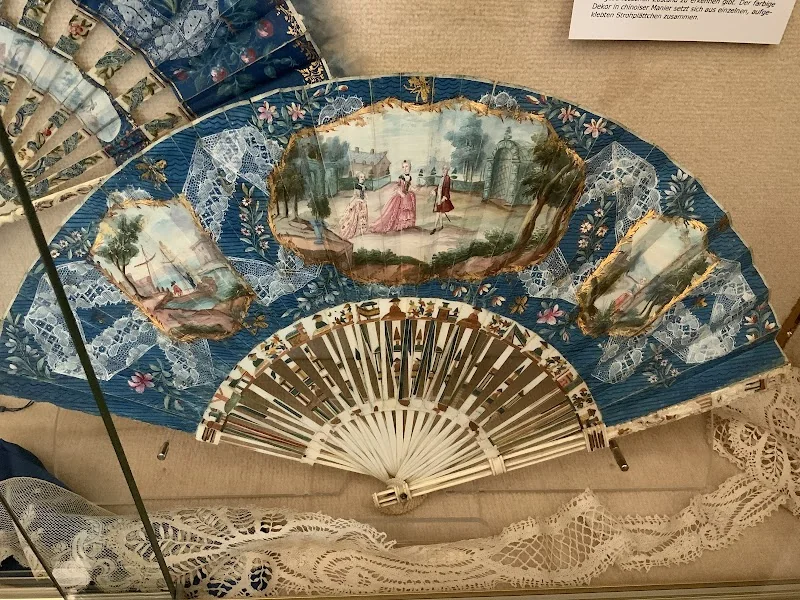
The object examples on the collection page make this diversity particularly vivid. Among the outstanding pieces is a folding fan from England after a painting by Peter Paul Rubens, around 1750, depicting the wedding of Maria de' Medici to Henry IV of France. The frame is made of cut-out, sculpted, and colored ivory; the leaf is mounted as a gouache painting on vellum. Another impressive piece is a brisé fan from Kyoto from 1880 with elaborate Japanese gold painting, deep lacquer decoration on ivory, and inlays of ivory, mother-of-pearl, horn, and coral. The French lorgnette fan from around 1780, the cast-iron fan from the time of Berlin iron, the Spanish handover of Granada around 1882, the London city map fan from 1790, the balloon ascent fan as a historical document, the fan with diamonds for Empress Elisabeth, or the Art Nouveau figure of the orchid woman around 1900 show how broad the collection is across countries, styles, and themes. The official object images and detail views reinforce this impression and make it understandable why many visitors look for photos and images of the museum in advance. ([faechermuseum.de](https://www.faechermuseum.de/collection))
This mix of typology and individual pieces is a significant SEO and visitor advantage, as it serves multiple search intentions simultaneously: Those searching for the term fan museum find the basic form of the house; those looking for photos or images receive visual object diversity; those interested in historical pieces encounter concrete provenances and datings; and those searching for the best place for a cultural discovery in Bielefeld quickly realize that the museum is not only rare but also remarkably rich in content. The collection does not appear as a mere accumulation of beautiful things but as a precisely constructed archive of fan culture, where material, occasion, origin, and imagery are closely interconnected. This is why the house is so well suited for visitors who want more than just a quick glance. ([faechermuseum.de](https://www.faechermuseum.de/typology))
Current Exhibition, Images, and What Visitors Experience On-Site
The official page on opening hours and directions currently lists the exhibition Treasures from Imperial Vienna as the current exhibition. This title alone shows that the museum not only works permanently with its permanent collection but also sets changing focal points that particularly highlight certain historical or aesthetic facets. For visitors, this is an important point, as a planned return visit can consciously differ from the first. The current exhibition is mentioned directly on the website next to the visitor information, thus at a point that shows: The museum always thinks of its content together with the practical visit. This creates a connection of information, curiosity, and concrete planning. So those looking for exhibitions, current themes, or special photos will find not just a static collection but a place with a changing perspective on the theme of fans. ([faechermuseum.de](https://www.faechermuseum.de/opening-route))
The visual experience plays a central role in this. The collection page works with numerous object images, full-screen hints, and highly individual exhibit descriptions. This makes the fans not just texts but visible art objects. This is important for a specialized museum, as many fans only unfold their effect in the interplay of form, color, material, and motif. A Rubens fan with a historical scene has a different effect than a gold-painted brisé fan from Japan, a cast-iron brisé fan from the time of Berlin iron, or a balloon ascent fan that conserves a historical moment. The website makes these differences perceptible even before the visit, fulfilling the desire of many search queries for images, photos, and impressions. The museum is thus not only a place for reading about fans but also for seeing fans. ([faechermuseum.de](https://www.faechermuseum.de/collection))
Content-wise, one thing is especially evident on-site: The fan is an object with enormous narrative potential. The museum's page mentions examples such as tiny thermometers, mirrors, powder boxes, or even a seemingly built-in pair of glasses, playfully and almost charmingly expanding the theme. Such hints are more than decorative anecdotes, as they illustrate how experimental and inventive the relationship between craftsmanship and function could be. Thus, when entering the museum, one does not simply see "beautiful old fans" but a multifaceted ensemble of courtly representation, fashionable communication, and technical imagination. The connection of exhibition, image material, and historical explanation makes the visit particularly rewarding, even for people who may have only informed themselves beforehand due to photos, reviews, or the name of the house. On-site, a search query quickly becomes a genuine discovery. ([bielefeld.jetzt](https://www.bielefeld.jetzt/deutsches-faechermuseum))
Barisch Foundation, Collaborations, and Why the Museum in Bielefeld is Special
The history of the house is closely linked to Marie-Luise and Günter Barisch. On the people page, the museum describes the two as founders of the foundation and museum. Based on Günter Barisch's work as a structural and interior architect and their shared collecting experiences, a steadily growing fascination for these miniature artworks in half-round developed after the first, rather accidental purchase of a fan. In 1994, the Barisch couple established an independent, non-profit foundation that maintains the so-called Fan Cabinet. After the opening of the only German fan museum, numerous donations further expanded the collection. The museum explicitly sees its task as preserving, researching, safeguarding, and making beautiful and valuable objects accessible to a broad public. This thought continues to shape the impact of the house today: it is not only a place of collection but also a place of mediation. ([faechermuseum.de](https://www.faechermuseum.de/persons))
Personnel continuity is also important. According to the museum's website, Maria Plet was appointed to the board in May 2018 and took over the management of the museum. Additionally, the house has been commemorating the foundation's co-founder Marie-Luise Barisch, who passed away in 2019, with the special exhibition Marie-Luise's Favorites since February 2020. This makes it clear that the museum does not just manage objects but also tells a very personal story. The fans are part of a biography, and the biography of the founder is in turn part of the institution. This human dimension makes the visit in Bielefeld so appealing. The house thus appears approachable, even though it is internationally networked and exchanges with professionals, museums, and circles of friends. ([faechermuseum.de](https://www.faechermuseum.de/persons))
The collaborations underscore the significance of the museum in the international context. The website mentions, among others, the Fan Circle International, the Fan Association of North America, the Cercle de l’Éventail, the Museums Initiative OWL, and the Hermitage in St. Petersburg. These partnerships show that the German Fan Museum is not an isolated case but part of a global professional community that deals with the preservation, research, evaluation, and history of fans. For visitors, this means: The exhibition in Bielefeld represents not only regional culture but is also part of a larger network of collector interests, research, and museum expertise. This is complemented by the Bielefeld tourism page, which highlights the museum as a special hotspot in the city and even refers to free admission with the discovery card. This makes the location additionally attractive, as it can easily be combined with a stroll through the old town, city center, and other cultural sites. So those searching for a fan museum in Bielefeld receive not just a small specialized museum but a well-established cultural address with an international perspective. ([faechermuseum.de](https://www.faechermuseum.de/cooperations))
Sources:
- German Fan Museum - Opening Hours & Directions
- German Fan Museum - Prices & Tours
- German Fan Museum - History of the Fan
- German Fan Museum - Typology of Fans
- German Fan Museum - Collection and Object Images
- German Fan Museum - Marie-Luise and Günter Barisch as well as Maria Plet
- German Fan Museum - Collaborations
- Bielefeld.JETZT - German Fan Museum
Show moreShow less
German Fan Museum | Opening Hours & Directions
The German Fan Museum in Bielefeld is an unusual house with great charisma, as it is entirely dedicated to an object that is at once a fashion accessory, artwork, status symbol, and historical document. According to the official tourism website, it is one of only three fan museums worldwide and the only fan museum in Germany; it was opened in 1996 in the old town of Bielefeld. The Barisch Foundation preserves a collection here that shows the fan not merely as an ornament, but as a cultural medium that has carried political, social, and artistic meanings over centuries. This is precisely the special strength of this house: it is small enough to feel very personal, yet rich enough to deeply introduce visitors to the world of historical materials, forms, and motifs. Those looking for opening hours, directions, parking, prices, tours, or photos will find not only practical answers here but also a content-rich reason to visit. The museum combines the fascination of rare objects with a clear, carefully curated narrative about craftsmanship, taste, and European cultural history. ([bielefeld.jetzt](https://www.bielefeld.jetzt/deutsches-faechermuseum))
Opening Hours, Address, Entrance, and Parking
The most important visitor information is clearly and concisely summarized on the official website, making planning very pleasant. The German Fan Museum is located at Am Bach 19, 33602 Bielefeld, with the entrance specifically via Neustädter Straße 16. This small but important piece of information is especially helpful for the first visit, as one does not have to wonder on-site if the visible access is not directly at the main address. The regular opening hours are currently Wednesdays and Thursdays from 2:30 PM to 5:30 PM. Additionally, the website points out that registrations can be made by phone or email, which is particularly useful for groups, researchers, or visitors with specific interests in individual objects. This way, a short visit quickly becomes a very personal museum experience with enough time for details, materials, and questions. ([faechermuseum.de](https://www.faechermuseum.de/opening-route))
The directions are also well described on the website. Those arriving by public transport can use the city rail stop Landgericht on lines 1 and 2. From there, the path leads up the platform, then right into Neustädter Straße and past the high bunker; after about 250 meters, the fan museum is on the right side. For drivers, the official site mentions two specific orientation points: From the A2, take the exit 25 at the Bielefeld interchange onto the A33 towards Bielefeld city center; alternatively, the A33 exit Bielefeld city center is mentioned. When parking, the Welle underground garage at Am Bach 20 is particularly convenient, as its entrance is diagonally opposite the museum. This makes the museum easily accessible for a spontaneous visit to the old town without having to search long for a parking space. Especially for a house in the old town of Bielefeld, this combination of central location and clear route guidance is a real plus. ([faechermuseum.de](https://www.faechermuseum.de/opening-route))
In practice, this means: Those looking for the opening hours of the German Fan Museum should plan their visit for a Wednesday or Thursday and, if they have greater interest, it is better to contact them in advance. The official information is deliberately kept concise, which fits a specialized museum with a personal character. Here, one does not receive anonymous mass processing, but rather the impression of a house that focuses on calm, concentration, and careful mediation. This is precisely why planning a visit works so well through short, concrete questions: When is it open? Where is the entrance? Where can I park? How do I get from the Landgericht? These questions can be quickly clarified, and that is exactly what makes the way to the museum so uncomplicated. Those who wish can also combine their visit with a stroll through the old town, as the location in Bielefeld's historic city center invites one to connect the museum with a city walk. ([faechermuseum.de](https://www.faechermuseum.de/opening-route))
Prices, Tours, and Visit Planning
The admission prices at the German Fan Museum remain pleasantly straightforward. The official price page lists 4 euros for adults and 3 euros for reduced admission. This makes the museum one of the more accessible cultural destinations that do not require a large budget even for a spontaneous visit. Particularly interesting is the arrangement for tours: A tour for up to ten people costs 40 euros by arrangement. This makes the museum attractive not only for individual guests but also for small groups, circles of friends, cultural associations, or professionally interested visitors who wish to embark on a thematically focused discovery tour together. Individuals are also explicitly mentioned, and tours can even be arranged outside regular opening hours upon request. This flexibility is a strong argument for a specialized museum, as it allows more time for conversations, detailed observations, and individual questions. ([faechermuseum.de](https://www.faechermuseum.de/prices))
Visit planning benefits from this in multiple ways. Those specifically wanting to see fan photos, historical details, or special exhibits can request a tour and thereby ensure that their time on-site is optimally utilized. This is particularly sensible when coming with a smaller group or using the museum as part of a cultural-historical excursion. The pricing structure also shows that the house focuses on accessibility rather than barriers. Four euros admission for adults is remarkably moderate compared to many other cultural offerings, especially since one visits a very independent specialized museum for that price. However, the low price is not the only argument. More important is the nature of the experience: It is not about a quick tour, but about a collection that rewards careful observation. Those who walk slowly through the showcases discover materials such as ivory, mother-of-pearl, horn, silk, paper, or lacquer and learn how finely graded the world of historical fans can be. ([faechermuseum.de](https://www.faechermuseum.de/prices))
For visitors, therefore, not only the price is important, but also the rhythm of the house. The opening hours on Wednesday afternoons and Thursday afternoons fit a museum that focuses on quality rather than quantity. Those looking for a short cultural break during the week get a concentrated insight here; those wanting to delve deeper can book a tour and even come outside regular hours. This makes the German Fan Museum a good destination for people who do not simply want to tick off sights but want to understand content. The museum is small enough to remain manageable, but large enough in its thematic depth to leave a lasting impression. This mix of accessibility, clarity, and specialization is a central feature of the house. ([faechermuseum.de](https://www.faechermuseum.de/prices))
The History of the Fan from Antiquity to Modern Times
The official museum website tells the story of the fan as a journey through very different epochs and cultures. References to its use can be found in early high cultures: In Egypt, among the Assyrians, Persians, and Indians, long-stemmed fans served as symbols of sovereignty. Even this early finding shows that the fan was much more than a tool against heat. It was a sign of rank, distance, and representation. In the Middle Ages, it appeared in Christian liturgy as a flabellum or flabellus, and long-stemmed radial fans also belonged to this sacred context. At the latest since Greek and Roman times, the fan was also an object of women's toilette, thus part of that everyday culture where beauty, etiquette, and self-presentation intersect. Here, it becomes clear why the museum does not only show decorative pieces but also cultural-historical sources that tell of courtly, religious, and social role models. ([faechermuseum.de](https://www.faechermuseum.de/history))
The foldable fan, which arrived in Europe from East Asia at the beginning of the 16th century, became particularly influential. Before that, ladies used feather fans, some with precious rods, but the triumph of the folding fan was unstoppable. Its heyday occurred in the 18th century when fan leaves were painted with mythological, biblical, or historical themes. Often, paintings by well-known artists served as templates. Later, gallant scenes and pastoral idylls dominated, reflecting the taste of the Rococo and the visual language of courtly sociability. A particularly large group consists of wedding fans, which were not only beautiful but also memorable and symbolically charged. In an era when clothing, gestures, and accessories conveyed social codes, the fan was an object that visibly represented taste, education, and status. ([faechermuseum.de](https://www.faechermuseum.de/history))
In the 18th century, the fan also transformed into a broader cultural carrier. With simple designs, it increasingly became part of bourgeois women's clothing, and the printed fan became a mass product. Particularly in this form, it gained a special role as a reporter of current political events, such as in connection with the French Revolution. This is particularly interesting from a cultural-historical perspective, as a seemingly delicate, fashionable object suddenly acquires a media function. The fan could thus not only be beautiful but also inform, comment, and translate the spirit of the times into images and texts. This multifacetedness makes the history of the fan so exciting: it links art, politics, fashion, technology, and communication in a single object. The German Fan Museum makes this development visible by keeping the long lines from antiquity to modernity comprehensible. ([faechermuseum.de](https://www.faechermuseum.de/history))
Collection, Typology, and Outstanding Exhibits
The collection of the German Fan Museum is particularly appealing because it does not treat the fan as a uniform object but rather divides it into different types and forms. The museum's page on typology speaks of a quartet or four relevant basic forms and explains them very vividly. The brisé fan consists of a collapsible frame made of uniform rods, held together at the top by a ribbon and at the bottom by a pin; materials include wood, ivory, bone, tortoiseshell, lacquer on wood, or cardboard. The folding fan, which is today the most well-known and widespread type of fan, also works with rods, pin, and ribbon, with the ribbon or leaf varying by epoch and made of paper, parchment, fabric, or even lace. Even these basic forms show how strongly a seemingly small object is shaped by material science, craftsmanship, and design. ([faechermuseum.de](https://www.faechermuseum.de/typology))
The collection is particularly well differentiated in naming further types. The cabriolet fan is a folding fan with two, rarely three, concentrically arranged leaves and was developed in France in the mid-18th century; typical motifs from Paris at that time include open horse-drawn carriages. The telescopic fan, on the other hand, is a variant of the folding fan, where the leaf can be slid up and down along the rods. This form likely emerged towards the end of the 18th century when the large pockets of fashion were replaced by smaller wrist bags. The radial fan, finally, does not have a classic leaf between the rods but a leafless leaf between two longer cover rods and can be fanned out to 360 degrees. Today, it is primarily manufactured in China and is known in Europe as an inexpensive handbag fan. Those interested in photos, forms, and differences will find not only beautiful images here but also a small typology of the fan itself. ([faechermuseum.de](https://www.faechermuseum.de/typology))
The object examples on the collection page make this diversity particularly vivid. Among the outstanding pieces is a folding fan from England after a painting by Peter Paul Rubens, around 1750, depicting the wedding of Maria de' Medici to Henry IV of France. The frame is made of cut-out, sculpted, and colored ivory; the leaf is mounted as a gouache painting on vellum. Another impressive piece is a brisé fan from Kyoto from 1880 with elaborate Japanese gold painting, deep lacquer decoration on ivory, and inlays of ivory, mother-of-pearl, horn, and coral. The French lorgnette fan from around 1780, the cast-iron fan from the time of Berlin iron, the Spanish handover of Granada around 1882, the London city map fan from 1790, the balloon ascent fan as a historical document, the fan with diamonds for Empress Elisabeth, or the Art Nouveau figure of the orchid woman around 1900 show how broad the collection is across countries, styles, and themes. The official object images and detail views reinforce this impression and make it understandable why many visitors look for photos and images of the museum in advance. ([faechermuseum.de](https://www.faechermuseum.de/collection))
This mix of typology and individual pieces is a significant SEO and visitor advantage, as it serves multiple search intentions simultaneously: Those searching for the term fan museum find the basic form of the house; those looking for photos or images receive visual object diversity; those interested in historical pieces encounter concrete provenances and datings; and those searching for the best place for a cultural discovery in Bielefeld quickly realize that the museum is not only rare but also remarkably rich in content. The collection does not appear as a mere accumulation of beautiful things but as a precisely constructed archive of fan culture, where material, occasion, origin, and imagery are closely interconnected. This is why the house is so well suited for visitors who want more than just a quick glance. ([faechermuseum.de](https://www.faechermuseum.de/typology))
Current Exhibition, Images, and What Visitors Experience On-Site
The official page on opening hours and directions currently lists the exhibition Treasures from Imperial Vienna as the current exhibition. This title alone shows that the museum not only works permanently with its permanent collection but also sets changing focal points that particularly highlight certain historical or aesthetic facets. For visitors, this is an important point, as a planned return visit can consciously differ from the first. The current exhibition is mentioned directly on the website next to the visitor information, thus at a point that shows: The museum always thinks of its content together with the practical visit. This creates a connection of information, curiosity, and concrete planning. So those looking for exhibitions, current themes, or special photos will find not just a static collection but a place with a changing perspective on the theme of fans. ([faechermuseum.de](https://www.faechermuseum.de/opening-route))
The visual experience plays a central role in this. The collection page works with numerous object images, full-screen hints, and highly individual exhibit descriptions. This makes the fans not just texts but visible art objects. This is important for a specialized museum, as many fans only unfold their effect in the interplay of form, color, material, and motif. A Rubens fan with a historical scene has a different effect than a gold-painted brisé fan from Japan, a cast-iron brisé fan from the time of Berlin iron, or a balloon ascent fan that conserves a historical moment. The website makes these differences perceptible even before the visit, fulfilling the desire of many search queries for images, photos, and impressions. The museum is thus not only a place for reading about fans but also for seeing fans. ([faechermuseum.de](https://www.faechermuseum.de/collection))
Content-wise, one thing is especially evident on-site: The fan is an object with enormous narrative potential. The museum's page mentions examples such as tiny thermometers, mirrors, powder boxes, or even a seemingly built-in pair of glasses, playfully and almost charmingly expanding the theme. Such hints are more than decorative anecdotes, as they illustrate how experimental and inventive the relationship between craftsmanship and function could be. Thus, when entering the museum, one does not simply see "beautiful old fans" but a multifaceted ensemble of courtly representation, fashionable communication, and technical imagination. The connection of exhibition, image material, and historical explanation makes the visit particularly rewarding, even for people who may have only informed themselves beforehand due to photos, reviews, or the name of the house. On-site, a search query quickly becomes a genuine discovery. ([bielefeld.jetzt](https://www.bielefeld.jetzt/deutsches-faechermuseum))
Barisch Foundation, Collaborations, and Why the Museum in Bielefeld is Special
The history of the house is closely linked to Marie-Luise and Günter Barisch. On the people page, the museum describes the two as founders of the foundation and museum. Based on Günter Barisch's work as a structural and interior architect and their shared collecting experiences, a steadily growing fascination for these miniature artworks in half-round developed after the first, rather accidental purchase of a fan. In 1994, the Barisch couple established an independent, non-profit foundation that maintains the so-called Fan Cabinet. After the opening of the only German fan museum, numerous donations further expanded the collection. The museum explicitly sees its task as preserving, researching, safeguarding, and making beautiful and valuable objects accessible to a broad public. This thought continues to shape the impact of the house today: it is not only a place of collection but also a place of mediation. ([faechermuseum.de](https://www.faechermuseum.de/persons))
Personnel continuity is also important. According to the museum's website, Maria Plet was appointed to the board in May 2018 and took over the management of the museum. Additionally, the house has been commemorating the foundation's co-founder Marie-Luise Barisch, who passed away in 2019, with the special exhibition Marie-Luise's Favorites since February 2020. This makes it clear that the museum does not just manage objects but also tells a very personal story. The fans are part of a biography, and the biography of the founder is in turn part of the institution. This human dimension makes the visit in Bielefeld so appealing. The house thus appears approachable, even though it is internationally networked and exchanges with professionals, museums, and circles of friends. ([faechermuseum.de](https://www.faechermuseum.de/persons))
The collaborations underscore the significance of the museum in the international context. The website mentions, among others, the Fan Circle International, the Fan Association of North America, the Cercle de l’Éventail, the Museums Initiative OWL, and the Hermitage in St. Petersburg. These partnerships show that the German Fan Museum is not an isolated case but part of a global professional community that deals with the preservation, research, evaluation, and history of fans. For visitors, this means: The exhibition in Bielefeld represents not only regional culture but is also part of a larger network of collector interests, research, and museum expertise. This is complemented by the Bielefeld tourism page, which highlights the museum as a special hotspot in the city and even refers to free admission with the discovery card. This makes the location additionally attractive, as it can easily be combined with a stroll through the old town, city center, and other cultural sites. So those searching for a fan museum in Bielefeld receive not just a small specialized museum but a well-established cultural address with an international perspective. ([faechermuseum.de](https://www.faechermuseum.de/cooperations))
Sources:
- German Fan Museum - Opening Hours & Directions
- German Fan Museum - Prices & Tours
- German Fan Museum - History of the Fan
- German Fan Museum - Typology of Fans
- German Fan Museum - Collection and Object Images
- German Fan Museum - Marie-Luise and Günter Barisch as well as Maria Plet
- German Fan Museum - Collaborations
- Bielefeld.JETZT - German Fan Museum
German Fan Museum | Opening Hours & Directions
The German Fan Museum in Bielefeld is an unusual house with great charisma, as it is entirely dedicated to an object that is at once a fashion accessory, artwork, status symbol, and historical document. According to the official tourism website, it is one of only three fan museums worldwide and the only fan museum in Germany; it was opened in 1996 in the old town of Bielefeld. The Barisch Foundation preserves a collection here that shows the fan not merely as an ornament, but as a cultural medium that has carried political, social, and artistic meanings over centuries. This is precisely the special strength of this house: it is small enough to feel very personal, yet rich enough to deeply introduce visitors to the world of historical materials, forms, and motifs. Those looking for opening hours, directions, parking, prices, tours, or photos will find not only practical answers here but also a content-rich reason to visit. The museum combines the fascination of rare objects with a clear, carefully curated narrative about craftsmanship, taste, and European cultural history. ([bielefeld.jetzt](https://www.bielefeld.jetzt/deutsches-faechermuseum))
Opening Hours, Address, Entrance, and Parking
The most important visitor information is clearly and concisely summarized on the official website, making planning very pleasant. The German Fan Museum is located at Am Bach 19, 33602 Bielefeld, with the entrance specifically via Neustädter Straße 16. This small but important piece of information is especially helpful for the first visit, as one does not have to wonder on-site if the visible access is not directly at the main address. The regular opening hours are currently Wednesdays and Thursdays from 2:30 PM to 5:30 PM. Additionally, the website points out that registrations can be made by phone or email, which is particularly useful for groups, researchers, or visitors with specific interests in individual objects. This way, a short visit quickly becomes a very personal museum experience with enough time for details, materials, and questions. ([faechermuseum.de](https://www.faechermuseum.de/opening-route))
The directions are also well described on the website. Those arriving by public transport can use the city rail stop Landgericht on lines 1 and 2. From there, the path leads up the platform, then right into Neustädter Straße and past the high bunker; after about 250 meters, the fan museum is on the right side. For drivers, the official site mentions two specific orientation points: From the A2, take the exit 25 at the Bielefeld interchange onto the A33 towards Bielefeld city center; alternatively, the A33 exit Bielefeld city center is mentioned. When parking, the Welle underground garage at Am Bach 20 is particularly convenient, as its entrance is diagonally opposite the museum. This makes the museum easily accessible for a spontaneous visit to the old town without having to search long for a parking space. Especially for a house in the old town of Bielefeld, this combination of central location and clear route guidance is a real plus. ([faechermuseum.de](https://www.faechermuseum.de/opening-route))
In practice, this means: Those looking for the opening hours of the German Fan Museum should plan their visit for a Wednesday or Thursday and, if they have greater interest, it is better to contact them in advance. The official information is deliberately kept concise, which fits a specialized museum with a personal character. Here, one does not receive anonymous mass processing, but rather the impression of a house that focuses on calm, concentration, and careful mediation. This is precisely why planning a visit works so well through short, concrete questions: When is it open? Where is the entrance? Where can I park? How do I get from the Landgericht? These questions can be quickly clarified, and that is exactly what makes the way to the museum so uncomplicated. Those who wish can also combine their visit with a stroll through the old town, as the location in Bielefeld's historic city center invites one to connect the museum with a city walk. ([faechermuseum.de](https://www.faechermuseum.de/opening-route))
Prices, Tours, and Visit Planning
The admission prices at the German Fan Museum remain pleasantly straightforward. The official price page lists 4 euros for adults and 3 euros for reduced admission. This makes the museum one of the more accessible cultural destinations that do not require a large budget even for a spontaneous visit. Particularly interesting is the arrangement for tours: A tour for up to ten people costs 40 euros by arrangement. This makes the museum attractive not only for individual guests but also for small groups, circles of friends, cultural associations, or professionally interested visitors who wish to embark on a thematically focused discovery tour together. Individuals are also explicitly mentioned, and tours can even be arranged outside regular opening hours upon request. This flexibility is a strong argument for a specialized museum, as it allows more time for conversations, detailed observations, and individual questions. ([faechermuseum.de](https://www.faechermuseum.de/prices))
Visit planning benefits from this in multiple ways. Those specifically wanting to see fan photos, historical details, or special exhibits can request a tour and thereby ensure that their time on-site is optimally utilized. This is particularly sensible when coming with a smaller group or using the museum as part of a cultural-historical excursion. The pricing structure also shows that the house focuses on accessibility rather than barriers. Four euros admission for adults is remarkably moderate compared to many other cultural offerings, especially since one visits a very independent specialized museum for that price. However, the low price is not the only argument. More important is the nature of the experience: It is not about a quick tour, but about a collection that rewards careful observation. Those who walk slowly through the showcases discover materials such as ivory, mother-of-pearl, horn, silk, paper, or lacquer and learn how finely graded the world of historical fans can be. ([faechermuseum.de](https://www.faechermuseum.de/prices))
For visitors, therefore, not only the price is important, but also the rhythm of the house. The opening hours on Wednesday afternoons and Thursday afternoons fit a museum that focuses on quality rather than quantity. Those looking for a short cultural break during the week get a concentrated insight here; those wanting to delve deeper can book a tour and even come outside regular hours. This makes the German Fan Museum a good destination for people who do not simply want to tick off sights but want to understand content. The museum is small enough to remain manageable, but large enough in its thematic depth to leave a lasting impression. This mix of accessibility, clarity, and specialization is a central feature of the house. ([faechermuseum.de](https://www.faechermuseum.de/prices))
The History of the Fan from Antiquity to Modern Times
The official museum website tells the story of the fan as a journey through very different epochs and cultures. References to its use can be found in early high cultures: In Egypt, among the Assyrians, Persians, and Indians, long-stemmed fans served as symbols of sovereignty. Even this early finding shows that the fan was much more than a tool against heat. It was a sign of rank, distance, and representation. In the Middle Ages, it appeared in Christian liturgy as a flabellum or flabellus, and long-stemmed radial fans also belonged to this sacred context. At the latest since Greek and Roman times, the fan was also an object of women's toilette, thus part of that everyday culture where beauty, etiquette, and self-presentation intersect. Here, it becomes clear why the museum does not only show decorative pieces but also cultural-historical sources that tell of courtly, religious, and social role models. ([faechermuseum.de](https://www.faechermuseum.de/history))
The foldable fan, which arrived in Europe from East Asia at the beginning of the 16th century, became particularly influential. Before that, ladies used feather fans, some with precious rods, but the triumph of the folding fan was unstoppable. Its heyday occurred in the 18th century when fan leaves were painted with mythological, biblical, or historical themes. Often, paintings by well-known artists served as templates. Later, gallant scenes and pastoral idylls dominated, reflecting the taste of the Rococo and the visual language of courtly sociability. A particularly large group consists of wedding fans, which were not only beautiful but also memorable and symbolically charged. In an era when clothing, gestures, and accessories conveyed social codes, the fan was an object that visibly represented taste, education, and status. ([faechermuseum.de](https://www.faechermuseum.de/history))
In the 18th century, the fan also transformed into a broader cultural carrier. With simple designs, it increasingly became part of bourgeois women's clothing, and the printed fan became a mass product. Particularly in this form, it gained a special role as a reporter of current political events, such as in connection with the French Revolution. This is particularly interesting from a cultural-historical perspective, as a seemingly delicate, fashionable object suddenly acquires a media function. The fan could thus not only be beautiful but also inform, comment, and translate the spirit of the times into images and texts. This multifacetedness makes the history of the fan so exciting: it links art, politics, fashion, technology, and communication in a single object. The German Fan Museum makes this development visible by keeping the long lines from antiquity to modernity comprehensible. ([faechermuseum.de](https://www.faechermuseum.de/history))
Collection, Typology, and Outstanding Exhibits
The collection of the German Fan Museum is particularly appealing because it does not treat the fan as a uniform object but rather divides it into different types and forms. The museum's page on typology speaks of a quartet or four relevant basic forms and explains them very vividly. The brisé fan consists of a collapsible frame made of uniform rods, held together at the top by a ribbon and at the bottom by a pin; materials include wood, ivory, bone, tortoiseshell, lacquer on wood, or cardboard. The folding fan, which is today the most well-known and widespread type of fan, also works with rods, pin, and ribbon, with the ribbon or leaf varying by epoch and made of paper, parchment, fabric, or even lace. Even these basic forms show how strongly a seemingly small object is shaped by material science, craftsmanship, and design. ([faechermuseum.de](https://www.faechermuseum.de/typology))
The collection is particularly well differentiated in naming further types. The cabriolet fan is a folding fan with two, rarely three, concentrically arranged leaves and was developed in France in the mid-18th century; typical motifs from Paris at that time include open horse-drawn carriages. The telescopic fan, on the other hand, is a variant of the folding fan, where the leaf can be slid up and down along the rods. This form likely emerged towards the end of the 18th century when the large pockets of fashion were replaced by smaller wrist bags. The radial fan, finally, does not have a classic leaf between the rods but a leafless leaf between two longer cover rods and can be fanned out to 360 degrees. Today, it is primarily manufactured in China and is known in Europe as an inexpensive handbag fan. Those interested in photos, forms, and differences will find not only beautiful images here but also a small typology of the fan itself. ([faechermuseum.de](https://www.faechermuseum.de/typology))
The object examples on the collection page make this diversity particularly vivid. Among the outstanding pieces is a folding fan from England after a painting by Peter Paul Rubens, around 1750, depicting the wedding of Maria de' Medici to Henry IV of France. The frame is made of cut-out, sculpted, and colored ivory; the leaf is mounted as a gouache painting on vellum. Another impressive piece is a brisé fan from Kyoto from 1880 with elaborate Japanese gold painting, deep lacquer decoration on ivory, and inlays of ivory, mother-of-pearl, horn, and coral. The French lorgnette fan from around 1780, the cast-iron fan from the time of Berlin iron, the Spanish handover of Granada around 1882, the London city map fan from 1790, the balloon ascent fan as a historical document, the fan with diamonds for Empress Elisabeth, or the Art Nouveau figure of the orchid woman around 1900 show how broad the collection is across countries, styles, and themes. The official object images and detail views reinforce this impression and make it understandable why many visitors look for photos and images of the museum in advance. ([faechermuseum.de](https://www.faechermuseum.de/collection))
This mix of typology and individual pieces is a significant SEO and visitor advantage, as it serves multiple search intentions simultaneously: Those searching for the term fan museum find the basic form of the house; those looking for photos or images receive visual object diversity; those interested in historical pieces encounter concrete provenances and datings; and those searching for the best place for a cultural discovery in Bielefeld quickly realize that the museum is not only rare but also remarkably rich in content. The collection does not appear as a mere accumulation of beautiful things but as a precisely constructed archive of fan culture, where material, occasion, origin, and imagery are closely interconnected. This is why the house is so well suited for visitors who want more than just a quick glance. ([faechermuseum.de](https://www.faechermuseum.de/typology))
Current Exhibition, Images, and What Visitors Experience On-Site
The official page on opening hours and directions currently lists the exhibition Treasures from Imperial Vienna as the current exhibition. This title alone shows that the museum not only works permanently with its permanent collection but also sets changing focal points that particularly highlight certain historical or aesthetic facets. For visitors, this is an important point, as a planned return visit can consciously differ from the first. The current exhibition is mentioned directly on the website next to the visitor information, thus at a point that shows: The museum always thinks of its content together with the practical visit. This creates a connection of information, curiosity, and concrete planning. So those looking for exhibitions, current themes, or special photos will find not just a static collection but a place with a changing perspective on the theme of fans. ([faechermuseum.de](https://www.faechermuseum.de/opening-route))
The visual experience plays a central role in this. The collection page works with numerous object images, full-screen hints, and highly individual exhibit descriptions. This makes the fans not just texts but visible art objects. This is important for a specialized museum, as many fans only unfold their effect in the interplay of form, color, material, and motif. A Rubens fan with a historical scene has a different effect than a gold-painted brisé fan from Japan, a cast-iron brisé fan from the time of Berlin iron, or a balloon ascent fan that conserves a historical moment. The website makes these differences perceptible even before the visit, fulfilling the desire of many search queries for images, photos, and impressions. The museum is thus not only a place for reading about fans but also for seeing fans. ([faechermuseum.de](https://www.faechermuseum.de/collection))
Content-wise, one thing is especially evident on-site: The fan is an object with enormous narrative potential. The museum's page mentions examples such as tiny thermometers, mirrors, powder boxes, or even a seemingly built-in pair of glasses, playfully and almost charmingly expanding the theme. Such hints are more than decorative anecdotes, as they illustrate how experimental and inventive the relationship between craftsmanship and function could be. Thus, when entering the museum, one does not simply see "beautiful old fans" but a multifaceted ensemble of courtly representation, fashionable communication, and technical imagination. The connection of exhibition, image material, and historical explanation makes the visit particularly rewarding, even for people who may have only informed themselves beforehand due to photos, reviews, or the name of the house. On-site, a search query quickly becomes a genuine discovery. ([bielefeld.jetzt](https://www.bielefeld.jetzt/deutsches-faechermuseum))
Barisch Foundation, Collaborations, and Why the Museum in Bielefeld is Special
The history of the house is closely linked to Marie-Luise and Günter Barisch. On the people page, the museum describes the two as founders of the foundation and museum. Based on Günter Barisch's work as a structural and interior architect and their shared collecting experiences, a steadily growing fascination for these miniature artworks in half-round developed after the first, rather accidental purchase of a fan. In 1994, the Barisch couple established an independent, non-profit foundation that maintains the so-called Fan Cabinet. After the opening of the only German fan museum, numerous donations further expanded the collection. The museum explicitly sees its task as preserving, researching, safeguarding, and making beautiful and valuable objects accessible to a broad public. This thought continues to shape the impact of the house today: it is not only a place of collection but also a place of mediation. ([faechermuseum.de](https://www.faechermuseum.de/persons))
Personnel continuity is also important. According to the museum's website, Maria Plet was appointed to the board in May 2018 and took over the management of the museum. Additionally, the house has been commemorating the foundation's co-founder Marie-Luise Barisch, who passed away in 2019, with the special exhibition Marie-Luise's Favorites since February 2020. This makes it clear that the museum does not just manage objects but also tells a very personal story. The fans are part of a biography, and the biography of the founder is in turn part of the institution. This human dimension makes the visit in Bielefeld so appealing. The house thus appears approachable, even though it is internationally networked and exchanges with professionals, museums, and circles of friends. ([faechermuseum.de](https://www.faechermuseum.de/persons))
The collaborations underscore the significance of the museum in the international context. The website mentions, among others, the Fan Circle International, the Fan Association of North America, the Cercle de l’Éventail, the Museums Initiative OWL, and the Hermitage in St. Petersburg. These partnerships show that the German Fan Museum is not an isolated case but part of a global professional community that deals with the preservation, research, evaluation, and history of fans. For visitors, this means: The exhibition in Bielefeld represents not only regional culture but is also part of a larger network of collector interests, research, and museum expertise. This is complemented by the Bielefeld tourism page, which highlights the museum as a special hotspot in the city and even refers to free admission with the discovery card. This makes the location additionally attractive, as it can easily be combined with a stroll through the old town, city center, and other cultural sites. So those searching for a fan museum in Bielefeld receive not just a small specialized museum but a well-established cultural address with an international perspective. ([faechermuseum.de](https://www.faechermuseum.de/cooperations))
Sources:
- German Fan Museum - Opening Hours & Directions
- German Fan Museum - Prices & Tours
- German Fan Museum - History of the Fan
- German Fan Museum - Typology of Fans
- German Fan Museum - Collection and Object Images
- German Fan Museum - Marie-Luise and Günter Barisch as well as Maria Plet
- German Fan Museum - Collaborations
- Bielefeld.JETZT - German Fan Museum
Frequently Asked Questions
Reviews
No reviews found