
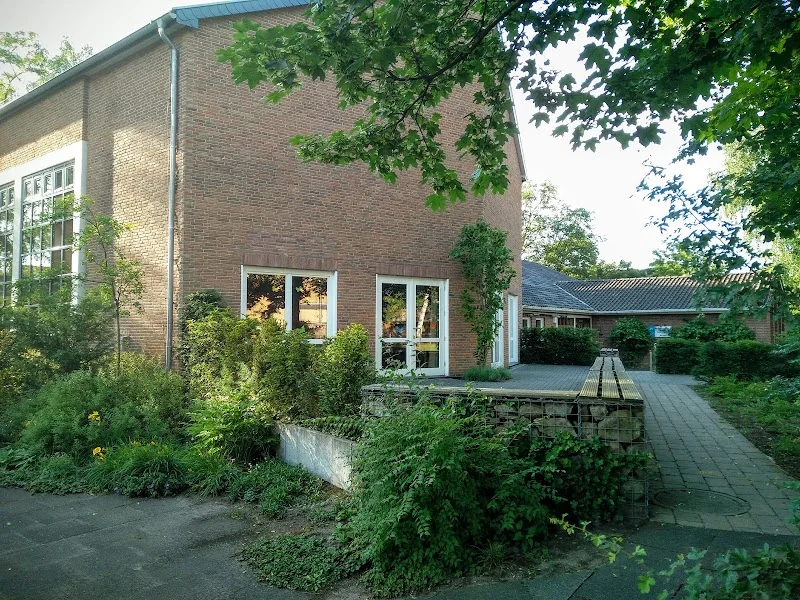
Bielefeld
Tulpenweg 9, 33659 Bielefeld-Senne, Deutschland
Diakonie Association Brackwede | Windflöte & Luther Church
Those looking for the Diakonie Association Brackwede Neighborhood Meeting Luther Church will find in Bielefeld-Senne a place that consciously does not feel like a classic single building, but like an open neighborhood house for the entire district. At Tulpenweg 9, in the middle of Windflöte, a neighborhood center has emerged from the former Luther Church and the adjacent community center, which has been officially in operation since January 2024. The city of Bielefeld describes the location as an inclusive meeting point for all people in the neighborhood, while the Diakonie additionally emphasizes the diversity of offerings, from encounters to counseling to leisure, family work, and senior services. This is precisely the unique strength of this place: it connects church history, social work, and everyday support at an address that can quickly become a familiar point of contact for people from Senne, Windflöte, and the surrounding areas. ([bielefeld.de](https://www.bielefeld.de/stadtteilzentren))
What makes the Windflöte neighborhood center in the Luther Church special?
The Windflöte neighborhood center is much more than a converted church space. According to the spatial concept of the city of Bielefeld, it is intended as an inclusive place of encounter and as the first point of contact for the residents of Senne, regardless of religious affiliation, origin, gender, or life situation. This openness also shapes the house in everyday life: the rooms are designed to be open, multifunctional, and barrier-free, making them suitable for counseling, group offerings, exchanges, lectures, projects, and smaller events, as well as for quiet conversations in a confidential setting. Additionally, the concept includes a dedicated area for open children and youth work, so that young people have a clearly recognizable space where they can move freely. The Diakonie describes the location as 550 barrier-free square meters, where an open place for encounters, counseling, and leisure has been created. This is particularly important for the search intent behind terms like neighborhood center, community meeting, or Luther Church: those who seek information are usually not just looking for an address, but a lively house with function. Windflöte offers exactly that. There is an open neighborhood café, a bistro, counseling rooms, a youth area, family work spaces, and areas that can be combined as needed. The city also states that the neighborhood center is intended as a meeting point for everyone and that café, language meetings, various counseling services, workshops, and projects are to take place there. For visitors, this creates a house that consciously does not appear exclusive, but rather inviting, practical, and accessible. The location in the former Luther Church creates a special contrast: where a primarily church space once stood at the center, today there is a multifunctional hub of the neighborhood. This combination of history and modernity makes Windflöte unique. ([bielefeld.de](https://www.bielefeld.de/stadtteilzentren))
What offerings are there for children, youth, and families?
For families, children, and youth, the Windflöte location is particularly interesting because several offerings are bundled here that truly help in everyday life while also enabling encounters. The Diakonie explicitly mentions open children and youth work, family education, playgroups, counseling on family and school issues, language meetings, and creative afternoon offerings for the neighborhood center. The city of Bielefeld adds in the spatial concept that the open children and youth work will have two clearly separated areas, namely a children's room and a youth room, each accommodating about 20 to 30 visitors. This makes it clear that this is not just any improvised space, but a place with educational aspirations and space for age-appropriate work. Especially parents looking for a community meeting or offerings around the Luther Church will find an environment that is not only friendly but also professionally thought out. According to the city, mornings are reserved for counseling, language courses, and senior services, while afternoons are for family and children’s offerings, mother-child groups, and creative activities in the bistro. Fridays are youth days. This structure is particularly valuable for families because it adapts to the daily rhythm and not only provides individual appointments but creates a reliable weekly framework. Additionally, the open children and youth work has moved from Hot Zefi to Windflöte, thus becoming even more firmly anchored in the neighborhood. The Diakonie also describes its open-door houses as places with a protected environment, free offerings, and without membership or access requirements. For children and youth, this means: just come by, participate, and make connections. For parents, it means: a place where their children can move safely and where support, education, and leisure activities come together. Therefore, anyone looking for family offerings, youth work, or playgroups in Bielefeld-Senne will find one of the most diverse neighborhood offerings in the district at Windflöte. ([bielefeld.de](https://www.bielefeld.de/stadtteilzentren))
Counseling, language courses, and senior work in the everyday life of Windflöte
A central feature of the Windflöte neighborhood center is the mix of social support, everyday relevance, and open neighborhood work. The spatial concept of the city of Bielefeld not only envisions encounters here but also explicitly includes counseling, homework help, educational offerings, mobile senior work, citizen café, and external event groups from culture, religion, movement, and other areas. In practice, this means: those who come with questions about family, school, educational support, social issues, or general concerns should meet people on-site who can provide orientation. The Diakonie also describes the facility as a participatory house, where visitors are encouraged to actively shape the program. This is SEO-relevant because search terms like counseling, language courses, café, or senior work reflect this everyday function. For older people, the location is particularly important because the city of Bielefeld explicitly mentions a cooperation between the Diakonie Association Brackwede and the AWO District Association for mobile senior work in Senne. Counseling takes place there on Mondays and Thursdays in the mornings by prior telephone appointment; additionally, people can get in touch who want to actively shape life in Windflöte. This shows that senior work here is not only understood as a supply service but as part of community and participation. The Diakonie also refers to offerings such as Open Neighborhood Café, language courses and language meetings, counseling on family and school issues, and project work on participation, democracy promotion, culture, and sports. The language area is particularly important for the neighborhood because a neighborhood center in a diverse district must not only be a meeting point but also a door opener. People with limited German skills find here a learning and conversation environment that is not schoolishly strict but rather focused on everyday life. Thus, Windflöte connects social counseling, education, and neighborhood in a way that is rare in the district and therefore all the more valuable. Therefore, anyone looking for mobile senior offerings, language courses, counseling, or an open café will find a well-visible and thematically broad center here. ([deine-diakonie.de](https://www.deine-diakonie.de/mein-stadtteil/stadtteilarbeit-2))
The history of the Luther Church: From church space to neighborhood center
The current use of the location becomes truly understandable only when considering the history of the Luther Church. The Protestant Church Community Bielefeld-South informs that the Luther Church was consecrated on May 29, 1966, and originally formed the center of the former Luther Church Community. The community itself originated from the Friedrichsdorf community district Windflöte, was independent from 1963 to 2005, and later became part of the Emmaus Church Community. In early 2008, the adjacent community center was relinquished, and community rooms were built into the church. This development already shows early on that the location flexibly responded to new needs in the neighborhood. The next major step followed in 2023, when a large part of the Luther Church was transformed into the Windflöte neighborhood center. A small part continues to be used as a place of worship and community events. This mixture of repurposing and continuity makes the house so exciting: it remains rooted in the church but simultaneously opens up significantly to social work in the neighborhood. For those searching for events, community offerings, or the neighborhood meeting at the Luther Church, this is a crucial point because the place today is not only a religious space but a multifunctional neighborhood center. The city of Bielefeld also integrates the project into its strategy for neighborhood centers and emphasizes that the offerings in Windflöte are barrier-free accessible under one roof. Thus, the location also exemplifies a development that affects several neighborhoods in Bielefeld: buildings with history are being remodeled to create modern, open, and usable places for many target groups. For visitors, this primarily means one thing: the Luther Church has not disappeared but is still present in the neighborhood in a new form. Those who know the address Tulpenweg 9 will find there a house that makes the past visible while actively shaping the future. ([evangelisch-bielefeld-sued.de](https://www.evangelisch-bielefeld-sued.de/standorte/senne))
Directions, address, and parking information
The official address of the neighborhood center is Tulpenweg 9, 33659 Bielefeld. The location is in the district of Senne, in the district of Windflöte, and thus in a residential and neighborhood environment that is more geared towards short distances and community than large event infrastructure. The city of Bielefeld describes Senne as an area south of the Teutoburg Forest between Brackwede and Sennestadt; exactly there lies Windflöte. For directions, it is therefore particularly important to have a clear orientation at the address, as the official pages primarily mention the location itself, the provider, and the contact options. A separate parking garage or a designated visitor parking space is not mentioned on the official pages. Therefore, those arriving by car should plan their journey via Tulpenweg 9 and check the current parking situation in the immediate vicinity on-site. At the same time, the location suggests that the site is intentionally designed as a neighborhood-friendly house: the center is not an isolated event complex but part of the neighborhood. The official Bielefeld offerings page also refers to contacts, phone, and email, which makes orientation easier if one has questions about appointments, rooms, or events in advance. The Protestant Church Community Bielefeld-South also explicitly names the Luther Church as a visitor address at Tulpenweg 9. Therefore, those looking for the place should ask for the Windflöte neighborhood center or the Luther Church in the Windflöte district, not just by the street name. This is particularly helpful for search inquiries regarding directions, parking, or address because users typically need a clear assignment quickly. The most important orientation remains: Tulpenweg 9, 33659 Bielefeld, Windflöte district, Senne district. ([bielefeld.de](https://www.bielefeld.de/node/34739))
Sources:
- City of Bielefeld - Neighborhood Centers for All
- City of Bielefeld - Neighborhood Center Senne-Windflöte
- Your Diakonie - Places of Encounter
- Protestant Church Community Bielefeld-South - Senne
- City of Bielefeld - Space Utilization Concept Neighborhood Center Windflöte
- City of Bielefeld - Mobile Senior Work Senne
Mehr anzeigenWeniger anzeigen
Diakonie Association Brackwede | Windflöte & Luther Church
Those looking for the Diakonie Association Brackwede Neighborhood Meeting Luther Church will find in Bielefeld-Senne a place that consciously does not feel like a classic single building, but like an open neighborhood house for the entire district. At Tulpenweg 9, in the middle of Windflöte, a neighborhood center has emerged from the former Luther Church and the adjacent community center, which has been officially in operation since January 2024. The city of Bielefeld describes the location as an inclusive meeting point for all people in the neighborhood, while the Diakonie additionally emphasizes the diversity of offerings, from encounters to counseling to leisure, family work, and senior services. This is precisely the unique strength of this place: it connects church history, social work, and everyday support at an address that can quickly become a familiar point of contact for people from Senne, Windflöte, and the surrounding areas. ([bielefeld.de](https://www.bielefeld.de/stadtteilzentren))
What makes the Windflöte neighborhood center in the Luther Church special?
The Windflöte neighborhood center is much more than a converted church space. According to the spatial concept of the city of Bielefeld, it is intended as an inclusive place of encounter and as the first point of contact for the residents of Senne, regardless of religious affiliation, origin, gender, or life situation. This openness also shapes the house in everyday life: the rooms are designed to be open, multifunctional, and barrier-free, making them suitable for counseling, group offerings, exchanges, lectures, projects, and smaller events, as well as for quiet conversations in a confidential setting. Additionally, the concept includes a dedicated area for open children and youth work, so that young people have a clearly recognizable space where they can move freely. The Diakonie describes the location as 550 barrier-free square meters, where an open place for encounters, counseling, and leisure has been created. This is particularly important for the search intent behind terms like neighborhood center, community meeting, or Luther Church: those who seek information are usually not just looking for an address, but a lively house with function. Windflöte offers exactly that. There is an open neighborhood café, a bistro, counseling rooms, a youth area, family work spaces, and areas that can be combined as needed. The city also states that the neighborhood center is intended as a meeting point for everyone and that café, language meetings, various counseling services, workshops, and projects are to take place there. For visitors, this creates a house that consciously does not appear exclusive, but rather inviting, practical, and accessible. The location in the former Luther Church creates a special contrast: where a primarily church space once stood at the center, today there is a multifunctional hub of the neighborhood. This combination of history and modernity makes Windflöte unique. ([bielefeld.de](https://www.bielefeld.de/stadtteilzentren))
What offerings are there for children, youth, and families?
For families, children, and youth, the Windflöte location is particularly interesting because several offerings are bundled here that truly help in everyday life while also enabling encounters. The Diakonie explicitly mentions open children and youth work, family education, playgroups, counseling on family and school issues, language meetings, and creative afternoon offerings for the neighborhood center. The city of Bielefeld adds in the spatial concept that the open children and youth work will have two clearly separated areas, namely a children's room and a youth room, each accommodating about 20 to 30 visitors. This makes it clear that this is not just any improvised space, but a place with educational aspirations and space for age-appropriate work. Especially parents looking for a community meeting or offerings around the Luther Church will find an environment that is not only friendly but also professionally thought out. According to the city, mornings are reserved for counseling, language courses, and senior services, while afternoons are for family and children’s offerings, mother-child groups, and creative activities in the bistro. Fridays are youth days. This structure is particularly valuable for families because it adapts to the daily rhythm and not only provides individual appointments but creates a reliable weekly framework. Additionally, the open children and youth work has moved from Hot Zefi to Windflöte, thus becoming even more firmly anchored in the neighborhood. The Diakonie also describes its open-door houses as places with a protected environment, free offerings, and without membership or access requirements. For children and youth, this means: just come by, participate, and make connections. For parents, it means: a place where their children can move safely and where support, education, and leisure activities come together. Therefore, anyone looking for family offerings, youth work, or playgroups in Bielefeld-Senne will find one of the most diverse neighborhood offerings in the district at Windflöte. ([bielefeld.de](https://www.bielefeld.de/stadtteilzentren))
Counseling, language courses, and senior work in the everyday life of Windflöte
A central feature of the Windflöte neighborhood center is the mix of social support, everyday relevance, and open neighborhood work. The spatial concept of the city of Bielefeld not only envisions encounters here but also explicitly includes counseling, homework help, educational offerings, mobile senior work, citizen café, and external event groups from culture, religion, movement, and other areas. In practice, this means: those who come with questions about family, school, educational support, social issues, or general concerns should meet people on-site who can provide orientation. The Diakonie also describes the facility as a participatory house, where visitors are encouraged to actively shape the program. This is SEO-relevant because search terms like counseling, language courses, café, or senior work reflect this everyday function. For older people, the location is particularly important because the city of Bielefeld explicitly mentions a cooperation between the Diakonie Association Brackwede and the AWO District Association for mobile senior work in Senne. Counseling takes place there on Mondays and Thursdays in the mornings by prior telephone appointment; additionally, people can get in touch who want to actively shape life in Windflöte. This shows that senior work here is not only understood as a supply service but as part of community and participation. The Diakonie also refers to offerings such as Open Neighborhood Café, language courses and language meetings, counseling on family and school issues, and project work on participation, democracy promotion, culture, and sports. The language area is particularly important for the neighborhood because a neighborhood center in a diverse district must not only be a meeting point but also a door opener. People with limited German skills find here a learning and conversation environment that is not schoolishly strict but rather focused on everyday life. Thus, Windflöte connects social counseling, education, and neighborhood in a way that is rare in the district and therefore all the more valuable. Therefore, anyone looking for mobile senior offerings, language courses, counseling, or an open café will find a well-visible and thematically broad center here. ([deine-diakonie.de](https://www.deine-diakonie.de/mein-stadtteil/stadtteilarbeit-2))
The history of the Luther Church: From church space to neighborhood center
The current use of the location becomes truly understandable only when considering the history of the Luther Church. The Protestant Church Community Bielefeld-South informs that the Luther Church was consecrated on May 29, 1966, and originally formed the center of the former Luther Church Community. The community itself originated from the Friedrichsdorf community district Windflöte, was independent from 1963 to 2005, and later became part of the Emmaus Church Community. In early 2008, the adjacent community center was relinquished, and community rooms were built into the church. This development already shows early on that the location flexibly responded to new needs in the neighborhood. The next major step followed in 2023, when a large part of the Luther Church was transformed into the Windflöte neighborhood center. A small part continues to be used as a place of worship and community events. This mixture of repurposing and continuity makes the house so exciting: it remains rooted in the church but simultaneously opens up significantly to social work in the neighborhood. For those searching for events, community offerings, or the neighborhood meeting at the Luther Church, this is a crucial point because the place today is not only a religious space but a multifunctional neighborhood center. The city of Bielefeld also integrates the project into its strategy for neighborhood centers and emphasizes that the offerings in Windflöte are barrier-free accessible under one roof. Thus, the location also exemplifies a development that affects several neighborhoods in Bielefeld: buildings with history are being remodeled to create modern, open, and usable places for many target groups. For visitors, this primarily means one thing: the Luther Church has not disappeared but is still present in the neighborhood in a new form. Those who know the address Tulpenweg 9 will find there a house that makes the past visible while actively shaping the future. ([evangelisch-bielefeld-sued.de](https://www.evangelisch-bielefeld-sued.de/standorte/senne))
Directions, address, and parking information
The official address of the neighborhood center is Tulpenweg 9, 33659 Bielefeld. The location is in the district of Senne, in the district of Windflöte, and thus in a residential and neighborhood environment that is more geared towards short distances and community than large event infrastructure. The city of Bielefeld describes Senne as an area south of the Teutoburg Forest between Brackwede and Sennestadt; exactly there lies Windflöte. For directions, it is therefore particularly important to have a clear orientation at the address, as the official pages primarily mention the location itself, the provider, and the contact options. A separate parking garage or a designated visitor parking space is not mentioned on the official pages. Therefore, those arriving by car should plan their journey via Tulpenweg 9 and check the current parking situation in the immediate vicinity on-site. At the same time, the location suggests that the site is intentionally designed as a neighborhood-friendly house: the center is not an isolated event complex but part of the neighborhood. The official Bielefeld offerings page also refers to contacts, phone, and email, which makes orientation easier if one has questions about appointments, rooms, or events in advance. The Protestant Church Community Bielefeld-South also explicitly names the Luther Church as a visitor address at Tulpenweg 9. Therefore, those looking for the place should ask for the Windflöte neighborhood center or the Luther Church in the Windflöte district, not just by the street name. This is particularly helpful for search inquiries regarding directions, parking, or address because users typically need a clear assignment quickly. The most important orientation remains: Tulpenweg 9, 33659 Bielefeld, Windflöte district, Senne district. ([bielefeld.de](https://www.bielefeld.de/node/34739))
Sources:
- City of Bielefeld - Neighborhood Centers for All
- City of Bielefeld - Neighborhood Center Senne-Windflöte
- Your Diakonie - Places of Encounter
- Protestant Church Community Bielefeld-South - Senne
- City of Bielefeld - Space Utilization Concept Neighborhood Center Windflöte
- City of Bielefeld - Mobile Senior Work Senne
Upcoming Events
No events found
Frequently Asked Questions
Reviews
No reviews found