
Bielefeld
Paracelsusweg 6, 33689 Bielefeld-Eckardtsheim, Deutschland
Eckardtskirche | History & Worship
The Eckardtskirche in Bielefeld-Eckardtsheim is much more than a church building: it is a visible piece of local history, a place for quiet contemplation, a community of worship, and a landmark in the southern area of Bielefeld. The church belongs to the Evangelical Institutional Church Community Bethel (Zionsgemeinde) and is accessible as an Open Church on weekdays, allowing visitors not only to attend services but also to come for a quiet moment, to light a candle, or to pause intentionally. Those looking for the Eckardtskirche will find it in the developed district of Eckardtsheim at an address that has been closely linked to the development of Bethel for many years. The unique blend of diaconal tradition, historical depth, and vibrant community work adds to the charm of this place and explains why so many inquiries range from history to photos to worship services and directions. ([kirche-bielefeld.de](https://www.kirche-bielefeld.de/auf-einen-blick/kirchen-in-bielefeld/evangelische-eckardtskirche-eckardtsheim))
Worship Services and Open Church at Eckardtskirche
The current community page lists the Eckardtskirche as a place for worship services starting, unless otherwise specified, at 11:00 AM. Additionally, it is accessible as an Open Church from Monday to Friday from 8:00 AM to 4:00 PM. This means: The door is open not only for liturgical occasions but also for visits, prayer, reflection, and lighting a candle. For many people, this combination is precisely why the Eckardtskirche frequently appears in inquiries with terms like worship service, opening hours, and photos. The place is thus as important for the daily life of the community as it is for guests who enter the church for the first time and simply want to perceive how calm and clear this space feels. ([kirche-bielefeld.de](https://www.kirche-bielefeld.de/auf-einen-blick/kirchen-in-bielefeld/evangelische-eckardtskirche-eckardtsheim))
The community relies on a lively but not loud presence. The worship schedule shows not only sermon services but also communion services and communal formats that explicitly focus on shared celebration. This creates a profile that ranges from classical devotion to low-threshold forms of encounter. Visitors thus experience the church not as a museum-like space but as an active part of community life. This is exactly what makes the Eckardtskirche interesting for people looking for a place in Bielefeld with a clear religious function, genuine use, and an open atmosphere. The Open Church also creates a framework in which visitation and spirituality intertwine without the need to wait for a fixed event format. ([zionsgemeinde-bethel.de](https://www.zionsgemeinde-bethel.de/.cms/150))
Moreover, the Eckardtskirche is situated in an environment where community life is consciously thought of as inclusive. The Zionsgemeinde describes the parish district Eckardtsheim/Schillingshofsiedlung as a place where people with and without disabilities actively participate in community life. Inclusive community building is a focus there, and musical work also plays an important role. This attitude noticeably shapes the atmosphere on site: The Eckardtskirche is not an aloof special object but an accessible, open space with lived community. So, for those looking for a church where one does not just watch but can truly feel the encounter, this is a very credible example. ([zionsgemeinde-bethel.de](https://www.zionsgemeinde-bethel.de/.cms/58?utm_source=openai))
History, Name, and Architectural Development Since 1889
The history of the Eckardtskirche begins with the laying of the foundation stone in 1889. At that time, the young Bethel branch in the Senne was already part of a growing diaconal environment, where scattered farms, houses, care facilities, and economic structures gradually connected to form a settlement. The cemetery existed since 1888, and in 1897 the rectory was built next to the church, with the location almost at the center of the first farms, where later worker colonies and healing and care houses emerged. The place of worship was initially called Eckardtskapelle; hardly anything remains of the original structure today. This early development makes it clear why the Eckardtskirche is not only a religious but also a social and local historical monument. It represents a phase in which many individual building blocks slowly became a vibrant district. ([hauptarchiv-bethel.de](https://www.hauptarchiv-bethel.de/unsere-themen/digitale-ausstellungen/eckardtsheim-historisch/eckardtskirche))
The church was named after the deceased husband of the widow Rosine Eckardt from Naumburg a. d. Saale, who donated 6,000 marks for the construction of a chapel. In February 1899, the name Eckardtsheim was transferred to the entire institution. The fact that the current external appearance of the church primarily dates back to 1961 shows how strongly the building was adapted to the needs of the growing institution. From originally around 250 seats, the church grew to about 1,500 seats by 1961. Thus, the Eckardtskirche is not only a religious but also an architectural testament to growth, remodeling, and lived history. The church tells of continuity and change at the same time: There is a solid historical core, but also numerous interventions, expansions, and adaptations that have continually re-adjusted the space to its use. ([hauptarchiv-bethel.de](https://www.hauptarchiv-bethel.de/unsere-themen/digitale-ausstellungen/eckardtsheim-historisch/eckardtskirche))
Historically interesting is also the connection between church, cemetery, and later community life. For many years, annual festivals took place in front of and next to the church, which have not been celebrated together in Bethel since 1956. Later, the Jekamifest and the regionally known Christmas market were added. The Christmas market attracted up to 60,000 visitors in some years before it was replaced by the smaller Advent magic. This development vividly shows that the Eckardtskirche has never been just a quiet building but has always been a center for public, communal, and festive forms of gathering. Thus, those searching for history today encounter a very vibrant heritage here. ([hauptarchiv-bethel.de](https://www.hauptarchiv-bethel.de/unsere-themen/digitale-ausstellungen/eckardtsheim-historisch/eckardtskirche))
Directions by Bus, Address, and Orientation in Eckardtsheim
The official address of the Eckardtskirche is Paracelsusweg 6, 33689 Bielefeld. On the location page of the church district, the church is explicitly described as accessible by bus. The nearest stop is called Pontus; it is about 170 meters away. The bus lines 37 and 237 are mentioned. For visitors, this is practical information, as the church fits well into the public transport system of the district and can be found quickly without complicated orientation. Especially for people visiting Eckardtsheim for the first time, this clear, short accessibility is a plus. The church is therefore well-suited for both everyday visits and targeted tours. ([kirche-bielefeld.de](https://www.kirche-bielefeld.de/auf-einen-blick/kirchen-in-bielefeld/evangelische-eckardtskirche-eckardtsheim))
Those visiting Eckardtsheim for the first time quickly notice that the district is closely linked to the history of Bethel. The parish district Eckardtsheim/Schillingshofsiedlung forms the southernmost point of the Bielefeld church district, and the community describes the place as a developed environment with people with and without disabilities, with inclusive community building and strong volunteer engagement. According to the community, around 2,000 people currently live in Eckardtsheim in private houses and facilities of the v. Bodelschwinghschen Stiftungen Bethel; the neighboring Schillingshofsiedlung also brings its own neighborhood structures. The church is therefore not just a point on the map but part of a vibrant social space. This makes the journey to the Eckardtskirche a small discovery tour in a historically shaped quarter for many guests. ([zionsgemeinde-bethel.de](https://www.zionsgemeinde-bethel.de/.cms/58?utm_source=openai))
Also noteworthy is the integration into the public space: The Eckardtskirche is not isolated but located in a district shaped by diaconal, social, and church structures. Those getting off at the Pontus stop can reach the church on foot in a short time, thus having immediate access to a place that is both functionally and symbolically important. This is helpful for travel planning, as the journey is not complicated, and the visit can easily be combined with other routes in the district. The briefly described but precise public transport connection fits well with a building that wants to be open and consciously integrates into the daily life of the surroundings. ([kirche-bielefeld.de](https://www.kirche-bielefeld.de/auf-einen-blick/kirchen-in-bielefeld/evangelische-eckardtskirche-eckardtsheim))
Events, Concerts, and Community Life on Site
Much more happens around the Eckardtskirche than just the Sunday worship service. The historical representation of the main archive Bethel mentions earlier annual festivals, the Jekamifest, the long-known Christmas market, and its successor, the smaller Advent magic. Additionally, the summer festival Eckardtsheim mittendrin! is highlighted as a much-anticipated event, complemented by smaller formats such as art exhibitions in the fall and spring and fall cleaning. This creates an event profile that connects church tradition with neighborhood, culture, and voluntary engagement. The church is thus not only a liturgical space but also a place where one can very concretely experience the social and cultural interaction of the district. ([hauptarchiv-bethel.de](https://www.hauptarchiv-bethel.de/unsere-themen/digitale-ausstellungen/eckardtsheim-historisch/eckardtskirche))
Musically, the church is also part of an active community life. The Zionsgemeinde refers to worship services with various musical and liturgical forms, and the community pages regularly showcase choirs, brass work, and concerts. For seekers, this is important because the Eckardtskirche is perceived not only as an architectural monument but also as a functioning event venue. Thus, those looking for programs, concerts, or a special occasion will find a place where community culture, music, and social closeness come together. It also fits that the community in Eckardtsheim works inclusively and explicitly highlights volunteer engagement. The event character is therefore not merely organizational but is content-driven by a clear understanding of community. ([zionsgemeinde-bethel.de](https://www.zionsgemeinde-bethel.de/.cms/150))
Also interesting is the shift from earlier large formats to today's more focused offerings. The formerly regionally known Christmas market was replaced by the Advent magic, and alongside the larger summer festival, smaller, often very local formats also take place. This development shows a church that has grown with its surroundings and simultaneously responds to new forms of gathering. For visitors, this means: The Eckardtskirche is a place with recurring occasions but without rigid templates. Depending on the season, it can be a festival site, exhibition space, concert venue, or quiet place for prayer. This versatility makes it particularly interesting for research on events. ([hauptarchiv-bethel.de](https://www.hauptarchiv-bethel.de/unsere-themen/digitale-ausstellungen/eckardtsheim-historisch/eckardtskirche))
Photos, Interior Views, and the Unique Appearance
Those looking for photos of the Eckardtskirche will find not only a view of the building but also its development in the historical collections of the main archive Bethel. Among other things, a photo of the Eckardtskirche from 1903 is mentioned, as well as an interior shot from the early 1930s. These images are particularly valuable because they show how much a place can change over the course of more than a century and how much history remains visible in a single church space. For those interested in searching for images, this is a real added value: Photography makes the architectural development tangible and connects it with the memory of earlier community situations. ([hauptarchiv-bethel.de](https://www.hauptarchiv-bethel.de/unsere-themen/digitale-ausstellungen/eckardtsheim-historisch/eckardtskirche?utm_source=openai))
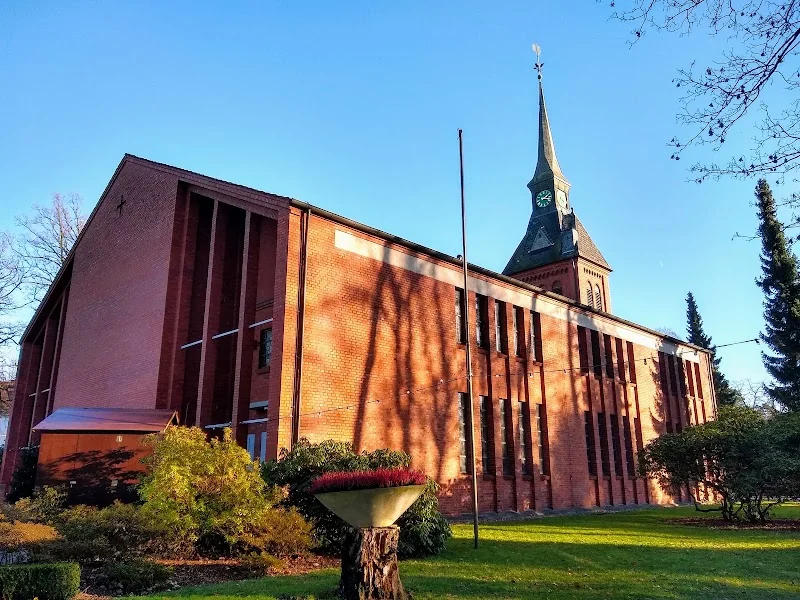
The current external appearance dates back to 1961 and is thus the result of several renovations, additions, and expansions. This is precisely what makes the Eckardtskirche appealing: It does not appear as a static building but as a grown house that has responded to new needs. Historical photos help to contextualize this development. They make visible why the church is a significant landmark in Eckardtsheim for many people and why it leaves a lasting impression on visitors. Architecture and use closely intertwine here. Therefore, when photographing or viewing the Eckardtskirche from a distance, one sees not just a church but a chronicle of stone, light, and renovation history. ([hauptarchiv-bethel.de](https://www.hauptarchiv-bethel.de/unsere-themen/digitale-ausstellungen/eckardtsheim-historisch/eckardtskirche))
Especially the interplay of historical and current images is important for the church's external presentation. The archives document the past, the community lives the present, and visitors thus receive an image that goes far beyond a single motif. The Eckardtskirche is therefore a worthwhile search topic for all those who understand photos not just as visual impressions but as access to history. On the internet, corresponding search inquiries often appear together with terms like Bielefeld, Eckardtsheim, and history, and that makes sense: The building is visually striking, historically deeply rooted, and still a place that is actively used. ([hauptarchiv-bethel.de](https://www.hauptarchiv-bethel.de/unsere-themen/digitale-ausstellungen/eckardtsheim-historisch/eckardtskirche?utm_source=openai))
Silence, Memory, and Neighborhood around Eckardtskirche
The Eckardtskirche is also a place of memory. Behind the church lies a spacious cemetery, which is described in the historical representation as a dignified resting place. Some graves invite one to become familiar with the history of Eckardtsheim. This connection between church, cemetery, and settlement gives the place a special depth: Those who linger here encounter not only a building but a developed life story of the district and its people. In many churches, the cemetery is only a marginal aspect; here it explicitly belongs to the narrative space of the place. ([hauptarchiv-bethel.de](https://www.hauptarchiv-bethel.de/unsere-themen/digitale-ausstellungen/eckardtsheim-historisch/eckardtskirche))
At the same time, the church stands for openness. The combination of visitable Open Church, regular worship services, musical offerings, and recurring festivals makes it a place where neighborhood becomes visible. This is important for the community because the church does not exist detached from its surroundings but is present in the everyday life of the district. In Eckardtsheim, people with different life stories and needs live, and the Zionsgemeinde explicitly emphasizes inclusive community building and volunteer engagement. This creates a very credible image of the church as a social space where tradition, help, music, and communal celebration come together. ([zionsgemeinde-bethel.de](https://www.zionsgemeinde-bethel.de/.cms/58?utm_source=openai))
Even for visitors without a religious occasion, this is relevant. Those visiting the Eckardtskirche often first seek peace, history, or a beautiful motif. On site, one then realizes that these expectations are indeed fulfilled without the place losing its vibrant function. The space is open, the history tangible, and the community present. Thus, the church becomes a destination that is interesting not only for the search for photos or data but also for a genuine visit. It is precisely in the interplay of silence and community that the special strength of the Eckardtskirche lies. It is a house that remembers and invites, and this dual quality makes it so distinctive for Bielefeld and Eckardtsheim. ([kirche-bielefeld.de](https://www.kirche-bielefeld.de/auf-einen-blick/kirchen-in-bielefeld/evangelische-eckardtskirche-eckardtsheim))
Sources:
Mehr anzeigenWeniger anzeigen
Eckardtskirche | History & Worship
The Eckardtskirche in Bielefeld-Eckardtsheim is much more than a church building: it is a visible piece of local history, a place for quiet contemplation, a community of worship, and a landmark in the southern area of Bielefeld. The church belongs to the Evangelical Institutional Church Community Bethel (Zionsgemeinde) and is accessible as an Open Church on weekdays, allowing visitors not only to attend services but also to come for a quiet moment, to light a candle, or to pause intentionally. Those looking for the Eckardtskirche will find it in the developed district of Eckardtsheim at an address that has been closely linked to the development of Bethel for many years. The unique blend of diaconal tradition, historical depth, and vibrant community work adds to the charm of this place and explains why so many inquiries range from history to photos to worship services and directions. ([kirche-bielefeld.de](https://www.kirche-bielefeld.de/auf-einen-blick/kirchen-in-bielefeld/evangelische-eckardtskirche-eckardtsheim))
Worship Services and Open Church at Eckardtskirche
The current community page lists the Eckardtskirche as a place for worship services starting, unless otherwise specified, at 11:00 AM. Additionally, it is accessible as an Open Church from Monday to Friday from 8:00 AM to 4:00 PM. This means: The door is open not only for liturgical occasions but also for visits, prayer, reflection, and lighting a candle. For many people, this combination is precisely why the Eckardtskirche frequently appears in inquiries with terms like worship service, opening hours, and photos. The place is thus as important for the daily life of the community as it is for guests who enter the church for the first time and simply want to perceive how calm and clear this space feels. ([kirche-bielefeld.de](https://www.kirche-bielefeld.de/auf-einen-blick/kirchen-in-bielefeld/evangelische-eckardtskirche-eckardtsheim))
The community relies on a lively but not loud presence. The worship schedule shows not only sermon services but also communion services and communal formats that explicitly focus on shared celebration. This creates a profile that ranges from classical devotion to low-threshold forms of encounter. Visitors thus experience the church not as a museum-like space but as an active part of community life. This is exactly what makes the Eckardtskirche interesting for people looking for a place in Bielefeld with a clear religious function, genuine use, and an open atmosphere. The Open Church also creates a framework in which visitation and spirituality intertwine without the need to wait for a fixed event format. ([zionsgemeinde-bethel.de](https://www.zionsgemeinde-bethel.de/.cms/150))
Moreover, the Eckardtskirche is situated in an environment where community life is consciously thought of as inclusive. The Zionsgemeinde describes the parish district Eckardtsheim/Schillingshofsiedlung as a place where people with and without disabilities actively participate in community life. Inclusive community building is a focus there, and musical work also plays an important role. This attitude noticeably shapes the atmosphere on site: The Eckardtskirche is not an aloof special object but an accessible, open space with lived community. So, for those looking for a church where one does not just watch but can truly feel the encounter, this is a very credible example. ([zionsgemeinde-bethel.de](https://www.zionsgemeinde-bethel.de/.cms/58?utm_source=openai))
History, Name, and Architectural Development Since 1889
The history of the Eckardtskirche begins with the laying of the foundation stone in 1889. At that time, the young Bethel branch in the Senne was already part of a growing diaconal environment, where scattered farms, houses, care facilities, and economic structures gradually connected to form a settlement. The cemetery existed since 1888, and in 1897 the rectory was built next to the church, with the location almost at the center of the first farms, where later worker colonies and healing and care houses emerged. The place of worship was initially called Eckardtskapelle; hardly anything remains of the original structure today. This early development makes it clear why the Eckardtskirche is not only a religious but also a social and local historical monument. It represents a phase in which many individual building blocks slowly became a vibrant district. ([hauptarchiv-bethel.de](https://www.hauptarchiv-bethel.de/unsere-themen/digitale-ausstellungen/eckardtsheim-historisch/eckardtskirche))
The church was named after the deceased husband of the widow Rosine Eckardt from Naumburg a. d. Saale, who donated 6,000 marks for the construction of a chapel. In February 1899, the name Eckardtsheim was transferred to the entire institution. The fact that the current external appearance of the church primarily dates back to 1961 shows how strongly the building was adapted to the needs of the growing institution. From originally around 250 seats, the church grew to about 1,500 seats by 1961. Thus, the Eckardtskirche is not only a religious but also an architectural testament to growth, remodeling, and lived history. The church tells of continuity and change at the same time: There is a solid historical core, but also numerous interventions, expansions, and adaptations that have continually re-adjusted the space to its use. ([hauptarchiv-bethel.de](https://www.hauptarchiv-bethel.de/unsere-themen/digitale-ausstellungen/eckardtsheim-historisch/eckardtskirche))
Historically interesting is also the connection between church, cemetery, and later community life. For many years, annual festivals took place in front of and next to the church, which have not been celebrated together in Bethel since 1956. Later, the Jekamifest and the regionally known Christmas market were added. The Christmas market attracted up to 60,000 visitors in some years before it was replaced by the smaller Advent magic. This development vividly shows that the Eckardtskirche has never been just a quiet building but has always been a center for public, communal, and festive forms of gathering. Thus, those searching for history today encounter a very vibrant heritage here. ([hauptarchiv-bethel.de](https://www.hauptarchiv-bethel.de/unsere-themen/digitale-ausstellungen/eckardtsheim-historisch/eckardtskirche))
Directions by Bus, Address, and Orientation in Eckardtsheim
The official address of the Eckardtskirche is Paracelsusweg 6, 33689 Bielefeld. On the location page of the church district, the church is explicitly described as accessible by bus. The nearest stop is called Pontus; it is about 170 meters away. The bus lines 37 and 237 are mentioned. For visitors, this is practical information, as the church fits well into the public transport system of the district and can be found quickly without complicated orientation. Especially for people visiting Eckardtsheim for the first time, this clear, short accessibility is a plus. The church is therefore well-suited for both everyday visits and targeted tours. ([kirche-bielefeld.de](https://www.kirche-bielefeld.de/auf-einen-blick/kirchen-in-bielefeld/evangelische-eckardtskirche-eckardtsheim))
Those visiting Eckardtsheim for the first time quickly notice that the district is closely linked to the history of Bethel. The parish district Eckardtsheim/Schillingshofsiedlung forms the southernmost point of the Bielefeld church district, and the community describes the place as a developed environment with people with and without disabilities, with inclusive community building and strong volunteer engagement. According to the community, around 2,000 people currently live in Eckardtsheim in private houses and facilities of the v. Bodelschwinghschen Stiftungen Bethel; the neighboring Schillingshofsiedlung also brings its own neighborhood structures. The church is therefore not just a point on the map but part of a vibrant social space. This makes the journey to the Eckardtskirche a small discovery tour in a historically shaped quarter for many guests. ([zionsgemeinde-bethel.de](https://www.zionsgemeinde-bethel.de/.cms/58?utm_source=openai))
Also noteworthy is the integration into the public space: The Eckardtskirche is not isolated but located in a district shaped by diaconal, social, and church structures. Those getting off at the Pontus stop can reach the church on foot in a short time, thus having immediate access to a place that is both functionally and symbolically important. This is helpful for travel planning, as the journey is not complicated, and the visit can easily be combined with other routes in the district. The briefly described but precise public transport connection fits well with a building that wants to be open and consciously integrates into the daily life of the surroundings. ([kirche-bielefeld.de](https://www.kirche-bielefeld.de/auf-einen-blick/kirchen-in-bielefeld/evangelische-eckardtskirche-eckardtsheim))
Events, Concerts, and Community Life on Site
Much more happens around the Eckardtskirche than just the Sunday worship service. The historical representation of the main archive Bethel mentions earlier annual festivals, the Jekamifest, the long-known Christmas market, and its successor, the smaller Advent magic. Additionally, the summer festival Eckardtsheim mittendrin! is highlighted as a much-anticipated event, complemented by smaller formats such as art exhibitions in the fall and spring and fall cleaning. This creates an event profile that connects church tradition with neighborhood, culture, and voluntary engagement. The church is thus not only a liturgical space but also a place where one can very concretely experience the social and cultural interaction of the district. ([hauptarchiv-bethel.de](https://www.hauptarchiv-bethel.de/unsere-themen/digitale-ausstellungen/eckardtsheim-historisch/eckardtskirche))
Musically, the church is also part of an active community life. The Zionsgemeinde refers to worship services with various musical and liturgical forms, and the community pages regularly showcase choirs, brass work, and concerts. For seekers, this is important because the Eckardtskirche is perceived not only as an architectural monument but also as a functioning event venue. Thus, those looking for programs, concerts, or a special occasion will find a place where community culture, music, and social closeness come together. It also fits that the community in Eckardtsheim works inclusively and explicitly highlights volunteer engagement. The event character is therefore not merely organizational but is content-driven by a clear understanding of community. ([zionsgemeinde-bethel.de](https://www.zionsgemeinde-bethel.de/.cms/150))
Also interesting is the shift from earlier large formats to today's more focused offerings. The formerly regionally known Christmas market was replaced by the Advent magic, and alongside the larger summer festival, smaller, often very local formats also take place. This development shows a church that has grown with its surroundings and simultaneously responds to new forms of gathering. For visitors, this means: The Eckardtskirche is a place with recurring occasions but without rigid templates. Depending on the season, it can be a festival site, exhibition space, concert venue, or quiet place for prayer. This versatility makes it particularly interesting for research on events. ([hauptarchiv-bethel.de](https://www.hauptarchiv-bethel.de/unsere-themen/digitale-ausstellungen/eckardtsheim-historisch/eckardtskirche))
Photos, Interior Views, and the Unique Appearance
Those looking for photos of the Eckardtskirche will find not only a view of the building but also its development in the historical collections of the main archive Bethel. Among other things, a photo of the Eckardtskirche from 1903 is mentioned, as well as an interior shot from the early 1930s. These images are particularly valuable because they show how much a place can change over the course of more than a century and how much history remains visible in a single church space. For those interested in searching for images, this is a real added value: Photography makes the architectural development tangible and connects it with the memory of earlier community situations. ([hauptarchiv-bethel.de](https://www.hauptarchiv-bethel.de/unsere-themen/digitale-ausstellungen/eckardtsheim-historisch/eckardtskirche?utm_source=openai))
The current external appearance dates back to 1961 and is thus the result of several renovations, additions, and expansions. This is precisely what makes the Eckardtskirche appealing: It does not appear as a static building but as a grown house that has responded to new needs. Historical photos help to contextualize this development. They make visible why the church is a significant landmark in Eckardtsheim for many people and why it leaves a lasting impression on visitors. Architecture and use closely intertwine here. Therefore, when photographing or viewing the Eckardtskirche from a distance, one sees not just a church but a chronicle of stone, light, and renovation history. ([hauptarchiv-bethel.de](https://www.hauptarchiv-bethel.de/unsere-themen/digitale-ausstellungen/eckardtsheim-historisch/eckardtskirche))
Especially the interplay of historical and current images is important for the church's external presentation. The archives document the past, the community lives the present, and visitors thus receive an image that goes far beyond a single motif. The Eckardtskirche is therefore a worthwhile search topic for all those who understand photos not just as visual impressions but as access to history. On the internet, corresponding search inquiries often appear together with terms like Bielefeld, Eckardtsheim, and history, and that makes sense: The building is visually striking, historically deeply rooted, and still a place that is actively used. ([hauptarchiv-bethel.de](https://www.hauptarchiv-bethel.de/unsere-themen/digitale-ausstellungen/eckardtsheim-historisch/eckardtskirche?utm_source=openai))
Silence, Memory, and Neighborhood around Eckardtskirche
The Eckardtskirche is also a place of memory. Behind the church lies a spacious cemetery, which is described in the historical representation as a dignified resting place. Some graves invite one to become familiar with the history of Eckardtsheim. This connection between church, cemetery, and settlement gives the place a special depth: Those who linger here encounter not only a building but a developed life story of the district and its people. In many churches, the cemetery is only a marginal aspect; here it explicitly belongs to the narrative space of the place. ([hauptarchiv-bethel.de](https://www.hauptarchiv-bethel.de/unsere-themen/digitale-ausstellungen/eckardtsheim-historisch/eckardtskirche))
At the same time, the church stands for openness. The combination of visitable Open Church, regular worship services, musical offerings, and recurring festivals makes it a place where neighborhood becomes visible. This is important for the community because the church does not exist detached from its surroundings but is present in the everyday life of the district. In Eckardtsheim, people with different life stories and needs live, and the Zionsgemeinde explicitly emphasizes inclusive community building and volunteer engagement. This creates a very credible image of the church as a social space where tradition, help, music, and communal celebration come together. ([zionsgemeinde-bethel.de](https://www.zionsgemeinde-bethel.de/.cms/58?utm_source=openai))
Even for visitors without a religious occasion, this is relevant. Those visiting the Eckardtskirche often first seek peace, history, or a beautiful motif. On site, one then realizes that these expectations are indeed fulfilled without the place losing its vibrant function. The space is open, the history tangible, and the community present. Thus, the church becomes a destination that is interesting not only for the search for photos or data but also for a genuine visit. It is precisely in the interplay of silence and community that the special strength of the Eckardtskirche lies. It is a house that remembers and invites, and this dual quality makes it so distinctive for Bielefeld and Eckardtsheim. ([kirche-bielefeld.de](https://www.kirche-bielefeld.de/auf-einen-blick/kirchen-in-bielefeld/evangelische-eckardtskirche-eckardtsheim))
Sources:
Upcoming Events
No events found
Frequently Asked Questions
Reviews
Martina Bendlin-W
6. December 2025
The "Eckardtsheim Christmas Market" in the Kirchpark by the Eckardts Church is a very special, charming market. Festively decorated stalls with handicrafts, treats, punch booths, and concerts in the Eckardts Church. The candles, fairy lights, and campfires create this warm, cozy, Christmas atmosphere. My special highlights: The Royal Rangers tent (yurt) with a campfire, emotional live music, and fruit punch. The delicious cinnamon stars from Café Möller. The Christmas market is open until 07.12.2025 from 14:00 - 19:00.
Frank Holtfreter
20. December 2025
We visited the church at the Christmas market in Eckardtheim for two days. Lovely crafts were offered in a beautiful atmosphere. This is how a Christmas market should be. Peaceful interactions among people, perfect for families with kids.
Lutz Plaß
11. December 2023
Christmas market in Eckardsheim. Many stalls with handicrafts. Nice ambiance.
Claudia
19. December 2018
The Christmas market was beautiful. I'm already looking forward to next year.
Bernd Brinkmann
9. December 2023
Although a bit smaller in 2023, it's still beautiful... you love to stroll around the square, browse the handicrafts, and enjoy the many treats. Concerts are taking place in the church again, and there's plenty to discover and buy there as well. A lot of it is for a good cause... Looking forward to next year again...