
Bielefeld
Vilsendorfer Str. 230, 33739 Bielefeld, Deutschland
Epiphany Church Vilsendorf | Photos & Directions
The Epiphany Church in Vilsendorf is much more than just a church in the northern part of Bielefeld. It is one of the three centers of the Evangelical-Lutheran Reconciliation Congregation Jöllenbeck and is thus firmly anchored in the community life of Vilsendorf, Theesen, and Jöllenbeck. Since the unification of the previously independent congregations on October 1, 2016, the current congregation has consolidated its work at three locations; in Vilsendorf, the Epiphany Church is the defining center. The congregation includes around 10,800 Protestant Christians in four parish districts. Those looking for photos, history, architecture, or practical information will find here not only a striking church building but also a developed ecclesiastical and social environment that remains visibly vibrant to this day. The address Vilsendorfer Straße 230 in 33739 Bielefeld makes the church easily accessible, and the official church presence shows that the location is consciously understood as a place for worship, encounters, and community activities. ([versoehnungs-kirchengemeinde.de](https://www.versoehnungs-kirchengemeinde.de/zentren))
Photos, Architecture, and Monument Character
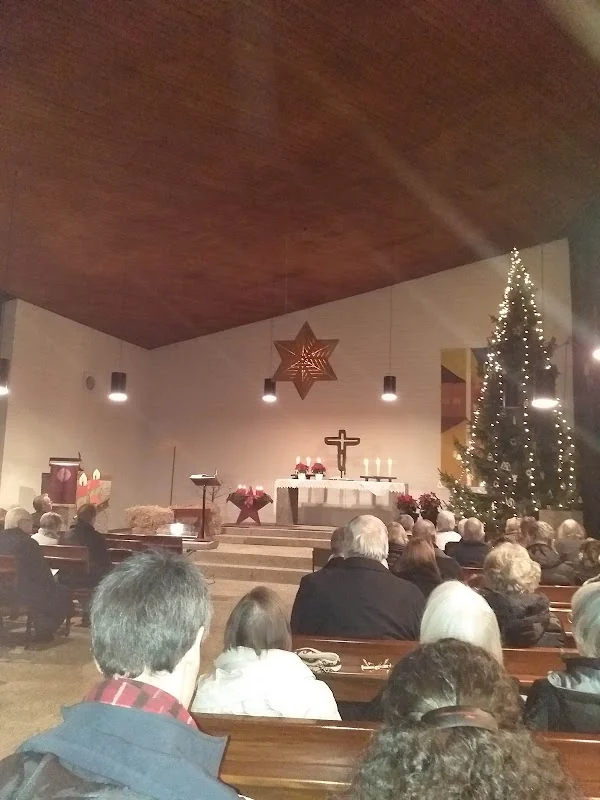
Anyone who photographs the Epiphany Church or searches for images will immediately recognize why this building appeals to so many people: The church has a strong, independent design language that clearly differs from classical village churches. The plans are by the Bielefeld architect Günther Klussmann. The building is polygonal and asymmetrical, the free-standing tower is made of exposed concrete, and the church nave features white plastered exposed brickwork along with a deliberately reduced but very precise material concept. Colored glass, clear lines, a striking portal, and the harmonized surfaces create an effect that is both modern and sacred. According to the feasibility study documents, the church is partly inspired by Le Corbusier's pilgrimage church in Ronchamp; it is precisely this combination of architectural independence and spiritual severity that gives the building its charm. Additionally, the original effect of the interior has largely been preserved: Benches, ceiling cladding, altar slab, and other elements are designed according to a coordinated color and material concept. The church building thus presents itself not as an arbitrary multipurpose hall but as a consciously composed space with a clear liturgical orientation. For photos, this means: Perspectives with the tower, forecourt, portal, stained glass windows, and the interplay between bright exposed brickwork and colored light create particularly expressive motifs. Because the church and tower stand as a solitaire in the village, exterior shots can also be taken with plenty of sky, open space, and a clear silhouette. This visual uniqueness is one reason why the Epiphany Church is repeatedly perceived as a remarkable example of modern Protestant church architecture in Bielefeld. ([versoehnungs-kirchengemeinde.de](https://www.versoehnungs-kirchengemeinde.de/uploads/craBMi3u/20230900_Machbarkeitsstudie_MFK_Vilsendorf.pdf))
The monument character of the Epiphany Church includes not only its outer form but also the history of the architectural and spiritual idea. The church was begun in 1962 and consecrated in 1963, at a time when Vilsendorf, like many places in northern Bielefeld, was characterized by population growth and new residential areas. After World War II, many congregations sought their own meeting places because the distances to the previous church and cemetery were far, and the districts were developing. The Epiphany Church is therefore a building of independence and new beginnings. Today it is described as a listed building; at the same time, a current contribution from the church district shows that its unusual form and very sacred orientation significantly limit possibilities for redesign. This is also its strength: The space tells of its time of origin, but without appearing museum-like. The white of the outer walls, the clear geometry, the free-standing tower, and the large glass surfaces make the church a building that impresses from both near and far. For visitors looking for photos, this is important because the Epiphany Church does not function through decorative overload but through proportion, light, and material. Therefore, anyone who wants to understand the building should not only consider the facade but also the transition from the forecourt to the interior, the effect of daylight through the windows, and the calm, concentrated atmosphere of the church nave. All of this is part of the special photographic and architectural appeal of this place. ([versoehnungs-kirchengemeinde.de](https://www.versoehnungs-kirchengemeinde.de/uploads/craBMi3u/20230900_Machbarkeitsstudie_MFK_Vilsendorf.pdf))
History of the Epiphany Church in Vilsendorf
The history of the Epiphany Church is closely linked to the development of Vilsendorf after World War II. The documents of the congregation and the feasibility study describe that Vilsendorf long belonged to the mother congregation of Schildesche and that the way to the church was arduous for many people. After 1945, the population in the new residential areas grew significantly, not least due to the influx of displaced persons and refugees. The desire for a dedicated place of worship became increasingly strong. Initially, the old school in Vilsendorf served as a spiritual space before the project for a new church became more concrete. On June 17, 1962, the foundation stone was laid, and on September 8, 1963, the consecration of the sacred building took place. The construction project included not only the church nave and the free-standing tower but also the conversion of the former village school into a community center and the new construction of the parsonage. Thus, a church ensemble gradually emerged that restructured the place and continues to shape it visibly today. This development also explains why the Epiphany Church should not be understood as an isolated object: It is part of a developed community complex of church, community center, and surroundings that responded to new social and spatial conditions. ([versoehnungs-kirchengemeinde.de](https://www.versoehnungs-kirchengemeinde.de/uploads/craBMi3u/20230900_Machbarkeitsstudie_MFK_Vilsendorf.pdf))
The spiritual and organizational history is also interesting. The current Reconciliation Congregation Jöllenbeck was formed on October 1, 2016, from the former congregations of Jöllenbeck, Theesen, and Vilsendorf. This completed a long-lasting structural process that also responded to the changing building stock, declining membership development, and the question of viable usage concepts. The congregation reports indicate that community life has almost returned to normal after the COVID-19 pandemic, and groups, circles, and events are taking place again. Therefore, the Epiphany Church is not only historically significant but also part of an active ecclesiastical landscape today. At the same time, it is a testament to regional church history: The Evangelical Church District of Bielefeld describes the congregation as shaped by the Ravensberger Awakening Movement and Pastor Johann Heinrich Volkening, who served in Jöllenbeck from 1839 to 1869. This spiritual tradition continues to influence the current congregational culture. Thus, anyone searching for the history of the Epiphany Church learns not only the dates of a building but also something about post-war development, ecclesiastical independence, regional influence, and how congregations respond to change. This connection between architecture, social history, and ecclesiastical identity makes the Epiphany Church a particularly fascinating place in Bielefeld-Vilsendorf. ([versoehnungs-kirchengemeinde.de](https://www.versoehnungs-kirchengemeinde.de/zentren))
Directions, Bus, and Parking
The official directions to the Epiphany Church are clear and helpful. The Bielefeld Church District states the address as Vilsendorfer Straße 230 in 33739 Bielefeld. The church is accessible by bus via the Orchideenstraße stop; from there, it is about 100 meters on foot. The bus lines 63, 155, and 156 are mentioned. Those coming from Jöllenbeck, Schildesche, or the surrounding districts can therefore travel relatively easily by public transport. This is particularly convenient for services, concerts, tours, or other community events because the distances are short and the location is well integrated into the village. For people searching Google for Epiphany Church Bus or Epiphany Church Directions, this information provides the central data. It is also important that the church, as a solitaire with a forecourt and free-standing tower, is clearly visible. Orientation is therefore also easy on foot when approaching the intersection and the church ensemble in Vilsendorf. For visitors, this means: The last stretch is short, clear, and manageable even without local knowledge. ([kirche-bielefeld.de](https://www.kirche-bielefeld.de/auf-einen-blick/kirchen-in-bielefeld/evangelische-epiphaniaskirche-vilsendorf))
When it comes to parking, the official sources also show concrete, local solutions. The city of Bielefeld points out that there are some parking spaces available for access by car on Epiphanienweg, accessible via Vilsendorfer Straße. The church's building data also indicate 10 parking spaces for cars. Thus, while the Epiphany Church is not a large event venue with a huge parking offer, it is well equipped for the typical use of a community and church culture. This is an important advantage, especially for events with a medium number of visitors. Those arriving by car should use the access via Vilsendorfer Straße and pay attention to local signs, as the surrounding area is a developed residential area and not a large-scale event parking lot. For visitors, it is advisable to allow some time for parking, especially if community events are taking place simultaneously or multiple appointments are scheduled at the location. At the same time, the church is attractive for all who consciously wish to travel without a car due to the bus connection. This combination of public transport and limited but available parking options makes the location practical for everyday use. Therefore, anyone searching for Epiphany Church parking or Epiphany Church Directions gets a clear picture: short distances, manageable parking options, and good access to public transport. ([bielefeld.de](https://www.bielefeld.de/node/3741))
Services, Groups, and Community Life
The Epiphany Church is not just a place for sightseeing but a vibrant part of the Reconciliation Congregation Jöllenbeck. On the official congregation page, it states that the churches and community centers of the founding congregations form the three centers where community life takes place with services and all other activities. For Vilsendorf, this means: The Epiphany Church is a place for liturgy, encounters, music, conversations, and community work. The church district also refers in its community overviews to a variety of groups and circles in the center of Vilsendorf, including women's aid, women's evening circle, women's creative circle, gardening group, board game meeting, open breakfast round, back gymnastics, chair gymnastics for seniors, experience dance, brass choir, church music support group, INJOYY, and church choir. This range shows that community life is not limited to Sunday services. Rather, the Epiphany Church is part of a social network that addresses very different age groups and interests. Therefore, those looking for churches with a genuine local connection will find a good example here of a congregation that connects spiritual life, music, community, and practical offerings. ([versoehnungs-kirchengemeinde.de](https://www.versoehnungs-kirchengemeinde.de/zentren))
Current reports also underscore this character. In the congregation meeting, for example, considerations were presented for the multifunctional use of the churches in Jöllenbeck, Theesen, and Vilsendorf, as ecclesiastical spaces need to be reorganized under changing conditions. For Vilsendorf, the discussion shows that while the Epiphany Church is listed as a monument and sets clear architectural limits, it is also understood as a place for future questions. This is typical of a vibrant congregation: It preserves what has grown while still thinking ahead. Formats such as Café Miteinander, exhibitions, tours, or special event evenings fit into this. The church district and the congregation also report on actions surrounding the Day of Open Monuments, where visitors can experience the church from a new perspective. Such offerings are not only culturally interesting but also an opportunity to get to know the Epiphany Church as a place of openness. Particularly for inquiries about services, community center, music, or events, it is important to know that Vilsendorf does not function in isolation but is embedded in a larger community network. The Epiphany Church thus represents a church that is present on-site, adapts to changes, and still maintains its profile. This connection between tradition, social space, and renewed use is one of the strongest features of the location. ([kirche-bielefeld.de](https://www.kirche-bielefeld.de/news-detailansicht/multifunktionale-nutzung-der-kirchen-in-der-versoehnungskirchengemeinde))
Events, Day of Open Monuments, and Use
The Epiphany Church is also interesting as an event venue because it repeatedly comes into focus with special formats. A current example is the Day of Open Monuments, for which the church is regularly opened. A program with tours under the motto Building According to Theological Concept is announced for 2026, complemented by Café Miteinander in the community center and an exhibition titled White Concrete and Colorful Glass – How Vilsendorf Came to Its Church. Such formats show very well how the church can be interpreted: not only as a house of worship but also as a building culture, a place of remembrance, and a place of mediation. The church district also describes that the Epiphany Church is considered a listed building and that its unusual form and sacred orientation allow for only limited redesigns. This is precisely why tours and thematic events are so meaningful: They make visible what makes the architecture unique without changing the character of the building. Visitors thus have the chance to see the church anew with professional guidance and to understand the details that are easily overlooked in everyday life. ([versoehnungs-kirchengemeinde.de](https://www.versoehnungs-kirchengemeinde.de/b/epiphaniaskirche-tag-des-offenen-denkmals-40820529))
The use of the location also includes looking at the history of attempts at architectural change. The feasibility study and the community texts make it clear that the Epiphany Church cannot simply be divided into arbitrary functional spaces due to its monument protection and strong architectural order. At the same time, considerations have been made on how multifunctional use could be possible without destroying the spatial quality. For the congregation, this is a balancing act between preservation and development. It is precisely in this tension that an important part of the location quality lies: Those looking for a classic multipurpose hall will not find it here; however, those seeking a church with a clear identity, high architectural presence, and meaningful public use will find a convincing place in Vilsendorf. Cultural and documentary elements also play a role. The congregation points out that the local history association Jöllenbeck has created a film about the Epiphany Church, and the events serve repeatedly to publicly tell the history of the church. Thus, a picture of use emerges that goes far beyond the service: ecclesiastical education, culture, remembrance, encounters, and practical community work interconnect. This is what makes the Epiphany Church in Bielefeld-Vilsendorf so exciting for visitors, seekers, and interested parties. ([versoehnungs-kirchengemeinde.de](https://www.versoehnungs-kirchengemeinde.de/b/epiphaniaskirche-tag-des-offenen-denkmals-40820529))
Orientation, Location, and Photo Tips
Those visiting the Epiphany Church for the first time benefit from its clear location in the village. The address Vilsendorfer Straße 230 is well documented, and the church, with its free-standing tower, forecourt, and bright building body, forms a clear point of orientation in Vilsendorf. According to a current description, the tower stands as a memorial for the victims of both world wars; together with the church, it forms a solitaire that connects old and new parts of the village as a widely visible landmark. For visitors, this means: The church does not appear hidden but is consciously a visible focal point. Those wanting to take photos should therefore not only approach the building from the front but also include the free-standing tower, the side bodies, and the effect of the intersection in the village area. Particularly harmonious are shots in daylight when the white surfaces, exposed brickwork, and colored windows reveal their contrasts. The transition from outside to inside is also photographically appealing because the strict geometry inside is repeated with light and material. The church is also easily accessible by bus, making spontaneous visits easier. The Orchideenstraße stop is only about 100 meters away. For those needing orientation in advance, additional information on photo opportunities, events, and church life in the center of Vilsendorf can be found on the official pages and in the community environment. ([kirche-bielefeld.de](https://www.kirche-bielefeld.de/auf-einen-blick/kirchen-in-bielefeld/evangelische-epiphaniaskirche-vilsendorf))
Practically, the location is also sensible for many occasions. Those driving to the Epiphany Church can often combine their visit with a walk through the church environment; those participating in tours or community events find the community center a direct complement to the church space. For photography enthusiasts, it is helpful to focus not only on the building itself but also on the relationship between architecture and surroundings. The church was built as an expression of a new ecclesiastical self-understanding that emerged from the old structures in the post-war years while still maintaining a strong connection to the place. This is still visible today: The building is modern but not cold; clear but not anonymous; liturgically shaped but open to documentation and encounters. Therefore, those searching for photos of the Epiphany Church should pay attention to details such as the portal, tower, colored glass, forecourt, and the interplay of white, concrete, and wood. Anyone who only considers the church as an address misses its true value. It is a place where architecture, community life, and local history come together. And that is why it is worthwhile to look at images, background, and directions alike. ([versoehnungs-kirchengemeinde.de](https://www.versoehnungs-kirchengemeinde.de/uploads/craBMi3u/20230900_Machbarkeitsstudie_MFK_Vilsendorf.pdf))
Sources:
Mehr anzeigenWeniger anzeigen
Epiphany Church Vilsendorf | Photos & Directions
The Epiphany Church in Vilsendorf is much more than just a church in the northern part of Bielefeld. It is one of the three centers of the Evangelical-Lutheran Reconciliation Congregation Jöllenbeck and is thus firmly anchored in the community life of Vilsendorf, Theesen, and Jöllenbeck. Since the unification of the previously independent congregations on October 1, 2016, the current congregation has consolidated its work at three locations; in Vilsendorf, the Epiphany Church is the defining center. The congregation includes around 10,800 Protestant Christians in four parish districts. Those looking for photos, history, architecture, or practical information will find here not only a striking church building but also a developed ecclesiastical and social environment that remains visibly vibrant to this day. The address Vilsendorfer Straße 230 in 33739 Bielefeld makes the church easily accessible, and the official church presence shows that the location is consciously understood as a place for worship, encounters, and community activities. ([versoehnungs-kirchengemeinde.de](https://www.versoehnungs-kirchengemeinde.de/zentren))
Photos, Architecture, and Monument Character
Anyone who photographs the Epiphany Church or searches for images will immediately recognize why this building appeals to so many people: The church has a strong, independent design language that clearly differs from classical village churches. The plans are by the Bielefeld architect Günther Klussmann. The building is polygonal and asymmetrical, the free-standing tower is made of exposed concrete, and the church nave features white plastered exposed brickwork along with a deliberately reduced but very precise material concept. Colored glass, clear lines, a striking portal, and the harmonized surfaces create an effect that is both modern and sacred. According to the feasibility study documents, the church is partly inspired by Le Corbusier's pilgrimage church in Ronchamp; it is precisely this combination of architectural independence and spiritual severity that gives the building its charm. Additionally, the original effect of the interior has largely been preserved: Benches, ceiling cladding, altar slab, and other elements are designed according to a coordinated color and material concept. The church building thus presents itself not as an arbitrary multipurpose hall but as a consciously composed space with a clear liturgical orientation. For photos, this means: Perspectives with the tower, forecourt, portal, stained glass windows, and the interplay between bright exposed brickwork and colored light create particularly expressive motifs. Because the church and tower stand as a solitaire in the village, exterior shots can also be taken with plenty of sky, open space, and a clear silhouette. This visual uniqueness is one reason why the Epiphany Church is repeatedly perceived as a remarkable example of modern Protestant church architecture in Bielefeld. ([versoehnungs-kirchengemeinde.de](https://www.versoehnungs-kirchengemeinde.de/uploads/craBMi3u/20230900_Machbarkeitsstudie_MFK_Vilsendorf.pdf))
The monument character of the Epiphany Church includes not only its outer form but also the history of the architectural and spiritual idea. The church was begun in 1962 and consecrated in 1963, at a time when Vilsendorf, like many places in northern Bielefeld, was characterized by population growth and new residential areas. After World War II, many congregations sought their own meeting places because the distances to the previous church and cemetery were far, and the districts were developing. The Epiphany Church is therefore a building of independence and new beginnings. Today it is described as a listed building; at the same time, a current contribution from the church district shows that its unusual form and very sacred orientation significantly limit possibilities for redesign. This is also its strength: The space tells of its time of origin, but without appearing museum-like. The white of the outer walls, the clear geometry, the free-standing tower, and the large glass surfaces make the church a building that impresses from both near and far. For visitors looking for photos, this is important because the Epiphany Church does not function through decorative overload but through proportion, light, and material. Therefore, anyone who wants to understand the building should not only consider the facade but also the transition from the forecourt to the interior, the effect of daylight through the windows, and the calm, concentrated atmosphere of the church nave. All of this is part of the special photographic and architectural appeal of this place. ([versoehnungs-kirchengemeinde.de](https://www.versoehnungs-kirchengemeinde.de/uploads/craBMi3u/20230900_Machbarkeitsstudie_MFK_Vilsendorf.pdf))
History of the Epiphany Church in Vilsendorf
The history of the Epiphany Church is closely linked to the development of Vilsendorf after World War II. The documents of the congregation and the feasibility study describe that Vilsendorf long belonged to the mother congregation of Schildesche and that the way to the church was arduous for many people. After 1945, the population in the new residential areas grew significantly, not least due to the influx of displaced persons and refugees. The desire for a dedicated place of worship became increasingly strong. Initially, the old school in Vilsendorf served as a spiritual space before the project for a new church became more concrete. On June 17, 1962, the foundation stone was laid, and on September 8, 1963, the consecration of the sacred building took place. The construction project included not only the church nave and the free-standing tower but also the conversion of the former village school into a community center and the new construction of the parsonage. Thus, a church ensemble gradually emerged that restructured the place and continues to shape it visibly today. This development also explains why the Epiphany Church should not be understood as an isolated object: It is part of a developed community complex of church, community center, and surroundings that responded to new social and spatial conditions. ([versoehnungs-kirchengemeinde.de](https://www.versoehnungs-kirchengemeinde.de/uploads/craBMi3u/20230900_Machbarkeitsstudie_MFK_Vilsendorf.pdf))
The spiritual and organizational history is also interesting. The current Reconciliation Congregation Jöllenbeck was formed on October 1, 2016, from the former congregations of Jöllenbeck, Theesen, and Vilsendorf. This completed a long-lasting structural process that also responded to the changing building stock, declining membership development, and the question of viable usage concepts. The congregation reports indicate that community life has almost returned to normal after the COVID-19 pandemic, and groups, circles, and events are taking place again. Therefore, the Epiphany Church is not only historically significant but also part of an active ecclesiastical landscape today. At the same time, it is a testament to regional church history: The Evangelical Church District of Bielefeld describes the congregation as shaped by the Ravensberger Awakening Movement and Pastor Johann Heinrich Volkening, who served in Jöllenbeck from 1839 to 1869. This spiritual tradition continues to influence the current congregational culture. Thus, anyone searching for the history of the Epiphany Church learns not only the dates of a building but also something about post-war development, ecclesiastical independence, regional influence, and how congregations respond to change. This connection between architecture, social history, and ecclesiastical identity makes the Epiphany Church a particularly fascinating place in Bielefeld-Vilsendorf. ([versoehnungs-kirchengemeinde.de](https://www.versoehnungs-kirchengemeinde.de/zentren))
Directions, Bus, and Parking
The official directions to the Epiphany Church are clear and helpful. The Bielefeld Church District states the address as Vilsendorfer Straße 230 in 33739 Bielefeld. The church is accessible by bus via the Orchideenstraße stop; from there, it is about 100 meters on foot. The bus lines 63, 155, and 156 are mentioned. Those coming from Jöllenbeck, Schildesche, or the surrounding districts can therefore travel relatively easily by public transport. This is particularly convenient for services, concerts, tours, or other community events because the distances are short and the location is well integrated into the village. For people searching Google for Epiphany Church Bus or Epiphany Church Directions, this information provides the central data. It is also important that the church, as a solitaire with a forecourt and free-standing tower, is clearly visible. Orientation is therefore also easy on foot when approaching the intersection and the church ensemble in Vilsendorf. For visitors, this means: The last stretch is short, clear, and manageable even without local knowledge. ([kirche-bielefeld.de](https://www.kirche-bielefeld.de/auf-einen-blick/kirchen-in-bielefeld/evangelische-epiphaniaskirche-vilsendorf))
When it comes to parking, the official sources also show concrete, local solutions. The city of Bielefeld points out that there are some parking spaces available for access by car on Epiphanienweg, accessible via Vilsendorfer Straße. The church's building data also indicate 10 parking spaces for cars. Thus, while the Epiphany Church is not a large event venue with a huge parking offer, it is well equipped for the typical use of a community and church culture. This is an important advantage, especially for events with a medium number of visitors. Those arriving by car should use the access via Vilsendorfer Straße and pay attention to local signs, as the surrounding area is a developed residential area and not a large-scale event parking lot. For visitors, it is advisable to allow some time for parking, especially if community events are taking place simultaneously or multiple appointments are scheduled at the location. At the same time, the church is attractive for all who consciously wish to travel without a car due to the bus connection. This combination of public transport and limited but available parking options makes the location practical for everyday use. Therefore, anyone searching for Epiphany Church parking or Epiphany Church Directions gets a clear picture: short distances, manageable parking options, and good access to public transport. ([bielefeld.de](https://www.bielefeld.de/node/3741))
Services, Groups, and Community Life
The Epiphany Church is not just a place for sightseeing but a vibrant part of the Reconciliation Congregation Jöllenbeck. On the official congregation page, it states that the churches and community centers of the founding congregations form the three centers where community life takes place with services and all other activities. For Vilsendorf, this means: The Epiphany Church is a place for liturgy, encounters, music, conversations, and community work. The church district also refers in its community overviews to a variety of groups and circles in the center of Vilsendorf, including women's aid, women's evening circle, women's creative circle, gardening group, board game meeting, open breakfast round, back gymnastics, chair gymnastics for seniors, experience dance, brass choir, church music support group, INJOYY, and church choir. This range shows that community life is not limited to Sunday services. Rather, the Epiphany Church is part of a social network that addresses very different age groups and interests. Therefore, those looking for churches with a genuine local connection will find a good example here of a congregation that connects spiritual life, music, community, and practical offerings. ([versoehnungs-kirchengemeinde.de](https://www.versoehnungs-kirchengemeinde.de/zentren))
Current reports also underscore this character. In the congregation meeting, for example, considerations were presented for the multifunctional use of the churches in Jöllenbeck, Theesen, and Vilsendorf, as ecclesiastical spaces need to be reorganized under changing conditions. For Vilsendorf, the discussion shows that while the Epiphany Church is listed as a monument and sets clear architectural limits, it is also understood as a place for future questions. This is typical of a vibrant congregation: It preserves what has grown while still thinking ahead. Formats such as Café Miteinander, exhibitions, tours, or special event evenings fit into this. The church district and the congregation also report on actions surrounding the Day of Open Monuments, where visitors can experience the church from a new perspective. Such offerings are not only culturally interesting but also an opportunity to get to know the Epiphany Church as a place of openness. Particularly for inquiries about services, community center, music, or events, it is important to know that Vilsendorf does not function in isolation but is embedded in a larger community network. The Epiphany Church thus represents a church that is present on-site, adapts to changes, and still maintains its profile. This connection between tradition, social space, and renewed use is one of the strongest features of the location. ([kirche-bielefeld.de](https://www.kirche-bielefeld.de/news-detailansicht/multifunktionale-nutzung-der-kirchen-in-der-versoehnungskirchengemeinde))
Events, Day of Open Monuments, and Use
The Epiphany Church is also interesting as an event venue because it repeatedly comes into focus with special formats. A current example is the Day of Open Monuments, for which the church is regularly opened. A program with tours under the motto Building According to Theological Concept is announced for 2026, complemented by Café Miteinander in the community center and an exhibition titled White Concrete and Colorful Glass – How Vilsendorf Came to Its Church. Such formats show very well how the church can be interpreted: not only as a house of worship but also as a building culture, a place of remembrance, and a place of mediation. The church district also describes that the Epiphany Church is considered a listed building and that its unusual form and sacred orientation allow for only limited redesigns. This is precisely why tours and thematic events are so meaningful: They make visible what makes the architecture unique without changing the character of the building. Visitors thus have the chance to see the church anew with professional guidance and to understand the details that are easily overlooked in everyday life. ([versoehnungs-kirchengemeinde.de](https://www.versoehnungs-kirchengemeinde.de/b/epiphaniaskirche-tag-des-offenen-denkmals-40820529))
The use of the location also includes looking at the history of attempts at architectural change. The feasibility study and the community texts make it clear that the Epiphany Church cannot simply be divided into arbitrary functional spaces due to its monument protection and strong architectural order. At the same time, considerations have been made on how multifunctional use could be possible without destroying the spatial quality. For the congregation, this is a balancing act between preservation and development. It is precisely in this tension that an important part of the location quality lies: Those looking for a classic multipurpose hall will not find it here; however, those seeking a church with a clear identity, high architectural presence, and meaningful public use will find a convincing place in Vilsendorf. Cultural and documentary elements also play a role. The congregation points out that the local history association Jöllenbeck has created a film about the Epiphany Church, and the events serve repeatedly to publicly tell the history of the church. Thus, a picture of use emerges that goes far beyond the service: ecclesiastical education, culture, remembrance, encounters, and practical community work interconnect. This is what makes the Epiphany Church in Bielefeld-Vilsendorf so exciting for visitors, seekers, and interested parties. ([versoehnungs-kirchengemeinde.de](https://www.versoehnungs-kirchengemeinde.de/b/epiphaniaskirche-tag-des-offenen-denkmals-40820529))
Orientation, Location, and Photo Tips
Those visiting the Epiphany Church for the first time benefit from its clear location in the village. The address Vilsendorfer Straße 230 is well documented, and the church, with its free-standing tower, forecourt, and bright building body, forms a clear point of orientation in Vilsendorf. According to a current description, the tower stands as a memorial for the victims of both world wars; together with the church, it forms a solitaire that connects old and new parts of the village as a widely visible landmark. For visitors, this means: The church does not appear hidden but is consciously a visible focal point. Those wanting to take photos should therefore not only approach the building from the front but also include the free-standing tower, the side bodies, and the effect of the intersection in the village area. Particularly harmonious are shots in daylight when the white surfaces, exposed brickwork, and colored windows reveal their contrasts. The transition from outside to inside is also photographically appealing because the strict geometry inside is repeated with light and material. The church is also easily accessible by bus, making spontaneous visits easier. The Orchideenstraße stop is only about 100 meters away. For those needing orientation in advance, additional information on photo opportunities, events, and church life in the center of Vilsendorf can be found on the official pages and in the community environment. ([kirche-bielefeld.de](https://www.kirche-bielefeld.de/auf-einen-blick/kirchen-in-bielefeld/evangelische-epiphaniaskirche-vilsendorf))
Practically, the location is also sensible for many occasions. Those driving to the Epiphany Church can often combine their visit with a walk through the church environment; those participating in tours or community events find the community center a direct complement to the church space. For photography enthusiasts, it is helpful to focus not only on the building itself but also on the relationship between architecture and surroundings. The church was built as an expression of a new ecclesiastical self-understanding that emerged from the old structures in the post-war years while still maintaining a strong connection to the place. This is still visible today: The building is modern but not cold; clear but not anonymous; liturgically shaped but open to documentation and encounters. Therefore, those searching for photos of the Epiphany Church should pay attention to details such as the portal, tower, colored glass, forecourt, and the interplay of white, concrete, and wood. Anyone who only considers the church as an address misses its true value. It is a place where architecture, community life, and local history come together. And that is why it is worthwhile to look at images, background, and directions alike. ([versoehnungs-kirchengemeinde.de](https://www.versoehnungs-kirchengemeinde.de/uploads/craBMi3u/20230900_Machbarkeitsstudie_MFK_Vilsendorf.pdf))
Sources:
Upcoming Events
No events found
Frequently Asked Questions
Reviews
Norbert Singe
9. July 2025
The concert was really good again. The church has a nice atmosphere.
Rezensionen Jäger
19. January 2023
Very good youth workers
Piotr “Piotras” Rezler
15. September 2018
Like in church
Klaus Zwick
1. February 2024
No comment
walter möller
17. August 2023
No comment