
Bielefeld
Johanniskirchpl. 1, 33615 Bielefeld, Deutschland
Johanniskirche Bielefeld | Photos & Parking
The Johanniskirche in the western part of Bielefeld is a place where history, community life, and contemporary use come together in remarkable ways. It belongs to the Ev.-Luth. Lydia Parish, is located at Johanniskirchplatz 1, and explicitly sees itself as a church for people in very different life situations and from different countries. Those looking for photos, impressions, or initial information will find not only the most important details on the official pages but also image galleries and impressions that make the character of the place clearly visible in advance. At the same time, the Johanniskirche does not stop at remembering its past: The community describes it today as the center of a vibrant work with spirituality, education, church music, as well as cultural and social projects. Thus, the Johanniskirche is both a historical church building and an active meeting point for the neighborhood. It is precisely this connection between tradition and the present that makes the place appealing and explains why so many inquiries revolve around photos, history, directions, parking, and current events. ([kirche-bielefeld.de](https://www.kirche-bielefeld.de/auf-einen-blick/gemeinden/region-mitte/ev-luth-lydia-kirchengemeinde))
Photos, Architecture, and First Impressions of the Johanniskirche
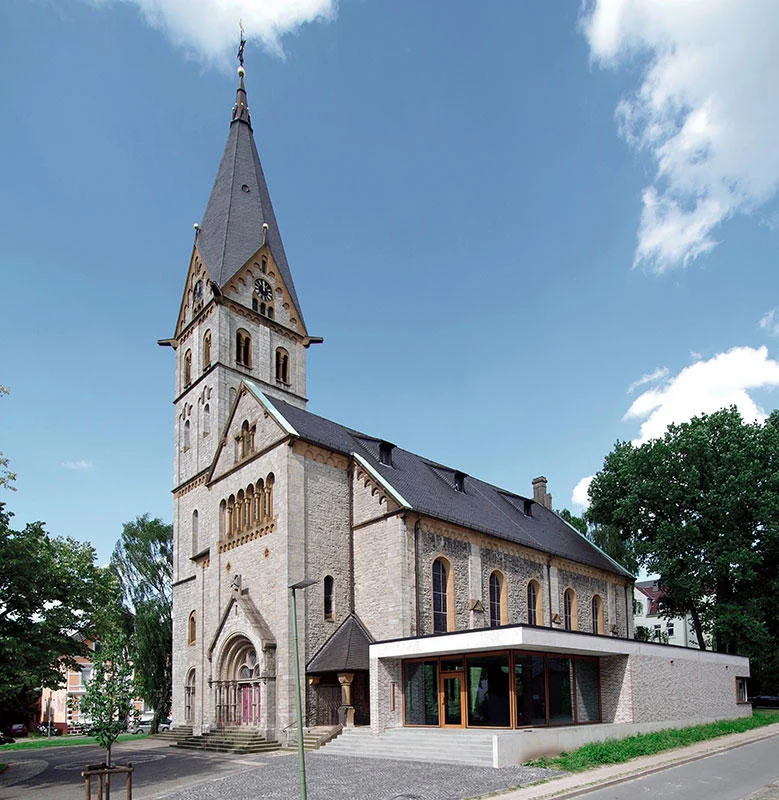
Anyone who wants to get to know the Johanniskirche initially through photos will find a good introduction on the official pages. The church appears there not only as a place of worship but also as a building with a clearly recognizable historical language. The Dehio describes it as an asymmetrical gallery church made of hammer-dressed rubble stone in forms of the Rhenish late Romanesque with a semicircular apse and a side tower. The western part is designed with a gabled forebuilding, column portal, and a series of arches with windows; the tower is characterized by pilasters and friezes. The sides also differ noticeably: The south side is more simply structured, while the north side appears more elaborate with two transverse gables as well as group and large rose windows. Inside, the wide hall with its coffin lid-like wooden ceiling and the northern aisle with gallery is described. These architectural details are important because they explain why the Johanniskirche is perceived not only as a community place but also as a noteworthy monument. ([de.dehio.org](https://de.dehio.org/bauwerk/bielefeld-ev-johanniskirche-0))
The first impression is therefore twofold: on one hand monumental and historical, on the other hand open and functional. This fits the development of the building, which was constructed from 1899 to 1901 based on plans by Alexander Trappen and was solemnly consecrated on November 6, 1901. Particularly significant is that the Johanniskirche was expanded into a multifunctional community center in 2013. The community's own concept speaks of more space for new forms of togetherness, and this is precisely reflected in today's use. So, those looking for photos of the Johanniskirche Bielefeld do not see just a classic church building but a structure that connects historical substance, spatial openness, and modern community work. The images on the official pages are therefore not mere decoration but a direct access to understanding this church. ([de.dehio.org](https://de.dehio.org/bauwerk/bielefeld-ev-johanniskirche-0))
History of the Johanniskirche and the Lydia Parish
The history of the Johanniskirche does not begin with the completed building but with the development of a new district in the western part of Bielefeld's city center. According to the official parish history, the first significant impulse came in 1891 when a donation of 10,000 marks enabled the purchase of a plot of land on the then still almost undeveloped Siegfriedstraße. In 1895, the Altstädter community established the Johannis parish district, named after the nearby Johannisberg, which previously belonged to the Johannisstift Schildesche. As the number of parish members quickly grew to over 8,000, the Altstädter presbytery decided in 1898 to build a new church. Construction began in 1900 and was completed in 1901. The solemn consecration took place on November 6, 1901. Thus, the Johanniskirche is closely linked to the growth of Bielefeld during industrialization when new living and working spaces emerged in the western part of the city. ([lydia-bielefeld.de](https://lydia-bielefeld.de/evangelisch-lutherische-lydia-kirchengemeinde/wir-ueber-uns/geschichte))
The later history of the community is also closely linked to changes in the church life of the city. The former Johannis community was initially established in 1895 as a district of the Altstädter community and became independent in 1952. The current Lydia community finally emerged on July 4, 2004, from the merger of the Erlöser and Johannis communities. Today, the Johannis district describes itself as a church for people in the western part of Bielefeld, for young and old, for women and men in different life forms, and for residents from various countries. This openness is not just a formula but part of the self-description. The community emphasizes spirituality and education, church music, children's and youth work, as well as cultural and social projects. This explains why the Johanniskirche today is much more than a historical building: it is a grown, diverse place where the history of a city, a neighborhood, and a community intertwines. ([kirche-bielefeld.de](https://www.kirche-bielefeld.de/auf-einen-blick/gemeinden/region-mitte/ev-luth-lydia-kirchengemeinde))
Directions, Public Transport, and Parking at the Johanniskirche
The Johanniskirche is well integrated into the Bielefeld transport network, which is a clear advantage for visitors without a car. The church district mentions the nearest bus connections as lines 25 and 26 to the Siegfriedstraße stop. From there, it is about 140 meters to the church. If you prefer to arrive by tram, you can take line 3 to the Wittekindstraße stop; it is also just a short distance of about 220 meters from there. These details are particularly practical for planning a visit because they provide quick orientation and show that the church is located in an urban area that is well developed. The official address is Johanniskirchplatz 1, 33615 Bielefeld. Together with its location in western Bielefeld, this results in a site that is equally suitable for community visits, events, cultural formats, and spontaneous visits. ([kirche-bielefeld.de](https://www.kirche-bielefeld.de/auf-einen-blick/kirchen-in-bielefeld/evangelische-johanniskirche))
Parking is a different matter. The church district explicitly points out that parking at the Johanniskirche is difficult. The nearest parking garage is the parking garage at the main train station. Access is via Große Kurfürstenstr. and Jöllenbeckerstr. So, if you are coming by car, you should plan for this in your journey and allow enough time for the last stretch. This information is important not only for worship visitors but also for people attending evening events, educational formats, or musical offerings. Especially because the Johanniskirche is located in a lively, urban area, the combination of public transport and a short walk is often the most relaxed solution. Therefore, the official information provides a clear answer to inquiries about parking, directions, or public transport for Johanniskirche Bielefeld that can be directly translated into visit planning. ([kirche-bielefeld.de](https://www.kirche-bielefeld.de/fileadmin/Dokumente/---Dienste/Stadtkantorat/Probenplaene/Probenplan_Seniorenchor_2025_02-2026-03.pdf?utm_source=openai))
Open Church, Office Hours, and Practical Visitor Information
The Johanniskirche is accessible as an Open Church and is thus deliberately not a place that is only used during fixed worship times. According to the church district, it can be visited during office hours through the office entrance. This is an important note for all who come not only to events but also want to experience the church in peace. The official information from the parish office adds specific office hours: Tuesdays from 10:00 to 12:00, Wednesdays from 9:00 to 12:00, Thursdays from 15:30 to 17:30, and Fridays from 9:00 to 12:00. This makes it clear that the church remains an accessible place, even as it functions as a parish office and event space. Those who want to inform themselves in advance can easily incorporate these times into their own planning and combine their visit with an appointment, a quiet tour, or an event. ([kirche-bielefeld.de](https://www.kirche-bielefeld.de/auf-einen-blick/kirchen-in-bielefeld/evangelische-johanniskirche))
It is also practical that the Johanniskirche does not stand alone but is organizationally closely linked to the Lydia Parish. The parish office is located directly at the Johanniskirchplatz address, and the church is supported by a community that describes itself as open and diverse. This is particularly important for people looking for photos, opening hours, or a first contact opportunity: The Johanniskirche is not only a monument but also a well-accessible, functioning place in the everyday life of the neighborhood. So, for those who do not just want to stop by but want to get to know the community, the office hours and the Open Church concept provide an uncomplicated entry point. This makes the Johanniskirche Bielefeld interesting for both spontaneous visits and targeted appointments. ([kirche-bielefeld.de](https://www.kirche-bielefeld.de/auf-einen-blick/kirchen-in-bielefeld/evangelische-johanniskirche))
Events, Music, and Educational Formats at the Johanniskirche
The Johanniskirche is now a versatile event venue. Official pages show that not only worship services take place there, but also formats with music, encounters, and education. One example is Tango in the Johanniskirche: with a trial lesson, milonga, and a deliberately open, social atmosphere. Another example is Morgenglanz, a series that combines enjoyable togetherness with breakfast and stimulating impulses and explicitly highlights moderated exchange in the communicative atmosphere of the Johanniskirche. Additionally, there is family singing, where children in kindergarten and elementary school age sing together with parents and grandparents, move, and can continue to experiment on the lawn afterward. This range shows that the church cannot be reduced to a single purpose. It is a space for different age groups, interests, and approaches. This is a large part of its current attractiveness. ([kirche-bielefeld.de](https://www.kirche-bielefeld.de/veranstaltung-detailansicht/tango-in-der-johanneskirche))
The self-description of the community also fits this spectrum of use. The Lydia Parish emphasizes spirituality and education, church music, children's and youth work, as well as cultural and social projects as focal points. Combined with the expanded architecture from 2013, this creates a place that is suitable for both classical church use and modern, low-threshold formats. This explains why the search for Johanniskirche Bielefeld events, programs, or worship offerings is so frequent. The church is not just a backdrop but an active meeting point where community life becomes visible. For visitors, this means: Those who come experience not just a building but a lively program that connects music, conversation, education, and community. It is precisely this mix that makes the Johanniskirche an exciting address in western Bielefeld. ([lydia-bielefeld.de](https://lydia-bielefeld.de/evangelisch-lutherische-lydia-kirchengemeinde/wir-ueber-uns/geschichte))
The Neighborhood, the Community, and Why a Visit is Worthwhile
The Johanniskirche is closely connected both content-wise and spatially with the western part of Bielefeld. The official community describes the Johannis district as a church for people in the western part of the city, for different life forms, and for residents from various countries. This is more than a sympathetic sentence: it describes a community that consciously thinks and acts openly. The transparent rooms of the Johanniskirche, expanded in 2013, support this claim because they allow not only liturgical use but also exchange, education, and encounters. Those interested in photos, history, or the current everyday life of the church quickly recognize that here a historical building has not become museum-like but has been further developed into the present. ([kirche-bielefeld.de](https://www.kirche-bielefeld.de/auf-einen-blick/gemeinden/region-mitte/ev-luth-lydia-kirchengemeinde))
A visit is worthwhile for several reasons. First, because of the architecture: The neo-Romanesque church with its distinctive tower and differentiated building body is one of the prominent church sites in western Bielefeld. Second, because of the history: From the donation in 1891 to the consecration in 1901 to the merger in 2004, the Johanniskirche tells of urban development and community change. Third, because of its current use: Open church, office hours, music formats, educational offerings, and cultural events make it a place with high everyday usability. So, for those searching for Johanniskirche Bielefeld photos, parking, directions, or events, they will find an address here that provides clear answers in all four areas. It is precisely the interplay of monument, community center, and event venue that makes the Johanniskirche one of the most interesting church sites in Bielefeld. ([de.dehio.org](https://de.dehio.org/bauwerk/bielefeld-ev-johanniskirche-0))
Sources:
- Evangelical Johanniskirche - Evangelical Church District Bielefeld ([kirche-bielefeld.de](https://www.kirche-bielefeld.de/auf-einen-blick/kirchen-in-bielefeld/evangelische-johanniskirche))
- History - Ev.-Luth. Lydia Parish ([lydia-bielefeld.de](https://lydia-bielefeld.de/evangelisch-lutherische-lydia-kirchengemeinde/wir-ueber-uns/geschichte))
- Ev.-Luth. Lydia Parish - Evangelical Church District Bielefeld ([kirche-bielefeld.de](https://www.kirche-bielefeld.de/auf-einen-blick/gemeinden/region-mitte/ev-luth-lydia-kirchengemeinde))
- BIELEFELD / Ev. Johanniskirche - Dehio DE ([de.dehio.org](https://de.dehio.org/bauwerk/bielefeld-ev-johanniskirche-0))
- Ev. City Cantorate Bielefeld - Rehearsal Plan Senior Choir 2025-2026 ([kirche-bielefeld.de](https://www.kirche-bielefeld.de/fileadmin/Dokumente/---Dienste/Stadtkantorat/Probenplaene/Probenplan_Seniorenchor_2025_02-2026-03.pdf?utm_source=openai))
- Tango in the Johanniskirche - Evangelical Church District Bielefeld ([kirche-bielefeld.de](https://www.kirche-bielefeld.de/veranstaltung-detailansicht/tango-in-der-johanneskirche))
- Morgenglanz - lifelong learning at breakfast in Lydia ([kirche-bielefeld.de](https://www.kirche-bielefeld.de/veranstaltung-detailansicht/morgenglanz-lebenslanges-lernen-beim-fruehstueck-in-lydia))
Show moreShow less
Johanniskirche Bielefeld | Photos & Parking
The Johanniskirche in the western part of Bielefeld is a place where history, community life, and contemporary use come together in remarkable ways. It belongs to the Ev.-Luth. Lydia Parish, is located at Johanniskirchplatz 1, and explicitly sees itself as a church for people in very different life situations and from different countries. Those looking for photos, impressions, or initial information will find not only the most important details on the official pages but also image galleries and impressions that make the character of the place clearly visible in advance. At the same time, the Johanniskirche does not stop at remembering its past: The community describes it today as the center of a vibrant work with spirituality, education, church music, as well as cultural and social projects. Thus, the Johanniskirche is both a historical church building and an active meeting point for the neighborhood. It is precisely this connection between tradition and the present that makes the place appealing and explains why so many inquiries revolve around photos, history, directions, parking, and current events. ([kirche-bielefeld.de](https://www.kirche-bielefeld.de/auf-einen-blick/gemeinden/region-mitte/ev-luth-lydia-kirchengemeinde))
Photos, Architecture, and First Impressions of the Johanniskirche
Anyone who wants to get to know the Johanniskirche initially through photos will find a good introduction on the official pages. The church appears there not only as a place of worship but also as a building with a clearly recognizable historical language. The Dehio describes it as an asymmetrical gallery church made of hammer-dressed rubble stone in forms of the Rhenish late Romanesque with a semicircular apse and a side tower. The western part is designed with a gabled forebuilding, column portal, and a series of arches with windows; the tower is characterized by pilasters and friezes. The sides also differ noticeably: The south side is more simply structured, while the north side appears more elaborate with two transverse gables as well as group and large rose windows. Inside, the wide hall with its coffin lid-like wooden ceiling and the northern aisle with gallery is described. These architectural details are important because they explain why the Johanniskirche is perceived not only as a community place but also as a noteworthy monument. ([de.dehio.org](https://de.dehio.org/bauwerk/bielefeld-ev-johanniskirche-0))
The first impression is therefore twofold: on one hand monumental and historical, on the other hand open and functional. This fits the development of the building, which was constructed from 1899 to 1901 based on plans by Alexander Trappen and was solemnly consecrated on November 6, 1901. Particularly significant is that the Johanniskirche was expanded into a multifunctional community center in 2013. The community's own concept speaks of more space for new forms of togetherness, and this is precisely reflected in today's use. So, those looking for photos of the Johanniskirche Bielefeld do not see just a classic church building but a structure that connects historical substance, spatial openness, and modern community work. The images on the official pages are therefore not mere decoration but a direct access to understanding this church. ([de.dehio.org](https://de.dehio.org/bauwerk/bielefeld-ev-johanniskirche-0))
History of the Johanniskirche and the Lydia Parish
The history of the Johanniskirche does not begin with the completed building but with the development of a new district in the western part of Bielefeld's city center. According to the official parish history, the first significant impulse came in 1891 when a donation of 10,000 marks enabled the purchase of a plot of land on the then still almost undeveloped Siegfriedstraße. In 1895, the Altstädter community established the Johannis parish district, named after the nearby Johannisberg, which previously belonged to the Johannisstift Schildesche. As the number of parish members quickly grew to over 8,000, the Altstädter presbytery decided in 1898 to build a new church. Construction began in 1900 and was completed in 1901. The solemn consecration took place on November 6, 1901. Thus, the Johanniskirche is closely linked to the growth of Bielefeld during industrialization when new living and working spaces emerged in the western part of the city. ([lydia-bielefeld.de](https://lydia-bielefeld.de/evangelisch-lutherische-lydia-kirchengemeinde/wir-ueber-uns/geschichte))
The later history of the community is also closely linked to changes in the church life of the city. The former Johannis community was initially established in 1895 as a district of the Altstädter community and became independent in 1952. The current Lydia community finally emerged on July 4, 2004, from the merger of the Erlöser and Johannis communities. Today, the Johannis district describes itself as a church for people in the western part of Bielefeld, for young and old, for women and men in different life forms, and for residents from various countries. This openness is not just a formula but part of the self-description. The community emphasizes spirituality and education, church music, children's and youth work, as well as cultural and social projects. This explains why the Johanniskirche today is much more than a historical building: it is a grown, diverse place where the history of a city, a neighborhood, and a community intertwines. ([kirche-bielefeld.de](https://www.kirche-bielefeld.de/auf-einen-blick/gemeinden/region-mitte/ev-luth-lydia-kirchengemeinde))
Directions, Public Transport, and Parking at the Johanniskirche
The Johanniskirche is well integrated into the Bielefeld transport network, which is a clear advantage for visitors without a car. The church district mentions the nearest bus connections as lines 25 and 26 to the Siegfriedstraße stop. From there, it is about 140 meters to the church. If you prefer to arrive by tram, you can take line 3 to the Wittekindstraße stop; it is also just a short distance of about 220 meters from there. These details are particularly practical for planning a visit because they provide quick orientation and show that the church is located in an urban area that is well developed. The official address is Johanniskirchplatz 1, 33615 Bielefeld. Together with its location in western Bielefeld, this results in a site that is equally suitable for community visits, events, cultural formats, and spontaneous visits. ([kirche-bielefeld.de](https://www.kirche-bielefeld.de/auf-einen-blick/kirchen-in-bielefeld/evangelische-johanniskirche))
Parking is a different matter. The church district explicitly points out that parking at the Johanniskirche is difficult. The nearest parking garage is the parking garage at the main train station. Access is via Große Kurfürstenstr. and Jöllenbeckerstr. So, if you are coming by car, you should plan for this in your journey and allow enough time for the last stretch. This information is important not only for worship visitors but also for people attending evening events, educational formats, or musical offerings. Especially because the Johanniskirche is located in a lively, urban area, the combination of public transport and a short walk is often the most relaxed solution. Therefore, the official information provides a clear answer to inquiries about parking, directions, or public transport for Johanniskirche Bielefeld that can be directly translated into visit planning. ([kirche-bielefeld.de](https://www.kirche-bielefeld.de/fileadmin/Dokumente/---Dienste/Stadtkantorat/Probenplaene/Probenplan_Seniorenchor_2025_02-2026-03.pdf?utm_source=openai))
Open Church, Office Hours, and Practical Visitor Information
The Johanniskirche is accessible as an Open Church and is thus deliberately not a place that is only used during fixed worship times. According to the church district, it can be visited during office hours through the office entrance. This is an important note for all who come not only to events but also want to experience the church in peace. The official information from the parish office adds specific office hours: Tuesdays from 10:00 to 12:00, Wednesdays from 9:00 to 12:00, Thursdays from 15:30 to 17:30, and Fridays from 9:00 to 12:00. This makes it clear that the church remains an accessible place, even as it functions as a parish office and event space. Those who want to inform themselves in advance can easily incorporate these times into their own planning and combine their visit with an appointment, a quiet tour, or an event. ([kirche-bielefeld.de](https://www.kirche-bielefeld.de/auf-einen-blick/kirchen-in-bielefeld/evangelische-johanniskirche))
It is also practical that the Johanniskirche does not stand alone but is organizationally closely linked to the Lydia Parish. The parish office is located directly at the Johanniskirchplatz address, and the church is supported by a community that describes itself as open and diverse. This is particularly important for people looking for photos, opening hours, or a first contact opportunity: The Johanniskirche is not only a monument but also a well-accessible, functioning place in the everyday life of the neighborhood. So, for those who do not just want to stop by but want to get to know the community, the office hours and the Open Church concept provide an uncomplicated entry point. This makes the Johanniskirche Bielefeld interesting for both spontaneous visits and targeted appointments. ([kirche-bielefeld.de](https://www.kirche-bielefeld.de/auf-einen-blick/kirchen-in-bielefeld/evangelische-johanniskirche))
Events, Music, and Educational Formats at the Johanniskirche
The Johanniskirche is now a versatile event venue. Official pages show that not only worship services take place there, but also formats with music, encounters, and education. One example is Tango in the Johanniskirche: with a trial lesson, milonga, and a deliberately open, social atmosphere. Another example is Morgenglanz, a series that combines enjoyable togetherness with breakfast and stimulating impulses and explicitly highlights moderated exchange in the communicative atmosphere of the Johanniskirche. Additionally, there is family singing, where children in kindergarten and elementary school age sing together with parents and grandparents, move, and can continue to experiment on the lawn afterward. This range shows that the church cannot be reduced to a single purpose. It is a space for different age groups, interests, and approaches. This is a large part of its current attractiveness. ([kirche-bielefeld.de](https://www.kirche-bielefeld.de/veranstaltung-detailansicht/tango-in-der-johanneskirche))
The self-description of the community also fits this spectrum of use. The Lydia Parish emphasizes spirituality and education, church music, children's and youth work, as well as cultural and social projects as focal points. Combined with the expanded architecture from 2013, this creates a place that is suitable for both classical church use and modern, low-threshold formats. This explains why the search for Johanniskirche Bielefeld events, programs, or worship offerings is so frequent. The church is not just a backdrop but an active meeting point where community life becomes visible. For visitors, this means: Those who come experience not just a building but a lively program that connects music, conversation, education, and community. It is precisely this mix that makes the Johanniskirche an exciting address in western Bielefeld. ([lydia-bielefeld.de](https://lydia-bielefeld.de/evangelisch-lutherische-lydia-kirchengemeinde/wir-ueber-uns/geschichte))
The Neighborhood, the Community, and Why a Visit is Worthwhile
The Johanniskirche is closely connected both content-wise and spatially with the western part of Bielefeld. The official community describes the Johannis district as a church for people in the western part of the city, for different life forms, and for residents from various countries. This is more than a sympathetic sentence: it describes a community that consciously thinks and acts openly. The transparent rooms of the Johanniskirche, expanded in 2013, support this claim because they allow not only liturgical use but also exchange, education, and encounters. Those interested in photos, history, or the current everyday life of the church quickly recognize that here a historical building has not become museum-like but has been further developed into the present. ([kirche-bielefeld.de](https://www.kirche-bielefeld.de/auf-einen-blick/gemeinden/region-mitte/ev-luth-lydia-kirchengemeinde))
A visit is worthwhile for several reasons. First, because of the architecture: The neo-Romanesque church with its distinctive tower and differentiated building body is one of the prominent church sites in western Bielefeld. Second, because of the history: From the donation in 1891 to the consecration in 1901 to the merger in 2004, the Johanniskirche tells of urban development and community change. Third, because of its current use: Open church, office hours, music formats, educational offerings, and cultural events make it a place with high everyday usability. So, for those searching for Johanniskirche Bielefeld photos, parking, directions, or events, they will find an address here that provides clear answers in all four areas. It is precisely the interplay of monument, community center, and event venue that makes the Johanniskirche one of the most interesting church sites in Bielefeld. ([de.dehio.org](https://de.dehio.org/bauwerk/bielefeld-ev-johanniskirche-0))
Sources:
- Evangelical Johanniskirche - Evangelical Church District Bielefeld ([kirche-bielefeld.de](https://www.kirche-bielefeld.de/auf-einen-blick/kirchen-in-bielefeld/evangelische-johanniskirche))
- History - Ev.-Luth. Lydia Parish ([lydia-bielefeld.de](https://lydia-bielefeld.de/evangelisch-lutherische-lydia-kirchengemeinde/wir-ueber-uns/geschichte))
- Ev.-Luth. Lydia Parish - Evangelical Church District Bielefeld ([kirche-bielefeld.de](https://www.kirche-bielefeld.de/auf-einen-blick/gemeinden/region-mitte/ev-luth-lydia-kirchengemeinde))
- BIELEFELD / Ev. Johanniskirche - Dehio DE ([de.dehio.org](https://de.dehio.org/bauwerk/bielefeld-ev-johanniskirche-0))
- Ev. City Cantorate Bielefeld - Rehearsal Plan Senior Choir 2025-2026 ([kirche-bielefeld.de](https://www.kirche-bielefeld.de/fileadmin/Dokumente/---Dienste/Stadtkantorat/Probenplaene/Probenplan_Seniorenchor_2025_02-2026-03.pdf?utm_source=openai))
- Tango in the Johanniskirche - Evangelical Church District Bielefeld ([kirche-bielefeld.de](https://www.kirche-bielefeld.de/veranstaltung-detailansicht/tango-in-der-johanneskirche))
- Morgenglanz - lifelong learning at breakfast in Lydia ([kirche-bielefeld.de](https://www.kirche-bielefeld.de/veranstaltung-detailansicht/morgenglanz-lebenslanges-lernen-beim-fruehstueck-in-lydia))
Johanniskirche Bielefeld | Photos & Parking
The Johanniskirche in the western part of Bielefeld is a place where history, community life, and contemporary use come together in remarkable ways. It belongs to the Ev.-Luth. Lydia Parish, is located at Johanniskirchplatz 1, and explicitly sees itself as a church for people in very different life situations and from different countries. Those looking for photos, impressions, or initial information will find not only the most important details on the official pages but also image galleries and impressions that make the character of the place clearly visible in advance. At the same time, the Johanniskirche does not stop at remembering its past: The community describes it today as the center of a vibrant work with spirituality, education, church music, as well as cultural and social projects. Thus, the Johanniskirche is both a historical church building and an active meeting point for the neighborhood. It is precisely this connection between tradition and the present that makes the place appealing and explains why so many inquiries revolve around photos, history, directions, parking, and current events. ([kirche-bielefeld.de](https://www.kirche-bielefeld.de/auf-einen-blick/gemeinden/region-mitte/ev-luth-lydia-kirchengemeinde))
Photos, Architecture, and First Impressions of the Johanniskirche
Anyone who wants to get to know the Johanniskirche initially through photos will find a good introduction on the official pages. The church appears there not only as a place of worship but also as a building with a clearly recognizable historical language. The Dehio describes it as an asymmetrical gallery church made of hammer-dressed rubble stone in forms of the Rhenish late Romanesque with a semicircular apse and a side tower. The western part is designed with a gabled forebuilding, column portal, and a series of arches with windows; the tower is characterized by pilasters and friezes. The sides also differ noticeably: The south side is more simply structured, while the north side appears more elaborate with two transverse gables as well as group and large rose windows. Inside, the wide hall with its coffin lid-like wooden ceiling and the northern aisle with gallery is described. These architectural details are important because they explain why the Johanniskirche is perceived not only as a community place but also as a noteworthy monument. ([de.dehio.org](https://de.dehio.org/bauwerk/bielefeld-ev-johanniskirche-0))
The first impression is therefore twofold: on one hand monumental and historical, on the other hand open and functional. This fits the development of the building, which was constructed from 1899 to 1901 based on plans by Alexander Trappen and was solemnly consecrated on November 6, 1901. Particularly significant is that the Johanniskirche was expanded into a multifunctional community center in 2013. The community's own concept speaks of more space for new forms of togetherness, and this is precisely reflected in today's use. So, those looking for photos of the Johanniskirche Bielefeld do not see just a classic church building but a structure that connects historical substance, spatial openness, and modern community work. The images on the official pages are therefore not mere decoration but a direct access to understanding this church. ([de.dehio.org](https://de.dehio.org/bauwerk/bielefeld-ev-johanniskirche-0))
History of the Johanniskirche and the Lydia Parish
The history of the Johanniskirche does not begin with the completed building but with the development of a new district in the western part of Bielefeld's city center. According to the official parish history, the first significant impulse came in 1891 when a donation of 10,000 marks enabled the purchase of a plot of land on the then still almost undeveloped Siegfriedstraße. In 1895, the Altstädter community established the Johannis parish district, named after the nearby Johannisberg, which previously belonged to the Johannisstift Schildesche. As the number of parish members quickly grew to over 8,000, the Altstädter presbytery decided in 1898 to build a new church. Construction began in 1900 and was completed in 1901. The solemn consecration took place on November 6, 1901. Thus, the Johanniskirche is closely linked to the growth of Bielefeld during industrialization when new living and working spaces emerged in the western part of the city. ([lydia-bielefeld.de](https://lydia-bielefeld.de/evangelisch-lutherische-lydia-kirchengemeinde/wir-ueber-uns/geschichte))
The later history of the community is also closely linked to changes in the church life of the city. The former Johannis community was initially established in 1895 as a district of the Altstädter community and became independent in 1952. The current Lydia community finally emerged on July 4, 2004, from the merger of the Erlöser and Johannis communities. Today, the Johannis district describes itself as a church for people in the western part of Bielefeld, for young and old, for women and men in different life forms, and for residents from various countries. This openness is not just a formula but part of the self-description. The community emphasizes spirituality and education, church music, children's and youth work, as well as cultural and social projects. This explains why the Johanniskirche today is much more than a historical building: it is a grown, diverse place where the history of a city, a neighborhood, and a community intertwines. ([kirche-bielefeld.de](https://www.kirche-bielefeld.de/auf-einen-blick/gemeinden/region-mitte/ev-luth-lydia-kirchengemeinde))
Directions, Public Transport, and Parking at the Johanniskirche
The Johanniskirche is well integrated into the Bielefeld transport network, which is a clear advantage for visitors without a car. The church district mentions the nearest bus connections as lines 25 and 26 to the Siegfriedstraße stop. From there, it is about 140 meters to the church. If you prefer to arrive by tram, you can take line 3 to the Wittekindstraße stop; it is also just a short distance of about 220 meters from there. These details are particularly practical for planning a visit because they provide quick orientation and show that the church is located in an urban area that is well developed. The official address is Johanniskirchplatz 1, 33615 Bielefeld. Together with its location in western Bielefeld, this results in a site that is equally suitable for community visits, events, cultural formats, and spontaneous visits. ([kirche-bielefeld.de](https://www.kirche-bielefeld.de/auf-einen-blick/kirchen-in-bielefeld/evangelische-johanniskirche))
Parking is a different matter. The church district explicitly points out that parking at the Johanniskirche is difficult. The nearest parking garage is the parking garage at the main train station. Access is via Große Kurfürstenstr. and Jöllenbeckerstr. So, if you are coming by car, you should plan for this in your journey and allow enough time for the last stretch. This information is important not only for worship visitors but also for people attending evening events, educational formats, or musical offerings. Especially because the Johanniskirche is located in a lively, urban area, the combination of public transport and a short walk is often the most relaxed solution. Therefore, the official information provides a clear answer to inquiries about parking, directions, or public transport for Johanniskirche Bielefeld that can be directly translated into visit planning. ([kirche-bielefeld.de](https://www.kirche-bielefeld.de/fileadmin/Dokumente/---Dienste/Stadtkantorat/Probenplaene/Probenplan_Seniorenchor_2025_02-2026-03.pdf?utm_source=openai))
Open Church, Office Hours, and Practical Visitor Information
The Johanniskirche is accessible as an Open Church and is thus deliberately not a place that is only used during fixed worship times. According to the church district, it can be visited during office hours through the office entrance. This is an important note for all who come not only to events but also want to experience the church in peace. The official information from the parish office adds specific office hours: Tuesdays from 10:00 to 12:00, Wednesdays from 9:00 to 12:00, Thursdays from 15:30 to 17:30, and Fridays from 9:00 to 12:00. This makes it clear that the church remains an accessible place, even as it functions as a parish office and event space. Those who want to inform themselves in advance can easily incorporate these times into their own planning and combine their visit with an appointment, a quiet tour, or an event. ([kirche-bielefeld.de](https://www.kirche-bielefeld.de/auf-einen-blick/kirchen-in-bielefeld/evangelische-johanniskirche))
It is also practical that the Johanniskirche does not stand alone but is organizationally closely linked to the Lydia Parish. The parish office is located directly at the Johanniskirchplatz address, and the church is supported by a community that describes itself as open and diverse. This is particularly important for people looking for photos, opening hours, or a first contact opportunity: The Johanniskirche is not only a monument but also a well-accessible, functioning place in the everyday life of the neighborhood. So, for those who do not just want to stop by but want to get to know the community, the office hours and the Open Church concept provide an uncomplicated entry point. This makes the Johanniskirche Bielefeld interesting for both spontaneous visits and targeted appointments. ([kirche-bielefeld.de](https://www.kirche-bielefeld.de/auf-einen-blick/kirchen-in-bielefeld/evangelische-johanniskirche))
Events, Music, and Educational Formats at the Johanniskirche
The Johanniskirche is now a versatile event venue. Official pages show that not only worship services take place there, but also formats with music, encounters, and education. One example is Tango in the Johanniskirche: with a trial lesson, milonga, and a deliberately open, social atmosphere. Another example is Morgenglanz, a series that combines enjoyable togetherness with breakfast and stimulating impulses and explicitly highlights moderated exchange in the communicative atmosphere of the Johanniskirche. Additionally, there is family singing, where children in kindergarten and elementary school age sing together with parents and grandparents, move, and can continue to experiment on the lawn afterward. This range shows that the church cannot be reduced to a single purpose. It is a space for different age groups, interests, and approaches. This is a large part of its current attractiveness. ([kirche-bielefeld.de](https://www.kirche-bielefeld.de/veranstaltung-detailansicht/tango-in-der-johanneskirche))
The self-description of the community also fits this spectrum of use. The Lydia Parish emphasizes spirituality and education, church music, children's and youth work, as well as cultural and social projects as focal points. Combined with the expanded architecture from 2013, this creates a place that is suitable for both classical church use and modern, low-threshold formats. This explains why the search for Johanniskirche Bielefeld events, programs, or worship offerings is so frequent. The church is not just a backdrop but an active meeting point where community life becomes visible. For visitors, this means: Those who come experience not just a building but a lively program that connects music, conversation, education, and community. It is precisely this mix that makes the Johanniskirche an exciting address in western Bielefeld. ([lydia-bielefeld.de](https://lydia-bielefeld.de/evangelisch-lutherische-lydia-kirchengemeinde/wir-ueber-uns/geschichte))
The Neighborhood, the Community, and Why a Visit is Worthwhile
The Johanniskirche is closely connected both content-wise and spatially with the western part of Bielefeld. The official community describes the Johannis district as a church for people in the western part of the city, for different life forms, and for residents from various countries. This is more than a sympathetic sentence: it describes a community that consciously thinks and acts openly. The transparent rooms of the Johanniskirche, expanded in 2013, support this claim because they allow not only liturgical use but also exchange, education, and encounters. Those interested in photos, history, or the current everyday life of the church quickly recognize that here a historical building has not become museum-like but has been further developed into the present. ([kirche-bielefeld.de](https://www.kirche-bielefeld.de/auf-einen-blick/gemeinden/region-mitte/ev-luth-lydia-kirchengemeinde))
A visit is worthwhile for several reasons. First, because of the architecture: The neo-Romanesque church with its distinctive tower and differentiated building body is one of the prominent church sites in western Bielefeld. Second, because of the history: From the donation in 1891 to the consecration in 1901 to the merger in 2004, the Johanniskirche tells of urban development and community change. Third, because of its current use: Open church, office hours, music formats, educational offerings, and cultural events make it a place with high everyday usability. So, for those searching for Johanniskirche Bielefeld photos, parking, directions, or events, they will find an address here that provides clear answers in all four areas. It is precisely the interplay of monument, community center, and event venue that makes the Johanniskirche one of the most interesting church sites in Bielefeld. ([de.dehio.org](https://de.dehio.org/bauwerk/bielefeld-ev-johanniskirche-0))
Sources:
- Evangelical Johanniskirche - Evangelical Church District Bielefeld ([kirche-bielefeld.de](https://www.kirche-bielefeld.de/auf-einen-blick/kirchen-in-bielefeld/evangelische-johanniskirche))
- History - Ev.-Luth. Lydia Parish ([lydia-bielefeld.de](https://lydia-bielefeld.de/evangelisch-lutherische-lydia-kirchengemeinde/wir-ueber-uns/geschichte))
- Ev.-Luth. Lydia Parish - Evangelical Church District Bielefeld ([kirche-bielefeld.de](https://www.kirche-bielefeld.de/auf-einen-blick/gemeinden/region-mitte/ev-luth-lydia-kirchengemeinde))
- BIELEFELD / Ev. Johanniskirche - Dehio DE ([de.dehio.org](https://de.dehio.org/bauwerk/bielefeld-ev-johanniskirche-0))
- Ev. City Cantorate Bielefeld - Rehearsal Plan Senior Choir 2025-2026 ([kirche-bielefeld.de](https://www.kirche-bielefeld.de/fileadmin/Dokumente/---Dienste/Stadtkantorat/Probenplaene/Probenplan_Seniorenchor_2025_02-2026-03.pdf?utm_source=openai))
- Tango in the Johanniskirche - Evangelical Church District Bielefeld ([kirche-bielefeld.de](https://www.kirche-bielefeld.de/veranstaltung-detailansicht/tango-in-der-johanneskirche))
- Morgenglanz - lifelong learning at breakfast in Lydia ([kirche-bielefeld.de](https://www.kirche-bielefeld.de/veranstaltung-detailansicht/morgenglanz-lebenslanges-lernen-beim-fruehstueck-in-lydia))

Frequently Asked Questions
Reviews
No reviews found