
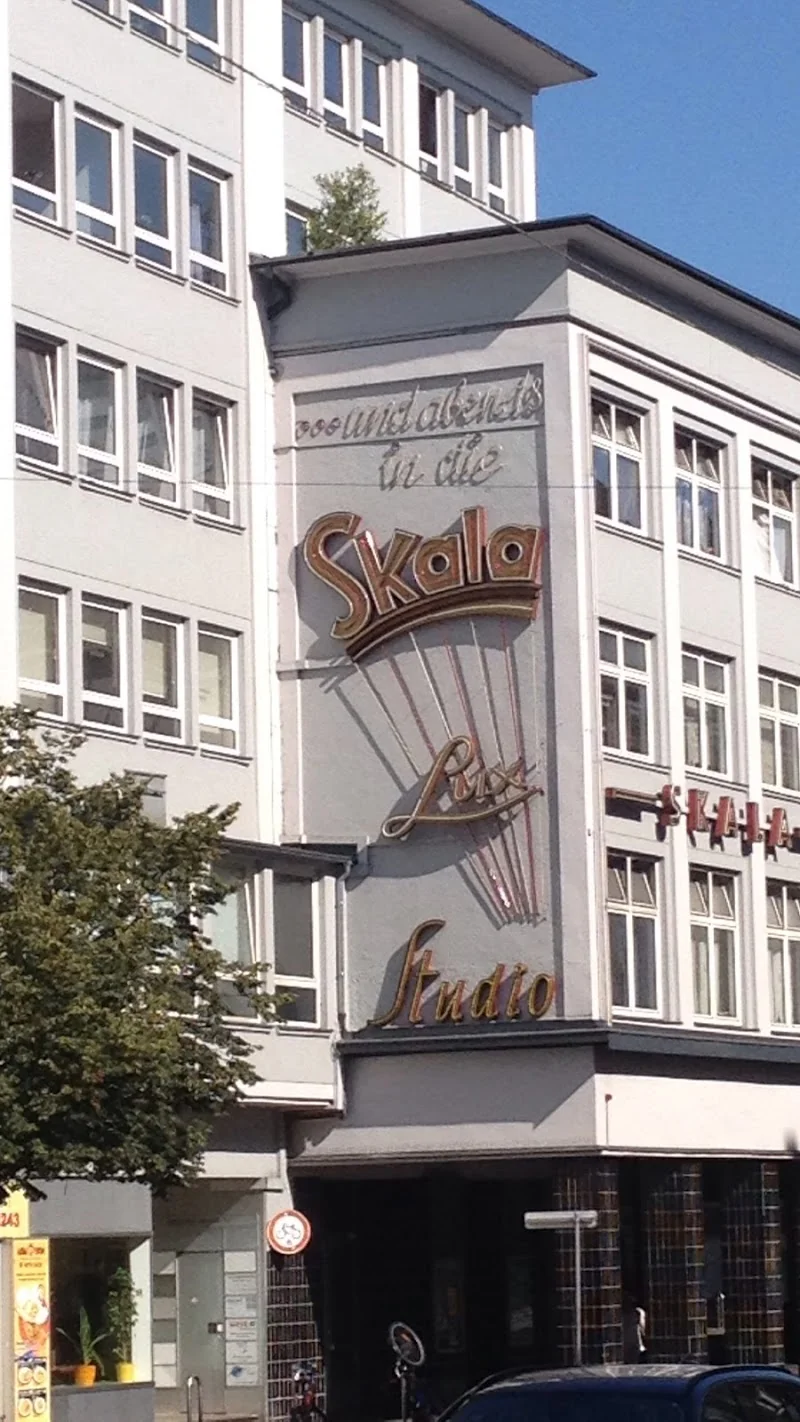
Herforder Str. 5-7, Bielefeld
Herforder Str. 5-7, 33602 Bielefeld, Germany
Kulturpunkt Skala e.V. | Program & Tickets Bielefeld
The Kulturpunkt Skala e.V. operates one of the most charming small stages in Bielefeld: the Skala at Jahnplatz, Herforder Straße 5 7. Where cinematic history was once made, today an immediate theater experience is created in a small space with close proximity to the stage and direct contact with the performers. The intimate size of around 100 seats, the central location in the city center, and the good accessibility by tram and bus make the Skala a preferred meeting point for puppet theater, improv shows, readings, and small music formats. The non-profit association Kulturpunkt Skala e.V. was founded in October 2016 by supporters of the Bielefeld Puppet Theater to strengthen the location organizationally and financially and to expand the program in cooperation with local cultural creators. Since then, both the Bielefeld Puppet Theater and the improv theater group Knall auf Fall have significantly shaped the program. For visitors, this means: manageable routes, clear information, warm hospitality at the box office, and a stage that is optimally lit for small arts. Those looking for a central, authentic cultural address in Bielefeld will find here a venue that combines historical atmosphere with vibrant present.
Tickets and Prices: Advance Sale, Box Office, and Free Seating
The ticket purchase for events at the Skala is based on the respective organizer, as the stage is used by various partners and ensembles. A proven example is the regular improv shows by Knall auf Fall. For these dates, interested parties can conveniently reserve their tickets online; in this format, free seating usually applies. The price range is transparent and remains visitor-friendly: For evening events, 14 euros are typically charged at the box office, reduced or 12 euros with advance reservation. Family formats like Knaller für Kids often cost 8 euros for adults and 6 euros for children. Reserved tickets are held at the Skala box office until shortly before the show starts and are paid for in cash on site; entry to the foyer usually begins 30 minutes before the performance, allowing enough time to pick up the reservation and start relaxed. For the puppet theater performances of the Bielefeld Puppet Theater, reservations are often made by phone or email through the ensemble. This practice fits the scale of the stage and contributes to the personal atmosphere of the house. In addition, individual Skala dates also appear in regional ticket and event portals, for example through the city's tourist information or municipal cultural calendars, allowing interested parties to find additional advance sale options. Important for all visitors: Since the Skala is a small house, many formats fill up quickly. Therefore, it is worthwhile to book or reserve early. The free seating at improv formats is appreciated by many guests because one can choose to be close to the stage or maintain an overview from a distance. For performances with particularly high demand, the box office usually still offers a small remaining contingent; early arrival is recommended here. Prices, discounts, and booking methods depend on the format but are clearly communicated by the respective organizers. Those who inform themselves in advance will experience a smooth entry and a quick process at the box office.
Program and Events: Improv, Puppet Theater, Readings, and Small Concerts
Content-wise, the Skala stands for a compact, varied repertoire. Since early 2018, the improv theater group Knall auf Fall has been a regular guest. The ensemble fills the intimate stage with spontaneous stories, interactive moments, and a lot of humor. Thanks to the size of the hall, every punchline hits directly, and the communicative distance between the audience and performers tends toward zero. Equally significant for the venue are the Bielefeld Puppet Theater. They bring lively puppet theater for children, families, and adults to the stage and utilize the strengths of the former cinema: the harmonious lighting, good sightlines, and cozy ambiance. In addition to these core formats, there are always readings, storytelling evenings, and small music events at the Skala, characterized by acoustic closeness and clear sightlines. External initiatives and festivals also use the hall occasionally, allowing new target groups to discover the venue. An example from recent history includes dates from the realm of young cultural initiatives or music theater projects that designate the Skala as a venue at Jahnplatz and offer their tickets partly solidarity-based or at low thresholds. For the audience, this mix means: a manageable calendar but a great variety of genres. Instead of getting lost in parallel large events, one consciously immerses in a concentrated experience space that emphasizes the immediate. The program is curated decentral; the most important sources remain the websites of the performing groups and the municipal cultural information. Those looking for a special evening will find short paths between advance notice and visit in the Skala: curtain up, choose a seat, dive in. The house is also excellent for first contacts with theater and small arts, for example, during family performances in the afternoon. Thus, the Skala becomes the hinge between the Bielefeld cultural scene and the city society, repeatedly trying out new formats in a trusting framework.
Directions and Public Transport to Jahnplatz: How to Quickly Get to Skala
The Skala is located at Herforder Straße 5 7 directly at Jahnplatz, the central traffic hub of Bielefeld. This location is particularly convenient for visitors, as nearly all important tram lines operate here, and numerous bus lines branch out in all directions. Those arriving from the main train station can reach Jahnplatz after a very short ride on any of the tram lines operating there; the frequency is high, the routes are barrier-free organized, and the signage in the city center makes orientation easy. From the Jahnplatz stop, a short walk along Herforder Straße leads directly to the entrance of the Skala. Due to the central location, the stage is excellently integrated into urban everyday life, facilitating spontaneous theater visits after work or on weekends. Visitors from the surrounding area also benefit, as buses and trains converge at Jahnplatz and ensure distribution into the city. Those arriving by bike will find places to park in the adjacent streets; the traffic management in the city center has aimed for good connections for environmentally friendly transport for years. For guests unfamiliar with the area, it is worthwhile to check the real-time information from the Bielefeld transport companies, which early indicate possible construction work or detours at Jahnplatz. During major events at the square, there may be temporary closures and adjusted routes; in such cases, passenger information reliably guides alternatives. The advantage remains: even with changed traffic management, Jahnplatz as a city center hub is quickly reachable, and from there, the walk to the Skala takes only a few minutes. Those wishing to continue seamlessly after the performance have connections until late in the evening at Jahnplatz. Thus, public transport connects the gap between program announcement and journey home and ensures that culture can be experienced without searching for parking and with short distances.
Parking at Skala: Parking Garages Nearby and Tips
Although the Skala is excellently accessible by public transport, some guests arrive by car. For this purpose, the immediate surroundings offer several parking garages that are within walking distance. Notable are particularly Q Park Karstadt, the parking garage Ritterstraße, the underground garage at the town hall, and the parking garage Kesselbrink. The city of Bielefeld points out that there are no parking spaces directly at Jahnplatz itself, but various parking garages in the immediate vicinity. Additionally, the cultural office notes that there is a parking garage directly next to the house. This keeps the distances short, even for events with higher attendance. It is advisable to initially plan about ten to fifteen minutes more time for parking and the short walk, especially on weekdays during peak traffic times or on Saturdays. Many parking garages now offer clear pricing and time models as well as digital displays of availability; those who check the respective parking garage's website in advance can minimize waiting times and choose the most economical option. For picking up reserved tickets at the box office, the close proximity is particularly helpful, as minor delays can be easily accommodated. Guests starting after 8 PM often benefit from cheaper evening rates. Those wishing to dine in the city center after the performance remain within immediate reach of gastronomy and other cultural venues with the mentioned parking garages. For visitors with mobility impairments, it is worthwhile, if available, to inquire about parking spaces in the nearest parking garages; the large operators usually provide detailed information online. Overall, the parking situation at Jahnplatz is pragmatically solvable: a short walk from the parking garage to the Skala, clear orientation along Herforder Straße, and the assurance that even with higher occupancy of the city center, several alternatives exist.
Hall, Seating, and Best Seats: Proximity to the Stage Instead of a Numbered Seating Plan
The charm of the Skala lies in the immediate experience. The hall of the former cinema is, according to the city's description, a cozy space with fixed bench seating and room for about 100 people. This results in a different seating feel than in large halls with steep tiers or expansive balconies. Instead of a detailed, numbered seating plan like in large venues, there is often free seating, including at the improv formats of Knall auf Fall. This allows the audience to directly engage with their preferences: those who want to see every movement of the performers take a front seat and experience facial expressions, timing, and small gestures up close. Those who love the overview choose the back rows, which, due to the size of the hall, remain very close to the action. A tip for first-time visitors: Arrive on time, orient yourself at the entrance, and secure a favorite seat early. Entry to the foyer begins for many formats about 30 minutes before the start; in the foyer, tickets can be picked up and drinks purchased before it’s relaxed into the hall. The nature of the space plays into the experience: proximity to the stage shortens acoustic paths and ensures clear speech intelligibility during readings and lively interplay during improv. The fixed bench seating supports an intimate room atmosphere, which is especially appreciated in small arts. Technically, the hall is well-equipped for its size; the house is designed for small productions, puppet theater, improv, and acoustically reduced music evenings. For productions with special technology, the performing groups coordinate their requirements individually with the house, such as regarding additional microphone equipment, projection, or smaller lighting concepts. Because the stage is not a large distance holder but rather a performance platform in the sight of all, the audience contributes significantly to the dynamics of the evening. This makes the Skala a place where one is quickly drawn into the performance energy and which presents the strengths of small formats unvarnished.
Facilities and Usage Options: What Organizers Should Know
Those considering the Skala as a space will find facilities tailored to the needs of small stages. According to the city’s overview, the hall has heating, air conditioning, and blackout capabilities, which facilitate planning for different formats and times of day. The varnished floor of the hall ensures a neat appearance and pleasant movement on stage. Two makeup stations are available behind the scenes; this allows compact productions and small arts evenings to be efficiently prepared. On the electrical side, Schuko connections are provided, which are sufficient for many setups in the small arts sector; for special requirements, technical managers coordinate details with the respective ensembles. Organizationally, the house is flexible: own staff deployment is generally possible, and box office staff is provided, which particularly facilitates the process for evenings with advance sale and box office. The city names small arts, improv theater, puppet theater, and small music events as types of events. This range covers the practice on site and is concretely filled with life through cooperation with the Bielefeld Puppet Theater and the improv group Knall auf Fall. For external partners, the location at Jahnplatz reduces logistical hurdles, as team, audience, and technology can quickly reach the city by tram and bus. The foyer is designed for reception, and reservations can usually be managed easily. Those who want to reach their audience precisely utilize visibility in the municipal cultural calendar and the short communication paths of the involved ensembles. Should an event require special audience guidance, the size of the hall is an advantage: instructions are quickly conveyed, and the atmosphere remains relaxed despite organizational necessities. From the visitor's perspective, this is reflected in a smooth process from arrival to ticket pickup to the first scene. Thus, the Skala becomes a place where art and organization come together in a harmonious, manageable infrastructure.
History and Special Features of the Skala House: From Cinema to Small Arts Stage
The Skala at Jahnplatz is more than just an address for today. Historical accounts describe the building as a traditional city center cinema that shaped film culture in Bielefeld for many years. Details from cinema chronicles report that in the same building, another cinema called Studio opened in the 1950s and that in 1965, the first Todd AO screen in Bielefeld for 70mm screenings was installed in the Skala. Such references mark the technical and cultural significance of the house in the city's history. After the cinema era, the building remained in family ownership and gradually opened up to new uses. The step to today's small arts stage arose from the combination of existing building substance, central location, and the initiative of local cultural creators. A central chapter of this development is the arrival of the Bielefeld Puppet Theater in the Skala building at Jahnplatz. Their presence gave the house a clear artistic signature, and in 2016, supporters of this engagement bundled their efforts in the non-profit Kulturpunkt Skala e.V. The association has been committed from the beginning to ensure that not only puppet theater takes place in the former cinema but that further formats enrich the program. Thus, with regular improv evenings, the immediacy of live-experienced stories returned to the hall. Today, those who ascend the stairs to the Skala feel a touch of nostalgia and at the same time the vibrancy of a place that has long accompanied the city. This tension between past and present is what makes the Skala appealing: a small hall with a great history that has remained what cultural venues are in the best sense, namely identification points in the city center. Together with the infrastructure of Jahnplatz, the short paths for guests and ensembles, and the open attitude towards new formats, the Skala remains an anchor point in Bielefeld's cultural life. It shows how existing spaces can write new chapters with commitment and cooperation without denying their origin.
Sources:
- Kulturpunkt Skala e.V. – Official Website of the Association
- Kulturpunkt Skala e.V. – Contact and Address
- Cultural Office Bielefeld – Skala: Capacity, Equipment, Usage
- Knall auf Fall – Improv Theater Bielefeld: Dates, Prices, Free Seating
- Bielefeld Puppet Theater – Dagmar Selje: Venue Skala
- City of Bielefeld – Jahnplatz: Location and Accessibility
- Q Park Karstadt Bielefeld – Parking Information City Center
- City of Bielefeld – Overview of Parking Garages and Spaces
- Klangfestival Bielefeld – Event Page with Venue Skala
- CinemaSite – History of Skala Cinema Bielefeld
Show moreShow less
Kulturpunkt Skala e.V. | Program & Tickets Bielefeld
The Kulturpunkt Skala e.V. operates one of the most charming small stages in Bielefeld: the Skala at Jahnplatz, Herforder Straße 5 7. Where cinematic history was once made, today an immediate theater experience is created in a small space with close proximity to the stage and direct contact with the performers. The intimate size of around 100 seats, the central location in the city center, and the good accessibility by tram and bus make the Skala a preferred meeting point for puppet theater, improv shows, readings, and small music formats. The non-profit association Kulturpunkt Skala e.V. was founded in October 2016 by supporters of the Bielefeld Puppet Theater to strengthen the location organizationally and financially and to expand the program in cooperation with local cultural creators. Since then, both the Bielefeld Puppet Theater and the improv theater group Knall auf Fall have significantly shaped the program. For visitors, this means: manageable routes, clear information, warm hospitality at the box office, and a stage that is optimally lit for small arts. Those looking for a central, authentic cultural address in Bielefeld will find here a venue that combines historical atmosphere with vibrant present.
Tickets and Prices: Advance Sale, Box Office, and Free Seating
The ticket purchase for events at the Skala is based on the respective organizer, as the stage is used by various partners and ensembles. A proven example is the regular improv shows by Knall auf Fall. For these dates, interested parties can conveniently reserve their tickets online; in this format, free seating usually applies. The price range is transparent and remains visitor-friendly: For evening events, 14 euros are typically charged at the box office, reduced or 12 euros with advance reservation. Family formats like Knaller für Kids often cost 8 euros for adults and 6 euros for children. Reserved tickets are held at the Skala box office until shortly before the show starts and are paid for in cash on site; entry to the foyer usually begins 30 minutes before the performance, allowing enough time to pick up the reservation and start relaxed. For the puppet theater performances of the Bielefeld Puppet Theater, reservations are often made by phone or email through the ensemble. This practice fits the scale of the stage and contributes to the personal atmosphere of the house. In addition, individual Skala dates also appear in regional ticket and event portals, for example through the city's tourist information or municipal cultural calendars, allowing interested parties to find additional advance sale options. Important for all visitors: Since the Skala is a small house, many formats fill up quickly. Therefore, it is worthwhile to book or reserve early. The free seating at improv formats is appreciated by many guests because one can choose to be close to the stage or maintain an overview from a distance. For performances with particularly high demand, the box office usually still offers a small remaining contingent; early arrival is recommended here. Prices, discounts, and booking methods depend on the format but are clearly communicated by the respective organizers. Those who inform themselves in advance will experience a smooth entry and a quick process at the box office.
Program and Events: Improv, Puppet Theater, Readings, and Small Concerts
Content-wise, the Skala stands for a compact, varied repertoire. Since early 2018, the improv theater group Knall auf Fall has been a regular guest. The ensemble fills the intimate stage with spontaneous stories, interactive moments, and a lot of humor. Thanks to the size of the hall, every punchline hits directly, and the communicative distance between the audience and performers tends toward zero. Equally significant for the venue are the Bielefeld Puppet Theater. They bring lively puppet theater for children, families, and adults to the stage and utilize the strengths of the former cinema: the harmonious lighting, good sightlines, and cozy ambiance. In addition to these core formats, there are always readings, storytelling evenings, and small music events at the Skala, characterized by acoustic closeness and clear sightlines. External initiatives and festivals also use the hall occasionally, allowing new target groups to discover the venue. An example from recent history includes dates from the realm of young cultural initiatives or music theater projects that designate the Skala as a venue at Jahnplatz and offer their tickets partly solidarity-based or at low thresholds. For the audience, this mix means: a manageable calendar but a great variety of genres. Instead of getting lost in parallel large events, one consciously immerses in a concentrated experience space that emphasizes the immediate. The program is curated decentral; the most important sources remain the websites of the performing groups and the municipal cultural information. Those looking for a special evening will find short paths between advance notice and visit in the Skala: curtain up, choose a seat, dive in. The house is also excellent for first contacts with theater and small arts, for example, during family performances in the afternoon. Thus, the Skala becomes the hinge between the Bielefeld cultural scene and the city society, repeatedly trying out new formats in a trusting framework.
Directions and Public Transport to Jahnplatz: How to Quickly Get to Skala
The Skala is located at Herforder Straße 5 7 directly at Jahnplatz, the central traffic hub of Bielefeld. This location is particularly convenient for visitors, as nearly all important tram lines operate here, and numerous bus lines branch out in all directions. Those arriving from the main train station can reach Jahnplatz after a very short ride on any of the tram lines operating there; the frequency is high, the routes are barrier-free organized, and the signage in the city center makes orientation easy. From the Jahnplatz stop, a short walk along Herforder Straße leads directly to the entrance of the Skala. Due to the central location, the stage is excellently integrated into urban everyday life, facilitating spontaneous theater visits after work or on weekends. Visitors from the surrounding area also benefit, as buses and trains converge at Jahnplatz and ensure distribution into the city. Those arriving by bike will find places to park in the adjacent streets; the traffic management in the city center has aimed for good connections for environmentally friendly transport for years. For guests unfamiliar with the area, it is worthwhile to check the real-time information from the Bielefeld transport companies, which early indicate possible construction work or detours at Jahnplatz. During major events at the square, there may be temporary closures and adjusted routes; in such cases, passenger information reliably guides alternatives. The advantage remains: even with changed traffic management, Jahnplatz as a city center hub is quickly reachable, and from there, the walk to the Skala takes only a few minutes. Those wishing to continue seamlessly after the performance have connections until late in the evening at Jahnplatz. Thus, public transport connects the gap between program announcement and journey home and ensures that culture can be experienced without searching for parking and with short distances.
Parking at Skala: Parking Garages Nearby and Tips
Although the Skala is excellently accessible by public transport, some guests arrive by car. For this purpose, the immediate surroundings offer several parking garages that are within walking distance. Notable are particularly Q Park Karstadt, the parking garage Ritterstraße, the underground garage at the town hall, and the parking garage Kesselbrink. The city of Bielefeld points out that there are no parking spaces directly at Jahnplatz itself, but various parking garages in the immediate vicinity. Additionally, the cultural office notes that there is a parking garage directly next to the house. This keeps the distances short, even for events with higher attendance. It is advisable to initially plan about ten to fifteen minutes more time for parking and the short walk, especially on weekdays during peak traffic times or on Saturdays. Many parking garages now offer clear pricing and time models as well as digital displays of availability; those who check the respective parking garage's website in advance can minimize waiting times and choose the most economical option. For picking up reserved tickets at the box office, the close proximity is particularly helpful, as minor delays can be easily accommodated. Guests starting after 8 PM often benefit from cheaper evening rates. Those wishing to dine in the city center after the performance remain within immediate reach of gastronomy and other cultural venues with the mentioned parking garages. For visitors with mobility impairments, it is worthwhile, if available, to inquire about parking spaces in the nearest parking garages; the large operators usually provide detailed information online. Overall, the parking situation at Jahnplatz is pragmatically solvable: a short walk from the parking garage to the Skala, clear orientation along Herforder Straße, and the assurance that even with higher occupancy of the city center, several alternatives exist.
Hall, Seating, and Best Seats: Proximity to the Stage Instead of a Numbered Seating Plan
The charm of the Skala lies in the immediate experience. The hall of the former cinema is, according to the city's description, a cozy space with fixed bench seating and room for about 100 people. This results in a different seating feel than in large halls with steep tiers or expansive balconies. Instead of a detailed, numbered seating plan like in large venues, there is often free seating, including at the improv formats of Knall auf Fall. This allows the audience to directly engage with their preferences: those who want to see every movement of the performers take a front seat and experience facial expressions, timing, and small gestures up close. Those who love the overview choose the back rows, which, due to the size of the hall, remain very close to the action. A tip for first-time visitors: Arrive on time, orient yourself at the entrance, and secure a favorite seat early. Entry to the foyer begins for many formats about 30 minutes before the start; in the foyer, tickets can be picked up and drinks purchased before it’s relaxed into the hall. The nature of the space plays into the experience: proximity to the stage shortens acoustic paths and ensures clear speech intelligibility during readings and lively interplay during improv. The fixed bench seating supports an intimate room atmosphere, which is especially appreciated in small arts. Technically, the hall is well-equipped for its size; the house is designed for small productions, puppet theater, improv, and acoustically reduced music evenings. For productions with special technology, the performing groups coordinate their requirements individually with the house, such as regarding additional microphone equipment, projection, or smaller lighting concepts. Because the stage is not a large distance holder but rather a performance platform in the sight of all, the audience contributes significantly to the dynamics of the evening. This makes the Skala a place where one is quickly drawn into the performance energy and which presents the strengths of small formats unvarnished.
Facilities and Usage Options: What Organizers Should Know
Those considering the Skala as a space will find facilities tailored to the needs of small stages. According to the city’s overview, the hall has heating, air conditioning, and blackout capabilities, which facilitate planning for different formats and times of day. The varnished floor of the hall ensures a neat appearance and pleasant movement on stage. Two makeup stations are available behind the scenes; this allows compact productions and small arts evenings to be efficiently prepared. On the electrical side, Schuko connections are provided, which are sufficient for many setups in the small arts sector; for special requirements, technical managers coordinate details with the respective ensembles. Organizationally, the house is flexible: own staff deployment is generally possible, and box office staff is provided, which particularly facilitates the process for evenings with advance sale and box office. The city names small arts, improv theater, puppet theater, and small music events as types of events. This range covers the practice on site and is concretely filled with life through cooperation with the Bielefeld Puppet Theater and the improv group Knall auf Fall. For external partners, the location at Jahnplatz reduces logistical hurdles, as team, audience, and technology can quickly reach the city by tram and bus. The foyer is designed for reception, and reservations can usually be managed easily. Those who want to reach their audience precisely utilize visibility in the municipal cultural calendar and the short communication paths of the involved ensembles. Should an event require special audience guidance, the size of the hall is an advantage: instructions are quickly conveyed, and the atmosphere remains relaxed despite organizational necessities. From the visitor's perspective, this is reflected in a smooth process from arrival to ticket pickup to the first scene. Thus, the Skala becomes a place where art and organization come together in a harmonious, manageable infrastructure.
History and Special Features of the Skala House: From Cinema to Small Arts Stage
The Skala at Jahnplatz is more than just an address for today. Historical accounts describe the building as a traditional city center cinema that shaped film culture in Bielefeld for many years. Details from cinema chronicles report that in the same building, another cinema called Studio opened in the 1950s and that in 1965, the first Todd AO screen in Bielefeld for 70mm screenings was installed in the Skala. Such references mark the technical and cultural significance of the house in the city's history. After the cinema era, the building remained in family ownership and gradually opened up to new uses. The step to today's small arts stage arose from the combination of existing building substance, central location, and the initiative of local cultural creators. A central chapter of this development is the arrival of the Bielefeld Puppet Theater in the Skala building at Jahnplatz. Their presence gave the house a clear artistic signature, and in 2016, supporters of this engagement bundled their efforts in the non-profit Kulturpunkt Skala e.V. The association has been committed from the beginning to ensure that not only puppet theater takes place in the former cinema but that further formats enrich the program. Thus, with regular improv evenings, the immediacy of live-experienced stories returned to the hall. Today, those who ascend the stairs to the Skala feel a touch of nostalgia and at the same time the vibrancy of a place that has long accompanied the city. This tension between past and present is what makes the Skala appealing: a small hall with a great history that has remained what cultural venues are in the best sense, namely identification points in the city center. Together with the infrastructure of Jahnplatz, the short paths for guests and ensembles, and the open attitude towards new formats, the Skala remains an anchor point in Bielefeld's cultural life. It shows how existing spaces can write new chapters with commitment and cooperation without denying their origin.
Sources:
- Kulturpunkt Skala e.V. – Official Website of the Association
- Kulturpunkt Skala e.V. – Contact and Address
- Cultural Office Bielefeld – Skala: Capacity, Equipment, Usage
- Knall auf Fall – Improv Theater Bielefeld: Dates, Prices, Free Seating
- Bielefeld Puppet Theater – Dagmar Selje: Venue Skala
- City of Bielefeld – Jahnplatz: Location and Accessibility
- Q Park Karstadt Bielefeld – Parking Information City Center
- City of Bielefeld – Overview of Parking Garages and Spaces
- Klangfestival Bielefeld – Event Page with Venue Skala
- CinemaSite – History of Skala Cinema Bielefeld
Kulturpunkt Skala e.V. | Program & Tickets Bielefeld
The Kulturpunkt Skala e.V. operates one of the most charming small stages in Bielefeld: the Skala at Jahnplatz, Herforder Straße 5 7. Where cinematic history was once made, today an immediate theater experience is created in a small space with close proximity to the stage and direct contact with the performers. The intimate size of around 100 seats, the central location in the city center, and the good accessibility by tram and bus make the Skala a preferred meeting point for puppet theater, improv shows, readings, and small music formats. The non-profit association Kulturpunkt Skala e.V. was founded in October 2016 by supporters of the Bielefeld Puppet Theater to strengthen the location organizationally and financially and to expand the program in cooperation with local cultural creators. Since then, both the Bielefeld Puppet Theater and the improv theater group Knall auf Fall have significantly shaped the program. For visitors, this means: manageable routes, clear information, warm hospitality at the box office, and a stage that is optimally lit for small arts. Those looking for a central, authentic cultural address in Bielefeld will find here a venue that combines historical atmosphere with vibrant present.
Tickets and Prices: Advance Sale, Box Office, and Free Seating
The ticket purchase for events at the Skala is based on the respective organizer, as the stage is used by various partners and ensembles. A proven example is the regular improv shows by Knall auf Fall. For these dates, interested parties can conveniently reserve their tickets online; in this format, free seating usually applies. The price range is transparent and remains visitor-friendly: For evening events, 14 euros are typically charged at the box office, reduced or 12 euros with advance reservation. Family formats like Knaller für Kids often cost 8 euros for adults and 6 euros for children. Reserved tickets are held at the Skala box office until shortly before the show starts and are paid for in cash on site; entry to the foyer usually begins 30 minutes before the performance, allowing enough time to pick up the reservation and start relaxed. For the puppet theater performances of the Bielefeld Puppet Theater, reservations are often made by phone or email through the ensemble. This practice fits the scale of the stage and contributes to the personal atmosphere of the house. In addition, individual Skala dates also appear in regional ticket and event portals, for example through the city's tourist information or municipal cultural calendars, allowing interested parties to find additional advance sale options. Important for all visitors: Since the Skala is a small house, many formats fill up quickly. Therefore, it is worthwhile to book or reserve early. The free seating at improv formats is appreciated by many guests because one can choose to be close to the stage or maintain an overview from a distance. For performances with particularly high demand, the box office usually still offers a small remaining contingent; early arrival is recommended here. Prices, discounts, and booking methods depend on the format but are clearly communicated by the respective organizers. Those who inform themselves in advance will experience a smooth entry and a quick process at the box office.
Program and Events: Improv, Puppet Theater, Readings, and Small Concerts
Content-wise, the Skala stands for a compact, varied repertoire. Since early 2018, the improv theater group Knall auf Fall has been a regular guest. The ensemble fills the intimate stage with spontaneous stories, interactive moments, and a lot of humor. Thanks to the size of the hall, every punchline hits directly, and the communicative distance between the audience and performers tends toward zero. Equally significant for the venue are the Bielefeld Puppet Theater. They bring lively puppet theater for children, families, and adults to the stage and utilize the strengths of the former cinema: the harmonious lighting, good sightlines, and cozy ambiance. In addition to these core formats, there are always readings, storytelling evenings, and small music events at the Skala, characterized by acoustic closeness and clear sightlines. External initiatives and festivals also use the hall occasionally, allowing new target groups to discover the venue. An example from recent history includes dates from the realm of young cultural initiatives or music theater projects that designate the Skala as a venue at Jahnplatz and offer their tickets partly solidarity-based or at low thresholds. For the audience, this mix means: a manageable calendar but a great variety of genres. Instead of getting lost in parallel large events, one consciously immerses in a concentrated experience space that emphasizes the immediate. The program is curated decentral; the most important sources remain the websites of the performing groups and the municipal cultural information. Those looking for a special evening will find short paths between advance notice and visit in the Skala: curtain up, choose a seat, dive in. The house is also excellent for first contacts with theater and small arts, for example, during family performances in the afternoon. Thus, the Skala becomes the hinge between the Bielefeld cultural scene and the city society, repeatedly trying out new formats in a trusting framework.
Directions and Public Transport to Jahnplatz: How to Quickly Get to Skala
The Skala is located at Herforder Straße 5 7 directly at Jahnplatz, the central traffic hub of Bielefeld. This location is particularly convenient for visitors, as nearly all important tram lines operate here, and numerous bus lines branch out in all directions. Those arriving from the main train station can reach Jahnplatz after a very short ride on any of the tram lines operating there; the frequency is high, the routes are barrier-free organized, and the signage in the city center makes orientation easy. From the Jahnplatz stop, a short walk along Herforder Straße leads directly to the entrance of the Skala. Due to the central location, the stage is excellently integrated into urban everyday life, facilitating spontaneous theater visits after work or on weekends. Visitors from the surrounding area also benefit, as buses and trains converge at Jahnplatz and ensure distribution into the city. Those arriving by bike will find places to park in the adjacent streets; the traffic management in the city center has aimed for good connections for environmentally friendly transport for years. For guests unfamiliar with the area, it is worthwhile to check the real-time information from the Bielefeld transport companies, which early indicate possible construction work or detours at Jahnplatz. During major events at the square, there may be temporary closures and adjusted routes; in such cases, passenger information reliably guides alternatives. The advantage remains: even with changed traffic management, Jahnplatz as a city center hub is quickly reachable, and from there, the walk to the Skala takes only a few minutes. Those wishing to continue seamlessly after the performance have connections until late in the evening at Jahnplatz. Thus, public transport connects the gap between program announcement and journey home and ensures that culture can be experienced without searching for parking and with short distances.
Parking at Skala: Parking Garages Nearby and Tips
Although the Skala is excellently accessible by public transport, some guests arrive by car. For this purpose, the immediate surroundings offer several parking garages that are within walking distance. Notable are particularly Q Park Karstadt, the parking garage Ritterstraße, the underground garage at the town hall, and the parking garage Kesselbrink. The city of Bielefeld points out that there are no parking spaces directly at Jahnplatz itself, but various parking garages in the immediate vicinity. Additionally, the cultural office notes that there is a parking garage directly next to the house. This keeps the distances short, even for events with higher attendance. It is advisable to initially plan about ten to fifteen minutes more time for parking and the short walk, especially on weekdays during peak traffic times or on Saturdays. Many parking garages now offer clear pricing and time models as well as digital displays of availability; those who check the respective parking garage's website in advance can minimize waiting times and choose the most economical option. For picking up reserved tickets at the box office, the close proximity is particularly helpful, as minor delays can be easily accommodated. Guests starting after 8 PM often benefit from cheaper evening rates. Those wishing to dine in the city center after the performance remain within immediate reach of gastronomy and other cultural venues with the mentioned parking garages. For visitors with mobility impairments, it is worthwhile, if available, to inquire about parking spaces in the nearest parking garages; the large operators usually provide detailed information online. Overall, the parking situation at Jahnplatz is pragmatically solvable: a short walk from the parking garage to the Skala, clear orientation along Herforder Straße, and the assurance that even with higher occupancy of the city center, several alternatives exist.
Hall, Seating, and Best Seats: Proximity to the Stage Instead of a Numbered Seating Plan
The charm of the Skala lies in the immediate experience. The hall of the former cinema is, according to the city's description, a cozy space with fixed bench seating and room for about 100 people. This results in a different seating feel than in large halls with steep tiers or expansive balconies. Instead of a detailed, numbered seating plan like in large venues, there is often free seating, including at the improv formats of Knall auf Fall. This allows the audience to directly engage with their preferences: those who want to see every movement of the performers take a front seat and experience facial expressions, timing, and small gestures up close. Those who love the overview choose the back rows, which, due to the size of the hall, remain very close to the action. A tip for first-time visitors: Arrive on time, orient yourself at the entrance, and secure a favorite seat early. Entry to the foyer begins for many formats about 30 minutes before the start; in the foyer, tickets can be picked up and drinks purchased before it’s relaxed into the hall. The nature of the space plays into the experience: proximity to the stage shortens acoustic paths and ensures clear speech intelligibility during readings and lively interplay during improv. The fixed bench seating supports an intimate room atmosphere, which is especially appreciated in small arts. Technically, the hall is well-equipped for its size; the house is designed for small productions, puppet theater, improv, and acoustically reduced music evenings. For productions with special technology, the performing groups coordinate their requirements individually with the house, such as regarding additional microphone equipment, projection, or smaller lighting concepts. Because the stage is not a large distance holder but rather a performance platform in the sight of all, the audience contributes significantly to the dynamics of the evening. This makes the Skala a place where one is quickly drawn into the performance energy and which presents the strengths of small formats unvarnished.
Facilities and Usage Options: What Organizers Should Know
Those considering the Skala as a space will find facilities tailored to the needs of small stages. According to the city’s overview, the hall has heating, air conditioning, and blackout capabilities, which facilitate planning for different formats and times of day. The varnished floor of the hall ensures a neat appearance and pleasant movement on stage. Two makeup stations are available behind the scenes; this allows compact productions and small arts evenings to be efficiently prepared. On the electrical side, Schuko connections are provided, which are sufficient for many setups in the small arts sector; for special requirements, technical managers coordinate details with the respective ensembles. Organizationally, the house is flexible: own staff deployment is generally possible, and box office staff is provided, which particularly facilitates the process for evenings with advance sale and box office. The city names small arts, improv theater, puppet theater, and small music events as types of events. This range covers the practice on site and is concretely filled with life through cooperation with the Bielefeld Puppet Theater and the improv group Knall auf Fall. For external partners, the location at Jahnplatz reduces logistical hurdles, as team, audience, and technology can quickly reach the city by tram and bus. The foyer is designed for reception, and reservations can usually be managed easily. Those who want to reach their audience precisely utilize visibility in the municipal cultural calendar and the short communication paths of the involved ensembles. Should an event require special audience guidance, the size of the hall is an advantage: instructions are quickly conveyed, and the atmosphere remains relaxed despite organizational necessities. From the visitor's perspective, this is reflected in a smooth process from arrival to ticket pickup to the first scene. Thus, the Skala becomes a place where art and organization come together in a harmonious, manageable infrastructure.
History and Special Features of the Skala House: From Cinema to Small Arts Stage
The Skala at Jahnplatz is more than just an address for today. Historical accounts describe the building as a traditional city center cinema that shaped film culture in Bielefeld for many years. Details from cinema chronicles report that in the same building, another cinema called Studio opened in the 1950s and that in 1965, the first Todd AO screen in Bielefeld for 70mm screenings was installed in the Skala. Such references mark the technical and cultural significance of the house in the city's history. After the cinema era, the building remained in family ownership and gradually opened up to new uses. The step to today's small arts stage arose from the combination of existing building substance, central location, and the initiative of local cultural creators. A central chapter of this development is the arrival of the Bielefeld Puppet Theater in the Skala building at Jahnplatz. Their presence gave the house a clear artistic signature, and in 2016, supporters of this engagement bundled their efforts in the non-profit Kulturpunkt Skala e.V. The association has been committed from the beginning to ensure that not only puppet theater takes place in the former cinema but that further formats enrich the program. Thus, with regular improv evenings, the immediacy of live-experienced stories returned to the hall. Today, those who ascend the stairs to the Skala feel a touch of nostalgia and at the same time the vibrancy of a place that has long accompanied the city. This tension between past and present is what makes the Skala appealing: a small hall with a great history that has remained what cultural venues are in the best sense, namely identification points in the city center. Together with the infrastructure of Jahnplatz, the short paths for guests and ensembles, and the open attitude towards new formats, the Skala remains an anchor point in Bielefeld's cultural life. It shows how existing spaces can write new chapters with commitment and cooperation without denying their origin.
Sources:
- Kulturpunkt Skala e.V. – Official Website of the Association
- Kulturpunkt Skala e.V. – Contact and Address
- Cultural Office Bielefeld – Skala: Capacity, Equipment, Usage
- Knall auf Fall – Improv Theater Bielefeld: Dates, Prices, Free Seating
- Bielefeld Puppet Theater – Dagmar Selje: Venue Skala
- City of Bielefeld – Jahnplatz: Location and Accessibility
- Q Park Karstadt Bielefeld – Parking Information City Center
- City of Bielefeld – Overview of Parking Garages and Spaces
- Klangfestival Bielefeld – Event Page with Venue Skala
- CinemaSite – History of Skala Cinema Bielefeld
Upcoming Events
No events found
Frequently Asked Questions
Reviews
St S.
5. March 2026
I went there for improv theater - great!
Simon
17. April 2024
We were here a few days ago for Dies Das Comedy and it was a lot of fun :)
Guido Neumann
4. June 2015
Best sound system in Germany!
Kirsten Teckentrup
11. March 2026
If Briks Comedy Club is there, definitely check it out.