
Welle 61, Bielefeld
Welle 61, 33602 Bielefeld, Germany
Kunstverein Bielefeld | Exhibitions & Opening Hours
The Kunstverein Bielefeld is one of the defining addresses for contemporary art in East Westphalia and combines civic engagement with a clear curatorial profile. The association was founded in 1929 with the premise of promoting art and strengthening its mediation; its work is now supported by almost 1000 members. The location in the Waldhof in Bielefeld's old town gives the house a special atmosphere: historically grown, but consistently focused on contemporary relevance. The Kunstverein sees itself as a place where young international positions, critical questions, and current societal debates come together. This is precisely what creates its special aura: not a neutral white cube, but a vibrant space for exchange, experiments, and new perspectives. Therefore, those looking for the Kunstverein Bielefeld will find not only exhibitions but also a culturally relevant house with strong membership, a diverse program, and a clear anchoring in the Bielefeld art triangle alongside Kunsthalle and Kunstforum Hermann Stenner. ([kunstverein-bielefeld.de](https://www.kunstverein-bielefeld.de/de/kvb))
Current Exhibition and Events at Kunstverein Bielefeld
The most important search intention regarding the Kunstverein Bielefeld concerns the current program. This is exactly where the website is very clear: under exhibitions and in the preview, ongoing and upcoming positions are made visible, supplemented by accompanying texts, image series, and information on openings. Currently, the overview lists, among others, Key Chain, maxiOffset 60 g/m², and the annual gifts 2025/26. This shows how broadly the house operates: exhibition, edition, member format, and mediation interlink. For visitors, this creates a clear access point, as current content is not only presented but also placed in larger contexts. Thematically, the Kunstverein follows its own claim to connect solo presentations with thematic exhibitions and collaborations with international as well as regional partners. This results in a program that does not treat contemporary art as a closed canon but as an open field for discussion, perception, and experience. This is exactly what makes the Kunstverein Bielefeld particularly relevant for search queries like current exhibition, program, or events. ([kunstverein-bielefeld.de](https://www.kunstverein-bielefeld.de/en/exhibitions/current-exhibitions))
The event structure is also closely intertwined with the exhibition operation. The preview shows tours through the art library, dialogical formats in the living room, holiday workshops for children, tours with the directors, as well as collaborations with the artists' forum BI-OWL and the cultural circle Sennestadt. This mix is typical for the Kunstverein: it does not only work with classic openings but also with low-threshold, regular meeting formats that actively involve the audience. The living room is more than just a place name; it stands for the relaxed, discursive atmosphere in which images, roles, and the present are discussed. Additionally, there are family offerings and participatory formats that make the Kunstverein interesting for people who do not primarily come for a single artwork but for the exchange. Therefore, those searching for Kunstverein Bielefeld events, program, or current exhibition will find a house that continuously sets impulses and understands the visit as an encounter. ([kunstverein-bielefeld.de](https://kunstverein-bielefeld.de/de/events))
Opening Hours, Admission, and Directions to Kunstverein Bielefeld
For practical planning, opening hours and admission are central topics. The Kunstverein Bielefeld is regularly open from Thursday to Sunday from 12:00 to 18:00; visits from Monday to Wednesday are possible by appointment, and the house is closed on public holidays. The office can be reached on weekdays from Monday to Friday from 9:00 to 18:00. For admission, the Kunstverein relies on a clear and fair structure: regular 3 euros, reduced 1.50 euros, free admission for members, Bielefeld Pass holders, children and teenagers up to 18 years, and every Thursday. These conditions consciously make the house openly accessible and support the aim of conveying art as a public cultural practice. Those searching for Kunstverein Bielefeld opening hours or admission will quickly find the most important visitor data at a glance. The current visitor overview also publishes special notes for individual public holidays and specific changed opening days, making the site particularly useful for concrete daily planning. ([kunstverein-bielefeld.de](https://kunstverein-bielefeld.de/de/kvb/about/besuch))
The approach is also uncomplicated. The Kunstverein is centrally located in Bielefeld, in direct proximity to Kunsthalle Bielefeld, Kunstforum Hermann Stenner, and the pedestrian zone of the old town. For travel from the main train station, the website recommends taking the city train line 1 towards Senne to the Adenauerplatz stop. This location is very attractive for visitors who want to explore the city center on foot, as several art venues are within short distance. Together with Kunsthalle and Kunstforum, the Kunstverein forms the Bielefeld art triangle, a meaningful destination for a complete cultural walk. The historical environment of the Waldhof also acts as a plus point: instead of an isolated museum visit, one experiences a place that connects urban history, old town, and contemporary art. Therefore, those searching for Kunstverein Bielefeld directions or parking should see the central location, public transport connections, and good integration into the city center as the most important orientation points. ([kunstverein-bielefeld.de](https://kunstverein-bielefeld.de/de/kvb/about/besuch))
Membership, Annual Gifts, and Art Library at Kunstverein Bielefeld
A particularly strong keyword regarding the Kunstverein Bielefeld is membership, and for good reason. The association thrives on the engagement of its members and offers concrete benefits for this. Members receive free admission to exhibitions and events of the Kunstverein as well as to 300 other German art associations affiliated with the ADKV. Additionally, there are reduced admission to Kunsthalle Bielefeld, personal invitations to openings and accompanying events, discounts on publications, and the opportunity to participate in special member events. The annual contributions are transparently tiered: individual membership 50 euros, couple membership 75 euros, freelance visual artists 20 euros, students, trainees, unemployed, and social assistance recipients 10 euros. A gift membership is also possible. This structure shows that membership in the Kunstverein Bielefeld is not only symbolic but directly contributes to cultural work and simultaneously creates real added value for individual access to art. For those searching for Kunstverein Bielefeld membership or team, this means: the association sees itself as an open community and not as a closed institution. ([kunstverein-bielefeld.de](https://kunstverein-bielefeld.de/de/kvb/membership/signup))
Equally important are the annual gifts. Each year, the Kunstverein presents its members with an exclusive selection of editions and unique pieces. The purchase is initially reserved for members; non-members can only order under certain conditions. The model is culturally interesting because it provides visibility for young artists while also strengthening the association financially. Therefore, those searching for Kunstverein Bielefeld annual gifts will find not arbitrary merchandising but curated artistic works with collecting and supporting character. This profile is complemented by the art library, which includes around 750 framed graphics, photographs, drawings, and prints from the 20th and 21st centuries. The collection was established in 1978 and continuously expanded; the works can be borrowed through the Bielefeld city library. The website mentions a fee of 2 euros per work. For many people, the art library is a low-threshold entry into the art world, as art can not only be viewed but also brought into everyday life for a period. This connection of mediation, collection, and member culture makes the Kunstverein Bielefeld so unique. ([kunstverein-bielefeld.de](https://kunstverein-bielefeld.de/de/kvb/editions))
Management and Team of Kunstverein Bielefeld
Those searching for Kunstverein Bielefeld management or team will find a clear and current structure on the official page. The directors are Katharina Klang and Victoria Tarak. The team is complemented by the scientific intern Vilma Klingaite and Vera Brüggemann in the area of visitor and member support. The board consists of Andreas Wannenmacher as chairman, Audrey Hörmann as deputy chairman, Fabian Kauczok as treasurer, as well as Prof. Roman Bezjak and Uli Horaczek. In addition, there is a broadly composed advisory board with personalities from art, culture, and science. This mix of full-time management, voluntary committee work, and professional advice fits the self-understanding of the house as a civic institution with a public cultural mandate. It also shows why the Kunstverein is perceived as a reliable actor beyond its actual exhibition operations. For search engine queries like Kunstverein Bielefeld team or management, these names are particularly relevant because they transparently name the responsible parties of the house. ([kunstverein-bielefeld.de](https://www.kunstverein-bielefeld.de/de/kvb))
The team structure is not only administration but also part of the mediation work. The website additionally lists freelancers for technology and mediation, and the events show that the house works strongly in a dialog-oriented manner. Formats like Tuesdays in the living room, tours through the art library, or workshops for children thrive on this personal presence. The Kunstverein is thus not an anonymous exhibition operation but an institution where visitor support, scientific work, curation, and technical implementation intertwine. This also explains why many visitors describe the place as warm and accessible: the reception is friendly, English is spoken, and contact with the public is explicitly welcomed. From an SEO perspective, this is important because terms like team, management, and membership not only provide names but create a credible image of an open art association. Therefore, those looking for Kunstverein Bielefeld are not only searching for art but also for people who make art visible and debatable. ([kunstverein-bielefeld.de](https://www.kunstverein-bielefeld.de/de/kvb))
History, Waldhof, and Special Rooms of Kunstverein Bielefeld
The historical depth of Kunstverein Bielefeld is one of its greatest unique selling points. The official history refers to a development that began in 1881 with the first art association for Bielefeld and the surrounding area. The current Kunstverein was newly founded in 1929 after the desire for a civic-supported art promotion arose again. In the following decades, the relationship with the city and other cultural institutions changed several times: the association supported exhibitions, organized art trips and lectures, set up annual gifts, and contributed to the establishment of the art library. A significant turning point was marked in 1984 when the Kunstverein took over the sponsorship of the former museum in Waldhof. With the more professional structure, a cooperation agreement with the city in 1991, and the renovation of the Waldhof in 1997, the house developed into an independent exhibition venue for contemporary art. Later, new thematic focuses were added, such as architectural mediation and the series Baukunst, which has been an important part of the profile since 2000. This historical development makes it clear that the Kunstverein Bielefeld is not simply a current exhibition location but a house with a grown cultural responsibility. ([kunstverein-bielefeld.de](https://kunstverein-bielefeld.de/de/kvb/about/geschichte))
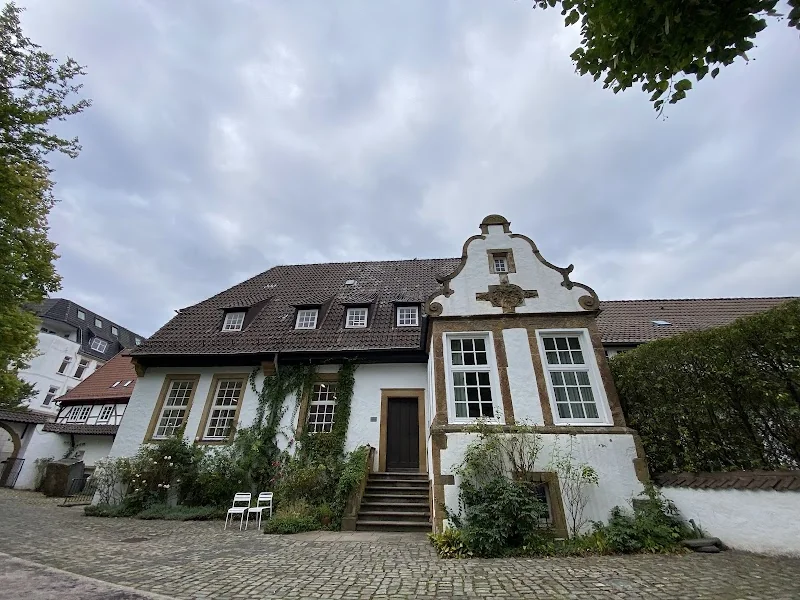
The place itself reinforces this profile. The Kunstverein is located in the Waldhof, a noble court from the 16th century in the style of Weser Renaissance. Parts of the building fabric date back to the time of the founding of Bielefeld in the 13th century, and the approximately forty square meter vault originates from the Gothic period. This mixture of age, materiality, and spatial concentration shapes the impact of the house. The vault can be rented for events by private individuals or companies and accommodates a maximum of 30 people, making the historical space particularly intimate. In the courtyard are the works Table by Reinhard Buxel and 1990 by Maria Dompè; additionally, the installation The Morning by Elisabeth Masé can be viewed by arrangement. Beyond regular opening hours, the courtyard is open on weekdays from 9:00 to 18:00. For visitors, this creates an unusually poetic overall picture: contemporary art, medieval substance, courtyard space, and small sculptures enter into a direct dialogue. This is precisely why the term Bielefeld Art Association in the Waldhof is so strong for SEO analysis, as it describes both place and identity. ([kunstverein-bielefeld.de](https://kunstverein-bielefeld.de/de/kvb/about/gebaeude))
Photos, Instagram, and Image Series from Kunstverein Bielefeld
For search queries like Kunstverein Bielefeld photos or Kunstverein Bielefeld Instagram, the website also offers helpful points of connection. The pages are directly linked to Facebook and Instagram, and many exhibition pages feature extensive image series. The current page on Hedda Roman, for example, shows several image views, while the overview pages of current exhibitions visually accompany the different projects. This is important for users who want to get an impression before a visit. Art is not only described here but shown in its spatial effect. Especially in a house like the Kunstverein Bielefeld, whose rooms are strongly shaped by architecture and light, photos are a central part of mediation. Those searching for impressions see not only individual works but also get an impression of the hanging, atmosphere, and courtyard situation. This is a significant advantage over purely text-based art sites, as the visual level makes the character of the place directly understandable. ([kunstverein-bielefeld.de](https://kunstverein-bielefeld.de/de/kvb/about/besuch))
In addition, there are further materials in the press area and at the exhibitions, such as press releases and PDF dossiers on individual projects. This is particularly useful for research because background information, image material, and curatorial classifications come together there. The website thus functions on two levels: as an information page for visitors and as a working tool for the press, art enthusiasts, and potential cooperation partners. The combination of social media presence, image series, program information, and archived exhibition texts makes the Kunstverein Bielefeld very easily findable online. Therefore, those searching for photos, Instagram, or current press information will find it directly on the official page and can get to know the place digitally before the real visit in the Waldhof begins. This closes the circle between digital visibility and physical art experience: the Kunstverein Bielefeld remains a place of encounter that cleverly prepares its impact online and convincingly fulfills it on-site. ([kunstverein-bielefeld.de](https://kunstverein-bielefeld.de/de/kvb/press?utm_source=openai))
Sources:
Show moreShow less
Kunstverein Bielefeld | Exhibitions & Opening Hours
The Kunstverein Bielefeld is one of the defining addresses for contemporary art in East Westphalia and combines civic engagement with a clear curatorial profile. The association was founded in 1929 with the premise of promoting art and strengthening its mediation; its work is now supported by almost 1000 members. The location in the Waldhof in Bielefeld's old town gives the house a special atmosphere: historically grown, but consistently focused on contemporary relevance. The Kunstverein sees itself as a place where young international positions, critical questions, and current societal debates come together. This is precisely what creates its special aura: not a neutral white cube, but a vibrant space for exchange, experiments, and new perspectives. Therefore, those looking for the Kunstverein Bielefeld will find not only exhibitions but also a culturally relevant house with strong membership, a diverse program, and a clear anchoring in the Bielefeld art triangle alongside Kunsthalle and Kunstforum Hermann Stenner. ([kunstverein-bielefeld.de](https://www.kunstverein-bielefeld.de/de/kvb))
Current Exhibition and Events at Kunstverein Bielefeld
The most important search intention regarding the Kunstverein Bielefeld concerns the current program. This is exactly where the website is very clear: under exhibitions and in the preview, ongoing and upcoming positions are made visible, supplemented by accompanying texts, image series, and information on openings. Currently, the overview lists, among others, Key Chain, maxiOffset 60 g/m², and the annual gifts 2025/26. This shows how broadly the house operates: exhibition, edition, member format, and mediation interlink. For visitors, this creates a clear access point, as current content is not only presented but also placed in larger contexts. Thematically, the Kunstverein follows its own claim to connect solo presentations with thematic exhibitions and collaborations with international as well as regional partners. This results in a program that does not treat contemporary art as a closed canon but as an open field for discussion, perception, and experience. This is exactly what makes the Kunstverein Bielefeld particularly relevant for search queries like current exhibition, program, or events. ([kunstverein-bielefeld.de](https://www.kunstverein-bielefeld.de/en/exhibitions/current-exhibitions))
The event structure is also closely intertwined with the exhibition operation. The preview shows tours through the art library, dialogical formats in the living room, holiday workshops for children, tours with the directors, as well as collaborations with the artists' forum BI-OWL and the cultural circle Sennestadt. This mix is typical for the Kunstverein: it does not only work with classic openings but also with low-threshold, regular meeting formats that actively involve the audience. The living room is more than just a place name; it stands for the relaxed, discursive atmosphere in which images, roles, and the present are discussed. Additionally, there are family offerings and participatory formats that make the Kunstverein interesting for people who do not primarily come for a single artwork but for the exchange. Therefore, those searching for Kunstverein Bielefeld events, program, or current exhibition will find a house that continuously sets impulses and understands the visit as an encounter. ([kunstverein-bielefeld.de](https://kunstverein-bielefeld.de/de/events))
Opening Hours, Admission, and Directions to Kunstverein Bielefeld
For practical planning, opening hours and admission are central topics. The Kunstverein Bielefeld is regularly open from Thursday to Sunday from 12:00 to 18:00; visits from Monday to Wednesday are possible by appointment, and the house is closed on public holidays. The office can be reached on weekdays from Monday to Friday from 9:00 to 18:00. For admission, the Kunstverein relies on a clear and fair structure: regular 3 euros, reduced 1.50 euros, free admission for members, Bielefeld Pass holders, children and teenagers up to 18 years, and every Thursday. These conditions consciously make the house openly accessible and support the aim of conveying art as a public cultural practice. Those searching for Kunstverein Bielefeld opening hours or admission will quickly find the most important visitor data at a glance. The current visitor overview also publishes special notes for individual public holidays and specific changed opening days, making the site particularly useful for concrete daily planning. ([kunstverein-bielefeld.de](https://kunstverein-bielefeld.de/de/kvb/about/besuch))
The approach is also uncomplicated. The Kunstverein is centrally located in Bielefeld, in direct proximity to Kunsthalle Bielefeld, Kunstforum Hermann Stenner, and the pedestrian zone of the old town. For travel from the main train station, the website recommends taking the city train line 1 towards Senne to the Adenauerplatz stop. This location is very attractive for visitors who want to explore the city center on foot, as several art venues are within short distance. Together with Kunsthalle and Kunstforum, the Kunstverein forms the Bielefeld art triangle, a meaningful destination for a complete cultural walk. The historical environment of the Waldhof also acts as a plus point: instead of an isolated museum visit, one experiences a place that connects urban history, old town, and contemporary art. Therefore, those searching for Kunstverein Bielefeld directions or parking should see the central location, public transport connections, and good integration into the city center as the most important orientation points. ([kunstverein-bielefeld.de](https://kunstverein-bielefeld.de/de/kvb/about/besuch))
Membership, Annual Gifts, and Art Library at Kunstverein Bielefeld
A particularly strong keyword regarding the Kunstverein Bielefeld is membership, and for good reason. The association thrives on the engagement of its members and offers concrete benefits for this. Members receive free admission to exhibitions and events of the Kunstverein as well as to 300 other German art associations affiliated with the ADKV. Additionally, there are reduced admission to Kunsthalle Bielefeld, personal invitations to openings and accompanying events, discounts on publications, and the opportunity to participate in special member events. The annual contributions are transparently tiered: individual membership 50 euros, couple membership 75 euros, freelance visual artists 20 euros, students, trainees, unemployed, and social assistance recipients 10 euros. A gift membership is also possible. This structure shows that membership in the Kunstverein Bielefeld is not only symbolic but directly contributes to cultural work and simultaneously creates real added value for individual access to art. For those searching for Kunstverein Bielefeld membership or team, this means: the association sees itself as an open community and not as a closed institution. ([kunstverein-bielefeld.de](https://kunstverein-bielefeld.de/de/kvb/membership/signup))
Equally important are the annual gifts. Each year, the Kunstverein presents its members with an exclusive selection of editions and unique pieces. The purchase is initially reserved for members; non-members can only order under certain conditions. The model is culturally interesting because it provides visibility for young artists while also strengthening the association financially. Therefore, those searching for Kunstverein Bielefeld annual gifts will find not arbitrary merchandising but curated artistic works with collecting and supporting character. This profile is complemented by the art library, which includes around 750 framed graphics, photographs, drawings, and prints from the 20th and 21st centuries. The collection was established in 1978 and continuously expanded; the works can be borrowed through the Bielefeld city library. The website mentions a fee of 2 euros per work. For many people, the art library is a low-threshold entry into the art world, as art can not only be viewed but also brought into everyday life for a period. This connection of mediation, collection, and member culture makes the Kunstverein Bielefeld so unique. ([kunstverein-bielefeld.de](https://kunstverein-bielefeld.de/de/kvb/editions))
Management and Team of Kunstverein Bielefeld
Those searching for Kunstverein Bielefeld management or team will find a clear and current structure on the official page. The directors are Katharina Klang and Victoria Tarak. The team is complemented by the scientific intern Vilma Klingaite and Vera Brüggemann in the area of visitor and member support. The board consists of Andreas Wannenmacher as chairman, Audrey Hörmann as deputy chairman, Fabian Kauczok as treasurer, as well as Prof. Roman Bezjak and Uli Horaczek. In addition, there is a broadly composed advisory board with personalities from art, culture, and science. This mix of full-time management, voluntary committee work, and professional advice fits the self-understanding of the house as a civic institution with a public cultural mandate. It also shows why the Kunstverein is perceived as a reliable actor beyond its actual exhibition operations. For search engine queries like Kunstverein Bielefeld team or management, these names are particularly relevant because they transparently name the responsible parties of the house. ([kunstverein-bielefeld.de](https://www.kunstverein-bielefeld.de/de/kvb))
The team structure is not only administration but also part of the mediation work. The website additionally lists freelancers for technology and mediation, and the events show that the house works strongly in a dialog-oriented manner. Formats like Tuesdays in the living room, tours through the art library, or workshops for children thrive on this personal presence. The Kunstverein is thus not an anonymous exhibition operation but an institution where visitor support, scientific work, curation, and technical implementation intertwine. This also explains why many visitors describe the place as warm and accessible: the reception is friendly, English is spoken, and contact with the public is explicitly welcomed. From an SEO perspective, this is important because terms like team, management, and membership not only provide names but create a credible image of an open art association. Therefore, those looking for Kunstverein Bielefeld are not only searching for art but also for people who make art visible and debatable. ([kunstverein-bielefeld.de](https://www.kunstverein-bielefeld.de/de/kvb))
History, Waldhof, and Special Rooms of Kunstverein Bielefeld
The historical depth of Kunstverein Bielefeld is one of its greatest unique selling points. The official history refers to a development that began in 1881 with the first art association for Bielefeld and the surrounding area. The current Kunstverein was newly founded in 1929 after the desire for a civic-supported art promotion arose again. In the following decades, the relationship with the city and other cultural institutions changed several times: the association supported exhibitions, organized art trips and lectures, set up annual gifts, and contributed to the establishment of the art library. A significant turning point was marked in 1984 when the Kunstverein took over the sponsorship of the former museum in Waldhof. With the more professional structure, a cooperation agreement with the city in 1991, and the renovation of the Waldhof in 1997, the house developed into an independent exhibition venue for contemporary art. Later, new thematic focuses were added, such as architectural mediation and the series Baukunst, which has been an important part of the profile since 2000. This historical development makes it clear that the Kunstverein Bielefeld is not simply a current exhibition location but a house with a grown cultural responsibility. ([kunstverein-bielefeld.de](https://kunstverein-bielefeld.de/de/kvb/about/geschichte))
The place itself reinforces this profile. The Kunstverein is located in the Waldhof, a noble court from the 16th century in the style of Weser Renaissance. Parts of the building fabric date back to the time of the founding of Bielefeld in the 13th century, and the approximately forty square meter vault originates from the Gothic period. This mixture of age, materiality, and spatial concentration shapes the impact of the house. The vault can be rented for events by private individuals or companies and accommodates a maximum of 30 people, making the historical space particularly intimate. In the courtyard are the works Table by Reinhard Buxel and 1990 by Maria Dompè; additionally, the installation The Morning by Elisabeth Masé can be viewed by arrangement. Beyond regular opening hours, the courtyard is open on weekdays from 9:00 to 18:00. For visitors, this creates an unusually poetic overall picture: contemporary art, medieval substance, courtyard space, and small sculptures enter into a direct dialogue. This is precisely why the term Bielefeld Art Association in the Waldhof is so strong for SEO analysis, as it describes both place and identity. ([kunstverein-bielefeld.de](https://kunstverein-bielefeld.de/de/kvb/about/gebaeude))
Photos, Instagram, and Image Series from Kunstverein Bielefeld
For search queries like Kunstverein Bielefeld photos or Kunstverein Bielefeld Instagram, the website also offers helpful points of connection. The pages are directly linked to Facebook and Instagram, and many exhibition pages feature extensive image series. The current page on Hedda Roman, for example, shows several image views, while the overview pages of current exhibitions visually accompany the different projects. This is important for users who want to get an impression before a visit. Art is not only described here but shown in its spatial effect. Especially in a house like the Kunstverein Bielefeld, whose rooms are strongly shaped by architecture and light, photos are a central part of mediation. Those searching for impressions see not only individual works but also get an impression of the hanging, atmosphere, and courtyard situation. This is a significant advantage over purely text-based art sites, as the visual level makes the character of the place directly understandable. ([kunstverein-bielefeld.de](https://kunstverein-bielefeld.de/de/kvb/about/besuch))
In addition, there are further materials in the press area and at the exhibitions, such as press releases and PDF dossiers on individual projects. This is particularly useful for research because background information, image material, and curatorial classifications come together there. The website thus functions on two levels: as an information page for visitors and as a working tool for the press, art enthusiasts, and potential cooperation partners. The combination of social media presence, image series, program information, and archived exhibition texts makes the Kunstverein Bielefeld very easily findable online. Therefore, those searching for photos, Instagram, or current press information will find it directly on the official page and can get to know the place digitally before the real visit in the Waldhof begins. This closes the circle between digital visibility and physical art experience: the Kunstverein Bielefeld remains a place of encounter that cleverly prepares its impact online and convincingly fulfills it on-site. ([kunstverein-bielefeld.de](https://kunstverein-bielefeld.de/de/kvb/press?utm_source=openai))
Sources:
Kunstverein Bielefeld | Exhibitions & Opening Hours
The Kunstverein Bielefeld is one of the defining addresses for contemporary art in East Westphalia and combines civic engagement with a clear curatorial profile. The association was founded in 1929 with the premise of promoting art and strengthening its mediation; its work is now supported by almost 1000 members. The location in the Waldhof in Bielefeld's old town gives the house a special atmosphere: historically grown, but consistently focused on contemporary relevance. The Kunstverein sees itself as a place where young international positions, critical questions, and current societal debates come together. This is precisely what creates its special aura: not a neutral white cube, but a vibrant space for exchange, experiments, and new perspectives. Therefore, those looking for the Kunstverein Bielefeld will find not only exhibitions but also a culturally relevant house with strong membership, a diverse program, and a clear anchoring in the Bielefeld art triangle alongside Kunsthalle and Kunstforum Hermann Stenner. ([kunstverein-bielefeld.de](https://www.kunstverein-bielefeld.de/de/kvb))
Current Exhibition and Events at Kunstverein Bielefeld
The most important search intention regarding the Kunstverein Bielefeld concerns the current program. This is exactly where the website is very clear: under exhibitions and in the preview, ongoing and upcoming positions are made visible, supplemented by accompanying texts, image series, and information on openings. Currently, the overview lists, among others, Key Chain, maxiOffset 60 g/m², and the annual gifts 2025/26. This shows how broadly the house operates: exhibition, edition, member format, and mediation interlink. For visitors, this creates a clear access point, as current content is not only presented but also placed in larger contexts. Thematically, the Kunstverein follows its own claim to connect solo presentations with thematic exhibitions and collaborations with international as well as regional partners. This results in a program that does not treat contemporary art as a closed canon but as an open field for discussion, perception, and experience. This is exactly what makes the Kunstverein Bielefeld particularly relevant for search queries like current exhibition, program, or events. ([kunstverein-bielefeld.de](https://www.kunstverein-bielefeld.de/en/exhibitions/current-exhibitions))
The event structure is also closely intertwined with the exhibition operation. The preview shows tours through the art library, dialogical formats in the living room, holiday workshops for children, tours with the directors, as well as collaborations with the artists' forum BI-OWL and the cultural circle Sennestadt. This mix is typical for the Kunstverein: it does not only work with classic openings but also with low-threshold, regular meeting formats that actively involve the audience. The living room is more than just a place name; it stands for the relaxed, discursive atmosphere in which images, roles, and the present are discussed. Additionally, there are family offerings and participatory formats that make the Kunstverein interesting for people who do not primarily come for a single artwork but for the exchange. Therefore, those searching for Kunstverein Bielefeld events, program, or current exhibition will find a house that continuously sets impulses and understands the visit as an encounter. ([kunstverein-bielefeld.de](https://kunstverein-bielefeld.de/de/events))
Opening Hours, Admission, and Directions to Kunstverein Bielefeld
For practical planning, opening hours and admission are central topics. The Kunstverein Bielefeld is regularly open from Thursday to Sunday from 12:00 to 18:00; visits from Monday to Wednesday are possible by appointment, and the house is closed on public holidays. The office can be reached on weekdays from Monday to Friday from 9:00 to 18:00. For admission, the Kunstverein relies on a clear and fair structure: regular 3 euros, reduced 1.50 euros, free admission for members, Bielefeld Pass holders, children and teenagers up to 18 years, and every Thursday. These conditions consciously make the house openly accessible and support the aim of conveying art as a public cultural practice. Those searching for Kunstverein Bielefeld opening hours or admission will quickly find the most important visitor data at a glance. The current visitor overview also publishes special notes for individual public holidays and specific changed opening days, making the site particularly useful for concrete daily planning. ([kunstverein-bielefeld.de](https://kunstverein-bielefeld.de/de/kvb/about/besuch))
The approach is also uncomplicated. The Kunstverein is centrally located in Bielefeld, in direct proximity to Kunsthalle Bielefeld, Kunstforum Hermann Stenner, and the pedestrian zone of the old town. For travel from the main train station, the website recommends taking the city train line 1 towards Senne to the Adenauerplatz stop. This location is very attractive for visitors who want to explore the city center on foot, as several art venues are within short distance. Together with Kunsthalle and Kunstforum, the Kunstverein forms the Bielefeld art triangle, a meaningful destination for a complete cultural walk. The historical environment of the Waldhof also acts as a plus point: instead of an isolated museum visit, one experiences a place that connects urban history, old town, and contemporary art. Therefore, those searching for Kunstverein Bielefeld directions or parking should see the central location, public transport connections, and good integration into the city center as the most important orientation points. ([kunstverein-bielefeld.de](https://kunstverein-bielefeld.de/de/kvb/about/besuch))
Membership, Annual Gifts, and Art Library at Kunstverein Bielefeld
A particularly strong keyword regarding the Kunstverein Bielefeld is membership, and for good reason. The association thrives on the engagement of its members and offers concrete benefits for this. Members receive free admission to exhibitions and events of the Kunstverein as well as to 300 other German art associations affiliated with the ADKV. Additionally, there are reduced admission to Kunsthalle Bielefeld, personal invitations to openings and accompanying events, discounts on publications, and the opportunity to participate in special member events. The annual contributions are transparently tiered: individual membership 50 euros, couple membership 75 euros, freelance visual artists 20 euros, students, trainees, unemployed, and social assistance recipients 10 euros. A gift membership is also possible. This structure shows that membership in the Kunstverein Bielefeld is not only symbolic but directly contributes to cultural work and simultaneously creates real added value for individual access to art. For those searching for Kunstverein Bielefeld membership or team, this means: the association sees itself as an open community and not as a closed institution. ([kunstverein-bielefeld.de](https://kunstverein-bielefeld.de/de/kvb/membership/signup))
Equally important are the annual gifts. Each year, the Kunstverein presents its members with an exclusive selection of editions and unique pieces. The purchase is initially reserved for members; non-members can only order under certain conditions. The model is culturally interesting because it provides visibility for young artists while also strengthening the association financially. Therefore, those searching for Kunstverein Bielefeld annual gifts will find not arbitrary merchandising but curated artistic works with collecting and supporting character. This profile is complemented by the art library, which includes around 750 framed graphics, photographs, drawings, and prints from the 20th and 21st centuries. The collection was established in 1978 and continuously expanded; the works can be borrowed through the Bielefeld city library. The website mentions a fee of 2 euros per work. For many people, the art library is a low-threshold entry into the art world, as art can not only be viewed but also brought into everyday life for a period. This connection of mediation, collection, and member culture makes the Kunstverein Bielefeld so unique. ([kunstverein-bielefeld.de](https://kunstverein-bielefeld.de/de/kvb/editions))
Management and Team of Kunstverein Bielefeld
Those searching for Kunstverein Bielefeld management or team will find a clear and current structure on the official page. The directors are Katharina Klang and Victoria Tarak. The team is complemented by the scientific intern Vilma Klingaite and Vera Brüggemann in the area of visitor and member support. The board consists of Andreas Wannenmacher as chairman, Audrey Hörmann as deputy chairman, Fabian Kauczok as treasurer, as well as Prof. Roman Bezjak and Uli Horaczek. In addition, there is a broadly composed advisory board with personalities from art, culture, and science. This mix of full-time management, voluntary committee work, and professional advice fits the self-understanding of the house as a civic institution with a public cultural mandate. It also shows why the Kunstverein is perceived as a reliable actor beyond its actual exhibition operations. For search engine queries like Kunstverein Bielefeld team or management, these names are particularly relevant because they transparently name the responsible parties of the house. ([kunstverein-bielefeld.de](https://www.kunstverein-bielefeld.de/de/kvb))
The team structure is not only administration but also part of the mediation work. The website additionally lists freelancers for technology and mediation, and the events show that the house works strongly in a dialog-oriented manner. Formats like Tuesdays in the living room, tours through the art library, or workshops for children thrive on this personal presence. The Kunstverein is thus not an anonymous exhibition operation but an institution where visitor support, scientific work, curation, and technical implementation intertwine. This also explains why many visitors describe the place as warm and accessible: the reception is friendly, English is spoken, and contact with the public is explicitly welcomed. From an SEO perspective, this is important because terms like team, management, and membership not only provide names but create a credible image of an open art association. Therefore, those looking for Kunstverein Bielefeld are not only searching for art but also for people who make art visible and debatable. ([kunstverein-bielefeld.de](https://www.kunstverein-bielefeld.de/de/kvb))
History, Waldhof, and Special Rooms of Kunstverein Bielefeld
The historical depth of Kunstverein Bielefeld is one of its greatest unique selling points. The official history refers to a development that began in 1881 with the first art association for Bielefeld and the surrounding area. The current Kunstverein was newly founded in 1929 after the desire for a civic-supported art promotion arose again. In the following decades, the relationship with the city and other cultural institutions changed several times: the association supported exhibitions, organized art trips and lectures, set up annual gifts, and contributed to the establishment of the art library. A significant turning point was marked in 1984 when the Kunstverein took over the sponsorship of the former museum in Waldhof. With the more professional structure, a cooperation agreement with the city in 1991, and the renovation of the Waldhof in 1997, the house developed into an independent exhibition venue for contemporary art. Later, new thematic focuses were added, such as architectural mediation and the series Baukunst, which has been an important part of the profile since 2000. This historical development makes it clear that the Kunstverein Bielefeld is not simply a current exhibition location but a house with a grown cultural responsibility. ([kunstverein-bielefeld.de](https://kunstverein-bielefeld.de/de/kvb/about/geschichte))
The place itself reinforces this profile. The Kunstverein is located in the Waldhof, a noble court from the 16th century in the style of Weser Renaissance. Parts of the building fabric date back to the time of the founding of Bielefeld in the 13th century, and the approximately forty square meter vault originates from the Gothic period. This mixture of age, materiality, and spatial concentration shapes the impact of the house. The vault can be rented for events by private individuals or companies and accommodates a maximum of 30 people, making the historical space particularly intimate. In the courtyard are the works Table by Reinhard Buxel and 1990 by Maria Dompè; additionally, the installation The Morning by Elisabeth Masé can be viewed by arrangement. Beyond regular opening hours, the courtyard is open on weekdays from 9:00 to 18:00. For visitors, this creates an unusually poetic overall picture: contemporary art, medieval substance, courtyard space, and small sculptures enter into a direct dialogue. This is precisely why the term Bielefeld Art Association in the Waldhof is so strong for SEO analysis, as it describes both place and identity. ([kunstverein-bielefeld.de](https://kunstverein-bielefeld.de/de/kvb/about/gebaeude))
Photos, Instagram, and Image Series from Kunstverein Bielefeld
For search queries like Kunstverein Bielefeld photos or Kunstverein Bielefeld Instagram, the website also offers helpful points of connection. The pages are directly linked to Facebook and Instagram, and many exhibition pages feature extensive image series. The current page on Hedda Roman, for example, shows several image views, while the overview pages of current exhibitions visually accompany the different projects. This is important for users who want to get an impression before a visit. Art is not only described here but shown in its spatial effect. Especially in a house like the Kunstverein Bielefeld, whose rooms are strongly shaped by architecture and light, photos are a central part of mediation. Those searching for impressions see not only individual works but also get an impression of the hanging, atmosphere, and courtyard situation. This is a significant advantage over purely text-based art sites, as the visual level makes the character of the place directly understandable. ([kunstverein-bielefeld.de](https://kunstverein-bielefeld.de/de/kvb/about/besuch))
In addition, there are further materials in the press area and at the exhibitions, such as press releases and PDF dossiers on individual projects. This is particularly useful for research because background information, image material, and curatorial classifications come together there. The website thus functions on two levels: as an information page for visitors and as a working tool for the press, art enthusiasts, and potential cooperation partners. The combination of social media presence, image series, program information, and archived exhibition texts makes the Kunstverein Bielefeld very easily findable online. Therefore, those searching for photos, Instagram, or current press information will find it directly on the official page and can get to know the place digitally before the real visit in the Waldhof begins. This closes the circle between digital visibility and physical art experience: the Kunstverein Bielefeld remains a place of encounter that cleverly prepares its impact online and convincingly fulfills it on-site. ([kunstverein-bielefeld.de](https://kunstverein-bielefeld.de/de/kvb/press?utm_source=openai))
Sources:
Frequently Asked Questions
Reviews
Daniela Ricardez
16. September 2024
Really interesting. The receptionist is super kind and speaks English, so you’ll be fine without German.
Michael G.
27. November 2018
Interesting place, the people who created it seem very committed. I enjoyed the art exhibition.
Carlos Mora Rubio
7. September 2022
It's just an open courtyard, but it's nice.
Jürgen Kullmann-Schneider
14. May 2023
The Bielefeld Art Association hosted a wonderful concert by Stephanie Lottermoser last night in the garden of the Waldhof. It was a special atmosphere and an extraordinary experience. I am very grateful that these special concerts are offered in this remarkable setting at such an excellent price.
Martin Dencker
13. November 2022
The curator personally presented the paintings to us. We gained completely new insights into art, especially that of young artists. Fantastic!