
Bielefeld
Senner Str. 255, 33659 Bielefeld, Deutschland
Museum Osthusschule | Opening Hours & Directions
The Museum Osthusschule in Bielefeld-Senne is not a museum that you visit briefly and forget. It is a place where school history, local heritage, regional art, and a spacious outdoor area come together to form a unique ensemble. Those who come here experience two historic school buildings, a garden with roses and herbs, a forest educational trail, as well as collections that range from teaching around 1900 to the working world in the Senner area. The museum is supported by the Förderverein Osthusschule e.V., is organized by volunteers, and explicitly sees itself as a school and local museum. This mix is precisely what attracts visitors looking for genuine information on opening hours, directions, parking, tours, or events. ([museum-osthusschule.de](https://www.museum-osthusschule.de/))
Opening Hours, Admission, and Directions to the Museum Osthusschule
For practical planning, the most important facts are clear and pleasantly uncomplicated: The museum is open on Tuesdays from 3 PM to 6 PM and is accessible by appointment. The website also emphasizes that exceptions in the area of current events will be announced. Admission is free, as is parking on the premises; donations for the museum's work are welcome. Those arriving by car will find a very low-threshold visit, which is particularly interesting for families, senior groups, or spontaneous outings. Cyclists are also explicitly welcome according to the museum's website. For visitors using public transport, the location is also well described: Bus line 40 stops directly in front of the museum entrance, and the contact page additionally mentions the Vormbrock stop for line 94. ([museum-osthusschule.de](https://www.museum-osthusschule.de/))
Particularly helpful is that the address is clearly and unequivocally stated: Senner Str. 255 in 33659 Bielefeld. This allows for planning the journey without detours, whether coming from the city center, from the southern part of Bielefeld, or from the surrounding area. For search queries like Museum Osthusschule Bielefeld, Museum Osthusschule Senne, or Museum Osthusschule Senner Straße Bielefeld, this location information is central, as it clearly places the museum in the district of Senne. Those who want to picture the visit can imagine it as a relaxed outing: short distances, free parking, direct bus connections, and a manageable, deliberately personal structure. Especially because the museum does not rely on mass operations but on volunteer work and careful supervision, the visit is rather quiet, focused, and pleasantly decelerated. ([museum-osthusschule.de](https://www.museum-osthusschule.de/kontakt))
Planning is also clearly organized for groups. Guided tours are offered by appointment, and the upper limit is set at 20 people to avoid overcrowding in the rooms. This is an important note for schools, clubs, or small travel groups specifically looking for Museum Osthusschule tours or Museum Osthusschule programs. For the visit, this means: it is better to inquire in advance rather than hoping for luck spontaneously. Those coming with a smaller group benefit from a very personal atmosphere that takes the historical layout into account. Thus, the museum is not experienced as an anonymous exhibition operation but as a well-kept, lively place with clear, easily understandable visiting rules. ([museum-osthusschule.de](https://www.museum-osthusschule.de/))
School Museum with Local Archive: What Can Be Seen in the Historic Classrooms
The core content of the Museum Osthusschule lies in the historic classrooms of the old school. In one of the former classrooms, a teaching room from around 1900 is set up. Visitors encounter narrow benches, a raised desk for the teacher, and teaching materials that differ significantly from today's school supplies. In this way, the museum makes visible how much school, discipline, and learning culture have changed within just over a hundred years. The room is complemented by collections of textbooks, stuffed animals, machine models, dollhouses, toys, and other everyday objects from the last century. This mix is particularly vivid for visitors because it not only explains school life abstractly but makes it spatially and sensually comprehensible. ([museum-osthusschule.de](https://www.museum-osthusschule.de/was-gibt-es-zu-sehen/die-osthusschule))
In the second room of the school building, further materials from the school and from the Senner area are the focus. The website mentions various collections of materials used in the school, and numerous exhibits of rural craftsmanship are displayed in the attic. This expands the museum beyond pure school history: It shows the connection between learning, work, and everyday life in a rural environment. Those searching for Museum Osthusschule photos or Museum Osthusschule reviews are often particularly interested in this authenticity because the museum does not rely on spectacular effects but on historical plausibility and regional depth. In the third room, there is also the local archive of the district of Senne. It can be viewed by appointment under supervision and also serves as a meeting room for the association. This makes the Osthusschule not only an exhibition space but also a memory space for the district. ([museum-osthusschule.de](https://www.museum-osthusschule.de/was-gibt-es-zu-sehen/die-osthusschule))
The special strength of this part of the museum lies in its proximity to everyday life. Here, not only is school history told, but an entire living environment around 1900 is made visible. Teacher's house, classrooms, tools, documents, pictures, and archives interconnect to form a dense picture of education, work, and social order in Senne. For visitors interested in local history, pedagogical development, or regional identity, this is the added value. The museum preserves memory without staging itself and thus offers a very credible, factual approach to the past. Those who look closely quickly understand that here the great history is revealed in a small space. ([museum-osthusschule.de](https://www.museum-osthusschule.de/was-gibt-es-zu-sehen/die-osthusschule))
The Half-Timbered School and the Life of the Teacher
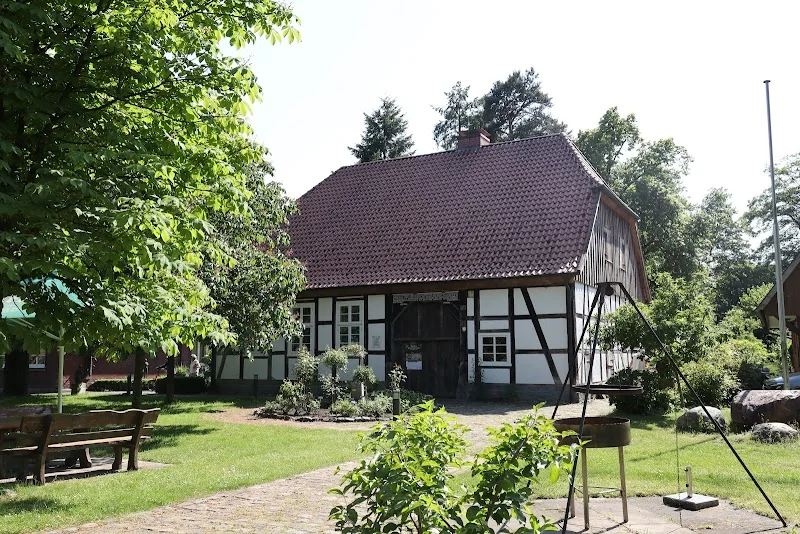
A second central component of the Museum Osthusschule is the half-timbered school. This building was constructed in 1832 in Oldentrup. The last school lesson took place there in 1887, after which the school was converted into a double residential house. Because the property was later to be used industrially, the house was stored for 16 years and finally rebuilt in 2003 in Senne at the Osthusschule in its original condition. This shows the museum not only as a school building but also as an example of monument preservation, translocation, and careful reconstruction. This story is particularly exciting for visitors searching for the Museum Osthusschule half-timbered school, as it makes the journey from school building to museum exhibit tangible. ([museum-osthusschule.de](https://www.museum-osthusschule.de/was-gibt-es-zu-sehen/die-fachwerkschule))
Inside, the half-timbered school vividly conveys how a teacher lived and worked in the past. Teachers often lived in the schoolhouse because the profession alone was often not enough to secure a livelihood. Therefore, alongside teaching, a small farm was also operated. These structures are replicated in the half-timbered school: there is a teacher's apartment, a kitchen area, a living room, a bedroom, and an area for agriculture. There is also a so-called Kannenstock, which is a cupboard with a plate rack. The building thus not only shows school operations but also the connection between living, working, and economic self-sufficiency. For visitors, this is particularly vivid because they can imagine the teacher not as an abstract figure but as a person in a concrete domestic and professional environment. ([museum-osthusschule.de](https://www.museum-osthusschule.de/was-gibt-es-zu-sehen/die-fachwerkschule))
Additionally, the large classroom of the half-timbered school can be used flexibly. According to the museum's website, the room can be used with variably arranged tables and chairs for seminars and celebrations, and in another offering, space for up to 50 people is mentioned for the former classroom. Thus, the half-timbered school is not only an exhibition space but also a functional place for smaller events. This dual use makes it attractive for inquiries about events, rentals, or group visits. Those seeking a special ambiance will find here not a neutralized event setting but a historical space with a clear signature. The charm lies in the fact that the place retains its past and thus remains open for present use. ([museum-osthusschule.de](https://www.museum-osthusschule.de/was-gibt-es-zu-sehen/die-fachwerkschule))
Museum Garden, Forest Educational Trail, and Regional Art
The Museum Osthusschule lives not only in its buildings but also in the outdoor space. The grounds encompass an outdoor area of around 7,000 square meters, characterized by perennial beds, a rose garden, a herb garden, lawns, and garden furniture. Additionally, there is a lovingly designed forest educational trail, where plants, shrubs, trees, and animals of the forest are presented in stations and explained in their significance for the community of life. This combination of museum and garden makes the visit particularly pleasant, especially in the warmer months. Those looking for a place where historical education and relaxation come together will find here a rare mix of cultural space, nature observation, and quiet stay. ([museum-osthusschule.de](https://www.museum-osthusschule.de/))
The garden is not just decoration but part of the museum concept. On the website, it is described as an ensemble that also includes sculptures by local artists. Among the roses, there are artworks by artists from Bielefeld or those connected to Bielefeld, and the outdoor areas invite both resting and closer inspection. This is important because the Museum Osthusschule distinguishes itself from many other smaller museums: here, the outdoor space is actively considered and not treated as a mere ancillary area. Thus, those searching for Museum Osthusschule photos will likely discover not only interior spaces but also gardens and sculptures in many impressions. This visual diversity supports the character of the house as a place of regional memory and quiet discoveries. ([museum-osthusschule.de](https://www.museum-osthusschule.de/))
The art collection itself is also remarkable. In both school buildings, the walls are adorned with paintings, and the museum has an extensive collection of works created by local artists or thematically related to Senne. Among other things, there are paintings and sculptures by Irene Müller, Eva Limberg, Roland Kündahl, Christa Göbel, Detlef Peinecke, and Horst Wasgindt. Many of the works preserve views of Senne from the good old days, including watercolors and oil paintings of farms, cottages, and landscapes that no longer exist today. This adds an additional layer to the museum visit: it is not only school history but also a visual memory of a region. For visitors who want to connect regional culture and local art, this is a strong added value. ([museum-osthusschule.de](https://www.museum-osthusschule.de/was-gibt-es-zu-sehen/kunst-im-museum))
Guided Tours, Events, and the History of the Osthusschule
The Museum Osthusschule is consciously more than a quiet showcase. The offerings page lists guided tours, lessons as they might have taken place in the past, rentals, music in the museum garden, a rose day, and a fairy tale evening for adults. Retired educators give a lesson as it might have happened around 1900, and the former strictness of school life is also addressed. The events in the garden make it clear that the museum takes its role as a meeting place for the Senner community seriously. This creates a program that not only informs historically but also fosters encounters. Those searching for Museum Osthusschule programs will therefore find not a rigid standard offering but a lively annual rhythm with changing accents. ([museum-osthusschule.de](https://www.museum-osthusschule.de/))
The history of the building itself is closely linked to the development of the Senne community. In 1894, the Osthus family donated the property for a school, the Osthusschule was built in 1895, and on January 6, 1896, it was inaugurated as the third school of the Senne community. After the closure of the primary school, the building served as a youth center and open youth center from 1971 until 1993 when a unanimous decision was made to use it as a school museum and district archive. Hans Schumacher and Volker Menzel then founded the museum and began renovations and setup. The museum was opened in 1995, exactly 100 years after the construction of the Osthusschule. This timeline is not only historically interesting but also a good example of how local initiative and civic engagement can permanently place a building in the service of the public. ([museum-osthusschule.de](https://www.museum-osthusschule.de/))
Today, the Förderverein Osthusschule e.V. carries the ongoing operation, and the museum explicitly emphasizes its volunteer structure. This explains why the atmosphere feels so personal and why many offerings only run by appointment or at fixed times. At the same time, it becomes clear that the collection is not static: events, new exhibitions, and regular maintenance keep the place lively. The fact that there is a local archive of the Bielefeld-Senne district in the museum further underscores this role as a memory space. Therefore, those who come here are not just visiting an exhibition but an active part of the district culture. Precisely for this reason, the Museum Osthusschule is so relevant for queries about Museum Osthusschule Senne, Museum Osthusschule directions, Museum Osthusschule opening hours, or Museum Osthusschule reviews: it connects practical visitor information with genuine content depth. ([museum-osthusschule.de](https://www.museum-osthusschule.de/))
Sources:
- Museum Osthusschule - Official Website
- Museum Osthusschule - Contact
- Museum Osthusschule - The Osthusschule
- Museum Osthusschule - The Half-Timbered School
- Museum Osthusschule - Art in the Museum
- NRW Foundation - Museum Osthusschule and Local Archive Bielefeld-Senne
- Day of Open Monuments - Museum Osthusschule
Show moreShow less
Museum Osthusschule | Opening Hours & Directions
The Museum Osthusschule in Bielefeld-Senne is not a museum that you visit briefly and forget. It is a place where school history, local heritage, regional art, and a spacious outdoor area come together to form a unique ensemble. Those who come here experience two historic school buildings, a garden with roses and herbs, a forest educational trail, as well as collections that range from teaching around 1900 to the working world in the Senner area. The museum is supported by the Förderverein Osthusschule e.V., is organized by volunteers, and explicitly sees itself as a school and local museum. This mix is precisely what attracts visitors looking for genuine information on opening hours, directions, parking, tours, or events. ([museum-osthusschule.de](https://www.museum-osthusschule.de/))
Opening Hours, Admission, and Directions to the Museum Osthusschule
For practical planning, the most important facts are clear and pleasantly uncomplicated: The museum is open on Tuesdays from 3 PM to 6 PM and is accessible by appointment. The website also emphasizes that exceptions in the area of current events will be announced. Admission is free, as is parking on the premises; donations for the museum's work are welcome. Those arriving by car will find a very low-threshold visit, which is particularly interesting for families, senior groups, or spontaneous outings. Cyclists are also explicitly welcome according to the museum's website. For visitors using public transport, the location is also well described: Bus line 40 stops directly in front of the museum entrance, and the contact page additionally mentions the Vormbrock stop for line 94. ([museum-osthusschule.de](https://www.museum-osthusschule.de/))
Particularly helpful is that the address is clearly and unequivocally stated: Senner Str. 255 in 33659 Bielefeld. This allows for planning the journey without detours, whether coming from the city center, from the southern part of Bielefeld, or from the surrounding area. For search queries like Museum Osthusschule Bielefeld, Museum Osthusschule Senne, or Museum Osthusschule Senner Straße Bielefeld, this location information is central, as it clearly places the museum in the district of Senne. Those who want to picture the visit can imagine it as a relaxed outing: short distances, free parking, direct bus connections, and a manageable, deliberately personal structure. Especially because the museum does not rely on mass operations but on volunteer work and careful supervision, the visit is rather quiet, focused, and pleasantly decelerated. ([museum-osthusschule.de](https://www.museum-osthusschule.de/kontakt))
Planning is also clearly organized for groups. Guided tours are offered by appointment, and the upper limit is set at 20 people to avoid overcrowding in the rooms. This is an important note for schools, clubs, or small travel groups specifically looking for Museum Osthusschule tours or Museum Osthusschule programs. For the visit, this means: it is better to inquire in advance rather than hoping for luck spontaneously. Those coming with a smaller group benefit from a very personal atmosphere that takes the historical layout into account. Thus, the museum is not experienced as an anonymous exhibition operation but as a well-kept, lively place with clear, easily understandable visiting rules. ([museum-osthusschule.de](https://www.museum-osthusschule.de/))
School Museum with Local Archive: What Can Be Seen in the Historic Classrooms
The core content of the Museum Osthusschule lies in the historic classrooms of the old school. In one of the former classrooms, a teaching room from around 1900 is set up. Visitors encounter narrow benches, a raised desk for the teacher, and teaching materials that differ significantly from today's school supplies. In this way, the museum makes visible how much school, discipline, and learning culture have changed within just over a hundred years. The room is complemented by collections of textbooks, stuffed animals, machine models, dollhouses, toys, and other everyday objects from the last century. This mix is particularly vivid for visitors because it not only explains school life abstractly but makes it spatially and sensually comprehensible. ([museum-osthusschule.de](https://www.museum-osthusschule.de/was-gibt-es-zu-sehen/die-osthusschule))
In the second room of the school building, further materials from the school and from the Senner area are the focus. The website mentions various collections of materials used in the school, and numerous exhibits of rural craftsmanship are displayed in the attic. This expands the museum beyond pure school history: It shows the connection between learning, work, and everyday life in a rural environment. Those searching for Museum Osthusschule photos or Museum Osthusschule reviews are often particularly interested in this authenticity because the museum does not rely on spectacular effects but on historical plausibility and regional depth. In the third room, there is also the local archive of the district of Senne. It can be viewed by appointment under supervision and also serves as a meeting room for the association. This makes the Osthusschule not only an exhibition space but also a memory space for the district. ([museum-osthusschule.de](https://www.museum-osthusschule.de/was-gibt-es-zu-sehen/die-osthusschule))
The special strength of this part of the museum lies in its proximity to everyday life. Here, not only is school history told, but an entire living environment around 1900 is made visible. Teacher's house, classrooms, tools, documents, pictures, and archives interconnect to form a dense picture of education, work, and social order in Senne. For visitors interested in local history, pedagogical development, or regional identity, this is the added value. The museum preserves memory without staging itself and thus offers a very credible, factual approach to the past. Those who look closely quickly understand that here the great history is revealed in a small space. ([museum-osthusschule.de](https://www.museum-osthusschule.de/was-gibt-es-zu-sehen/die-osthusschule))
The Half-Timbered School and the Life of the Teacher
A second central component of the Museum Osthusschule is the half-timbered school. This building was constructed in 1832 in Oldentrup. The last school lesson took place there in 1887, after which the school was converted into a double residential house. Because the property was later to be used industrially, the house was stored for 16 years and finally rebuilt in 2003 in Senne at the Osthusschule in its original condition. This shows the museum not only as a school building but also as an example of monument preservation, translocation, and careful reconstruction. This story is particularly exciting for visitors searching for the Museum Osthusschule half-timbered school, as it makes the journey from school building to museum exhibit tangible. ([museum-osthusschule.de](https://www.museum-osthusschule.de/was-gibt-es-zu-sehen/die-fachwerkschule))
Inside, the half-timbered school vividly conveys how a teacher lived and worked in the past. Teachers often lived in the schoolhouse because the profession alone was often not enough to secure a livelihood. Therefore, alongside teaching, a small farm was also operated. These structures are replicated in the half-timbered school: there is a teacher's apartment, a kitchen area, a living room, a bedroom, and an area for agriculture. There is also a so-called Kannenstock, which is a cupboard with a plate rack. The building thus not only shows school operations but also the connection between living, working, and economic self-sufficiency. For visitors, this is particularly vivid because they can imagine the teacher not as an abstract figure but as a person in a concrete domestic and professional environment. ([museum-osthusschule.de](https://www.museum-osthusschule.de/was-gibt-es-zu-sehen/die-fachwerkschule))
Additionally, the large classroom of the half-timbered school can be used flexibly. According to the museum's website, the room can be used with variably arranged tables and chairs for seminars and celebrations, and in another offering, space for up to 50 people is mentioned for the former classroom. Thus, the half-timbered school is not only an exhibition space but also a functional place for smaller events. This dual use makes it attractive for inquiries about events, rentals, or group visits. Those seeking a special ambiance will find here not a neutralized event setting but a historical space with a clear signature. The charm lies in the fact that the place retains its past and thus remains open for present use. ([museum-osthusschule.de](https://www.museum-osthusschule.de/was-gibt-es-zu-sehen/die-fachwerkschule))
Museum Garden, Forest Educational Trail, and Regional Art
The Museum Osthusschule lives not only in its buildings but also in the outdoor space. The grounds encompass an outdoor area of around 7,000 square meters, characterized by perennial beds, a rose garden, a herb garden, lawns, and garden furniture. Additionally, there is a lovingly designed forest educational trail, where plants, shrubs, trees, and animals of the forest are presented in stations and explained in their significance for the community of life. This combination of museum and garden makes the visit particularly pleasant, especially in the warmer months. Those looking for a place where historical education and relaxation come together will find here a rare mix of cultural space, nature observation, and quiet stay. ([museum-osthusschule.de](https://www.museum-osthusschule.de/))
The garden is not just decoration but part of the museum concept. On the website, it is described as an ensemble that also includes sculptures by local artists. Among the roses, there are artworks by artists from Bielefeld or those connected to Bielefeld, and the outdoor areas invite both resting and closer inspection. This is important because the Museum Osthusschule distinguishes itself from many other smaller museums: here, the outdoor space is actively considered and not treated as a mere ancillary area. Thus, those searching for Museum Osthusschule photos will likely discover not only interior spaces but also gardens and sculptures in many impressions. This visual diversity supports the character of the house as a place of regional memory and quiet discoveries. ([museum-osthusschule.de](https://www.museum-osthusschule.de/))
The art collection itself is also remarkable. In both school buildings, the walls are adorned with paintings, and the museum has an extensive collection of works created by local artists or thematically related to Senne. Among other things, there are paintings and sculptures by Irene Müller, Eva Limberg, Roland Kündahl, Christa Göbel, Detlef Peinecke, and Horst Wasgindt. Many of the works preserve views of Senne from the good old days, including watercolors and oil paintings of farms, cottages, and landscapes that no longer exist today. This adds an additional layer to the museum visit: it is not only school history but also a visual memory of a region. For visitors who want to connect regional culture and local art, this is a strong added value. ([museum-osthusschule.de](https://www.museum-osthusschule.de/was-gibt-es-zu-sehen/kunst-im-museum))
Guided Tours, Events, and the History of the Osthusschule
The Museum Osthusschule is consciously more than a quiet showcase. The offerings page lists guided tours, lessons as they might have taken place in the past, rentals, music in the museum garden, a rose day, and a fairy tale evening for adults. Retired educators give a lesson as it might have happened around 1900, and the former strictness of school life is also addressed. The events in the garden make it clear that the museum takes its role as a meeting place for the Senner community seriously. This creates a program that not only informs historically but also fosters encounters. Those searching for Museum Osthusschule programs will therefore find not a rigid standard offering but a lively annual rhythm with changing accents. ([museum-osthusschule.de](https://www.museum-osthusschule.de/))
The history of the building itself is closely linked to the development of the Senne community. In 1894, the Osthus family donated the property for a school, the Osthusschule was built in 1895, and on January 6, 1896, it was inaugurated as the third school of the Senne community. After the closure of the primary school, the building served as a youth center and open youth center from 1971 until 1993 when a unanimous decision was made to use it as a school museum and district archive. Hans Schumacher and Volker Menzel then founded the museum and began renovations and setup. The museum was opened in 1995, exactly 100 years after the construction of the Osthusschule. This timeline is not only historically interesting but also a good example of how local initiative and civic engagement can permanently place a building in the service of the public. ([museum-osthusschule.de](https://www.museum-osthusschule.de/))
Today, the Förderverein Osthusschule e.V. carries the ongoing operation, and the museum explicitly emphasizes its volunteer structure. This explains why the atmosphere feels so personal and why many offerings only run by appointment or at fixed times. At the same time, it becomes clear that the collection is not static: events, new exhibitions, and regular maintenance keep the place lively. The fact that there is a local archive of the Bielefeld-Senne district in the museum further underscores this role as a memory space. Therefore, those who come here are not just visiting an exhibition but an active part of the district culture. Precisely for this reason, the Museum Osthusschule is so relevant for queries about Museum Osthusschule Senne, Museum Osthusschule directions, Museum Osthusschule opening hours, or Museum Osthusschule reviews: it connects practical visitor information with genuine content depth. ([museum-osthusschule.de](https://www.museum-osthusschule.de/))
Sources:
- Museum Osthusschule - Official Website
- Museum Osthusschule - Contact
- Museum Osthusschule - The Osthusschule
- Museum Osthusschule - The Half-Timbered School
- Museum Osthusschule - Art in the Museum
- NRW Foundation - Museum Osthusschule and Local Archive Bielefeld-Senne
- Day of Open Monuments - Museum Osthusschule
Museum Osthusschule | Opening Hours & Directions
The Museum Osthusschule in Bielefeld-Senne is not a museum that you visit briefly and forget. It is a place where school history, local heritage, regional art, and a spacious outdoor area come together to form a unique ensemble. Those who come here experience two historic school buildings, a garden with roses and herbs, a forest educational trail, as well as collections that range from teaching around 1900 to the working world in the Senner area. The museum is supported by the Förderverein Osthusschule e.V., is organized by volunteers, and explicitly sees itself as a school and local museum. This mix is precisely what attracts visitors looking for genuine information on opening hours, directions, parking, tours, or events. ([museum-osthusschule.de](https://www.museum-osthusschule.de/))
Opening Hours, Admission, and Directions to the Museum Osthusschule
For practical planning, the most important facts are clear and pleasantly uncomplicated: The museum is open on Tuesdays from 3 PM to 6 PM and is accessible by appointment. The website also emphasizes that exceptions in the area of current events will be announced. Admission is free, as is parking on the premises; donations for the museum's work are welcome. Those arriving by car will find a very low-threshold visit, which is particularly interesting for families, senior groups, or spontaneous outings. Cyclists are also explicitly welcome according to the museum's website. For visitors using public transport, the location is also well described: Bus line 40 stops directly in front of the museum entrance, and the contact page additionally mentions the Vormbrock stop for line 94. ([museum-osthusschule.de](https://www.museum-osthusschule.de/))
Particularly helpful is that the address is clearly and unequivocally stated: Senner Str. 255 in 33659 Bielefeld. This allows for planning the journey without detours, whether coming from the city center, from the southern part of Bielefeld, or from the surrounding area. For search queries like Museum Osthusschule Bielefeld, Museum Osthusschule Senne, or Museum Osthusschule Senner Straße Bielefeld, this location information is central, as it clearly places the museum in the district of Senne. Those who want to picture the visit can imagine it as a relaxed outing: short distances, free parking, direct bus connections, and a manageable, deliberately personal structure. Especially because the museum does not rely on mass operations but on volunteer work and careful supervision, the visit is rather quiet, focused, and pleasantly decelerated. ([museum-osthusschule.de](https://www.museum-osthusschule.de/kontakt))
Planning is also clearly organized for groups. Guided tours are offered by appointment, and the upper limit is set at 20 people to avoid overcrowding in the rooms. This is an important note for schools, clubs, or small travel groups specifically looking for Museum Osthusschule tours or Museum Osthusschule programs. For the visit, this means: it is better to inquire in advance rather than hoping for luck spontaneously. Those coming with a smaller group benefit from a very personal atmosphere that takes the historical layout into account. Thus, the museum is not experienced as an anonymous exhibition operation but as a well-kept, lively place with clear, easily understandable visiting rules. ([museum-osthusschule.de](https://www.museum-osthusschule.de/))
School Museum with Local Archive: What Can Be Seen in the Historic Classrooms
The core content of the Museum Osthusschule lies in the historic classrooms of the old school. In one of the former classrooms, a teaching room from around 1900 is set up. Visitors encounter narrow benches, a raised desk for the teacher, and teaching materials that differ significantly from today's school supplies. In this way, the museum makes visible how much school, discipline, and learning culture have changed within just over a hundred years. The room is complemented by collections of textbooks, stuffed animals, machine models, dollhouses, toys, and other everyday objects from the last century. This mix is particularly vivid for visitors because it not only explains school life abstractly but makes it spatially and sensually comprehensible. ([museum-osthusschule.de](https://www.museum-osthusschule.de/was-gibt-es-zu-sehen/die-osthusschule))
In the second room of the school building, further materials from the school and from the Senner area are the focus. The website mentions various collections of materials used in the school, and numerous exhibits of rural craftsmanship are displayed in the attic. This expands the museum beyond pure school history: It shows the connection between learning, work, and everyday life in a rural environment. Those searching for Museum Osthusschule photos or Museum Osthusschule reviews are often particularly interested in this authenticity because the museum does not rely on spectacular effects but on historical plausibility and regional depth. In the third room, there is also the local archive of the district of Senne. It can be viewed by appointment under supervision and also serves as a meeting room for the association. This makes the Osthusschule not only an exhibition space but also a memory space for the district. ([museum-osthusschule.de](https://www.museum-osthusschule.de/was-gibt-es-zu-sehen/die-osthusschule))
The special strength of this part of the museum lies in its proximity to everyday life. Here, not only is school history told, but an entire living environment around 1900 is made visible. Teacher's house, classrooms, tools, documents, pictures, and archives interconnect to form a dense picture of education, work, and social order in Senne. For visitors interested in local history, pedagogical development, or regional identity, this is the added value. The museum preserves memory without staging itself and thus offers a very credible, factual approach to the past. Those who look closely quickly understand that here the great history is revealed in a small space. ([museum-osthusschule.de](https://www.museum-osthusschule.de/was-gibt-es-zu-sehen/die-osthusschule))
The Half-Timbered School and the Life of the Teacher
A second central component of the Museum Osthusschule is the half-timbered school. This building was constructed in 1832 in Oldentrup. The last school lesson took place there in 1887, after which the school was converted into a double residential house. Because the property was later to be used industrially, the house was stored for 16 years and finally rebuilt in 2003 in Senne at the Osthusschule in its original condition. This shows the museum not only as a school building but also as an example of monument preservation, translocation, and careful reconstruction. This story is particularly exciting for visitors searching for the Museum Osthusschule half-timbered school, as it makes the journey from school building to museum exhibit tangible. ([museum-osthusschule.de](https://www.museum-osthusschule.de/was-gibt-es-zu-sehen/die-fachwerkschule))
Inside, the half-timbered school vividly conveys how a teacher lived and worked in the past. Teachers often lived in the schoolhouse because the profession alone was often not enough to secure a livelihood. Therefore, alongside teaching, a small farm was also operated. These structures are replicated in the half-timbered school: there is a teacher's apartment, a kitchen area, a living room, a bedroom, and an area for agriculture. There is also a so-called Kannenstock, which is a cupboard with a plate rack. The building thus not only shows school operations but also the connection between living, working, and economic self-sufficiency. For visitors, this is particularly vivid because they can imagine the teacher not as an abstract figure but as a person in a concrete domestic and professional environment. ([museum-osthusschule.de](https://www.museum-osthusschule.de/was-gibt-es-zu-sehen/die-fachwerkschule))
Additionally, the large classroom of the half-timbered school can be used flexibly. According to the museum's website, the room can be used with variably arranged tables and chairs for seminars and celebrations, and in another offering, space for up to 50 people is mentioned for the former classroom. Thus, the half-timbered school is not only an exhibition space but also a functional place for smaller events. This dual use makes it attractive for inquiries about events, rentals, or group visits. Those seeking a special ambiance will find here not a neutralized event setting but a historical space with a clear signature. The charm lies in the fact that the place retains its past and thus remains open for present use. ([museum-osthusschule.de](https://www.museum-osthusschule.de/was-gibt-es-zu-sehen/die-fachwerkschule))
Museum Garden, Forest Educational Trail, and Regional Art
The Museum Osthusschule lives not only in its buildings but also in the outdoor space. The grounds encompass an outdoor area of around 7,000 square meters, characterized by perennial beds, a rose garden, a herb garden, lawns, and garden furniture. Additionally, there is a lovingly designed forest educational trail, where plants, shrubs, trees, and animals of the forest are presented in stations and explained in their significance for the community of life. This combination of museum and garden makes the visit particularly pleasant, especially in the warmer months. Those looking for a place where historical education and relaxation come together will find here a rare mix of cultural space, nature observation, and quiet stay. ([museum-osthusschule.de](https://www.museum-osthusschule.de/))
The garden is not just decoration but part of the museum concept. On the website, it is described as an ensemble that also includes sculptures by local artists. Among the roses, there are artworks by artists from Bielefeld or those connected to Bielefeld, and the outdoor areas invite both resting and closer inspection. This is important because the Museum Osthusschule distinguishes itself from many other smaller museums: here, the outdoor space is actively considered and not treated as a mere ancillary area. Thus, those searching for Museum Osthusschule photos will likely discover not only interior spaces but also gardens and sculptures in many impressions. This visual diversity supports the character of the house as a place of regional memory and quiet discoveries. ([museum-osthusschule.de](https://www.museum-osthusschule.de/))
The art collection itself is also remarkable. In both school buildings, the walls are adorned with paintings, and the museum has an extensive collection of works created by local artists or thematically related to Senne. Among other things, there are paintings and sculptures by Irene Müller, Eva Limberg, Roland Kündahl, Christa Göbel, Detlef Peinecke, and Horst Wasgindt. Many of the works preserve views of Senne from the good old days, including watercolors and oil paintings of farms, cottages, and landscapes that no longer exist today. This adds an additional layer to the museum visit: it is not only school history but also a visual memory of a region. For visitors who want to connect regional culture and local art, this is a strong added value. ([museum-osthusschule.de](https://www.museum-osthusschule.de/was-gibt-es-zu-sehen/kunst-im-museum))
Guided Tours, Events, and the History of the Osthusschule
The Museum Osthusschule is consciously more than a quiet showcase. The offerings page lists guided tours, lessons as they might have taken place in the past, rentals, music in the museum garden, a rose day, and a fairy tale evening for adults. Retired educators give a lesson as it might have happened around 1900, and the former strictness of school life is also addressed. The events in the garden make it clear that the museum takes its role as a meeting place for the Senner community seriously. This creates a program that not only informs historically but also fosters encounters. Those searching for Museum Osthusschule programs will therefore find not a rigid standard offering but a lively annual rhythm with changing accents. ([museum-osthusschule.de](https://www.museum-osthusschule.de/))
The history of the building itself is closely linked to the development of the Senne community. In 1894, the Osthus family donated the property for a school, the Osthusschule was built in 1895, and on January 6, 1896, it was inaugurated as the third school of the Senne community. After the closure of the primary school, the building served as a youth center and open youth center from 1971 until 1993 when a unanimous decision was made to use it as a school museum and district archive. Hans Schumacher and Volker Menzel then founded the museum and began renovations and setup. The museum was opened in 1995, exactly 100 years after the construction of the Osthusschule. This timeline is not only historically interesting but also a good example of how local initiative and civic engagement can permanently place a building in the service of the public. ([museum-osthusschule.de](https://www.museum-osthusschule.de/))
Today, the Förderverein Osthusschule e.V. carries the ongoing operation, and the museum explicitly emphasizes its volunteer structure. This explains why the atmosphere feels so personal and why many offerings only run by appointment or at fixed times. At the same time, it becomes clear that the collection is not static: events, new exhibitions, and regular maintenance keep the place lively. The fact that there is a local archive of the Bielefeld-Senne district in the museum further underscores this role as a memory space. Therefore, those who come here are not just visiting an exhibition but an active part of the district culture. Precisely for this reason, the Museum Osthusschule is so relevant for queries about Museum Osthusschule Senne, Museum Osthusschule directions, Museum Osthusschule opening hours, or Museum Osthusschule reviews: it connects practical visitor information with genuine content depth. ([museum-osthusschule.de](https://www.museum-osthusschule.de/))
Sources:
- Museum Osthusschule - Official Website
- Museum Osthusschule - Contact
- Museum Osthusschule - The Osthusschule
- Museum Osthusschule - The Half-Timbered School
- Museum Osthusschule - Art in the Museum
- NRW Foundation - Museum Osthusschule and Local Archive Bielefeld-Senne
- Day of Open Monuments - Museum Osthusschule
Upcoming Events
No events found
Frequently Asked Questions
Reviews
Alex
18. June 2022
Super
Dallmann Detlef
29. June 2025
The Rose Days are always an experience, many exhibitors, and there’s plenty of food and drink available.
Gisela S.
12. July 2023
A very beautiful place on the outskirts of Bielefeld, the school museum is worth seeing, the garden has an amazing variety of roses, a great herb garden where you can discover a lot, sculptures in the outdoor area, a forest educational trail, and a wonderful atmosphere (inside and outside) that can be rented for a celebration. Thanks to the support association!
Horst Sander
1. September 2025
Interesting place We celebrated a birthday there. Space for kids to play and a lot of history to discover.
H. Epiphanius
29. June 2023
Memories from school days come to mind. That was very nice...