
Bielefeld
Kreuzstraße 20, 33602 Bielefeld, Deutschland
Naturkunde-Museum Bielefeld | Opening Hours & Tickets
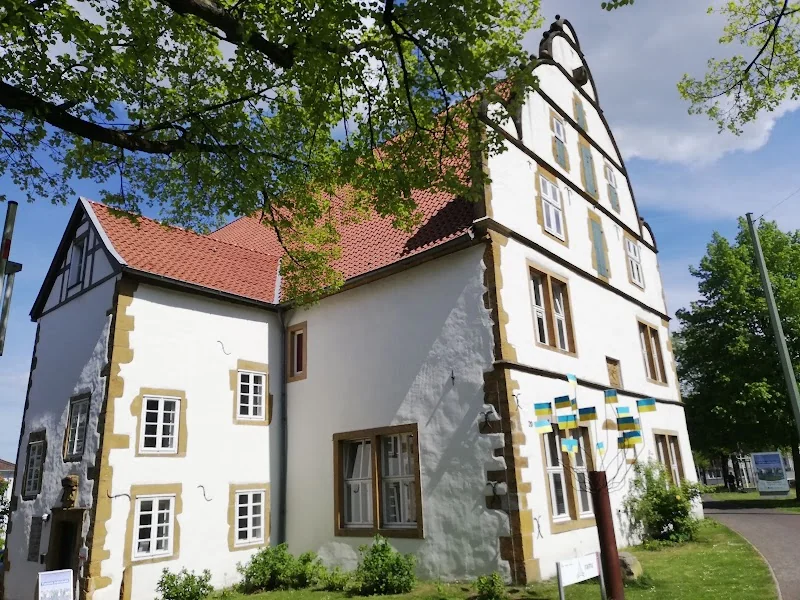
The Naturkunde-Museum Bielefeld, also known as namu, is much more than a classic city museum. It combines nature, humanity, and the environment into an experience that is both understandable and surprising. Housed in the historic Spiegelshof, one of the few remaining noble courts in the city dating back to 1540, the museum unfolds a unique blend of architectural history, scientific education, and interactive exhibitions. Upon entering the building, visitors encounter not only fossils, rocks, and taxidermy specimens but also questions that are more relevant today than ever: How does humanity change its environment? What is the significance of biodiversity? And what can we learn from Earth's history for the future? This connection makes namu one of the most exciting cultural and educational places in Bielefeld. Visitors will find a museum that does not remain stuck in the past but visibly links the present and the future. ([bielefeld.de](https://www.bielefeld.de/node/2663))
At the same time, the Naturkunde-Museum impresses with its diversity in everyday life. It offers a permanent exhibition, the Geo-Stollen, changing special exhibitions, and a wide educational program for children, families, school classes, and adults. The magazines house hundreds of thousands of collection objects, which only hint at a part of the museum's work. Thus, the museum is not only a place for exhibitions but also a research facility, a learning space, and a meeting point for people who want to experience natural knowledge in a lively way. Those looking for opening hours, tickets, directions, or parking will find practical information as well as exciting content for their next visit. This combination of practicality and depth of content makes namu a location that covers a wide range of different interests in search behavior. ([namu-ev.de](https://namu-ev.de/das-museum/))
What does the Naturkunde-Museum Bielefeld show in its exhibitions?
The thematic heart of the museum is the permanent exhibition nature | human | environment. It not only displays objects but also places them in larger contexts. The focus is on the relationship between humanity and nature, complemented by the value of biodiversity and the phenomena of climate change. What is special about it is the way the content is conveyed: The information is presented in a vivid, understandable, and experience-oriented manner, making even complex scientific topics easily accessible. This is what makes namu a place that does not rely solely on observation but encourages discovery and engagement. It is a place where natural history does not seem dry but becomes tangible. The exhibition appeals to people interested in animals, plants, rocks, habitats, and ecological connections, while also creating a link to the city and region of Bielefeld. ([bielefeld.de](https://www.bielefeld.de/node/2663))
A special attraction is the Geo-Stollen. It continues the themes of the permanent exhibition underground and extends them from a geological perspective. In an underground atmosphere, the geological processes of the region, plate tectonics, and global earthquake activity are explained interactively. This gives the visit a unique dramaturgy: From visible nature, it goes down into the depths of Earth's history. This staging is not only exciting but also cleverly constructed in content, as it links local and global processes. Those who visit the Geo-Stollen experience natural science as a spatial and sensory experience. That is why this offer is equally interesting for families, school groups, and adults. It is an exhibition that not only conveys knowledge but makes it experiential. ([bielefeld.de](https://www.bielefeld.de/node/2663))
Additionally, there are changing special exhibitions, of which the museum shows three to four annually according to the city of Bielefeld. The current website highlights the informative and interactive exhibitions Expedition Schneeleo and Home, sweet home. Expedition Schneeleo can be seen until September 20, 2026, during regular opening hours, while Home, sweet home, about animal traces in the home region, runs until February 2027. These contents demonstrate how flexible namu operates: It combines classic museum work with current topics, contemporary design, and a presentation that works both emotionally and factually. Those who return regularly will therefore not find the same thing every time but new approaches to nature, the environment, and science. ([bielefeld.de](https://www.bielefeld.de/node/2663))
Also noteworthy is the Natural History Time Travel, which the museum has expanded into public space in collaboration with the Bielefeld tram. At several stops between the museum and the university, passengers encounter museum showcases and floor vitrines with spectacular fossils, including woolly rhinoceros, fish dinosaurs, and giant amphibians. This concept is considered unique in Germany according to the museum and impressively shows how strongly namu impacts the city. The exhibition does not stop at the building's door but continues in everyday life. For Bielefeld, this is a significant advantage because culture and knowledge do not remain isolated but become part of urban experiences. Those interested in unusual museum formats should definitely consider this form of communication, as it is one of the strongest features of the house. ([namu-ev.de](https://namu-ev.de/unsere-ausstellungen/ausser-haus/naturhistorische-zeitreise/?utm_source=openai))
Opening Hours, Tickets, and Admission Prices at a Glance
For planning a visit, the opening hours are clear and practical: The Naturkunde-Museum Bielefeld is open from Tuesday to Sunday from 10:00 AM to 5:00 PM. The address is Kreuzstraße 20, 33602 Bielefeld. This makes the museum easy to plan for a family outing, a school appointment, or a spontaneous cultural visit on the weekend. Those looking for tickets will find a ticket shop on the website as well as different price levels. The regular admission for individual visitors is 4.00 euros, and the reduced admission costs 2.00 euros. Families pay 1.50 euros per adult, and groups of ten paying persons or more pay 2.50 euros per adult. This pricing policy clearly shows that the museum aims to attract both individual guests and groups and educational institutions. ([namu-ev.de](https://namu-ev.de/das-museum/besuchen/))
Particularly attractive are the free contingents. Children and young people under 18 years have free admission, as do school classes with accompanying persons, groups from open all-day schools, daycare centers, and educational assistance institutions. Students have free admission every Wednesday, and seniors aged 65 and older on the first Wednesday of the month. Additionally, free tickets are available for the Bielefeld Pass, for accompanying persons of severely disabled individuals with the characteristic B, as well as for members of ICOM and the German Museum Association. Combo offers are also available: With the combo ticket and the combo annual ticket, visitors can connect the Naturkunde-Museum, Historical Museum, and Museum Huelsmann. This is not only practical but also economically sensible for guests who want to explore several Bielefeld museums in one or more days. ([namu-ev.de](https://namu-ev.de/das-museum/besuchen/))
Those who want to plan their visit more specifically should keep an eye on the ticket shop and any special dates. The museum regularly communicates events, lectures, workshops, and programs on its website, some of which can be booked separately. Especially for family-oriented offers or educational formats, timely booking is advisable. For SEO search queries such as tickets, admission prices, or opening hours, namu is therefore a very rewarding target because the information is transparent and immediately accessible. The visit begins even during planning: One quickly recognizes when the museum is open, which offers are free, and which combinations are worthwhile. This reduces barriers and makes access to natural knowledge easier. ([namu-ev.de](https://namu-ev.de/das-museum/besuchen/))
Directions, Parking, and Accessibility at namu
The journey to the Naturkunde-Museum Bielefeld is intentionally kept uncomplicated. With tram line 1, you can ride to the Adenauerplatz stop and then walk about 300 meters. By bus, the museum can be reached via the Bielefeld Kunsthalle stop; among others, lines 21, 22, 24, 28, 29, 48, 80.2, 83, 87, 88, 95, 142, and 228 stop there. This good connection makes the location particularly practical, even if you are traveling without a car. For guests who want to use several locations of the museum, it is also important to know that the house operates not only the exhibition building but also an administrative building at Adenauerplatz 2 and the branch Green House at Sparrenburg. Especially for events and tours, the exact address may vary depending on the program. ([namu-ev.de](https://namu-ev.de/das-museum/besuchen/))
Regarding parking, the official information is differentiated and helpful. There are parking spaces at the museum forecourt near the exhibition building; if none are available, you should contact the museum staff. There are no parking spaces directly at the administrative building, and the walk from the parking lot of the exhibition building is about 200 meters. For the Green House, the museum recommends public parking around Sparrenburg. Therefore, if you come by car, you should not only know the address but also consider the location within the museum network. An important advantage in terms of accessibility is that the exhibition building is largely wheelchair accessible, has an elevator, and a barrier-free restroom that is accessible by elevator. A wheelchair can be borrowed, mobile seating options are available, and there is also a step-free entrance at the back. Assistance dogs are allowed. The administrative building is only partially wheelchair accessible, while the Green House is accessible via several steps. This transparency is exemplary as it allows visitors to prepare realistically. ([namu-ev.de](https://namu-ev.de/das-museum/besuchen/))
Even in everyday visits, the museum is well organized. The cloakroom can be used throughout the opening hours, larger bags and backpacks can be stored in lockers, and private photo and video recordings without flash are generally allowed in the exhibition rooms. At the same time, clear rules apply to protect the objects and other guests. For barrier-free planning, it is also important that accompanying persons of severely disabled individuals with the characteristic B can enter the museum free of charge. This makes the visit not only possible but also practical. Overall, it is evident that those looking for directions, parking, or accessibility will receive very concrete guidance at namu that goes far beyond general information. ([namu-ev.de](https://namu-ev.de/das-museum/besuchen/))
History, Spiegelshof, and Collection with around 575,000 Objects
The history of the Naturkunde-Museum dates back a long way and is closely linked to the city of Bielefeld. On May 12, 1889, natural and cultural historical objects were first presented to the public at Sparrenburg. This marked the birth of the city's first museum. On October 3, 1906, the Museum of the City of Bielefeld was inaugurated, in which a scientific department was established thanks to the commitment of August Oetker and Alfred Zickgraf. This department later developed into the Naturkunde-Museum. This development shows that the house did not arise by chance but from civic engagement, scientific interest, and a long tradition of collecting and conveying. Today, the museum is housed in the Spiegelshof, which is considered one of the few remaining noble courts in the city from 1540. Thus, namu harmoniously combines historical shell and scientific content. ([bielefeld.de](https://www.bielefeld.de/node/30204))
The collections of the museum are of great importance to Bielefeld and extend far beyond the visible exhibits. According to the official website, they comprise around 575,000 objects; the city of Bielefeld mentions almost 600,000 objects in the magazines. This number illustrates that the museum is not just made up of display cases but also involves research, preservation, and documentation. Since its founding, the house has been particularly supported by the Natural Science Association for Bielefeld and the surrounding area, and in 1994, the Friends of the Naturkunde-Museum of the City of Bielefeld e.V. was added. Both structures remain important for the development, expansion, and communication of the museum to this day. Without voluntary and scientific commitment, the current breadth of the house would hardly be conceivable. That is why namu is also a good example of how local initiative, city history, and natural science can interact. ([namu-ev.de](https://namu-ev.de/das-museum/))
Thematically, the museum is strongly oriented towards a guiding principle of sustainable and future-oriented development. This is reflected in the selection of topics, in the permanent exhibitions, and in the communication approach. Nature, biodiversity, climate, regional geology, and humanity as part of ecological connections form a common thread that runs through the entire house. The aforementioned Natural History Time Travel in the tram fits into this picture: It expands the museum into public space and makes scientific content visible in everyday life. The Spiegelshof is thus not only a beautiful historical building but also a place where the past, present, and future meet. Those who want to understand Bielefeld and its culture will find here a very condensed access to city history, natural history, and education. ([namu-ev.de](https://namu-ev.de/das-museum/))
Educational Offers, Tours, and Visiting Tips for Families
The Naturkunde-Museum Bielefeld explicitly sees itself as an educational place. This is evident in a wide range of offerings that include lecture series, excursions, workshops, guided talks, school programs, kindergarten programs, holiday games, festivals, and children's birthdays. Thus, the house is interesting not only for individual visits but also for groups, families, and educational institutions. The action-oriented approach is particularly important: Nature and environmental topics are not presented abstractly but conveyed practically, dialogically, and experience-oriented. This fits very well with current search intentions around tours, educational offers, and family-friendly museum experiences. For children and young people, namu is therefore a place where they can not only look but also discover, try out, and ask questions. ([namu-ev.de](https://namu-ev.de/das-museum/))
In practical visiting everyday life, the museum is also geared towards families and groups. Children and young people under 18 years have free admission, as do school classes, and there are special free Fridays and Wednesdays for students and seniors. For orientation in the house, cloakrooms and lockers are available. Eating and drinking are generally not permitted in the exhibition rooms, which protects the exhibits and makes the stay pleasant for everyone. Photography for private purposes without flash is allowed, while commercial or editorial recordings require written permission. These rules are clearly formulated and create good conditions for a quiet museum visit. Families also benefit from the fact that the offers are often age-appropriate and provide both simple access and in-depth content. This makes the museum visit manageable, pleasant, and content-rich. ([namu-ev.de](https://namu-ev.de/das-museum/besuchen/))
Those who want to round off their visit meaningfully should also keep an eye on the current special exhibitions and events. The museum regularly announces workshops, lectures, and family activities that create additional incentives for a return visit. Because the topics range from natural history to fossils to climate issues, the program is so diverse that different age groups can each find their own access. For search queries such as tours, programs, family offers, or exhibitions, namu is therefore particularly relevant. It not only offers a place to look but also a place to understand. This is what makes the difference between a short stop and a memorable visit. Those looking for a location in Bielefeld that connects education, history, and modern communication will find it very quickly at the Naturkunde-Museum. ([namu-ev.de](https://namu-ev.de/))
The conclusion is clear: The Naturkunde-Museum Bielefeld is a versatile cultural and learning place with historical depth, a strong educational profile, and very concrete visitor information. The combination of Spiegelshof, Geo-Stollen, current special exhibitions, extensive collection, and good accessibility makes namu a location that is well-suited for both spontaneous visits and planned excursions. Those looking for opening hours, tickets, directions, parking, or accessibility will find reliable and practical information. Additionally, those interested in nature, the environment, and science will receive content that piques curiosity and stays with them. That is why the Naturkunde-Museum Bielefeld is among the places that one does not just visit but leaves with new knowledge. ([namu-ev.de](https://namu-ev.de/das-museum/besuchen/))
Sources:
Show moreShow less
Naturkunde-Museum Bielefeld | Opening Hours & Tickets
The Naturkunde-Museum Bielefeld, also known as namu, is much more than a classic city museum. It combines nature, humanity, and the environment into an experience that is both understandable and surprising. Housed in the historic Spiegelshof, one of the few remaining noble courts in the city dating back to 1540, the museum unfolds a unique blend of architectural history, scientific education, and interactive exhibitions. Upon entering the building, visitors encounter not only fossils, rocks, and taxidermy specimens but also questions that are more relevant today than ever: How does humanity change its environment? What is the significance of biodiversity? And what can we learn from Earth's history for the future? This connection makes namu one of the most exciting cultural and educational places in Bielefeld. Visitors will find a museum that does not remain stuck in the past but visibly links the present and the future. ([bielefeld.de](https://www.bielefeld.de/node/2663))
At the same time, the Naturkunde-Museum impresses with its diversity in everyday life. It offers a permanent exhibition, the Geo-Stollen, changing special exhibitions, and a wide educational program for children, families, school classes, and adults. The magazines house hundreds of thousands of collection objects, which only hint at a part of the museum's work. Thus, the museum is not only a place for exhibitions but also a research facility, a learning space, and a meeting point for people who want to experience natural knowledge in a lively way. Those looking for opening hours, tickets, directions, or parking will find practical information as well as exciting content for their next visit. This combination of practicality and depth of content makes namu a location that covers a wide range of different interests in search behavior. ([namu-ev.de](https://namu-ev.de/das-museum/))
What does the Naturkunde-Museum Bielefeld show in its exhibitions?
The thematic heart of the museum is the permanent exhibition nature | human | environment. It not only displays objects but also places them in larger contexts. The focus is on the relationship between humanity and nature, complemented by the value of biodiversity and the phenomena of climate change. What is special about it is the way the content is conveyed: The information is presented in a vivid, understandable, and experience-oriented manner, making even complex scientific topics easily accessible. This is what makes namu a place that does not rely solely on observation but encourages discovery and engagement. It is a place where natural history does not seem dry but becomes tangible. The exhibition appeals to people interested in animals, plants, rocks, habitats, and ecological connections, while also creating a link to the city and region of Bielefeld. ([bielefeld.de](https://www.bielefeld.de/node/2663))
A special attraction is the Geo-Stollen. It continues the themes of the permanent exhibition underground and extends them from a geological perspective. In an underground atmosphere, the geological processes of the region, plate tectonics, and global earthquake activity are explained interactively. This gives the visit a unique dramaturgy: From visible nature, it goes down into the depths of Earth's history. This staging is not only exciting but also cleverly constructed in content, as it links local and global processes. Those who visit the Geo-Stollen experience natural science as a spatial and sensory experience. That is why this offer is equally interesting for families, school groups, and adults. It is an exhibition that not only conveys knowledge but makes it experiential. ([bielefeld.de](https://www.bielefeld.de/node/2663))
Additionally, there are changing special exhibitions, of which the museum shows three to four annually according to the city of Bielefeld. The current website highlights the informative and interactive exhibitions Expedition Schneeleo and Home, sweet home. Expedition Schneeleo can be seen until September 20, 2026, during regular opening hours, while Home, sweet home, about animal traces in the home region, runs until February 2027. These contents demonstrate how flexible namu operates: It combines classic museum work with current topics, contemporary design, and a presentation that works both emotionally and factually. Those who return regularly will therefore not find the same thing every time but new approaches to nature, the environment, and science. ([bielefeld.de](https://www.bielefeld.de/node/2663))
Also noteworthy is the Natural History Time Travel, which the museum has expanded into public space in collaboration with the Bielefeld tram. At several stops between the museum and the university, passengers encounter museum showcases and floor vitrines with spectacular fossils, including woolly rhinoceros, fish dinosaurs, and giant amphibians. This concept is considered unique in Germany according to the museum and impressively shows how strongly namu impacts the city. The exhibition does not stop at the building's door but continues in everyday life. For Bielefeld, this is a significant advantage because culture and knowledge do not remain isolated but become part of urban experiences. Those interested in unusual museum formats should definitely consider this form of communication, as it is one of the strongest features of the house. ([namu-ev.de](https://namu-ev.de/unsere-ausstellungen/ausser-haus/naturhistorische-zeitreise/?utm_source=openai))
Opening Hours, Tickets, and Admission Prices at a Glance
For planning a visit, the opening hours are clear and practical: The Naturkunde-Museum Bielefeld is open from Tuesday to Sunday from 10:00 AM to 5:00 PM. The address is Kreuzstraße 20, 33602 Bielefeld. This makes the museum easy to plan for a family outing, a school appointment, or a spontaneous cultural visit on the weekend. Those looking for tickets will find a ticket shop on the website as well as different price levels. The regular admission for individual visitors is 4.00 euros, and the reduced admission costs 2.00 euros. Families pay 1.50 euros per adult, and groups of ten paying persons or more pay 2.50 euros per adult. This pricing policy clearly shows that the museum aims to attract both individual guests and groups and educational institutions. ([namu-ev.de](https://namu-ev.de/das-museum/besuchen/))
Particularly attractive are the free contingents. Children and young people under 18 years have free admission, as do school classes with accompanying persons, groups from open all-day schools, daycare centers, and educational assistance institutions. Students have free admission every Wednesday, and seniors aged 65 and older on the first Wednesday of the month. Additionally, free tickets are available for the Bielefeld Pass, for accompanying persons of severely disabled individuals with the characteristic B, as well as for members of ICOM and the German Museum Association. Combo offers are also available: With the combo ticket and the combo annual ticket, visitors can connect the Naturkunde-Museum, Historical Museum, and Museum Huelsmann. This is not only practical but also economically sensible for guests who want to explore several Bielefeld museums in one or more days. ([namu-ev.de](https://namu-ev.de/das-museum/besuchen/))
Those who want to plan their visit more specifically should keep an eye on the ticket shop and any special dates. The museum regularly communicates events, lectures, workshops, and programs on its website, some of which can be booked separately. Especially for family-oriented offers or educational formats, timely booking is advisable. For SEO search queries such as tickets, admission prices, or opening hours, namu is therefore a very rewarding target because the information is transparent and immediately accessible. The visit begins even during planning: One quickly recognizes when the museum is open, which offers are free, and which combinations are worthwhile. This reduces barriers and makes access to natural knowledge easier. ([namu-ev.de](https://namu-ev.de/das-museum/besuchen/))
Directions, Parking, and Accessibility at namu
The journey to the Naturkunde-Museum Bielefeld is intentionally kept uncomplicated. With tram line 1, you can ride to the Adenauerplatz stop and then walk about 300 meters. By bus, the museum can be reached via the Bielefeld Kunsthalle stop; among others, lines 21, 22, 24, 28, 29, 48, 80.2, 83, 87, 88, 95, 142, and 228 stop there. This good connection makes the location particularly practical, even if you are traveling without a car. For guests who want to use several locations of the museum, it is also important to know that the house operates not only the exhibition building but also an administrative building at Adenauerplatz 2 and the branch Green House at Sparrenburg. Especially for events and tours, the exact address may vary depending on the program. ([namu-ev.de](https://namu-ev.de/das-museum/besuchen/))
Regarding parking, the official information is differentiated and helpful. There are parking spaces at the museum forecourt near the exhibition building; if none are available, you should contact the museum staff. There are no parking spaces directly at the administrative building, and the walk from the parking lot of the exhibition building is about 200 meters. For the Green House, the museum recommends public parking around Sparrenburg. Therefore, if you come by car, you should not only know the address but also consider the location within the museum network. An important advantage in terms of accessibility is that the exhibition building is largely wheelchair accessible, has an elevator, and a barrier-free restroom that is accessible by elevator. A wheelchair can be borrowed, mobile seating options are available, and there is also a step-free entrance at the back. Assistance dogs are allowed. The administrative building is only partially wheelchair accessible, while the Green House is accessible via several steps. This transparency is exemplary as it allows visitors to prepare realistically. ([namu-ev.de](https://namu-ev.de/das-museum/besuchen/))
Even in everyday visits, the museum is well organized. The cloakroom can be used throughout the opening hours, larger bags and backpacks can be stored in lockers, and private photo and video recordings without flash are generally allowed in the exhibition rooms. At the same time, clear rules apply to protect the objects and other guests. For barrier-free planning, it is also important that accompanying persons of severely disabled individuals with the characteristic B can enter the museum free of charge. This makes the visit not only possible but also practical. Overall, it is evident that those looking for directions, parking, or accessibility will receive very concrete guidance at namu that goes far beyond general information. ([namu-ev.de](https://namu-ev.de/das-museum/besuchen/))
History, Spiegelshof, and Collection with around 575,000 Objects
The history of the Naturkunde-Museum dates back a long way and is closely linked to the city of Bielefeld. On May 12, 1889, natural and cultural historical objects were first presented to the public at Sparrenburg. This marked the birth of the city's first museum. On October 3, 1906, the Museum of the City of Bielefeld was inaugurated, in which a scientific department was established thanks to the commitment of August Oetker and Alfred Zickgraf. This department later developed into the Naturkunde-Museum. This development shows that the house did not arise by chance but from civic engagement, scientific interest, and a long tradition of collecting and conveying. Today, the museum is housed in the Spiegelshof, which is considered one of the few remaining noble courts in the city from 1540. Thus, namu harmoniously combines historical shell and scientific content. ([bielefeld.de](https://www.bielefeld.de/node/30204))
The collections of the museum are of great importance to Bielefeld and extend far beyond the visible exhibits. According to the official website, they comprise around 575,000 objects; the city of Bielefeld mentions almost 600,000 objects in the magazines. This number illustrates that the museum is not just made up of display cases but also involves research, preservation, and documentation. Since its founding, the house has been particularly supported by the Natural Science Association for Bielefeld and the surrounding area, and in 1994, the Friends of the Naturkunde-Museum of the City of Bielefeld e.V. was added. Both structures remain important for the development, expansion, and communication of the museum to this day. Without voluntary and scientific commitment, the current breadth of the house would hardly be conceivable. That is why namu is also a good example of how local initiative, city history, and natural science can interact. ([namu-ev.de](https://namu-ev.de/das-museum/))
Thematically, the museum is strongly oriented towards a guiding principle of sustainable and future-oriented development. This is reflected in the selection of topics, in the permanent exhibitions, and in the communication approach. Nature, biodiversity, climate, regional geology, and humanity as part of ecological connections form a common thread that runs through the entire house. The aforementioned Natural History Time Travel in the tram fits into this picture: It expands the museum into public space and makes scientific content visible in everyday life. The Spiegelshof is thus not only a beautiful historical building but also a place where the past, present, and future meet. Those who want to understand Bielefeld and its culture will find here a very condensed access to city history, natural history, and education. ([namu-ev.de](https://namu-ev.de/das-museum/))
Educational Offers, Tours, and Visiting Tips for Families
The Naturkunde-Museum Bielefeld explicitly sees itself as an educational place. This is evident in a wide range of offerings that include lecture series, excursions, workshops, guided talks, school programs, kindergarten programs, holiday games, festivals, and children's birthdays. Thus, the house is interesting not only for individual visits but also for groups, families, and educational institutions. The action-oriented approach is particularly important: Nature and environmental topics are not presented abstractly but conveyed practically, dialogically, and experience-oriented. This fits very well with current search intentions around tours, educational offers, and family-friendly museum experiences. For children and young people, namu is therefore a place where they can not only look but also discover, try out, and ask questions. ([namu-ev.de](https://namu-ev.de/das-museum/))
In practical visiting everyday life, the museum is also geared towards families and groups. Children and young people under 18 years have free admission, as do school classes, and there are special free Fridays and Wednesdays for students and seniors. For orientation in the house, cloakrooms and lockers are available. Eating and drinking are generally not permitted in the exhibition rooms, which protects the exhibits and makes the stay pleasant for everyone. Photography for private purposes without flash is allowed, while commercial or editorial recordings require written permission. These rules are clearly formulated and create good conditions for a quiet museum visit. Families also benefit from the fact that the offers are often age-appropriate and provide both simple access and in-depth content. This makes the museum visit manageable, pleasant, and content-rich. ([namu-ev.de](https://namu-ev.de/das-museum/besuchen/))
Those who want to round off their visit meaningfully should also keep an eye on the current special exhibitions and events. The museum regularly announces workshops, lectures, and family activities that create additional incentives for a return visit. Because the topics range from natural history to fossils to climate issues, the program is so diverse that different age groups can each find their own access. For search queries such as tours, programs, family offers, or exhibitions, namu is therefore particularly relevant. It not only offers a place to look but also a place to understand. This is what makes the difference between a short stop and a memorable visit. Those looking for a location in Bielefeld that connects education, history, and modern communication will find it very quickly at the Naturkunde-Museum. ([namu-ev.de](https://namu-ev.de/))
The conclusion is clear: The Naturkunde-Museum Bielefeld is a versatile cultural and learning place with historical depth, a strong educational profile, and very concrete visitor information. The combination of Spiegelshof, Geo-Stollen, current special exhibitions, extensive collection, and good accessibility makes namu a location that is well-suited for both spontaneous visits and planned excursions. Those looking for opening hours, tickets, directions, parking, or accessibility will find reliable and practical information. Additionally, those interested in nature, the environment, and science will receive content that piques curiosity and stays with them. That is why the Naturkunde-Museum Bielefeld is among the places that one does not just visit but leaves with new knowledge. ([namu-ev.de](https://namu-ev.de/das-museum/besuchen/))
Sources:
Naturkunde-Museum Bielefeld | Opening Hours & Tickets
The Naturkunde-Museum Bielefeld, also known as namu, is much more than a classic city museum. It combines nature, humanity, and the environment into an experience that is both understandable and surprising. Housed in the historic Spiegelshof, one of the few remaining noble courts in the city dating back to 1540, the museum unfolds a unique blend of architectural history, scientific education, and interactive exhibitions. Upon entering the building, visitors encounter not only fossils, rocks, and taxidermy specimens but also questions that are more relevant today than ever: How does humanity change its environment? What is the significance of biodiversity? And what can we learn from Earth's history for the future? This connection makes namu one of the most exciting cultural and educational places in Bielefeld. Visitors will find a museum that does not remain stuck in the past but visibly links the present and the future. ([bielefeld.de](https://www.bielefeld.de/node/2663))
At the same time, the Naturkunde-Museum impresses with its diversity in everyday life. It offers a permanent exhibition, the Geo-Stollen, changing special exhibitions, and a wide educational program for children, families, school classes, and adults. The magazines house hundreds of thousands of collection objects, which only hint at a part of the museum's work. Thus, the museum is not only a place for exhibitions but also a research facility, a learning space, and a meeting point for people who want to experience natural knowledge in a lively way. Those looking for opening hours, tickets, directions, or parking will find practical information as well as exciting content for their next visit. This combination of practicality and depth of content makes namu a location that covers a wide range of different interests in search behavior. ([namu-ev.de](https://namu-ev.de/das-museum/))
What does the Naturkunde-Museum Bielefeld show in its exhibitions?
The thematic heart of the museum is the permanent exhibition nature | human | environment. It not only displays objects but also places them in larger contexts. The focus is on the relationship between humanity and nature, complemented by the value of biodiversity and the phenomena of climate change. What is special about it is the way the content is conveyed: The information is presented in a vivid, understandable, and experience-oriented manner, making even complex scientific topics easily accessible. This is what makes namu a place that does not rely solely on observation but encourages discovery and engagement. It is a place where natural history does not seem dry but becomes tangible. The exhibition appeals to people interested in animals, plants, rocks, habitats, and ecological connections, while also creating a link to the city and region of Bielefeld. ([bielefeld.de](https://www.bielefeld.de/node/2663))
A special attraction is the Geo-Stollen. It continues the themes of the permanent exhibition underground and extends them from a geological perspective. In an underground atmosphere, the geological processes of the region, plate tectonics, and global earthquake activity are explained interactively. This gives the visit a unique dramaturgy: From visible nature, it goes down into the depths of Earth's history. This staging is not only exciting but also cleverly constructed in content, as it links local and global processes. Those who visit the Geo-Stollen experience natural science as a spatial and sensory experience. That is why this offer is equally interesting for families, school groups, and adults. It is an exhibition that not only conveys knowledge but makes it experiential. ([bielefeld.de](https://www.bielefeld.de/node/2663))
Additionally, there are changing special exhibitions, of which the museum shows three to four annually according to the city of Bielefeld. The current website highlights the informative and interactive exhibitions Expedition Schneeleo and Home, sweet home. Expedition Schneeleo can be seen until September 20, 2026, during regular opening hours, while Home, sweet home, about animal traces in the home region, runs until February 2027. These contents demonstrate how flexible namu operates: It combines classic museum work with current topics, contemporary design, and a presentation that works both emotionally and factually. Those who return regularly will therefore not find the same thing every time but new approaches to nature, the environment, and science. ([bielefeld.de](https://www.bielefeld.de/node/2663))
Also noteworthy is the Natural History Time Travel, which the museum has expanded into public space in collaboration with the Bielefeld tram. At several stops between the museum and the university, passengers encounter museum showcases and floor vitrines with spectacular fossils, including woolly rhinoceros, fish dinosaurs, and giant amphibians. This concept is considered unique in Germany according to the museum and impressively shows how strongly namu impacts the city. The exhibition does not stop at the building's door but continues in everyday life. For Bielefeld, this is a significant advantage because culture and knowledge do not remain isolated but become part of urban experiences. Those interested in unusual museum formats should definitely consider this form of communication, as it is one of the strongest features of the house. ([namu-ev.de](https://namu-ev.de/unsere-ausstellungen/ausser-haus/naturhistorische-zeitreise/?utm_source=openai))
Opening Hours, Tickets, and Admission Prices at a Glance
For planning a visit, the opening hours are clear and practical: The Naturkunde-Museum Bielefeld is open from Tuesday to Sunday from 10:00 AM to 5:00 PM. The address is Kreuzstraße 20, 33602 Bielefeld. This makes the museum easy to plan for a family outing, a school appointment, or a spontaneous cultural visit on the weekend. Those looking for tickets will find a ticket shop on the website as well as different price levels. The regular admission for individual visitors is 4.00 euros, and the reduced admission costs 2.00 euros. Families pay 1.50 euros per adult, and groups of ten paying persons or more pay 2.50 euros per adult. This pricing policy clearly shows that the museum aims to attract both individual guests and groups and educational institutions. ([namu-ev.de](https://namu-ev.de/das-museum/besuchen/))
Particularly attractive are the free contingents. Children and young people under 18 years have free admission, as do school classes with accompanying persons, groups from open all-day schools, daycare centers, and educational assistance institutions. Students have free admission every Wednesday, and seniors aged 65 and older on the first Wednesday of the month. Additionally, free tickets are available for the Bielefeld Pass, for accompanying persons of severely disabled individuals with the characteristic B, as well as for members of ICOM and the German Museum Association. Combo offers are also available: With the combo ticket and the combo annual ticket, visitors can connect the Naturkunde-Museum, Historical Museum, and Museum Huelsmann. This is not only practical but also economically sensible for guests who want to explore several Bielefeld museums in one or more days. ([namu-ev.de](https://namu-ev.de/das-museum/besuchen/))
Those who want to plan their visit more specifically should keep an eye on the ticket shop and any special dates. The museum regularly communicates events, lectures, workshops, and programs on its website, some of which can be booked separately. Especially for family-oriented offers or educational formats, timely booking is advisable. For SEO search queries such as tickets, admission prices, or opening hours, namu is therefore a very rewarding target because the information is transparent and immediately accessible. The visit begins even during planning: One quickly recognizes when the museum is open, which offers are free, and which combinations are worthwhile. This reduces barriers and makes access to natural knowledge easier. ([namu-ev.de](https://namu-ev.de/das-museum/besuchen/))
Directions, Parking, and Accessibility at namu
The journey to the Naturkunde-Museum Bielefeld is intentionally kept uncomplicated. With tram line 1, you can ride to the Adenauerplatz stop and then walk about 300 meters. By bus, the museum can be reached via the Bielefeld Kunsthalle stop; among others, lines 21, 22, 24, 28, 29, 48, 80.2, 83, 87, 88, 95, 142, and 228 stop there. This good connection makes the location particularly practical, even if you are traveling without a car. For guests who want to use several locations of the museum, it is also important to know that the house operates not only the exhibition building but also an administrative building at Adenauerplatz 2 and the branch Green House at Sparrenburg. Especially for events and tours, the exact address may vary depending on the program. ([namu-ev.de](https://namu-ev.de/das-museum/besuchen/))
Regarding parking, the official information is differentiated and helpful. There are parking spaces at the museum forecourt near the exhibition building; if none are available, you should contact the museum staff. There are no parking spaces directly at the administrative building, and the walk from the parking lot of the exhibition building is about 200 meters. For the Green House, the museum recommends public parking around Sparrenburg. Therefore, if you come by car, you should not only know the address but also consider the location within the museum network. An important advantage in terms of accessibility is that the exhibition building is largely wheelchair accessible, has an elevator, and a barrier-free restroom that is accessible by elevator. A wheelchair can be borrowed, mobile seating options are available, and there is also a step-free entrance at the back. Assistance dogs are allowed. The administrative building is only partially wheelchair accessible, while the Green House is accessible via several steps. This transparency is exemplary as it allows visitors to prepare realistically. ([namu-ev.de](https://namu-ev.de/das-museum/besuchen/))
Even in everyday visits, the museum is well organized. The cloakroom can be used throughout the opening hours, larger bags and backpacks can be stored in lockers, and private photo and video recordings without flash are generally allowed in the exhibition rooms. At the same time, clear rules apply to protect the objects and other guests. For barrier-free planning, it is also important that accompanying persons of severely disabled individuals with the characteristic B can enter the museum free of charge. This makes the visit not only possible but also practical. Overall, it is evident that those looking for directions, parking, or accessibility will receive very concrete guidance at namu that goes far beyond general information. ([namu-ev.de](https://namu-ev.de/das-museum/besuchen/))
History, Spiegelshof, and Collection with around 575,000 Objects
The history of the Naturkunde-Museum dates back a long way and is closely linked to the city of Bielefeld. On May 12, 1889, natural and cultural historical objects were first presented to the public at Sparrenburg. This marked the birth of the city's first museum. On October 3, 1906, the Museum of the City of Bielefeld was inaugurated, in which a scientific department was established thanks to the commitment of August Oetker and Alfred Zickgraf. This department later developed into the Naturkunde-Museum. This development shows that the house did not arise by chance but from civic engagement, scientific interest, and a long tradition of collecting and conveying. Today, the museum is housed in the Spiegelshof, which is considered one of the few remaining noble courts in the city from 1540. Thus, namu harmoniously combines historical shell and scientific content. ([bielefeld.de](https://www.bielefeld.de/node/30204))
The collections of the museum are of great importance to Bielefeld and extend far beyond the visible exhibits. According to the official website, they comprise around 575,000 objects; the city of Bielefeld mentions almost 600,000 objects in the magazines. This number illustrates that the museum is not just made up of display cases but also involves research, preservation, and documentation. Since its founding, the house has been particularly supported by the Natural Science Association for Bielefeld and the surrounding area, and in 1994, the Friends of the Naturkunde-Museum of the City of Bielefeld e.V. was added. Both structures remain important for the development, expansion, and communication of the museum to this day. Without voluntary and scientific commitment, the current breadth of the house would hardly be conceivable. That is why namu is also a good example of how local initiative, city history, and natural science can interact. ([namu-ev.de](https://namu-ev.de/das-museum/))
Thematically, the museum is strongly oriented towards a guiding principle of sustainable and future-oriented development. This is reflected in the selection of topics, in the permanent exhibitions, and in the communication approach. Nature, biodiversity, climate, regional geology, and humanity as part of ecological connections form a common thread that runs through the entire house. The aforementioned Natural History Time Travel in the tram fits into this picture: It expands the museum into public space and makes scientific content visible in everyday life. The Spiegelshof is thus not only a beautiful historical building but also a place where the past, present, and future meet. Those who want to understand Bielefeld and its culture will find here a very condensed access to city history, natural history, and education. ([namu-ev.de](https://namu-ev.de/das-museum/))
Educational Offers, Tours, and Visiting Tips for Families
The Naturkunde-Museum Bielefeld explicitly sees itself as an educational place. This is evident in a wide range of offerings that include lecture series, excursions, workshops, guided talks, school programs, kindergarten programs, holiday games, festivals, and children's birthdays. Thus, the house is interesting not only for individual visits but also for groups, families, and educational institutions. The action-oriented approach is particularly important: Nature and environmental topics are not presented abstractly but conveyed practically, dialogically, and experience-oriented. This fits very well with current search intentions around tours, educational offers, and family-friendly museum experiences. For children and young people, namu is therefore a place where they can not only look but also discover, try out, and ask questions. ([namu-ev.de](https://namu-ev.de/das-museum/))
In practical visiting everyday life, the museum is also geared towards families and groups. Children and young people under 18 years have free admission, as do school classes, and there are special free Fridays and Wednesdays for students and seniors. For orientation in the house, cloakrooms and lockers are available. Eating and drinking are generally not permitted in the exhibition rooms, which protects the exhibits and makes the stay pleasant for everyone. Photography for private purposes without flash is allowed, while commercial or editorial recordings require written permission. These rules are clearly formulated and create good conditions for a quiet museum visit. Families also benefit from the fact that the offers are often age-appropriate and provide both simple access and in-depth content. This makes the museum visit manageable, pleasant, and content-rich. ([namu-ev.de](https://namu-ev.de/das-museum/besuchen/))
Those who want to round off their visit meaningfully should also keep an eye on the current special exhibitions and events. The museum regularly announces workshops, lectures, and family activities that create additional incentives for a return visit. Because the topics range from natural history to fossils to climate issues, the program is so diverse that different age groups can each find their own access. For search queries such as tours, programs, family offers, or exhibitions, namu is therefore particularly relevant. It not only offers a place to look but also a place to understand. This is what makes the difference between a short stop and a memorable visit. Those looking for a location in Bielefeld that connects education, history, and modern communication will find it very quickly at the Naturkunde-Museum. ([namu-ev.de](https://namu-ev.de/))
The conclusion is clear: The Naturkunde-Museum Bielefeld is a versatile cultural and learning place with historical depth, a strong educational profile, and very concrete visitor information. The combination of Spiegelshof, Geo-Stollen, current special exhibitions, extensive collection, and good accessibility makes namu a location that is well-suited for both spontaneous visits and planned excursions. Those looking for opening hours, tickets, directions, parking, or accessibility will find reliable and practical information. Additionally, those interested in nature, the environment, and science will receive content that piques curiosity and stays with them. That is why the Naturkunde-Museum Bielefeld is among the places that one does not just visit but leaves with new knowledge. ([namu-ev.de](https://namu-ev.de/das-museum/besuchen/))
Sources:
Frequently Asked Questions
Reviews
Daniela Ricardez
16. September 2024
It’s really interesting and it’s good for all the family (they have a lot of interactive activities). The receptionist speaks English, but all the information in the exhibition is in German, so take note.
Elly Jeurissen
24. August 2016
Nice museum, slightly geared towards a younger audience. Worth the visit IF you can read German, as all information is only available in the local language. The permanent exhibition on climate change is unique in its form and recommended. I visited the temporary exhibition on evolution and that was also very well done. The only reason for not giving 5 stars is the need for knowledge of German.
Adrian Russell (Adie)
21. August 2019
Great, inexpensive, little museum with friendly staff. Lots of touchy feely stuff for the kids.
Margret Barner
4. February 2019
The building of the museum of natural sciences is very old with broad stone walls. This time we went to an exhibition of mainly living venomous animals.
Shiny Shinx
5. January 2022
A lot of mushrooms there at the moment but I'm not complaining.