
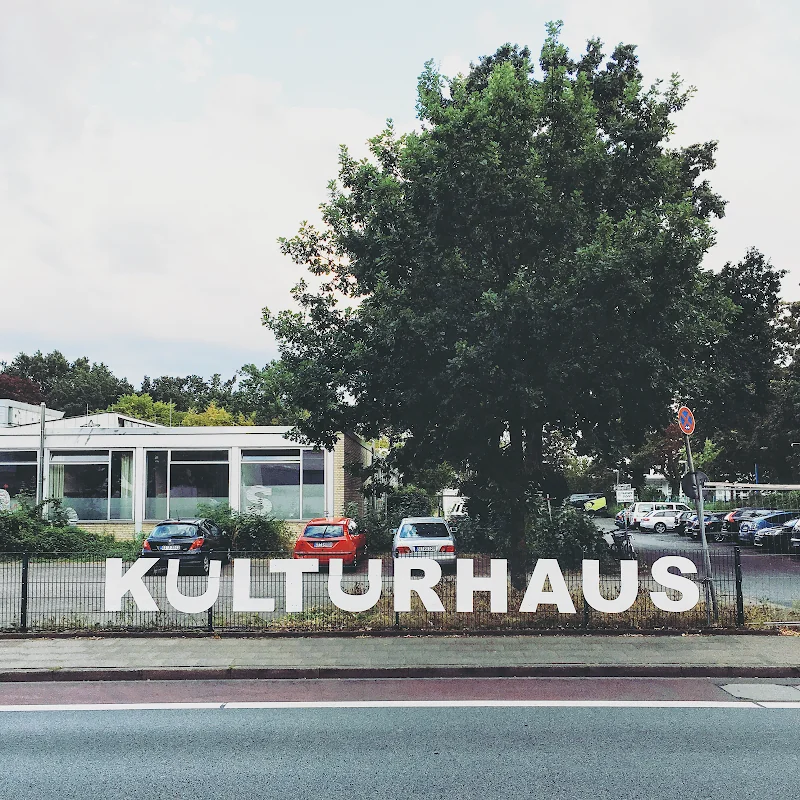
Bielefeld
Werner-Bock-Straße 34c, 33602 Bielefeld, Deutschland
Ostblock - Kulturhaus Bielefeld e.V. | Program & Directions
The Ostblock - Kulturhaus Bielefeld e.V. is in Bielefeld more than just an address for art and culture: It is an open house for studios, workshop activities, exhibitions, workshops, and events, which has developed a very unique character in the former FH building at Werner-Bock-Straße 34c. The association describes its place as an enrichment for the city, a space for exchange, participation, and creative development, and the current location description confirms the site near Kesselbrink with good accessibility from the city center and East City. Those searching for Ostblock Kulturhaus Bielefeld, Ostblock Bielefeld, or the Kulturhaus Bielefeld are usually looking for this mix of urban creativity, approachable community, and genuine use rather than mere backdrop. Since spring 2019, more than 150 artists and other creatives have been working there in over 40 studios, while the association's page emphasizes the open, as barrier-free as possible, claim of the house. ([kulturhaus-ostblock.de](https://kulturhaus-ostblock.de/ueber-uns/der-verein/?utm_source=openai))
Events, Program, and Current Events at Ostblock
The search interest surrounding Ostblock Kulturhaus Bielefeld revolves not only around the name but especially around what happens there. On the official website, the house presents itself as a place with a consciously broad program: concerts, parties, workshops, exhibitions, market formats, performances, theater, and dance regularly appear in the event announcements. A look at the current and recent contributions clearly shows the diversity: collective and community formats, night views, painting, word art, LAN parties, indoor evening flea markets, open workshop and studio offers, as well as regular Sunday or neighborhood formats. This mix is no coincidence but follows the association's purpose of promoting art and culture, education, and collaboration between art, culture, and urban development. Particularly exciting is that the place is not reduced to a single scene: Alongside classical cultural events, there are experimental, low-threshold, and often interactive formats that directly involve visitors. Examples from the published dates range from exhibitions and workshops to song and art formats to surprising pop-up ideas like open studios or communal game and networking evenings. For SEO search, therefore, the keyword program is just as important as events, workshops, and exhibitions, as they best reflect the actual demand for the place. Those visiting Ostblock do not receive a rigid schedule in the sense of a classical concert hall but an open cultural program that can change quickly and continually redefines the house. That is exactly what makes it appealing: Ostblock is not only a venue but also a production site, a meeting place, and a project area. ([kulturhaus-ostblock.de](https://kulturhaus-ostblock.de/?utm_source=openai))
Directions, Parking, and Barrier-Free Access to the Kulturhaus
Those searching for directions, parking, or barrier-free access primarily want practical information without detours. The current venue info from Bielefeld.JETZT names the Ostblock Kulturhaus Bielefeld with the address Werner-Bock-Straße 34c, 33602 Bielefeld, along with a barrier-free entrance and a restroom on site. Also listed are the public transport stops Arbeitsamt and Wiesenbad, as well as a shuttle bus stop No. 1 at the Volkshochschule. This is very helpful orientation for visitors as it shows that the house is integrated into urban mobility and does not function as an isolated peripheral location. The association's page complements the location character with the description that the place is conveniently located east of Kesselbrink and is easily accessible from the city center and East City. This mix of central location and culture-friendly environment is crucial for search queries Ostblock Bielefeld directions and Ostblock parking. An explicit list of its own parking spaces is not mentioned in the published info; therefore, for drivers, the classic city center logic with public parking garages and a subsequent short drive, for example by public transport or on foot, is the obvious practical solution. This is also sensible because the Kulturhaus itself is much more geared towards flexible use and public accessibility than a pure car infrastructure. In its external representation, the house thus appears modern and down-to-earth at the same time: Those arriving by bus, train, bicycle, or on foot reach a cultural place that does not hide behind a large event facade but openly interacts with the neighborhood. For the search for barrier-free, directions, parking, and address, the house thus provides the most important information directly on the official pages. ([bielefeld.jetzt](https://www.bielefeld.jetzt/node/426734))
Studios, Workshop, and Open Space: the Creative Rooms in the House
A central theme of the Ostblock Kulturhaus is its spaces. The association speaks of studios, dialogue, encounters, and interaction, while the public location description mentions more than 150 artists and other creatives in over 40 studios. This makes it clear that the house does not only host individual events but offers a permanent creative infrastructure. This is particularly concrete in the workshop: It was established in 2019 upon moving in, covers approximately 40 square meters, and features a large workbench as well as various tools. Mentioned are woodworking, metalworking with restrictions, electronics with restrictions, as well as repairs and maintenance. This is important because it shows that the workshop is not just an ancillary room but a true production site for art, design, upcycling, repair, and community projects. Furthermore, the Open Space appears in event descriptions as a large room that was once the central laboratory of the FH and is now used for art, sound, film, sculpture, live acts, and experimental formats. The kitchen and garden are also integrated into individual formats, so the house cannot be reduced to a single room or stage. The Open Space is limited, but precisely this limitation often creates closeness and intensity: people can move freely, sit, lie down, dream, and experience art not only frontally but spatially. For search queries like workshop, Open Space, studio, or rooms, Ostblock is particularly interesting because it is both a production site and a presentation venue. The structure of the house also explains why so many different formats can coexist there: small workshops, open studio hours, exhibitions, repair ideas, music, readings, installations, and spontaneous community projects. ([kulturhaus-ostblock.de](https://kulturhaus-ostblock.de/werkstatt/?utm_source=openai))
History and Association: How an Idea Became a Cultural House
The history of the Ostblock Kulturhaus is relevant for SEO and for visitors alike because it explains why the place appears so independent. According to the association's page, the first attempts date back several years before the opening; as early as 2015, the need for a space for work and exchange in the creative and subcultural scene was recognized. After political negotiations and much support from the city, politics, the population, and creative networks, the approval for the temporary use of the former FH building at Werner-Bock-Straße came at the end of 2018. Since April 2019, the Kulturhaus has been officially opened, and the development since then shows that an idea has become a robust cultural infrastructure. The association's statute clearly describes the purpose of the association: promotion of art and culture, promotion of popular and vocational education, as well as the implementation of exhibitions, concerts, performance art, theater, dance, workshops, and educational offerings. Thus, Ostblock is not a random project space but a non-profit organized cultural place with a broadly defined substantive mission. This institutional foundation is particularly important for understanding because it explains why not only individual events but also workshops, studios, exchange formats, and societal discourses are bundled there. The history of the house is also closely linked to urban development: the location was described as easily accessible and suitable for studios, open spaces, and events, thus as a place where cultural interim use and long-term impact can come together. For users searching for Ostblock Kulturhaus Bielefeld e.V., this is a strong signal: Here stands not a short-lived event brand but an association with a development path, statute, community structure, and real urban anchoring. ([kulturhaus-ostblock.de](https://kulturhaus-ostblock.de/ueber-uns/der-verein/?utm_source=openai))
Workshops, Participation, and Creative Community in Ostblock
Another core motif of the search is the question of how open and participatory Ostblock is. The association's page states very clearly: The place should be as barrier-free as possible and enable participation in a diverse community, even with very limited financial means. The support page adds that since the opening, about 100 creatives from all fields have created a communal place for working, experimenting, and networking, and that the association is organized non-profit and voluntarily. This is exactly what distinguishes a pure event location from a cultural house. At Ostblock, it is not only about consumable culture but also about participation, learning, experimenting, and producing together. This is evident in open studios, sewing and fashion formats, word art workshops, participatory event series, and offerings that explicitly also address people without significant financial means or professional prior experience. The programs emphasize low-threshold access, and even in experimental formats, there is often talk of beginner-friendliness or open participation. Particularly interesting is the mix of art, craft, social exchange, and neighborhood work: The house aims not only to serve artists but also to involve citizens from Bielefeld and the surrounding area. For search terms like workshops, studios, Kulturhaus Bielefeld, and Ostblock Kulturhaus, this is crucial because it describes the actual use of the place. The Kulturhaus is a place where knowledge, techniques, and ideas are shared, where people with different backgrounds can connect, and where culture is understood not as a completed performance but as an open practice. This attitude shapes the external perception of the house and makes it a special attraction for many visitors. ([kulturhaus-ostblock.de](https://kulturhaus-ostblock.de/ueber-uns/der-verein/?utm_source=openai))
Photos, Atmosphere, and Why Ostblock is So Often Searched
The keyword photos very well shows what many people are really interested in when searching: not only the address but the atmosphere. At Ostblock, this atmosphere is strongly characterized by changeability. The website visibly works in a visually oriented manner because the current program page features many event images, posters, and changing motifs, and because formats like night views, exhibitions, collage workshops, graffiti stations, or word art also create very different visual impressions. From the room and event descriptions, it can be inferred that the place consciously oscillates between raw, creative, experimental, and communal. The former FH building, the Open Space, the workshop, the studios, and the garden together do not create a sterile showroom but a lively backdrop for cultural work and neighborhood projects. Those searching for Ostblock Kulturhaus Bielefeld photos will therefore primarily find images of art in progress, of groups in action, of installations, of workshops, and of space-consuming events, not just of a fixed architecture. This mix makes the place strong in searches: Many people want to see how large the space appears, what the studios look like, how open the entrance area is, and how diverse the events are staged. For social media and discovery, this is relevant because the house can be visually narrated very well: industrial structure, creative use, open community, changing art forms, and a clear connection to the city. The public perception is thus not shaped by luxury or pomp but by authenticity and immediate presence. This is a strong SEO advantage because search queries for photos usually target real impressions, and Ostblock delivers exactly these impressions: a cultural house that is not finished decorated but is constantly reshaped by people, projects, and events. ([kulturhaus-ostblock.de](https://kulturhaus-ostblock.de/?utm_source=openai))
Sources:
Show moreShow less
Ostblock - Kulturhaus Bielefeld e.V. | Program & Directions
The Ostblock - Kulturhaus Bielefeld e.V. is in Bielefeld more than just an address for art and culture: It is an open house for studios, workshop activities, exhibitions, workshops, and events, which has developed a very unique character in the former FH building at Werner-Bock-Straße 34c. The association describes its place as an enrichment for the city, a space for exchange, participation, and creative development, and the current location description confirms the site near Kesselbrink with good accessibility from the city center and East City. Those searching for Ostblock Kulturhaus Bielefeld, Ostblock Bielefeld, or the Kulturhaus Bielefeld are usually looking for this mix of urban creativity, approachable community, and genuine use rather than mere backdrop. Since spring 2019, more than 150 artists and other creatives have been working there in over 40 studios, while the association's page emphasizes the open, as barrier-free as possible, claim of the house. ([kulturhaus-ostblock.de](https://kulturhaus-ostblock.de/ueber-uns/der-verein/?utm_source=openai))
Events, Program, and Current Events at Ostblock
The search interest surrounding Ostblock Kulturhaus Bielefeld revolves not only around the name but especially around what happens there. On the official website, the house presents itself as a place with a consciously broad program: concerts, parties, workshops, exhibitions, market formats, performances, theater, and dance regularly appear in the event announcements. A look at the current and recent contributions clearly shows the diversity: collective and community formats, night views, painting, word art, LAN parties, indoor evening flea markets, open workshop and studio offers, as well as regular Sunday or neighborhood formats. This mix is no coincidence but follows the association's purpose of promoting art and culture, education, and collaboration between art, culture, and urban development. Particularly exciting is that the place is not reduced to a single scene: Alongside classical cultural events, there are experimental, low-threshold, and often interactive formats that directly involve visitors. Examples from the published dates range from exhibitions and workshops to song and art formats to surprising pop-up ideas like open studios or communal game and networking evenings. For SEO search, therefore, the keyword program is just as important as events, workshops, and exhibitions, as they best reflect the actual demand for the place. Those visiting Ostblock do not receive a rigid schedule in the sense of a classical concert hall but an open cultural program that can change quickly and continually redefines the house. That is exactly what makes it appealing: Ostblock is not only a venue but also a production site, a meeting place, and a project area. ([kulturhaus-ostblock.de](https://kulturhaus-ostblock.de/?utm_source=openai))
Directions, Parking, and Barrier-Free Access to the Kulturhaus
Those searching for directions, parking, or barrier-free access primarily want practical information without detours. The current venue info from Bielefeld.JETZT names the Ostblock Kulturhaus Bielefeld with the address Werner-Bock-Straße 34c, 33602 Bielefeld, along with a barrier-free entrance and a restroom on site. Also listed are the public transport stops Arbeitsamt and Wiesenbad, as well as a shuttle bus stop No. 1 at the Volkshochschule. This is very helpful orientation for visitors as it shows that the house is integrated into urban mobility and does not function as an isolated peripheral location. The association's page complements the location character with the description that the place is conveniently located east of Kesselbrink and is easily accessible from the city center and East City. This mix of central location and culture-friendly environment is crucial for search queries Ostblock Bielefeld directions and Ostblock parking. An explicit list of its own parking spaces is not mentioned in the published info; therefore, for drivers, the classic city center logic with public parking garages and a subsequent short drive, for example by public transport or on foot, is the obvious practical solution. This is also sensible because the Kulturhaus itself is much more geared towards flexible use and public accessibility than a pure car infrastructure. In its external representation, the house thus appears modern and down-to-earth at the same time: Those arriving by bus, train, bicycle, or on foot reach a cultural place that does not hide behind a large event facade but openly interacts with the neighborhood. For the search for barrier-free, directions, parking, and address, the house thus provides the most important information directly on the official pages. ([bielefeld.jetzt](https://www.bielefeld.jetzt/node/426734))
Studios, Workshop, and Open Space: the Creative Rooms in the House
A central theme of the Ostblock Kulturhaus is its spaces. The association speaks of studios, dialogue, encounters, and interaction, while the public location description mentions more than 150 artists and other creatives in over 40 studios. This makes it clear that the house does not only host individual events but offers a permanent creative infrastructure. This is particularly concrete in the workshop: It was established in 2019 upon moving in, covers approximately 40 square meters, and features a large workbench as well as various tools. Mentioned are woodworking, metalworking with restrictions, electronics with restrictions, as well as repairs and maintenance. This is important because it shows that the workshop is not just an ancillary room but a true production site for art, design, upcycling, repair, and community projects. Furthermore, the Open Space appears in event descriptions as a large room that was once the central laboratory of the FH and is now used for art, sound, film, sculpture, live acts, and experimental formats. The kitchen and garden are also integrated into individual formats, so the house cannot be reduced to a single room or stage. The Open Space is limited, but precisely this limitation often creates closeness and intensity: people can move freely, sit, lie down, dream, and experience art not only frontally but spatially. For search queries like workshop, Open Space, studio, or rooms, Ostblock is particularly interesting because it is both a production site and a presentation venue. The structure of the house also explains why so many different formats can coexist there: small workshops, open studio hours, exhibitions, repair ideas, music, readings, installations, and spontaneous community projects. ([kulturhaus-ostblock.de](https://kulturhaus-ostblock.de/werkstatt/?utm_source=openai))
History and Association: How an Idea Became a Cultural House
The history of the Ostblock Kulturhaus is relevant for SEO and for visitors alike because it explains why the place appears so independent. According to the association's page, the first attempts date back several years before the opening; as early as 2015, the need for a space for work and exchange in the creative and subcultural scene was recognized. After political negotiations and much support from the city, politics, the population, and creative networks, the approval for the temporary use of the former FH building at Werner-Bock-Straße came at the end of 2018. Since April 2019, the Kulturhaus has been officially opened, and the development since then shows that an idea has become a robust cultural infrastructure. The association's statute clearly describes the purpose of the association: promotion of art and culture, promotion of popular and vocational education, as well as the implementation of exhibitions, concerts, performance art, theater, dance, workshops, and educational offerings. Thus, Ostblock is not a random project space but a non-profit organized cultural place with a broadly defined substantive mission. This institutional foundation is particularly important for understanding because it explains why not only individual events but also workshops, studios, exchange formats, and societal discourses are bundled there. The history of the house is also closely linked to urban development: the location was described as easily accessible and suitable for studios, open spaces, and events, thus as a place where cultural interim use and long-term impact can come together. For users searching for Ostblock Kulturhaus Bielefeld e.V., this is a strong signal: Here stands not a short-lived event brand but an association with a development path, statute, community structure, and real urban anchoring. ([kulturhaus-ostblock.de](https://kulturhaus-ostblock.de/ueber-uns/der-verein/?utm_source=openai))
Workshops, Participation, and Creative Community in Ostblock
Another core motif of the search is the question of how open and participatory Ostblock is. The association's page states very clearly: The place should be as barrier-free as possible and enable participation in a diverse community, even with very limited financial means. The support page adds that since the opening, about 100 creatives from all fields have created a communal place for working, experimenting, and networking, and that the association is organized non-profit and voluntarily. This is exactly what distinguishes a pure event location from a cultural house. At Ostblock, it is not only about consumable culture but also about participation, learning, experimenting, and producing together. This is evident in open studios, sewing and fashion formats, word art workshops, participatory event series, and offerings that explicitly also address people without significant financial means or professional prior experience. The programs emphasize low-threshold access, and even in experimental formats, there is often talk of beginner-friendliness or open participation. Particularly interesting is the mix of art, craft, social exchange, and neighborhood work: The house aims not only to serve artists but also to involve citizens from Bielefeld and the surrounding area. For search terms like workshops, studios, Kulturhaus Bielefeld, and Ostblock Kulturhaus, this is crucial because it describes the actual use of the place. The Kulturhaus is a place where knowledge, techniques, and ideas are shared, where people with different backgrounds can connect, and where culture is understood not as a completed performance but as an open practice. This attitude shapes the external perception of the house and makes it a special attraction for many visitors. ([kulturhaus-ostblock.de](https://kulturhaus-ostblock.de/ueber-uns/der-verein/?utm_source=openai))
Photos, Atmosphere, and Why Ostblock is So Often Searched
The keyword photos very well shows what many people are really interested in when searching: not only the address but the atmosphere. At Ostblock, this atmosphere is strongly characterized by changeability. The website visibly works in a visually oriented manner because the current program page features many event images, posters, and changing motifs, and because formats like night views, exhibitions, collage workshops, graffiti stations, or word art also create very different visual impressions. From the room and event descriptions, it can be inferred that the place consciously oscillates between raw, creative, experimental, and communal. The former FH building, the Open Space, the workshop, the studios, and the garden together do not create a sterile showroom but a lively backdrop for cultural work and neighborhood projects. Those searching for Ostblock Kulturhaus Bielefeld photos will therefore primarily find images of art in progress, of groups in action, of installations, of workshops, and of space-consuming events, not just of a fixed architecture. This mix makes the place strong in searches: Many people want to see how large the space appears, what the studios look like, how open the entrance area is, and how diverse the events are staged. For social media and discovery, this is relevant because the house can be visually narrated very well: industrial structure, creative use, open community, changing art forms, and a clear connection to the city. The public perception is thus not shaped by luxury or pomp but by authenticity and immediate presence. This is a strong SEO advantage because search queries for photos usually target real impressions, and Ostblock delivers exactly these impressions: a cultural house that is not finished decorated but is constantly reshaped by people, projects, and events. ([kulturhaus-ostblock.de](https://kulturhaus-ostblock.de/?utm_source=openai))
Sources:
Ostblock - Kulturhaus Bielefeld e.V. | Program & Directions
The Ostblock - Kulturhaus Bielefeld e.V. is in Bielefeld more than just an address for art and culture: It is an open house for studios, workshop activities, exhibitions, workshops, and events, which has developed a very unique character in the former FH building at Werner-Bock-Straße 34c. The association describes its place as an enrichment for the city, a space for exchange, participation, and creative development, and the current location description confirms the site near Kesselbrink with good accessibility from the city center and East City. Those searching for Ostblock Kulturhaus Bielefeld, Ostblock Bielefeld, or the Kulturhaus Bielefeld are usually looking for this mix of urban creativity, approachable community, and genuine use rather than mere backdrop. Since spring 2019, more than 150 artists and other creatives have been working there in over 40 studios, while the association's page emphasizes the open, as barrier-free as possible, claim of the house. ([kulturhaus-ostblock.de](https://kulturhaus-ostblock.de/ueber-uns/der-verein/?utm_source=openai))
Events, Program, and Current Events at Ostblock
The search interest surrounding Ostblock Kulturhaus Bielefeld revolves not only around the name but especially around what happens there. On the official website, the house presents itself as a place with a consciously broad program: concerts, parties, workshops, exhibitions, market formats, performances, theater, and dance regularly appear in the event announcements. A look at the current and recent contributions clearly shows the diversity: collective and community formats, night views, painting, word art, LAN parties, indoor evening flea markets, open workshop and studio offers, as well as regular Sunday or neighborhood formats. This mix is no coincidence but follows the association's purpose of promoting art and culture, education, and collaboration between art, culture, and urban development. Particularly exciting is that the place is not reduced to a single scene: Alongside classical cultural events, there are experimental, low-threshold, and often interactive formats that directly involve visitors. Examples from the published dates range from exhibitions and workshops to song and art formats to surprising pop-up ideas like open studios or communal game and networking evenings. For SEO search, therefore, the keyword program is just as important as events, workshops, and exhibitions, as they best reflect the actual demand for the place. Those visiting Ostblock do not receive a rigid schedule in the sense of a classical concert hall but an open cultural program that can change quickly and continually redefines the house. That is exactly what makes it appealing: Ostblock is not only a venue but also a production site, a meeting place, and a project area. ([kulturhaus-ostblock.de](https://kulturhaus-ostblock.de/?utm_source=openai))
Directions, Parking, and Barrier-Free Access to the Kulturhaus
Those searching for directions, parking, or barrier-free access primarily want practical information without detours. The current venue info from Bielefeld.JETZT names the Ostblock Kulturhaus Bielefeld with the address Werner-Bock-Straße 34c, 33602 Bielefeld, along with a barrier-free entrance and a restroom on site. Also listed are the public transport stops Arbeitsamt and Wiesenbad, as well as a shuttle bus stop No. 1 at the Volkshochschule. This is very helpful orientation for visitors as it shows that the house is integrated into urban mobility and does not function as an isolated peripheral location. The association's page complements the location character with the description that the place is conveniently located east of Kesselbrink and is easily accessible from the city center and East City. This mix of central location and culture-friendly environment is crucial for search queries Ostblock Bielefeld directions and Ostblock parking. An explicit list of its own parking spaces is not mentioned in the published info; therefore, for drivers, the classic city center logic with public parking garages and a subsequent short drive, for example by public transport or on foot, is the obvious practical solution. This is also sensible because the Kulturhaus itself is much more geared towards flexible use and public accessibility than a pure car infrastructure. In its external representation, the house thus appears modern and down-to-earth at the same time: Those arriving by bus, train, bicycle, or on foot reach a cultural place that does not hide behind a large event facade but openly interacts with the neighborhood. For the search for barrier-free, directions, parking, and address, the house thus provides the most important information directly on the official pages. ([bielefeld.jetzt](https://www.bielefeld.jetzt/node/426734))
Studios, Workshop, and Open Space: the Creative Rooms in the House
A central theme of the Ostblock Kulturhaus is its spaces. The association speaks of studios, dialogue, encounters, and interaction, while the public location description mentions more than 150 artists and other creatives in over 40 studios. This makes it clear that the house does not only host individual events but offers a permanent creative infrastructure. This is particularly concrete in the workshop: It was established in 2019 upon moving in, covers approximately 40 square meters, and features a large workbench as well as various tools. Mentioned are woodworking, metalworking with restrictions, electronics with restrictions, as well as repairs and maintenance. This is important because it shows that the workshop is not just an ancillary room but a true production site for art, design, upcycling, repair, and community projects. Furthermore, the Open Space appears in event descriptions as a large room that was once the central laboratory of the FH and is now used for art, sound, film, sculpture, live acts, and experimental formats. The kitchen and garden are also integrated into individual formats, so the house cannot be reduced to a single room or stage. The Open Space is limited, but precisely this limitation often creates closeness and intensity: people can move freely, sit, lie down, dream, and experience art not only frontally but spatially. For search queries like workshop, Open Space, studio, or rooms, Ostblock is particularly interesting because it is both a production site and a presentation venue. The structure of the house also explains why so many different formats can coexist there: small workshops, open studio hours, exhibitions, repair ideas, music, readings, installations, and spontaneous community projects. ([kulturhaus-ostblock.de](https://kulturhaus-ostblock.de/werkstatt/?utm_source=openai))
History and Association: How an Idea Became a Cultural House
The history of the Ostblock Kulturhaus is relevant for SEO and for visitors alike because it explains why the place appears so independent. According to the association's page, the first attempts date back several years before the opening; as early as 2015, the need for a space for work and exchange in the creative and subcultural scene was recognized. After political negotiations and much support from the city, politics, the population, and creative networks, the approval for the temporary use of the former FH building at Werner-Bock-Straße came at the end of 2018. Since April 2019, the Kulturhaus has been officially opened, and the development since then shows that an idea has become a robust cultural infrastructure. The association's statute clearly describes the purpose of the association: promotion of art and culture, promotion of popular and vocational education, as well as the implementation of exhibitions, concerts, performance art, theater, dance, workshops, and educational offerings. Thus, Ostblock is not a random project space but a non-profit organized cultural place with a broadly defined substantive mission. This institutional foundation is particularly important for understanding because it explains why not only individual events but also workshops, studios, exchange formats, and societal discourses are bundled there. The history of the house is also closely linked to urban development: the location was described as easily accessible and suitable for studios, open spaces, and events, thus as a place where cultural interim use and long-term impact can come together. For users searching for Ostblock Kulturhaus Bielefeld e.V., this is a strong signal: Here stands not a short-lived event brand but an association with a development path, statute, community structure, and real urban anchoring. ([kulturhaus-ostblock.de](https://kulturhaus-ostblock.de/ueber-uns/der-verein/?utm_source=openai))
Workshops, Participation, and Creative Community in Ostblock
Another core motif of the search is the question of how open and participatory Ostblock is. The association's page states very clearly: The place should be as barrier-free as possible and enable participation in a diverse community, even with very limited financial means. The support page adds that since the opening, about 100 creatives from all fields have created a communal place for working, experimenting, and networking, and that the association is organized non-profit and voluntarily. This is exactly what distinguishes a pure event location from a cultural house. At Ostblock, it is not only about consumable culture but also about participation, learning, experimenting, and producing together. This is evident in open studios, sewing and fashion formats, word art workshops, participatory event series, and offerings that explicitly also address people without significant financial means or professional prior experience. The programs emphasize low-threshold access, and even in experimental formats, there is often talk of beginner-friendliness or open participation. Particularly interesting is the mix of art, craft, social exchange, and neighborhood work: The house aims not only to serve artists but also to involve citizens from Bielefeld and the surrounding area. For search terms like workshops, studios, Kulturhaus Bielefeld, and Ostblock Kulturhaus, this is crucial because it describes the actual use of the place. The Kulturhaus is a place where knowledge, techniques, and ideas are shared, where people with different backgrounds can connect, and where culture is understood not as a completed performance but as an open practice. This attitude shapes the external perception of the house and makes it a special attraction for many visitors. ([kulturhaus-ostblock.de](https://kulturhaus-ostblock.de/ueber-uns/der-verein/?utm_source=openai))
Photos, Atmosphere, and Why Ostblock is So Often Searched
The keyword photos very well shows what many people are really interested in when searching: not only the address but the atmosphere. At Ostblock, this atmosphere is strongly characterized by changeability. The website visibly works in a visually oriented manner because the current program page features many event images, posters, and changing motifs, and because formats like night views, exhibitions, collage workshops, graffiti stations, or word art also create very different visual impressions. From the room and event descriptions, it can be inferred that the place consciously oscillates between raw, creative, experimental, and communal. The former FH building, the Open Space, the workshop, the studios, and the garden together do not create a sterile showroom but a lively backdrop for cultural work and neighborhood projects. Those searching for Ostblock Kulturhaus Bielefeld photos will therefore primarily find images of art in progress, of groups in action, of installations, of workshops, and of space-consuming events, not just of a fixed architecture. This mix makes the place strong in searches: Many people want to see how large the space appears, what the studios look like, how open the entrance area is, and how diverse the events are staged. For social media and discovery, this is relevant because the house can be visually narrated very well: industrial structure, creative use, open community, changing art forms, and a clear connection to the city. The public perception is thus not shaped by luxury or pomp but by authenticity and immediate presence. This is a strong SEO advantage because search queries for photos usually target real impressions, and Ostblock delivers exactly these impressions: a cultural house that is not finished decorated but is constantly reshaped by people, projects, and events. ([kulturhaus-ostblock.de](https://kulturhaus-ostblock.de/?utm_source=openai))
Sources:
Frequently Asked Questions
Reviews
Moh Theshow (Mohtheshow)
10. October 2024
Cool to be there ;)
Nils Bentlage
5. September 2019
Fanboy!!
Gali Ri
11. September 2025
Really interesting and cool place with very good events! It's always worth checking out what's going on there and helping them on a donation basis so that culture can thrive!
Lisa Rahmöller
13. February 2025
I participated in a pottery course at the cultural center. The course was really nice, highly recommend it. The cultural center is a great place to get creative.
Ralph Klocke
10. April 2019
Something great is being created here for Bielefeld, my tip for the Night Views 2019. There will be a work in progress to see, definitely the most exciting location for culture explorers. Maybe just temporary, maybe a new creative place near the center beyond 2019.