
Bielefeld
Sennestadtring 15a, 33689 Bielefeld, Deutschland
Sennestadt Pavilion | Rent Hall & Directions
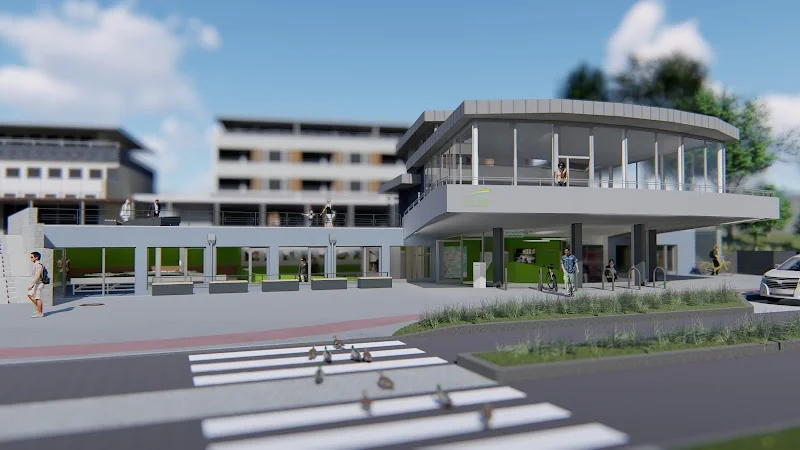
The Sennestadt Pavilion at Sennestadtring 15a in Bielefeld is much more than an ordinary event space. It is a building with history, a visible part of the Sennestadt identity, and at the same time an actively used place for neighborhood work, workshops, city tours, and cultural formats. The city of Bielefeld describes the pavilion as a sales pavilion built in 1968, which, along with its twin pavilion, is part of the city crown and is considered a typical witness of the Sennestadt. Sennestadt GmbH emphasizes that since the energetic renovation and redesign with funds from urban development assistance, the pavilion has been used as a cultural and architectural place in the basement. There you will find the historical planning model of Sennestadt, an info point, a conference area, and a co-working offer. Those looking for a Sennestadt hall, a conference room, or a flexible space in Bielefeld will find a location that unusually combines architecture, neighborhood work, and practical usability. ([bielefeld.de](https://www.bielefeld.de/node/25847?utm_source=openai))
History and Architecture of the Sennestadt Pavilion
The history of the Sennestadt Pavilion does not begin as an event location, but as a sales building. According to the city of Bielefeld, the delicate building was constructed in 1968. It is located in the center of Sennestadt and, together with the twin pavilion, forms part of the so-called city crown. This location is important because Sennestadt itself was developed from 1956 as a new town based on the designs of Hans Bernhard Reichow. The settlement was planned as a response to housing shortages and refugee movements and remains a well-known example of organic urban development to this day. The pavilion is therefore not isolated but situated in an urban context that emphasizes the connection between people, landscape, and architecture. This gives it a special appeal for visitors searching for Sennestadt Pavilion, Ring Pavilion Sennestadt, or Sennestadt hall: The building is small enough for personal encounters while being historically charged enough to spark curiosity. ([bielefeld.de](https://www.bielefeld.de/node/25847?utm_source=openai))
The history of use is also important for today's perception. Since its opening, the pavilion has taken on very different functions, from a music store to gastronomic use and even a drugstore. After the bankruptcy of the drugstore chain, there was initially no new tenant; only a small part of the basement was temporarily rented out as a workshop. During the urban redevelopment process, the building also housed the neighborhood office and was already used by associations and for cultural events. This varied history explains why the pavilion is still often associated with terms like Sennestadt events, Sennestadt party room, or Sennestadt hall rental. At the same time, it shows that the place was never just a commercial space but was perceived early on as a social and cultural building block in the neighborhood. Today's use connects precisely to this multiple role and makes the building attractive for neighborhood meetings, education, and public formats. ([bielefeld.de](https://www.bielefeld.de/node/25847?utm_source=openai))
Rent Sennestadt Hall: Conference Room, Model Room, and Co-Working
Those wishing to rent the Sennestadt Pavilion will find a clearly structured usage concept in the basement. The official building culture site mentions 350 barrier-free square meters in the basement. The centerpiece is the conference and model room with chairs and tables for about 25 people. Additionally, there is a smart display, Wi-Fi, up to five mobile pinboards, a mobile speaker box or sound system, and access to the tea kitchen with dishes and coffee machine. A usage fee of 80 euros is indicated for four hours. This makes the place particularly interesting for workshops, small conferences, association meetings, discussions, presentations, and educational formats. For SEO inquiries like Sennestadt hall, Sennestadt conference room, or Sennestadt hall rental, this combination of atmosphere, technology, and manageable size is relevant as it describes a professional yet not oversized location. ([baukultur.sennestadt.de](https://baukultur.sennestadt.de/))
Moreover, the pavilion is not just a room but a small urban laboratory. The exhibition room contains the historical planning model of Sennestadt, which makes the urban planning idea of the neighborhood tangible. An info point serves as a starting point for city tours and also houses city management. The co-working area offers 11 workstations and lockable lockers, also with Wi-Fi and tea kitchen access. This makes the building suitable not only for classic event requests but also for temporary project work, creative team days, and hybrid neighborhood formats. Sennestadt GmbH therefore describes the pavilion as a cultural educational institution and as an extracurricular learning location where children, young people, and adults are taught urban planning, architectural, and cultural topics. This mix of space for focused work and space for public communication is a key reason why the Sennestadt Pavilion functions so well as a flexible address in the district. ([sennestadt-gmbh.de](https://www.sennestadt-gmbh.de/sennestadtpavillon/))
Barrier-Free at Sennestadt Pavilion: Renovation and Equipment
A strong feature of the building is the renovation. The city of Bielefeld states that the pavilion was energetically renovated and made barrier-free in 2020 and 2021 with the help of urban development funds. The goals were improved technology, modernized glass facades, barrier-free access to publicly accessible areas, and the implementation of fire protection regulations. This is important for visitors because the location is not only historically interesting but also usable in a contemporary way. This is a central argument for search queries like Sennestadt barrier-free or Sennestadt Pavilion rental. When planning a small event, one typically wants not only an attractive room but also a space that can be accessed and used by as many people as possible without major hurdles. The pavilion meets this requirement because the renovation has not only preserved the old building substance but has also functionally developed it further. ([bielefeld.de](https://www.bielefeld.de/node/25847?utm_source=openai))
The planning documents and the official offer page complement this picture with concrete details. In the basement, a barrier-free toilet is indicated, and the views of the renovation show a newly constructed ramp with a six percent incline. The building culture site also explicitly mentions barrier-free access at the info point. Together with the barrier-free use of the basement, this results in a coherent, practical concept for inclusive events and consulting offers. This is particularly relevant for neighborhood meetings, educational offerings, or smaller formats where different user groups come together. From the perspective of spatial impact, this is also sensible: The combination of historical architecture and modern accessibility creates an atmosphere that is neither museum-like nor sterile. This balance is exactly what makes the Sennestadt Pavilion so interesting today. It conveys history while remaining open to new uses that would not be possible without renovation and reconstruction. ([bielefeld.de](https://www.bielefeld.de/sites/default/files/datei/2023/Pavillon_Ansicht_UG.pdf))
Directions and Parking at Sennestadt Pavilion
Access is a crucial criterion for an event location. The Sennestadt Pavilion is centrally located in Sennestadt, and the official website mentions the combination of city rail line 1 and bus line 135 for public transport. Both connections bring visitors to Sennestadt; the stop is Jadeweg, which is in sight of the pavilion. This makes the location easily accessible even without a car. The location in the southeastern district of Bielefeld is also practical for people from the neighborhood itself because the pavilion is embedded in the quarter and does not have to be searched for in a peripheral industrial area. For SEO terms like Sennestadt directions or Sennestadt Pavilion, such specific information is particularly valuable as it quickly orients visitors and simultaneously builds trust. ([baukultur.sennestadt.de](https://baukultur.sennestadt.de/))
For those arriving by car, the building culture site provides a clear navigation address: An der Maiwiese, 33689 Bielefeld. Visitors can park for free about 50 meters away. This is a strong practical argument for a compact neighborhood location, as it significantly simplifies parking searches and facilitates access for small groups, material transports, or event guests. The note about short distances is as important for usability as the address itself, as the pavilion is frequently used for workshops, meetings, and tours, where many people arrive at different times. Additionally, the location benefits from the fact that Sennestadt is known for its clear urban structure and good accessibility via major traffic routes. So, those searching for Sennestadt parking or Sennestadt Pavilion parking will find a rare combination of central location, public transport connection, and pedestrian parking options. ([baukultur.sennestadt.de](https://baukultur.sennestadt.de/))
Events, City Tours, and Neighborhood Management
The Sennestadt Pavilion is now not just a rental space but an active meeting point for urban development and education. Sennestadt GmbH describes it as the location of the city manager, as a venue and workplace for sustainable urban development, and as an extracurricular educational place. In the event calendar, visitors will find not only dates but also occupancy information, usage conditions, directions, and contact options. This structure shows that the pavilion does not function as a static space but as a vibrant part of neighborhood management. This makes it particularly relevant for search queries related to Sennestadt events, Sennestadt coworking, or Sennestadt model. It is not just about a room with tables and chairs but about a place where neighborhood work, communication, and encounters are interconnected. ([sennestadt-gmbh.de](https://www.sennestadt-gmbh.de/sennestadtpavillon/))
Current notices also demonstrate the regular use. The Bielefeld heat ambassador training cites the Sennestadt Pavilion as a venue, and during the open monument day, the pavilion served as a meeting point for a city tour through Sennestadt. Such formats show that the building is perceived far beyond internal administration. It is a stage for neighborhood offerings, a contact point for tour dates, and a meeting place for people interested in urban history, climate adaptation, or local participation. For organizers, this is an advantage because the location is already thematically oriented towards public formats. Those planning workshops, lectures, or information evenings thus get a place that not only functions technically but also fits thematically. The Sennestadt Pavilion does not convey the anonymous neutrality of a standard room but a genuine connection to the neighborhood and the topics being discussed there. ([bielefeld.de](https://www.bielefeld.de/node/33992?utm_source=openai))
Sennestadt as a District: Why the Location is So Special
The location of the pavilion is hardly understandable without Sennestadt itself. The city of Bielefeld describes the district as a model city that was established from 1956 based on the designs of Hans Bernhard Reichow. The goal was to accommodate refugees and displaced persons and to alleviate the housing shortage of the post-war period. Sennestadt is characterized by organic urban development, where people and their needs are at the center. This idea continues to shape the atmosphere of the neighborhood today. Therefore, when visiting the pavilion, one does not simply experience an individual building but a piece of urban planning history that continues to resonate in its surroundings. For search terms like Sennestadt house Bielefeld, Sennestadt hall, or Sennestadt Pavilion, this context is important as it explains why the district bundles so many public, cultural, and social uses. ([bielefeld.de](https://www.bielefeld.de/insek-sennestadt?utm_source=openai))
At the same time, Sennestadt is a vibrant present. The city of Bielefeld refers to a diverse cultural life, Sennestadt GmbH speaks of a central place in the urban redevelopment process, and the renovation of the pavilion is part of this development. This makes the building an example of how historical building substance, neighborhood work, and modern use can be meaningfully combined. This is precisely the special strength of this location: It is neither purely nostalgic nor purely functional but both at the same time. Those seeking a small, easily accessible, barrier-free, and content-rich space will find here an address with real profile. Whether for conferences, workshops, association meetings, city tours, or project work - the Sennestadt Pavilion offers a suitable framework that makes the identity of the district tangible while remaining very practically usable. For visitors, this means an authentic experience with a short journey, and for organizers, a location with clear recognition value. ([sennestadt-gmbh.de](https://www.sennestadt-gmbh.de/sennestadtpavillon/))
Sources:
Show moreShow less
Sennestadt Pavilion | Rent Hall & Directions
The Sennestadt Pavilion at Sennestadtring 15a in Bielefeld is much more than an ordinary event space. It is a building with history, a visible part of the Sennestadt identity, and at the same time an actively used place for neighborhood work, workshops, city tours, and cultural formats. The city of Bielefeld describes the pavilion as a sales pavilion built in 1968, which, along with its twin pavilion, is part of the city crown and is considered a typical witness of the Sennestadt. Sennestadt GmbH emphasizes that since the energetic renovation and redesign with funds from urban development assistance, the pavilion has been used as a cultural and architectural place in the basement. There you will find the historical planning model of Sennestadt, an info point, a conference area, and a co-working offer. Those looking for a Sennestadt hall, a conference room, or a flexible space in Bielefeld will find a location that unusually combines architecture, neighborhood work, and practical usability. ([bielefeld.de](https://www.bielefeld.de/node/25847?utm_source=openai))
History and Architecture of the Sennestadt Pavilion
The history of the Sennestadt Pavilion does not begin as an event location, but as a sales building. According to the city of Bielefeld, the delicate building was constructed in 1968. It is located in the center of Sennestadt and, together with the twin pavilion, forms part of the so-called city crown. This location is important because Sennestadt itself was developed from 1956 as a new town based on the designs of Hans Bernhard Reichow. The settlement was planned as a response to housing shortages and refugee movements and remains a well-known example of organic urban development to this day. The pavilion is therefore not isolated but situated in an urban context that emphasizes the connection between people, landscape, and architecture. This gives it a special appeal for visitors searching for Sennestadt Pavilion, Ring Pavilion Sennestadt, or Sennestadt hall: The building is small enough for personal encounters while being historically charged enough to spark curiosity. ([bielefeld.de](https://www.bielefeld.de/node/25847?utm_source=openai))
The history of use is also important for today's perception. Since its opening, the pavilion has taken on very different functions, from a music store to gastronomic use and even a drugstore. After the bankruptcy of the drugstore chain, there was initially no new tenant; only a small part of the basement was temporarily rented out as a workshop. During the urban redevelopment process, the building also housed the neighborhood office and was already used by associations and for cultural events. This varied history explains why the pavilion is still often associated with terms like Sennestadt events, Sennestadt party room, or Sennestadt hall rental. At the same time, it shows that the place was never just a commercial space but was perceived early on as a social and cultural building block in the neighborhood. Today's use connects precisely to this multiple role and makes the building attractive for neighborhood meetings, education, and public formats. ([bielefeld.de](https://www.bielefeld.de/node/25847?utm_source=openai))
Rent Sennestadt Hall: Conference Room, Model Room, and Co-Working
Those wishing to rent the Sennestadt Pavilion will find a clearly structured usage concept in the basement. The official building culture site mentions 350 barrier-free square meters in the basement. The centerpiece is the conference and model room with chairs and tables for about 25 people. Additionally, there is a smart display, Wi-Fi, up to five mobile pinboards, a mobile speaker box or sound system, and access to the tea kitchen with dishes and coffee machine. A usage fee of 80 euros is indicated for four hours. This makes the place particularly interesting for workshops, small conferences, association meetings, discussions, presentations, and educational formats. For SEO inquiries like Sennestadt hall, Sennestadt conference room, or Sennestadt hall rental, this combination of atmosphere, technology, and manageable size is relevant as it describes a professional yet not oversized location. ([baukultur.sennestadt.de](https://baukultur.sennestadt.de/))
Moreover, the pavilion is not just a room but a small urban laboratory. The exhibition room contains the historical planning model of Sennestadt, which makes the urban planning idea of the neighborhood tangible. An info point serves as a starting point for city tours and also houses city management. The co-working area offers 11 workstations and lockable lockers, also with Wi-Fi and tea kitchen access. This makes the building suitable not only for classic event requests but also for temporary project work, creative team days, and hybrid neighborhood formats. Sennestadt GmbH therefore describes the pavilion as a cultural educational institution and as an extracurricular learning location where children, young people, and adults are taught urban planning, architectural, and cultural topics. This mix of space for focused work and space for public communication is a key reason why the Sennestadt Pavilion functions so well as a flexible address in the district. ([sennestadt-gmbh.de](https://www.sennestadt-gmbh.de/sennestadtpavillon/))
Barrier-Free at Sennestadt Pavilion: Renovation and Equipment
A strong feature of the building is the renovation. The city of Bielefeld states that the pavilion was energetically renovated and made barrier-free in 2020 and 2021 with the help of urban development funds. The goals were improved technology, modernized glass facades, barrier-free access to publicly accessible areas, and the implementation of fire protection regulations. This is important for visitors because the location is not only historically interesting but also usable in a contemporary way. This is a central argument for search queries like Sennestadt barrier-free or Sennestadt Pavilion rental. When planning a small event, one typically wants not only an attractive room but also a space that can be accessed and used by as many people as possible without major hurdles. The pavilion meets this requirement because the renovation has not only preserved the old building substance but has also functionally developed it further. ([bielefeld.de](https://www.bielefeld.de/node/25847?utm_source=openai))
The planning documents and the official offer page complement this picture with concrete details. In the basement, a barrier-free toilet is indicated, and the views of the renovation show a newly constructed ramp with a six percent incline. The building culture site also explicitly mentions barrier-free access at the info point. Together with the barrier-free use of the basement, this results in a coherent, practical concept for inclusive events and consulting offers. This is particularly relevant for neighborhood meetings, educational offerings, or smaller formats where different user groups come together. From the perspective of spatial impact, this is also sensible: The combination of historical architecture and modern accessibility creates an atmosphere that is neither museum-like nor sterile. This balance is exactly what makes the Sennestadt Pavilion so interesting today. It conveys history while remaining open to new uses that would not be possible without renovation and reconstruction. ([bielefeld.de](https://www.bielefeld.de/sites/default/files/datei/2023/Pavillon_Ansicht_UG.pdf))
Directions and Parking at Sennestadt Pavilion
Access is a crucial criterion for an event location. The Sennestadt Pavilion is centrally located in Sennestadt, and the official website mentions the combination of city rail line 1 and bus line 135 for public transport. Both connections bring visitors to Sennestadt; the stop is Jadeweg, which is in sight of the pavilion. This makes the location easily accessible even without a car. The location in the southeastern district of Bielefeld is also practical for people from the neighborhood itself because the pavilion is embedded in the quarter and does not have to be searched for in a peripheral industrial area. For SEO terms like Sennestadt directions or Sennestadt Pavilion, such specific information is particularly valuable as it quickly orients visitors and simultaneously builds trust. ([baukultur.sennestadt.de](https://baukultur.sennestadt.de/))
For those arriving by car, the building culture site provides a clear navigation address: An der Maiwiese, 33689 Bielefeld. Visitors can park for free about 50 meters away. This is a strong practical argument for a compact neighborhood location, as it significantly simplifies parking searches and facilitates access for small groups, material transports, or event guests. The note about short distances is as important for usability as the address itself, as the pavilion is frequently used for workshops, meetings, and tours, where many people arrive at different times. Additionally, the location benefits from the fact that Sennestadt is known for its clear urban structure and good accessibility via major traffic routes. So, those searching for Sennestadt parking or Sennestadt Pavilion parking will find a rare combination of central location, public transport connection, and pedestrian parking options. ([baukultur.sennestadt.de](https://baukultur.sennestadt.de/))
Events, City Tours, and Neighborhood Management
The Sennestadt Pavilion is now not just a rental space but an active meeting point for urban development and education. Sennestadt GmbH describes it as the location of the city manager, as a venue and workplace for sustainable urban development, and as an extracurricular educational place. In the event calendar, visitors will find not only dates but also occupancy information, usage conditions, directions, and contact options. This structure shows that the pavilion does not function as a static space but as a vibrant part of neighborhood management. This makes it particularly relevant for search queries related to Sennestadt events, Sennestadt coworking, or Sennestadt model. It is not just about a room with tables and chairs but about a place where neighborhood work, communication, and encounters are interconnected. ([sennestadt-gmbh.de](https://www.sennestadt-gmbh.de/sennestadtpavillon/))
Current notices also demonstrate the regular use. The Bielefeld heat ambassador training cites the Sennestadt Pavilion as a venue, and during the open monument day, the pavilion served as a meeting point for a city tour through Sennestadt. Such formats show that the building is perceived far beyond internal administration. It is a stage for neighborhood offerings, a contact point for tour dates, and a meeting place for people interested in urban history, climate adaptation, or local participation. For organizers, this is an advantage because the location is already thematically oriented towards public formats. Those planning workshops, lectures, or information evenings thus get a place that not only functions technically but also fits thematically. The Sennestadt Pavilion does not convey the anonymous neutrality of a standard room but a genuine connection to the neighborhood and the topics being discussed there. ([bielefeld.de](https://www.bielefeld.de/node/33992?utm_source=openai))
Sennestadt as a District: Why the Location is So Special
The location of the pavilion is hardly understandable without Sennestadt itself. The city of Bielefeld describes the district as a model city that was established from 1956 based on the designs of Hans Bernhard Reichow. The goal was to accommodate refugees and displaced persons and to alleviate the housing shortage of the post-war period. Sennestadt is characterized by organic urban development, where people and their needs are at the center. This idea continues to shape the atmosphere of the neighborhood today. Therefore, when visiting the pavilion, one does not simply experience an individual building but a piece of urban planning history that continues to resonate in its surroundings. For search terms like Sennestadt house Bielefeld, Sennestadt hall, or Sennestadt Pavilion, this context is important as it explains why the district bundles so many public, cultural, and social uses. ([bielefeld.de](https://www.bielefeld.de/insek-sennestadt?utm_source=openai))
At the same time, Sennestadt is a vibrant present. The city of Bielefeld refers to a diverse cultural life, Sennestadt GmbH speaks of a central place in the urban redevelopment process, and the renovation of the pavilion is part of this development. This makes the building an example of how historical building substance, neighborhood work, and modern use can be meaningfully combined. This is precisely the special strength of this location: It is neither purely nostalgic nor purely functional but both at the same time. Those seeking a small, easily accessible, barrier-free, and content-rich space will find here an address with real profile. Whether for conferences, workshops, association meetings, city tours, or project work - the Sennestadt Pavilion offers a suitable framework that makes the identity of the district tangible while remaining very practically usable. For visitors, this means an authentic experience with a short journey, and for organizers, a location with clear recognition value. ([sennestadt-gmbh.de](https://www.sennestadt-gmbh.de/sennestadtpavillon/))
Sources:
Sennestadt Pavilion | Rent Hall & Directions
The Sennestadt Pavilion at Sennestadtring 15a in Bielefeld is much more than an ordinary event space. It is a building with history, a visible part of the Sennestadt identity, and at the same time an actively used place for neighborhood work, workshops, city tours, and cultural formats. The city of Bielefeld describes the pavilion as a sales pavilion built in 1968, which, along with its twin pavilion, is part of the city crown and is considered a typical witness of the Sennestadt. Sennestadt GmbH emphasizes that since the energetic renovation and redesign with funds from urban development assistance, the pavilion has been used as a cultural and architectural place in the basement. There you will find the historical planning model of Sennestadt, an info point, a conference area, and a co-working offer. Those looking for a Sennestadt hall, a conference room, or a flexible space in Bielefeld will find a location that unusually combines architecture, neighborhood work, and practical usability. ([bielefeld.de](https://www.bielefeld.de/node/25847?utm_source=openai))
History and Architecture of the Sennestadt Pavilion
The history of the Sennestadt Pavilion does not begin as an event location, but as a sales building. According to the city of Bielefeld, the delicate building was constructed in 1968. It is located in the center of Sennestadt and, together with the twin pavilion, forms part of the so-called city crown. This location is important because Sennestadt itself was developed from 1956 as a new town based on the designs of Hans Bernhard Reichow. The settlement was planned as a response to housing shortages and refugee movements and remains a well-known example of organic urban development to this day. The pavilion is therefore not isolated but situated in an urban context that emphasizes the connection between people, landscape, and architecture. This gives it a special appeal for visitors searching for Sennestadt Pavilion, Ring Pavilion Sennestadt, or Sennestadt hall: The building is small enough for personal encounters while being historically charged enough to spark curiosity. ([bielefeld.de](https://www.bielefeld.de/node/25847?utm_source=openai))
The history of use is also important for today's perception. Since its opening, the pavilion has taken on very different functions, from a music store to gastronomic use and even a drugstore. After the bankruptcy of the drugstore chain, there was initially no new tenant; only a small part of the basement was temporarily rented out as a workshop. During the urban redevelopment process, the building also housed the neighborhood office and was already used by associations and for cultural events. This varied history explains why the pavilion is still often associated with terms like Sennestadt events, Sennestadt party room, or Sennestadt hall rental. At the same time, it shows that the place was never just a commercial space but was perceived early on as a social and cultural building block in the neighborhood. Today's use connects precisely to this multiple role and makes the building attractive for neighborhood meetings, education, and public formats. ([bielefeld.de](https://www.bielefeld.de/node/25847?utm_source=openai))
Rent Sennestadt Hall: Conference Room, Model Room, and Co-Working
Those wishing to rent the Sennestadt Pavilion will find a clearly structured usage concept in the basement. The official building culture site mentions 350 barrier-free square meters in the basement. The centerpiece is the conference and model room with chairs and tables for about 25 people. Additionally, there is a smart display, Wi-Fi, up to five mobile pinboards, a mobile speaker box or sound system, and access to the tea kitchen with dishes and coffee machine. A usage fee of 80 euros is indicated for four hours. This makes the place particularly interesting for workshops, small conferences, association meetings, discussions, presentations, and educational formats. For SEO inquiries like Sennestadt hall, Sennestadt conference room, or Sennestadt hall rental, this combination of atmosphere, technology, and manageable size is relevant as it describes a professional yet not oversized location. ([baukultur.sennestadt.de](https://baukultur.sennestadt.de/))
Moreover, the pavilion is not just a room but a small urban laboratory. The exhibition room contains the historical planning model of Sennestadt, which makes the urban planning idea of the neighborhood tangible. An info point serves as a starting point for city tours and also houses city management. The co-working area offers 11 workstations and lockable lockers, also with Wi-Fi and tea kitchen access. This makes the building suitable not only for classic event requests but also for temporary project work, creative team days, and hybrid neighborhood formats. Sennestadt GmbH therefore describes the pavilion as a cultural educational institution and as an extracurricular learning location where children, young people, and adults are taught urban planning, architectural, and cultural topics. This mix of space for focused work and space for public communication is a key reason why the Sennestadt Pavilion functions so well as a flexible address in the district. ([sennestadt-gmbh.de](https://www.sennestadt-gmbh.de/sennestadtpavillon/))
Barrier-Free at Sennestadt Pavilion: Renovation and Equipment
A strong feature of the building is the renovation. The city of Bielefeld states that the pavilion was energetically renovated and made barrier-free in 2020 and 2021 with the help of urban development funds. The goals were improved technology, modernized glass facades, barrier-free access to publicly accessible areas, and the implementation of fire protection regulations. This is important for visitors because the location is not only historically interesting but also usable in a contemporary way. This is a central argument for search queries like Sennestadt barrier-free or Sennestadt Pavilion rental. When planning a small event, one typically wants not only an attractive room but also a space that can be accessed and used by as many people as possible without major hurdles. The pavilion meets this requirement because the renovation has not only preserved the old building substance but has also functionally developed it further. ([bielefeld.de](https://www.bielefeld.de/node/25847?utm_source=openai))
The planning documents and the official offer page complement this picture with concrete details. In the basement, a barrier-free toilet is indicated, and the views of the renovation show a newly constructed ramp with a six percent incline. The building culture site also explicitly mentions barrier-free access at the info point. Together with the barrier-free use of the basement, this results in a coherent, practical concept for inclusive events and consulting offers. This is particularly relevant for neighborhood meetings, educational offerings, or smaller formats where different user groups come together. From the perspective of spatial impact, this is also sensible: The combination of historical architecture and modern accessibility creates an atmosphere that is neither museum-like nor sterile. This balance is exactly what makes the Sennestadt Pavilion so interesting today. It conveys history while remaining open to new uses that would not be possible without renovation and reconstruction. ([bielefeld.de](https://www.bielefeld.de/sites/default/files/datei/2023/Pavillon_Ansicht_UG.pdf))
Directions and Parking at Sennestadt Pavilion
Access is a crucial criterion for an event location. The Sennestadt Pavilion is centrally located in Sennestadt, and the official website mentions the combination of city rail line 1 and bus line 135 for public transport. Both connections bring visitors to Sennestadt; the stop is Jadeweg, which is in sight of the pavilion. This makes the location easily accessible even without a car. The location in the southeastern district of Bielefeld is also practical for people from the neighborhood itself because the pavilion is embedded in the quarter and does not have to be searched for in a peripheral industrial area. For SEO terms like Sennestadt directions or Sennestadt Pavilion, such specific information is particularly valuable as it quickly orients visitors and simultaneously builds trust. ([baukultur.sennestadt.de](https://baukultur.sennestadt.de/))
For those arriving by car, the building culture site provides a clear navigation address: An der Maiwiese, 33689 Bielefeld. Visitors can park for free about 50 meters away. This is a strong practical argument for a compact neighborhood location, as it significantly simplifies parking searches and facilitates access for small groups, material transports, or event guests. The note about short distances is as important for usability as the address itself, as the pavilion is frequently used for workshops, meetings, and tours, where many people arrive at different times. Additionally, the location benefits from the fact that Sennestadt is known for its clear urban structure and good accessibility via major traffic routes. So, those searching for Sennestadt parking or Sennestadt Pavilion parking will find a rare combination of central location, public transport connection, and pedestrian parking options. ([baukultur.sennestadt.de](https://baukultur.sennestadt.de/))
Events, City Tours, and Neighborhood Management
The Sennestadt Pavilion is now not just a rental space but an active meeting point for urban development and education. Sennestadt GmbH describes it as the location of the city manager, as a venue and workplace for sustainable urban development, and as an extracurricular educational place. In the event calendar, visitors will find not only dates but also occupancy information, usage conditions, directions, and contact options. This structure shows that the pavilion does not function as a static space but as a vibrant part of neighborhood management. This makes it particularly relevant for search queries related to Sennestadt events, Sennestadt coworking, or Sennestadt model. It is not just about a room with tables and chairs but about a place where neighborhood work, communication, and encounters are interconnected. ([sennestadt-gmbh.de](https://www.sennestadt-gmbh.de/sennestadtpavillon/))
Current notices also demonstrate the regular use. The Bielefeld heat ambassador training cites the Sennestadt Pavilion as a venue, and during the open monument day, the pavilion served as a meeting point for a city tour through Sennestadt. Such formats show that the building is perceived far beyond internal administration. It is a stage for neighborhood offerings, a contact point for tour dates, and a meeting place for people interested in urban history, climate adaptation, or local participation. For organizers, this is an advantage because the location is already thematically oriented towards public formats. Those planning workshops, lectures, or information evenings thus get a place that not only functions technically but also fits thematically. The Sennestadt Pavilion does not convey the anonymous neutrality of a standard room but a genuine connection to the neighborhood and the topics being discussed there. ([bielefeld.de](https://www.bielefeld.de/node/33992?utm_source=openai))
Sennestadt as a District: Why the Location is So Special
The location of the pavilion is hardly understandable without Sennestadt itself. The city of Bielefeld describes the district as a model city that was established from 1956 based on the designs of Hans Bernhard Reichow. The goal was to accommodate refugees and displaced persons and to alleviate the housing shortage of the post-war period. Sennestadt is characterized by organic urban development, where people and their needs are at the center. This idea continues to shape the atmosphere of the neighborhood today. Therefore, when visiting the pavilion, one does not simply experience an individual building but a piece of urban planning history that continues to resonate in its surroundings. For search terms like Sennestadt house Bielefeld, Sennestadt hall, or Sennestadt Pavilion, this context is important as it explains why the district bundles so many public, cultural, and social uses. ([bielefeld.de](https://www.bielefeld.de/insek-sennestadt?utm_source=openai))
At the same time, Sennestadt is a vibrant present. The city of Bielefeld refers to a diverse cultural life, Sennestadt GmbH speaks of a central place in the urban redevelopment process, and the renovation of the pavilion is part of this development. This makes the building an example of how historical building substance, neighborhood work, and modern use can be meaningfully combined. This is precisely the special strength of this location: It is neither purely nostalgic nor purely functional but both at the same time. Those seeking a small, easily accessible, barrier-free, and content-rich space will find here an address with real profile. Whether for conferences, workshops, association meetings, city tours, or project work - the Sennestadt Pavilion offers a suitable framework that makes the identity of the district tangible while remaining very practically usable. For visitors, this means an authentic experience with a short journey, and for organizers, a location with clear recognition value. ([sennestadt-gmbh.de](https://www.sennestadt-gmbh.de/sennestadtpavillon/))
Sources:
Upcoming Events
No events found
Frequently Asked Questions
Reviews
No reviews found