
Bielefeld
Kesselbrink 2, 33602 Bielefeld, Deutschland
Neighborhood Center Green Cube | Events & Photos
The Green Cube at Kesselbrink is not a place you only visit when there is a fixed program on the calendar. It is an open neighborhood center, a participatory meeting place, and a space where everyday life, community, culture, and social offerings naturally mix. The house is aimed at children, teenagers, and adults, opens its rooms for free and cost-free offerings, and invites people to participate in shaping it rather than just watching. This is precisely the unique strength of this place: it was not created as a finished product but as a shared space for people from the city. The website describes the Green Cube as an innovative meeting center in the heart of Bielefeld, which has been in operation since 2020 and has been managed by a sponsoring community since 2023. This makes it a lively place with changing groups, projects, and events that are oriented towards the actual needs of the neighborhood. Those searching for green cube bielefeld, neighborhood center green cube photos, or green cube events are often looking for exactly that: a place where encounter, participation, and practical offerings are meaningfully connected. The Green Cube provides a very clear profile that ranges from open meetings to cultural formats, advice, movement, and room rentals. ([gruenerwuerfel.de](https://www.gruenerwuerfel.de/gruener-wuerfel/))
Events and Open Offers at the Green Cube
The keyword search clearly shows that many people are not only looking for the house itself but especially for what happens there. Therefore, the most important topic is the event and offering profile. The official website mentions sports and movement offerings, advisory and networking groups, cultural offerings, social and political working groups, as well as children's and youth offerings. This mix makes the Green Cube so relevant for the city center: it is not a specialized place for just one target group but an open house for many life situations. In the cultural offerings, for example, art exhibitions, concerts, theater workshops, language cafés, reading circles, swap parties, drumming without borders, singing for all, an improv meeting, a knitting and crocheting group, an art project, and a public bookshelf appear. Additionally, there are formats like the intercultural men's meeting or the VHS language café, which, according to the website, takes place free of charge on Thursdays. So, those searching for green cube program or green cube events do not find a rigid event house here but a place with a growing, socially oriented program. It is particularly important that many offerings are freely accessible, and participation is explicitly kept open. This fits with the idea of the house as a participatory center, where groups and projects are not only consumed but developed together. The event schedule and the subpages for future and past events also show that the Green Cube structures its everyday life transparently and continuously updates it. For visitors, this means: it is worthwhile not only to look at individual dates but to regularly pay attention to new groups, networking meetings, and cultural actions. The mix of everyday relevance and diversity is one of the reasons why the house works so well in Bielefeld's city center. ([gruenerwuerfel.de](https://www.gruenerwuerfel.de/unsere-angebote/))
Rooms, Room Inquiry, and Flexible Use of the Neighborhood Center
Another strong search impulse is room usage. Those searching for green cube room inquiry or a seating plan usually want to know how the house functions spatially and whether events can be planned there at all. This is where the Green Cube becomes very concrete. The room inquiry page describes several areas that can be requested depending on the occasion. The large room is located on the first floor, is 55 square meters in size, bright and long, has an adjacent balcony of 50 square meters, and large window fronts that can be completely opened in summer. The small room on the first floor is 25 square meters, has floor-to-ceiling windows, and is separated from the rest of the house by a glass sliding door. The ground floor is reserved for bistro operations during the day. The bistro area itself can be used after bistro hours from Monday to Thursday from 6 PM and all day on Saturday and Sunday. Additionally, there is an info point on the ground floor next to the counter, which is intended for low-threshold consultations and provides acoustic and visual protection. The rooftop garden on the second floor is particularly interesting, as it can be used in the summer, especially in the evenings, and is often maintained and planted by children during the day. The rooms are freely available for open offers; paid rentals are possible for closed or private events. This structure is practical for organizers, associations, initiatives, and neighborhood groups alike because it is not limited to a single hall or rigid seating arrangement. So, those expecting a seating plan will find a flexible room concept rather than a classic event architecture. This makes the Green Cube particularly suitable for small and medium formats, consultations, meetings, workshops, cultural evenings, and communal uses that should adapt to the occasion. ([gruenerwuerfel.de](https://www.gruenerwuerfel.de/raumanfrage/))
Access, Parking, and Barrier-Free Accessibility at Kesselbrink
In the keyword analysis, access, parking, and barrier-free accessibility are among the obvious topics because the Green Cube is located in the center and is also a house for many different user groups. The location Kesselbrink 2 is situated in Bielefeld's city center, at a central square with high visibility and good connections. According to Bielefeld barrier-free, the public transport stops Jahnplatz and Kesselbrink are suitable for barrier-free access, and the entrance of the facility is barrier-free. There are no dedicated disabled parking spaces directly at the facility, but there are public disabled parking spaces on the surrounding streets at Kesselbrink and in the Kesselbrink underground garage. Therefore, parking is possible if arriving by car and preferring short distances. The page also points out that assistance persons are available on-site and that support needs can be registered in advance. This is especially important for people who need safe orientation or support during their visit. Content-wise, this fits well with the character of the house: the Green Cube is not isolated but closely connected to Kesselbrink. The square itself is a central meeting point in the city center and is used for sports and cultural offerings, a skate park, a calisthenics facility, a children's play area, a petanque court, a fountain, and the weekly market, according to the city page. This makes access attractive: one does not just come to a house but to an entire urban environment with many possibilities. Therefore, those searching for green cube access or green cube parking receive more than just directions. They find a location that lies in the midst of city life and is still oriented towards a maximally accessible visit. The combination of a central location, public accessibility, and available parking options in close proximity is one of the reasons why the house works well for different age groups and occasions. ([bielefeld-barrierefrei.de](https://bielefeld-barrierefrei.de/gebaeude/stadtteilzentrum-gruener-wuerfel/?utm_source=openai))
Bistro in the Green Cube and Lunch Menu
The bistro in the Green Cube is more than just a side service of the house. It is part of the identity of the place and is a draw for many visitors. The website currently lists seasonal opening hours and refers to a daily changing lunch menu, which always includes a vegetarian dish. After the Easter holidays in 2026, the summer opening hours from Monday to Friday between 10:00 AM and 5:00 PM will apply, and the bistro will be closed on weekends. The winter opening hours differ from this and are also transparently stated on the website. Particularly noteworthy is the social history of the bistro: the project originated in the late 1990s from the self-help sector when parents wanted to expand the professional participation opportunities for their children with disabilities. This led to pilot projects and over time small niche businesses that served qualification and employment, especially in food production. Today, Pascal Klapper operates the bistro independently, supported by Prowerk Bethel. The team consists of ten people with disabilities working alongside three professionals who have experience in gastronomy and education. The core offering is aimed at working people and residents of the area but also at guests of the Green Cube itself. The website describes the lunch menu as fresher than a snack bar, cheaper than an à la carte restaurant, and prepared with regional ingredients. For Kesselbrink, the bistro is therefore not just a place to eat but an inclusive employment and meeting project. Those searching for green cube bistro do not find classic gastronomy here but a conscious social component of the overall place. Especially in combination with events, open groups, and room usage, the bistro significantly enhances the quality of stay at the house. It makes the Green Cube practical, low-threshold, and pleasant for longer visits where conversation, breaks, and participation go hand in hand. ([gruenerwuerfel.de](https://www.gruenerwuerfel.de/bistro-keimzeit/))
Photos, Architecture, and Special Places in the House
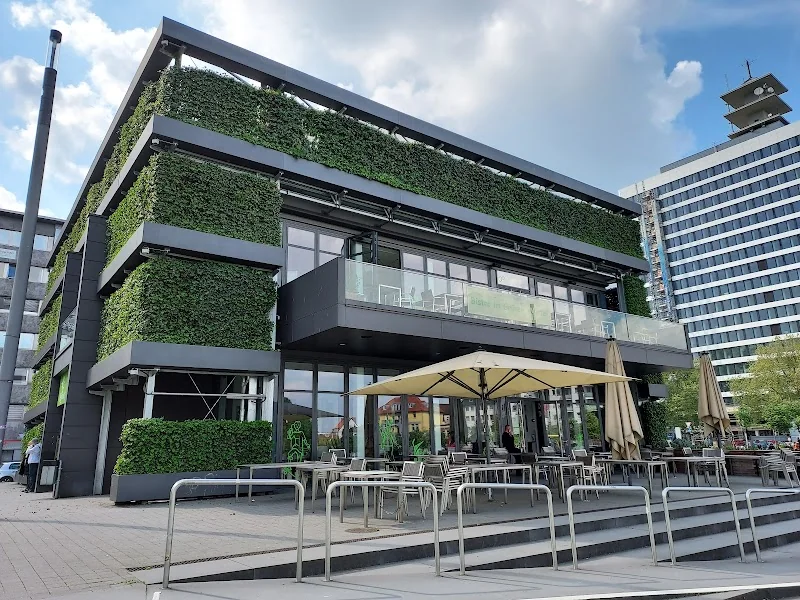
The search queries for photos and images of neighborhood center green cube bielefeld show that the building is also strongly perceived visually. This is no coincidence, as the city describes the Green Cube as green and covered with plants. At Kesselbrink, the house thus appears as a striking contrast to the open square situation, but at the same time as a natural part of the newly designed center. This recognizability makes it interesting for photos: the building has a clear color, its own language, and several architectural details that remain visible in everyday life, such as the rooftop garden, the large balcony of the large room, and the open window fronts. Unlike a classic event hall, the Green Cube is not reduced to a single use. It has different zones that differ spatially and functionally: the bistro on the ground floor, the info point as a protected conversation place, the two flexibly usable rooms on the first floor, and the rooftop garden on the second floor. This mix of architecture and everyday life makes the house photogenic and understandable at the same time. The images on the website show not only rooms but also uses: people in exchange, groups in motion, cultural activities, and open encounters. This visual material thus supports the substantive message of the house, namely that the Green Cube is not a closed place but an open urban space. Particularly exciting is the connection with Kesselbrink itself, which, after its redesign, became a place with green areas, water play, skate and BMX facilities, a calisthenics area, and a playground. The building thus integrates into an environment that already offers many images and perspectives. Those searching for Green Cube photos often look for exactly this mix of architecture, space, and life. The place is not an abstract cultural container but a walkable neighborhood image with clear design and high recognizability. ([bielefeld.de](https://www.bielefeld.de/node/26942?utm_source=openai))
History of Kesselbrink and the Participatory Meeting Center
The history of the Green Cube is closely linked to the history of Kesselbrink, and that is why it is worth taking a look at the background. The city describes Kesselbrink as a central square in the heart of Bielefeld's city center, which has had many functions over time: from pasture to healing spring and drill ground to bus station and parking lot. Its current appearance was shaped by redesigns between 2013 and 2019. In 2013, the area was reopened after extensive redesign with new green spaces, a water play area, and a large skate and BMX facility. In summer 2019, a calisthenics facility and a large climbing and play area were added. The square is also known for major events, summer music events, and the Saturday weekly market. In this environment, the Green Cube was initially opened in 2014 as a café and restaurant operation, but changing tenants could not establish themselves long-term. After another vacancy starting in August 2019, it became clear that a different concept was necessary. This led to the idea of a participatory meeting center for children, teenagers, and adults, which should be developed together with users, neighbors, associations, and other actors. This approach is described on the website as deliberately open and democratic, free from prejudice and discrimination. Since 2020, the Green Cube has been in operation; in September 2023, a sponsoring community from AWO District Association Bielefeld and Diakonie for Bielefeld took over the organization of the offerings. This development is central to the current position of the house because it shows that the Green Cube does not rely on chance or a single gastronomic concept but on participation, social responsibility, and flexible use. This is precisely what makes it stable and relevant to the neighborhood in the long term. For search queries like neighborhood center green cube bielefeld or green cube kesselbrink, this background is particularly important because it explains why the house stands exactly where it does and how it functions today. ([gruenerwuerfel.de](https://www.gruenerwuerfel.de/gruener-wuerfel/))
Who the Green Cube is Particularly Worthwhile For
The Green Cube is interesting for very different people, and that is precisely its strength. Families find open children’s and youth offerings here, people from the neighborhood can participate in groups and conversation formats, culture enthusiasts find exhibitions, concerts, language and creative offerings, and associations or initiatives can request rooms for open events. It is also useful for people who are specifically looking for support, as advisory and networking groups as well as a protected info point are available. The city of Bielefeld emphasizes that the Green Cube was originally planned as an innovative participatory meeting center for children, teenagers, and adults, and that potential users have been involved from the beginning in developing how the house should operate. This has resulted in a very low-threshold character: not an elitist cultural place but an open neighborhood center in the best sense. For visitors searching for photos, events, parking, or room rentals, the result is particularly practical because all these topics are bundled in one place. The flexible room structure makes the Green Cube usable for workshops, celebrations, meetings, and open formats without a rigid hall model getting in the way. At the same time, Kesselbrink as a public square remains visibly integrated into the usage concept. So, those looking for a place in Bielefeld that combines social mix, cultural diversity, and practical accessibility will find themselves very well accommodated here. The Green Cube is neither just a bistro nor just an event location nor just an advisory center. It is an urban meeting house with a clear stance, open access, and a program that is oriented towards real needs. That is why it fits so well with search terms related to neighborhood center green cube photos, green cube program, green cube access, and green cube barrier-free. Here, needs are not only named but spatially and organizationally implemented. ([bielefeld.de](https://www.bielefeld.de/stadtteilzentren))
Sources:
- Green Cube - Official Website
- Green Cube - Neighborhood Center and History
- Green Cube - Room Inquiry and Rooms
- Green Cube - Bistro in the Green Cube
- Green Cube - Our Offers
- Green Cube - Cultural Offers
- Green Cube - Advisory and Networking Groups
- City of Bielefeld - Neighborhood Centers for All
- Experience Bielefeld Barrier-Free - Neighborhood Center Green Cube
Show moreShow less
Neighborhood Center Green Cube | Events & Photos
The Green Cube at Kesselbrink is not a place you only visit when there is a fixed program on the calendar. It is an open neighborhood center, a participatory meeting place, and a space where everyday life, community, culture, and social offerings naturally mix. The house is aimed at children, teenagers, and adults, opens its rooms for free and cost-free offerings, and invites people to participate in shaping it rather than just watching. This is precisely the unique strength of this place: it was not created as a finished product but as a shared space for people from the city. The website describes the Green Cube as an innovative meeting center in the heart of Bielefeld, which has been in operation since 2020 and has been managed by a sponsoring community since 2023. This makes it a lively place with changing groups, projects, and events that are oriented towards the actual needs of the neighborhood. Those searching for green cube bielefeld, neighborhood center green cube photos, or green cube events are often looking for exactly that: a place where encounter, participation, and practical offerings are meaningfully connected. The Green Cube provides a very clear profile that ranges from open meetings to cultural formats, advice, movement, and room rentals. ([gruenerwuerfel.de](https://www.gruenerwuerfel.de/gruener-wuerfel/))
Events and Open Offers at the Green Cube
The keyword search clearly shows that many people are not only looking for the house itself but especially for what happens there. Therefore, the most important topic is the event and offering profile. The official website mentions sports and movement offerings, advisory and networking groups, cultural offerings, social and political working groups, as well as children's and youth offerings. This mix makes the Green Cube so relevant for the city center: it is not a specialized place for just one target group but an open house for many life situations. In the cultural offerings, for example, art exhibitions, concerts, theater workshops, language cafés, reading circles, swap parties, drumming without borders, singing for all, an improv meeting, a knitting and crocheting group, an art project, and a public bookshelf appear. Additionally, there are formats like the intercultural men's meeting or the VHS language café, which, according to the website, takes place free of charge on Thursdays. So, those searching for green cube program or green cube events do not find a rigid event house here but a place with a growing, socially oriented program. It is particularly important that many offerings are freely accessible, and participation is explicitly kept open. This fits with the idea of the house as a participatory center, where groups and projects are not only consumed but developed together. The event schedule and the subpages for future and past events also show that the Green Cube structures its everyday life transparently and continuously updates it. For visitors, this means: it is worthwhile not only to look at individual dates but to regularly pay attention to new groups, networking meetings, and cultural actions. The mix of everyday relevance and diversity is one of the reasons why the house works so well in Bielefeld's city center. ([gruenerwuerfel.de](https://www.gruenerwuerfel.de/unsere-angebote/))
Rooms, Room Inquiry, and Flexible Use of the Neighborhood Center
Another strong search impulse is room usage. Those searching for green cube room inquiry or a seating plan usually want to know how the house functions spatially and whether events can be planned there at all. This is where the Green Cube becomes very concrete. The room inquiry page describes several areas that can be requested depending on the occasion. The large room is located on the first floor, is 55 square meters in size, bright and long, has an adjacent balcony of 50 square meters, and large window fronts that can be completely opened in summer. The small room on the first floor is 25 square meters, has floor-to-ceiling windows, and is separated from the rest of the house by a glass sliding door. The ground floor is reserved for bistro operations during the day. The bistro area itself can be used after bistro hours from Monday to Thursday from 6 PM and all day on Saturday and Sunday. Additionally, there is an info point on the ground floor next to the counter, which is intended for low-threshold consultations and provides acoustic and visual protection. The rooftop garden on the second floor is particularly interesting, as it can be used in the summer, especially in the evenings, and is often maintained and planted by children during the day. The rooms are freely available for open offers; paid rentals are possible for closed or private events. This structure is practical for organizers, associations, initiatives, and neighborhood groups alike because it is not limited to a single hall or rigid seating arrangement. So, those expecting a seating plan will find a flexible room concept rather than a classic event architecture. This makes the Green Cube particularly suitable for small and medium formats, consultations, meetings, workshops, cultural evenings, and communal uses that should adapt to the occasion. ([gruenerwuerfel.de](https://www.gruenerwuerfel.de/raumanfrage/))
Access, Parking, and Barrier-Free Accessibility at Kesselbrink
In the keyword analysis, access, parking, and barrier-free accessibility are among the obvious topics because the Green Cube is located in the center and is also a house for many different user groups. The location Kesselbrink 2 is situated in Bielefeld's city center, at a central square with high visibility and good connections. According to Bielefeld barrier-free, the public transport stops Jahnplatz and Kesselbrink are suitable for barrier-free access, and the entrance of the facility is barrier-free. There are no dedicated disabled parking spaces directly at the facility, but there are public disabled parking spaces on the surrounding streets at Kesselbrink and in the Kesselbrink underground garage. Therefore, parking is possible if arriving by car and preferring short distances. The page also points out that assistance persons are available on-site and that support needs can be registered in advance. This is especially important for people who need safe orientation or support during their visit. Content-wise, this fits well with the character of the house: the Green Cube is not isolated but closely connected to Kesselbrink. The square itself is a central meeting point in the city center and is used for sports and cultural offerings, a skate park, a calisthenics facility, a children's play area, a petanque court, a fountain, and the weekly market, according to the city page. This makes access attractive: one does not just come to a house but to an entire urban environment with many possibilities. Therefore, those searching for green cube access or green cube parking receive more than just directions. They find a location that lies in the midst of city life and is still oriented towards a maximally accessible visit. The combination of a central location, public accessibility, and available parking options in close proximity is one of the reasons why the house works well for different age groups and occasions. ([bielefeld-barrierefrei.de](https://bielefeld-barrierefrei.de/gebaeude/stadtteilzentrum-gruener-wuerfel/?utm_source=openai))
Bistro in the Green Cube and Lunch Menu
The bistro in the Green Cube is more than just a side service of the house. It is part of the identity of the place and is a draw for many visitors. The website currently lists seasonal opening hours and refers to a daily changing lunch menu, which always includes a vegetarian dish. After the Easter holidays in 2026, the summer opening hours from Monday to Friday between 10:00 AM and 5:00 PM will apply, and the bistro will be closed on weekends. The winter opening hours differ from this and are also transparently stated on the website. Particularly noteworthy is the social history of the bistro: the project originated in the late 1990s from the self-help sector when parents wanted to expand the professional participation opportunities for their children with disabilities. This led to pilot projects and over time small niche businesses that served qualification and employment, especially in food production. Today, Pascal Klapper operates the bistro independently, supported by Prowerk Bethel. The team consists of ten people with disabilities working alongside three professionals who have experience in gastronomy and education. The core offering is aimed at working people and residents of the area but also at guests of the Green Cube itself. The website describes the lunch menu as fresher than a snack bar, cheaper than an à la carte restaurant, and prepared with regional ingredients. For Kesselbrink, the bistro is therefore not just a place to eat but an inclusive employment and meeting project. Those searching for green cube bistro do not find classic gastronomy here but a conscious social component of the overall place. Especially in combination with events, open groups, and room usage, the bistro significantly enhances the quality of stay at the house. It makes the Green Cube practical, low-threshold, and pleasant for longer visits where conversation, breaks, and participation go hand in hand. ([gruenerwuerfel.de](https://www.gruenerwuerfel.de/bistro-keimzeit/))
Photos, Architecture, and Special Places in the House
The search queries for photos and images of neighborhood center green cube bielefeld show that the building is also strongly perceived visually. This is no coincidence, as the city describes the Green Cube as green and covered with plants. At Kesselbrink, the house thus appears as a striking contrast to the open square situation, but at the same time as a natural part of the newly designed center. This recognizability makes it interesting for photos: the building has a clear color, its own language, and several architectural details that remain visible in everyday life, such as the rooftop garden, the large balcony of the large room, and the open window fronts. Unlike a classic event hall, the Green Cube is not reduced to a single use. It has different zones that differ spatially and functionally: the bistro on the ground floor, the info point as a protected conversation place, the two flexibly usable rooms on the first floor, and the rooftop garden on the second floor. This mix of architecture and everyday life makes the house photogenic and understandable at the same time. The images on the website show not only rooms but also uses: people in exchange, groups in motion, cultural activities, and open encounters. This visual material thus supports the substantive message of the house, namely that the Green Cube is not a closed place but an open urban space. Particularly exciting is the connection with Kesselbrink itself, which, after its redesign, became a place with green areas, water play, skate and BMX facilities, a calisthenics area, and a playground. The building thus integrates into an environment that already offers many images and perspectives. Those searching for Green Cube photos often look for exactly this mix of architecture, space, and life. The place is not an abstract cultural container but a walkable neighborhood image with clear design and high recognizability. ([bielefeld.de](https://www.bielefeld.de/node/26942?utm_source=openai))
History of Kesselbrink and the Participatory Meeting Center
The history of the Green Cube is closely linked to the history of Kesselbrink, and that is why it is worth taking a look at the background. The city describes Kesselbrink as a central square in the heart of Bielefeld's city center, which has had many functions over time: from pasture to healing spring and drill ground to bus station and parking lot. Its current appearance was shaped by redesigns between 2013 and 2019. In 2013, the area was reopened after extensive redesign with new green spaces, a water play area, and a large skate and BMX facility. In summer 2019, a calisthenics facility and a large climbing and play area were added. The square is also known for major events, summer music events, and the Saturday weekly market. In this environment, the Green Cube was initially opened in 2014 as a café and restaurant operation, but changing tenants could not establish themselves long-term. After another vacancy starting in August 2019, it became clear that a different concept was necessary. This led to the idea of a participatory meeting center for children, teenagers, and adults, which should be developed together with users, neighbors, associations, and other actors. This approach is described on the website as deliberately open and democratic, free from prejudice and discrimination. Since 2020, the Green Cube has been in operation; in September 2023, a sponsoring community from AWO District Association Bielefeld and Diakonie for Bielefeld took over the organization of the offerings. This development is central to the current position of the house because it shows that the Green Cube does not rely on chance or a single gastronomic concept but on participation, social responsibility, and flexible use. This is precisely what makes it stable and relevant to the neighborhood in the long term. For search queries like neighborhood center green cube bielefeld or green cube kesselbrink, this background is particularly important because it explains why the house stands exactly where it does and how it functions today. ([gruenerwuerfel.de](https://www.gruenerwuerfel.de/gruener-wuerfel/))
Who the Green Cube is Particularly Worthwhile For
The Green Cube is interesting for very different people, and that is precisely its strength. Families find open children’s and youth offerings here, people from the neighborhood can participate in groups and conversation formats, culture enthusiasts find exhibitions, concerts, language and creative offerings, and associations or initiatives can request rooms for open events. It is also useful for people who are specifically looking for support, as advisory and networking groups as well as a protected info point are available. The city of Bielefeld emphasizes that the Green Cube was originally planned as an innovative participatory meeting center for children, teenagers, and adults, and that potential users have been involved from the beginning in developing how the house should operate. This has resulted in a very low-threshold character: not an elitist cultural place but an open neighborhood center in the best sense. For visitors searching for photos, events, parking, or room rentals, the result is particularly practical because all these topics are bundled in one place. The flexible room structure makes the Green Cube usable for workshops, celebrations, meetings, and open formats without a rigid hall model getting in the way. At the same time, Kesselbrink as a public square remains visibly integrated into the usage concept. So, those looking for a place in Bielefeld that combines social mix, cultural diversity, and practical accessibility will find themselves very well accommodated here. The Green Cube is neither just a bistro nor just an event location nor just an advisory center. It is an urban meeting house with a clear stance, open access, and a program that is oriented towards real needs. That is why it fits so well with search terms related to neighborhood center green cube photos, green cube program, green cube access, and green cube barrier-free. Here, needs are not only named but spatially and organizationally implemented. ([bielefeld.de](https://www.bielefeld.de/stadtteilzentren))
Sources:
- Green Cube - Official Website
- Green Cube - Neighborhood Center and History
- Green Cube - Room Inquiry and Rooms
- Green Cube - Bistro in the Green Cube
- Green Cube - Our Offers
- Green Cube - Cultural Offers
- Green Cube - Advisory and Networking Groups
- City of Bielefeld - Neighborhood Centers for All
- Experience Bielefeld Barrier-Free - Neighborhood Center Green Cube
Neighborhood Center Green Cube | Events & Photos
The Green Cube at Kesselbrink is not a place you only visit when there is a fixed program on the calendar. It is an open neighborhood center, a participatory meeting place, and a space where everyday life, community, culture, and social offerings naturally mix. The house is aimed at children, teenagers, and adults, opens its rooms for free and cost-free offerings, and invites people to participate in shaping it rather than just watching. This is precisely the unique strength of this place: it was not created as a finished product but as a shared space for people from the city. The website describes the Green Cube as an innovative meeting center in the heart of Bielefeld, which has been in operation since 2020 and has been managed by a sponsoring community since 2023. This makes it a lively place with changing groups, projects, and events that are oriented towards the actual needs of the neighborhood. Those searching for green cube bielefeld, neighborhood center green cube photos, or green cube events are often looking for exactly that: a place where encounter, participation, and practical offerings are meaningfully connected. The Green Cube provides a very clear profile that ranges from open meetings to cultural formats, advice, movement, and room rentals. ([gruenerwuerfel.de](https://www.gruenerwuerfel.de/gruener-wuerfel/))
Events and Open Offers at the Green Cube
The keyword search clearly shows that many people are not only looking for the house itself but especially for what happens there. Therefore, the most important topic is the event and offering profile. The official website mentions sports and movement offerings, advisory and networking groups, cultural offerings, social and political working groups, as well as children's and youth offerings. This mix makes the Green Cube so relevant for the city center: it is not a specialized place for just one target group but an open house for many life situations. In the cultural offerings, for example, art exhibitions, concerts, theater workshops, language cafés, reading circles, swap parties, drumming without borders, singing for all, an improv meeting, a knitting and crocheting group, an art project, and a public bookshelf appear. Additionally, there are formats like the intercultural men's meeting or the VHS language café, which, according to the website, takes place free of charge on Thursdays. So, those searching for green cube program or green cube events do not find a rigid event house here but a place with a growing, socially oriented program. It is particularly important that many offerings are freely accessible, and participation is explicitly kept open. This fits with the idea of the house as a participatory center, where groups and projects are not only consumed but developed together. The event schedule and the subpages for future and past events also show that the Green Cube structures its everyday life transparently and continuously updates it. For visitors, this means: it is worthwhile not only to look at individual dates but to regularly pay attention to new groups, networking meetings, and cultural actions. The mix of everyday relevance and diversity is one of the reasons why the house works so well in Bielefeld's city center. ([gruenerwuerfel.de](https://www.gruenerwuerfel.de/unsere-angebote/))
Rooms, Room Inquiry, and Flexible Use of the Neighborhood Center
Another strong search impulse is room usage. Those searching for green cube room inquiry or a seating plan usually want to know how the house functions spatially and whether events can be planned there at all. This is where the Green Cube becomes very concrete. The room inquiry page describes several areas that can be requested depending on the occasion. The large room is located on the first floor, is 55 square meters in size, bright and long, has an adjacent balcony of 50 square meters, and large window fronts that can be completely opened in summer. The small room on the first floor is 25 square meters, has floor-to-ceiling windows, and is separated from the rest of the house by a glass sliding door. The ground floor is reserved for bistro operations during the day. The bistro area itself can be used after bistro hours from Monday to Thursday from 6 PM and all day on Saturday and Sunday. Additionally, there is an info point on the ground floor next to the counter, which is intended for low-threshold consultations and provides acoustic and visual protection. The rooftop garden on the second floor is particularly interesting, as it can be used in the summer, especially in the evenings, and is often maintained and planted by children during the day. The rooms are freely available for open offers; paid rentals are possible for closed or private events. This structure is practical for organizers, associations, initiatives, and neighborhood groups alike because it is not limited to a single hall or rigid seating arrangement. So, those expecting a seating plan will find a flexible room concept rather than a classic event architecture. This makes the Green Cube particularly suitable for small and medium formats, consultations, meetings, workshops, cultural evenings, and communal uses that should adapt to the occasion. ([gruenerwuerfel.de](https://www.gruenerwuerfel.de/raumanfrage/))
Access, Parking, and Barrier-Free Accessibility at Kesselbrink
In the keyword analysis, access, parking, and barrier-free accessibility are among the obvious topics because the Green Cube is located in the center and is also a house for many different user groups. The location Kesselbrink 2 is situated in Bielefeld's city center, at a central square with high visibility and good connections. According to Bielefeld barrier-free, the public transport stops Jahnplatz and Kesselbrink are suitable for barrier-free access, and the entrance of the facility is barrier-free. There are no dedicated disabled parking spaces directly at the facility, but there are public disabled parking spaces on the surrounding streets at Kesselbrink and in the Kesselbrink underground garage. Therefore, parking is possible if arriving by car and preferring short distances. The page also points out that assistance persons are available on-site and that support needs can be registered in advance. This is especially important for people who need safe orientation or support during their visit. Content-wise, this fits well with the character of the house: the Green Cube is not isolated but closely connected to Kesselbrink. The square itself is a central meeting point in the city center and is used for sports and cultural offerings, a skate park, a calisthenics facility, a children's play area, a petanque court, a fountain, and the weekly market, according to the city page. This makes access attractive: one does not just come to a house but to an entire urban environment with many possibilities. Therefore, those searching for green cube access or green cube parking receive more than just directions. They find a location that lies in the midst of city life and is still oriented towards a maximally accessible visit. The combination of a central location, public accessibility, and available parking options in close proximity is one of the reasons why the house works well for different age groups and occasions. ([bielefeld-barrierefrei.de](https://bielefeld-barrierefrei.de/gebaeude/stadtteilzentrum-gruener-wuerfel/?utm_source=openai))
Bistro in the Green Cube and Lunch Menu
The bistro in the Green Cube is more than just a side service of the house. It is part of the identity of the place and is a draw for many visitors. The website currently lists seasonal opening hours and refers to a daily changing lunch menu, which always includes a vegetarian dish. After the Easter holidays in 2026, the summer opening hours from Monday to Friday between 10:00 AM and 5:00 PM will apply, and the bistro will be closed on weekends. The winter opening hours differ from this and are also transparently stated on the website. Particularly noteworthy is the social history of the bistro: the project originated in the late 1990s from the self-help sector when parents wanted to expand the professional participation opportunities for their children with disabilities. This led to pilot projects and over time small niche businesses that served qualification and employment, especially in food production. Today, Pascal Klapper operates the bistro independently, supported by Prowerk Bethel. The team consists of ten people with disabilities working alongside three professionals who have experience in gastronomy and education. The core offering is aimed at working people and residents of the area but also at guests of the Green Cube itself. The website describes the lunch menu as fresher than a snack bar, cheaper than an à la carte restaurant, and prepared with regional ingredients. For Kesselbrink, the bistro is therefore not just a place to eat but an inclusive employment and meeting project. Those searching for green cube bistro do not find classic gastronomy here but a conscious social component of the overall place. Especially in combination with events, open groups, and room usage, the bistro significantly enhances the quality of stay at the house. It makes the Green Cube practical, low-threshold, and pleasant for longer visits where conversation, breaks, and participation go hand in hand. ([gruenerwuerfel.de](https://www.gruenerwuerfel.de/bistro-keimzeit/))
Photos, Architecture, and Special Places in the House
The search queries for photos and images of neighborhood center green cube bielefeld show that the building is also strongly perceived visually. This is no coincidence, as the city describes the Green Cube as green and covered with plants. At Kesselbrink, the house thus appears as a striking contrast to the open square situation, but at the same time as a natural part of the newly designed center. This recognizability makes it interesting for photos: the building has a clear color, its own language, and several architectural details that remain visible in everyday life, such as the rooftop garden, the large balcony of the large room, and the open window fronts. Unlike a classic event hall, the Green Cube is not reduced to a single use. It has different zones that differ spatially and functionally: the bistro on the ground floor, the info point as a protected conversation place, the two flexibly usable rooms on the first floor, and the rooftop garden on the second floor. This mix of architecture and everyday life makes the house photogenic and understandable at the same time. The images on the website show not only rooms but also uses: people in exchange, groups in motion, cultural activities, and open encounters. This visual material thus supports the substantive message of the house, namely that the Green Cube is not a closed place but an open urban space. Particularly exciting is the connection with Kesselbrink itself, which, after its redesign, became a place with green areas, water play, skate and BMX facilities, a calisthenics area, and a playground. The building thus integrates into an environment that already offers many images and perspectives. Those searching for Green Cube photos often look for exactly this mix of architecture, space, and life. The place is not an abstract cultural container but a walkable neighborhood image with clear design and high recognizability. ([bielefeld.de](https://www.bielefeld.de/node/26942?utm_source=openai))
History of Kesselbrink and the Participatory Meeting Center
The history of the Green Cube is closely linked to the history of Kesselbrink, and that is why it is worth taking a look at the background. The city describes Kesselbrink as a central square in the heart of Bielefeld's city center, which has had many functions over time: from pasture to healing spring and drill ground to bus station and parking lot. Its current appearance was shaped by redesigns between 2013 and 2019. In 2013, the area was reopened after extensive redesign with new green spaces, a water play area, and a large skate and BMX facility. In summer 2019, a calisthenics facility and a large climbing and play area were added. The square is also known for major events, summer music events, and the Saturday weekly market. In this environment, the Green Cube was initially opened in 2014 as a café and restaurant operation, but changing tenants could not establish themselves long-term. After another vacancy starting in August 2019, it became clear that a different concept was necessary. This led to the idea of a participatory meeting center for children, teenagers, and adults, which should be developed together with users, neighbors, associations, and other actors. This approach is described on the website as deliberately open and democratic, free from prejudice and discrimination. Since 2020, the Green Cube has been in operation; in September 2023, a sponsoring community from AWO District Association Bielefeld and Diakonie for Bielefeld took over the organization of the offerings. This development is central to the current position of the house because it shows that the Green Cube does not rely on chance or a single gastronomic concept but on participation, social responsibility, and flexible use. This is precisely what makes it stable and relevant to the neighborhood in the long term. For search queries like neighborhood center green cube bielefeld or green cube kesselbrink, this background is particularly important because it explains why the house stands exactly where it does and how it functions today. ([gruenerwuerfel.de](https://www.gruenerwuerfel.de/gruener-wuerfel/))
Who the Green Cube is Particularly Worthwhile For
The Green Cube is interesting for very different people, and that is precisely its strength. Families find open children’s and youth offerings here, people from the neighborhood can participate in groups and conversation formats, culture enthusiasts find exhibitions, concerts, language and creative offerings, and associations or initiatives can request rooms for open events. It is also useful for people who are specifically looking for support, as advisory and networking groups as well as a protected info point are available. The city of Bielefeld emphasizes that the Green Cube was originally planned as an innovative participatory meeting center for children, teenagers, and adults, and that potential users have been involved from the beginning in developing how the house should operate. This has resulted in a very low-threshold character: not an elitist cultural place but an open neighborhood center in the best sense. For visitors searching for photos, events, parking, or room rentals, the result is particularly practical because all these topics are bundled in one place. The flexible room structure makes the Green Cube usable for workshops, celebrations, meetings, and open formats without a rigid hall model getting in the way. At the same time, Kesselbrink as a public square remains visibly integrated into the usage concept. So, those looking for a place in Bielefeld that combines social mix, cultural diversity, and practical accessibility will find themselves very well accommodated here. The Green Cube is neither just a bistro nor just an event location nor just an advisory center. It is an urban meeting house with a clear stance, open access, and a program that is oriented towards real needs. That is why it fits so well with search terms related to neighborhood center green cube photos, green cube program, green cube access, and green cube barrier-free. Here, needs are not only named but spatially and organizationally implemented. ([bielefeld.de](https://www.bielefeld.de/stadtteilzentren))
Sources:
- Green Cube - Official Website
- Green Cube - Neighborhood Center and History
- Green Cube - Room Inquiry and Rooms
- Green Cube - Bistro in the Green Cube
- Green Cube - Our Offers
- Green Cube - Cultural Offers
- Green Cube - Advisory and Networking Groups
- City of Bielefeld - Neighborhood Centers for All
- Experience Bielefeld Barrier-Free - Neighborhood Center Green Cube
Frequently Asked Questions
Reviews
No reviews found