
Bielefeld
Niederwall 27, 33602 Bielefeld, Deutschland
Bielefeld City Theater | Tickets & Seating Plan
The Bielefeld City Theater at Niederwall 27 is one of the most influential cultural institutions in the city center and is also the central theater house for the stages and orchestras of the city of Bielefeld. Those looking for the address will find the building directly next to the town hall, right in the urban center yet with the special atmosphere of a classic city theater. The building is not just a performance venue but a piece of city history: here, civic engagement, architectural quality, musical tradition, and a vibrant program come together to create a place where Bielefeld makes culture visible and audible. The theater operates in three venues and four genres, offers more than 600 performances per season, and reaches over 200,000 spectators. It is precisely this mix of historical significance and contemporary relevance that makes the charm of the city theater. It is a place that one visits for grand evenings, but also for introductions, tours, discussions, and special formats that perceive the theater as part of the urban society. ([buo-bielefeld.de](https://buo-bielefeld.de/infos-mehr/das-sind-wir/ueber-uns))
Tickets, Schedule, and Current Performances at the Bielefeld City Theater
Those interested in the Bielefeld City Theater usually start their visit with the current program. Here, the strength of the house as a multi-genre operation becomes evident: on the website of the stages and orchestras of the city of Bielefeld, the genres of singing, dance, drama, JUNG, club productions, and specials are clearly categorized, allowing the schedule to be quickly filtered according to interests. The advance sale for the 2026/27 season is already visible on the homepage, and the next events are announced directly on the homepage. This makes orientation easy, whether one is looking for an opera, a play, a dance piece, or a special format. For visitors, this is important because the city theater cannot be reduced to a single genre. It is a place for premieres, revivals, world premieres, introductions, and formats that appeal to very different audience groups. Thus, the theater fulfills both the claim of a classic repertoire house and that of a contemporary cultural platform. ([theater-bielefeld.de](https://theater-bielefeld.de/fileadmin/Downloads_Drucksachen/TB_Spielzeitheft1819_black.pdf))
From an SEO perspective, the focus on tickets and programs is also logical, as many users search for the city theater with very specific questions: Are tickets available online? Where is the schedule? What performances are running in the current season? The answer is clear: the webshop, the calendar, and the service pages are closely interconnected. Those wishing to buy tickets find direct access to ticket purchases on the website; those wanting to orient themselves receive a compact structure through the program overviews. Particularly helpful is that the stages and orchestras not only present individual productions but also showcase the overall profile of the house. This makes it clear that the Bielefeld City Theater is much more than a venue for evening performances. It is a cultural hub where repertoire, current topics, emerging formats, and audience discussions meaningfully complement each other. For a visitor, this means: the first look at the website is always worthwhile, as it already reveals how diverse the theater evening can be. ([theater-bielefeld.de](https://theater-bielefeld.de/fileadmin/Downloads_Drucksachen/TB_Spielzeitheft1819_black.pdf))
Seating Plan, Seats, and Capacity of the City Theater
With up to 725 seats, the auditorium of the city theater is among the larger theater spaces in the city. Additionally, there are 6 wheelchair spaces indicated in the published seating plan. The plan shows a classic structure with stalls and boxes on the left and right, creating a familiar and representative spatial feeling for many theatergoers. This mix of clarity and festive atmosphere is one reason why the city theater is suitable not only for regular performances but also for special occasions. The house is explicitly described in the rental information as a venue for large events, award ceremonies, and private performances. The auditorium thus functions both as a theater space and as a representative stage for events where a strong presence of the venue is desired. Those who check the seating plan in advance can better plan their seat choice and assess which areas are particularly suitable for the desired view or preferred distance from the stage. ([theater-bielefeld.de](https://theater-bielefeld.de/fileadmin/Downloads_Drucksachen/24-25/BiPhil_ROH_Konzert_Saisonheft_24-25.pdf?utm_source=openai))
The spatial effect of the city theater arises not only from the number of seats but also from the way visitors are seated in the auditorium. Classic boxes, a clearly structured stall, and the main stage create the theater aesthetics that many people associate with a representative city theater. The auditorium is thus not a neutral event space but a room with character and history. For groups, couples, or individual visitors, it can therefore be worthwhile to look at the seating plan in advance and consider whether one prefers to sit more centrally in the stalls, in one of the boxes, or a bit further out. This is not only a matter of comfort but also of staging one's theater evening. Thus, those attending a performance at the city theater experience not only the stage program but also the architecturally staged framework of the house. This framework is precisely what makes a performance here so appealing. ([theater-bielefeld.de](https://theater-bielefeld.de/fileadmin/Downloads_Drucksachen/24-25/BiPhil_ROH_Konzert_Saisonheft_24-25.pdf?utm_source=openai))
Another feature of the house is that the city theater is versatile due to its complementary areas. The rental and event information describes foyer, lounge, and loft areas that can serve as reception areas, break areas, or accompanying spaces for special occasions, depending on the format. This shows that the capacity of the city theater cannot only be measured in seating. The adjacent rooms also contribute to the house's ability to respond flexibly to different requirements. For cultural events, this means a good combination of a classic theater auditorium and complementary infrastructure. For companies or organizers, it is a plus because a festive evening at the city theater can be organized with catering, reception, and evening program all in one house. And for the audience, it means that a theater visit often involves more than just the performance: it becomes a complete experience with space, path, pause, and afterglow. ([theater-bielefeld.de](https://theater-bielefeld.de/fileadmin/Downloads_Drucksachen/24-25/BiPhil_ROH_Konzert_Saisonheft_24-25.pdf?utm_source=openai))
Directions, Public Transport, and Parking at the Bielefeld City Theater
The journey to the city theater is pleasantly uncomplicated because the house is located right in the city center. The official address is Niederwall 27, 33602 Bielefeld, and the theater is directly next to the town hall. Those arriving by tram can take lines 1, 2, 3, or 4 from the main train station to the Rathaus stop. From there, the entrance is on the left side or directly next to the town hall, depending on which direction one comes from. The house is also very accessible on foot: from the main train station, the route takes about 10 to 15 minutes via Bahnhofstraße, Jahnplatz, and Niederwall to the theater. From Jahnplatz, it is about 5 minutes along Niederwall. This short distance is a real advantage for visitors who want to combine their theater evening with a restaurant visit, a walk through the city center, or a quick stroll. The location makes the city theater a venue that can easily be integrated into an entire city evening. ([buo-bielefeld.de](https://www.buo-bielefeld.de/ls/infos-mehr/service/anfahrt?utm_source=openai))
For the use of public transport, it is particularly interesting that tickets are valid as travel tickets. The current service information from the stages and orchestras of the city of Bielefeld explains that visitors can travel in Bielefeld without extra charge with bus and train using their ticket, two hours before and two hours after the event in the Bielefeld area. This is a real comfort advantage, as it makes the journey to and from the theater much more relaxed and avoids parking pressure in the city center. The route is also clearly described: those coming from the main train station travel to Rathaus; those coming from the bus network often get off at Jahnplatz and walk along Niederwall. This proximity of the stop, city center, and theater makes the house particularly practical. For visitors from the region, this is an important signal: the Bielefeld City Theater is not only attractive for culture fans but also logistically easy to reach. ([buo-bielefeld.de](https://www.buo-bielefeld.de/ls/infos-mehr/service/anfahrt?utm_source=openai))
Parking is also organized for those arriving by car. The service pages mention the underground garage of the New Town Hall at the Körnerstraße entrance as a parking option for city theater visitors. The current accessibility information also lists numerous disabled parking spaces in the vicinity, such as directly at Niederwall/corner Brunnenstraße, at the House of Health in Brunnenstraße, and in the underground garage of the New Town Hall. There is also a discounted flat rate for theater visitors mentioned, and the exit tickets can be validated through the entrance staff or the program booklet sales. This is particularly relevant for people with mobility restrictions, as access to the house is not hindered by parking issues. Overall, the journey situation shows that the city theater utilizes its central location without connecting the visit with unnecessary hurdles. This is a strong argument in an inner-city location. ([buo-bielefeld.de](https://buo-bielefeld.de/infos-mehr/service/anfahrt?utm_source=openai))
History, Architecture, and Reopening of the City Theater
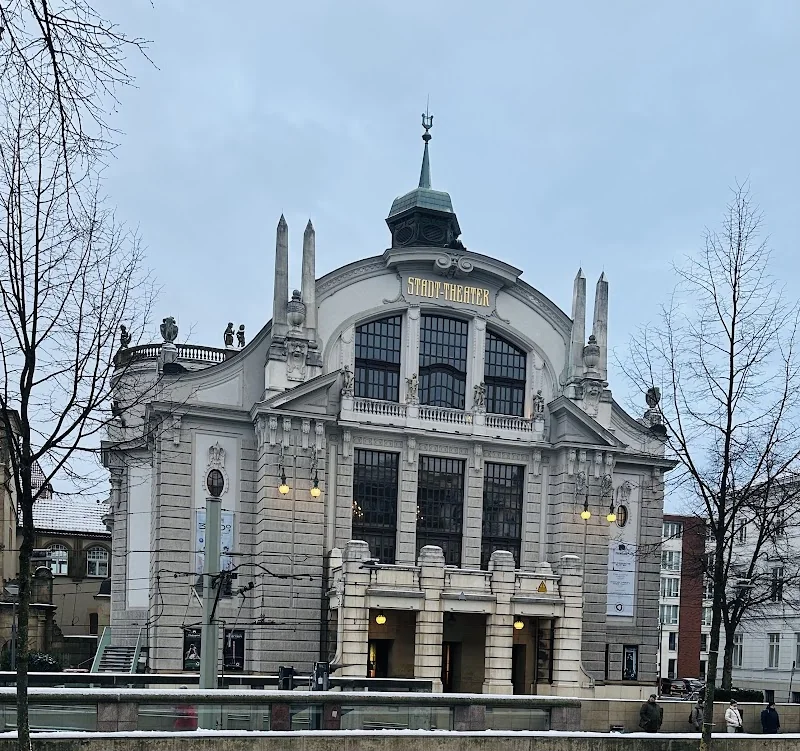
The history of the city theater begins with a civic cultural desire. As early as 1885, the widow Crüwell donated 10,000 marks for a concert and theater hall, and in 1902, the foundation stone for the city theater designed by Bernhard Sehring was laid. The house was ceremoniously inaugurated on April 3, 1904. These early dates show that the city theater did not arise as a random building but as a conscious urban project that emerged from donations, engagement, and cultural-political will. The description as a Jugendstil building and a listed building further emphasizes this historical quality. For Bielefeld, the theater is thus a symbol of how strongly culture and civic spirit have shaped urban development. Today, those standing in front of the house see not only a façade but the result of a long local idea: art should be visibly anchored in the city and have its own house. ([theaterstiftung-bielefeld.de](https://theaterstiftung-bielefeld.de/chronik/))
The further history of the house is also closely linked to the political and structural upheavals of the 20th century. In 1944, large parts of the theater were destroyed by grenades and bombs, but by 1945, the performance operation could be resumed. The chronicle of the theater foundation documents that the reopening took place with Mozart's Magic Flute. Later, in 1960, during a renovation, part of the Jugendstil elements on the façade was removed, before the original condition was reconstructed in 1979 for the 75th anniversary. This sequence explains why the city theater today appears historically and yet has been shaped multiple times. It is not a static museum object but a building that has survived war, reconstruction, redesign, and a return to its roots. This is precisely what gives it its character: it tells not only of theater history but also of city history and the fractures of an entire era. ([theaterstiftung-bielefeld.de](https://theaterstiftung-bielefeld.de/chronik/))
The more recent history is equally important. In 2004, the city theater was closed for two years to carry out renovation and restoration work. In 2006, the house was reopened with a theater festival. This not only provided Bielefeld with a technically renewed theater but also a modernized auditorium and infrastructure that better meets today's requirements. The renovation shows how seriously the city and the stages take their cultural house. For visitors, this means: one experiences a historical building with contemporary stage technology and a renewed audience area. The charm of the old has thus not been preserved at the expense of use but has been transferred into a modern theater practice. This is a decisive reason why the city theater continues to function as a central cultural venue today and is not merely perceived as a monument. ([theaterstiftung-bielefeld.de](https://theaterstiftung-bielefeld.de/chronik/))
Accessibility, Tours, and Services at the Bielefeld City Theater
Accessibility is a clear part of the visitor service at the city theater. The stages and orchestras of the city of Bielefeld describe that the tram stop Rathaus is accessible and that the city theater can be reached from there without detours. In addition, wheelchair spaces are offered in the house, which can be reserved directly when purchasing tickets. The current accessibility information also mentions accessible toilets. For people arriving with walking aids, wheelchairs, or other mobility aids, this is an important signal: the visit should not fail due to architectural hurdles but should be planable and pleasant. It is particularly noteworthy for a historic house when accessibility is actively considered. This makes the theater visit more open and contemporary. ([buo-bielefeld.de](https://www.buo-bielefeld.de/infos-mehr/service/barrierefreiheit?utm_source=openai))
There are also additional aids for people with visual or hearing impairments. The chronicle of the house notes that the theater was one of the first theaters in Germany to offer performances with audio description for visually impaired and blind visitors as early as 2009. Today's service information also describes hearing aids that can be obtained from the service staff and transmit the stage sound directly to hearing aids. This shows that inclusion at the city theater is not understood as a one-time project but as an ongoing task. Additionally, there are tours for various visitor groups and educational offers that make the theater experienceable even outside of the actual performance. This makes the house a place where culture can not only be consumed but also explained, explored, and experienced together. For many guests, this is precisely a reason to plan the city theater not only for a single performance but also for accompanying offers. ([buo-bielefeld.de](https://buo-bielefeld.de/infos-mehr/das-sind-wir/ueber-uns))
The educational work is generally closely linked to the house. On the pages of the stages and orchestras, workshops, training sessions, tours, children's club, teen club, youth club, and other formats are offered. This is important for a city theater because it lowers the threshold to the building and strengthens contact with different age groups. Visitors, school classes, and groups thus receive opportunities to get to know the theater beyond the actual stage performance. Especially in a city like Bielefeld, where the theater is understood as the cultural center of East Westphalia, such mediation is an essential part of the overall picture. The city theater is thus not only a stage for stars, ensembles, and premieres but also a place of learning, a place for conversation, and a house that passes on its history to the next generation. ([theater-bielefeld.de](https://theater-bielefeld.de/fileadmin/Downloads_Drucksachen/TB_Spielzeitheft1819_black.pdf))
Events, Special Features, and the Character as an Event Location
The Bielefeld City Theater is not only a venue for the classic theater evening but also a versatile event address. In the rental information, the house is described as a suitable framework for award ceremonies, corporate celebrations, and private performances. This makes it clear that the auditorium is thought of far beyond regular performances. The large main stage, the clear auditorium structure, and the representative architecture create an environment that works for both artistic and festive occasions. Those looking for a location that combines cultural weight with formal impact will find a suitable setting at the city theater. Especially for events with an audience, stage, and special framework, the house is a strong place because it tells a story even before the program begins. This narrative quality is an essential part of its appeal. ([theater-bielefeld.de](https://theater-bielefeld.de/fileadmin/Downloads_Drucksachen/24-25/BiPhil_ROH_Konzert_Saisonheft_24-25.pdf?utm_source=openai))
Another special feature of the city theater is its role in the overall concept of the stages and orchestras of the city of Bielefeld. The theater is part of a system of three houses, four genres, and eight venues. It works with music theater, dance, drama, and cross-genre formats, appealing to a very broad audience. This makes the location at Niederwall 27 so relevant: not only performances take place here, but also artistic developments, rehearsals, tours, and audience encounters come together. In connection with the city center location, good accessibility, and the historic façade, a venue emerges that is attractive for cultural travelers, local visitors, and organizers alike. Therefore, those visiting the Bielefeld City Theater do not simply experience a single house but a central part of the Bielefeld cultural landscape. This combination of history, function, and atmosphere is what makes the place sustainably special. ([buo-bielefeld.de](https://buo-bielefeld.de/infos-mehr/das-sind-wir/ueber-uns))
Sources:
Show moreShow less
Bielefeld City Theater | Tickets & Seating Plan
The Bielefeld City Theater at Niederwall 27 is one of the most influential cultural institutions in the city center and is also the central theater house for the stages and orchestras of the city of Bielefeld. Those looking for the address will find the building directly next to the town hall, right in the urban center yet with the special atmosphere of a classic city theater. The building is not just a performance venue but a piece of city history: here, civic engagement, architectural quality, musical tradition, and a vibrant program come together to create a place where Bielefeld makes culture visible and audible. The theater operates in three venues and four genres, offers more than 600 performances per season, and reaches over 200,000 spectators. It is precisely this mix of historical significance and contemporary relevance that makes the charm of the city theater. It is a place that one visits for grand evenings, but also for introductions, tours, discussions, and special formats that perceive the theater as part of the urban society. ([buo-bielefeld.de](https://buo-bielefeld.de/infos-mehr/das-sind-wir/ueber-uns))
Tickets, Schedule, and Current Performances at the Bielefeld City Theater
Those interested in the Bielefeld City Theater usually start their visit with the current program. Here, the strength of the house as a multi-genre operation becomes evident: on the website of the stages and orchestras of the city of Bielefeld, the genres of singing, dance, drama, JUNG, club productions, and specials are clearly categorized, allowing the schedule to be quickly filtered according to interests. The advance sale for the 2026/27 season is already visible on the homepage, and the next events are announced directly on the homepage. This makes orientation easy, whether one is looking for an opera, a play, a dance piece, or a special format. For visitors, this is important because the city theater cannot be reduced to a single genre. It is a place for premieres, revivals, world premieres, introductions, and formats that appeal to very different audience groups. Thus, the theater fulfills both the claim of a classic repertoire house and that of a contemporary cultural platform. ([theater-bielefeld.de](https://theater-bielefeld.de/fileadmin/Downloads_Drucksachen/TB_Spielzeitheft1819_black.pdf))
From an SEO perspective, the focus on tickets and programs is also logical, as many users search for the city theater with very specific questions: Are tickets available online? Where is the schedule? What performances are running in the current season? The answer is clear: the webshop, the calendar, and the service pages are closely interconnected. Those wishing to buy tickets find direct access to ticket purchases on the website; those wanting to orient themselves receive a compact structure through the program overviews. Particularly helpful is that the stages and orchestras not only present individual productions but also showcase the overall profile of the house. This makes it clear that the Bielefeld City Theater is much more than a venue for evening performances. It is a cultural hub where repertoire, current topics, emerging formats, and audience discussions meaningfully complement each other. For a visitor, this means: the first look at the website is always worthwhile, as it already reveals how diverse the theater evening can be. ([theater-bielefeld.de](https://theater-bielefeld.de/fileadmin/Downloads_Drucksachen/TB_Spielzeitheft1819_black.pdf))
Seating Plan, Seats, and Capacity of the City Theater
With up to 725 seats, the auditorium of the city theater is among the larger theater spaces in the city. Additionally, there are 6 wheelchair spaces indicated in the published seating plan. The plan shows a classic structure with stalls and boxes on the left and right, creating a familiar and representative spatial feeling for many theatergoers. This mix of clarity and festive atmosphere is one reason why the city theater is suitable not only for regular performances but also for special occasions. The house is explicitly described in the rental information as a venue for large events, award ceremonies, and private performances. The auditorium thus functions both as a theater space and as a representative stage for events where a strong presence of the venue is desired. Those who check the seating plan in advance can better plan their seat choice and assess which areas are particularly suitable for the desired view or preferred distance from the stage. ([theater-bielefeld.de](https://theater-bielefeld.de/fileadmin/Downloads_Drucksachen/24-25/BiPhil_ROH_Konzert_Saisonheft_24-25.pdf?utm_source=openai))
The spatial effect of the city theater arises not only from the number of seats but also from the way visitors are seated in the auditorium. Classic boxes, a clearly structured stall, and the main stage create the theater aesthetics that many people associate with a representative city theater. The auditorium is thus not a neutral event space but a room with character and history. For groups, couples, or individual visitors, it can therefore be worthwhile to look at the seating plan in advance and consider whether one prefers to sit more centrally in the stalls, in one of the boxes, or a bit further out. This is not only a matter of comfort but also of staging one's theater evening. Thus, those attending a performance at the city theater experience not only the stage program but also the architecturally staged framework of the house. This framework is precisely what makes a performance here so appealing. ([theater-bielefeld.de](https://theater-bielefeld.de/fileadmin/Downloads_Drucksachen/24-25/BiPhil_ROH_Konzert_Saisonheft_24-25.pdf?utm_source=openai))
Another feature of the house is that the city theater is versatile due to its complementary areas. The rental and event information describes foyer, lounge, and loft areas that can serve as reception areas, break areas, or accompanying spaces for special occasions, depending on the format. This shows that the capacity of the city theater cannot only be measured in seating. The adjacent rooms also contribute to the house's ability to respond flexibly to different requirements. For cultural events, this means a good combination of a classic theater auditorium and complementary infrastructure. For companies or organizers, it is a plus because a festive evening at the city theater can be organized with catering, reception, and evening program all in one house. And for the audience, it means that a theater visit often involves more than just the performance: it becomes a complete experience with space, path, pause, and afterglow. ([theater-bielefeld.de](https://theater-bielefeld.de/fileadmin/Downloads_Drucksachen/24-25/BiPhil_ROH_Konzert_Saisonheft_24-25.pdf?utm_source=openai))
Directions, Public Transport, and Parking at the Bielefeld City Theater
The journey to the city theater is pleasantly uncomplicated because the house is located right in the city center. The official address is Niederwall 27, 33602 Bielefeld, and the theater is directly next to the town hall. Those arriving by tram can take lines 1, 2, 3, or 4 from the main train station to the Rathaus stop. From there, the entrance is on the left side or directly next to the town hall, depending on which direction one comes from. The house is also very accessible on foot: from the main train station, the route takes about 10 to 15 minutes via Bahnhofstraße, Jahnplatz, and Niederwall to the theater. From Jahnplatz, it is about 5 minutes along Niederwall. This short distance is a real advantage for visitors who want to combine their theater evening with a restaurant visit, a walk through the city center, or a quick stroll. The location makes the city theater a venue that can easily be integrated into an entire city evening. ([buo-bielefeld.de](https://www.buo-bielefeld.de/ls/infos-mehr/service/anfahrt?utm_source=openai))
For the use of public transport, it is particularly interesting that tickets are valid as travel tickets. The current service information from the stages and orchestras of the city of Bielefeld explains that visitors can travel in Bielefeld without extra charge with bus and train using their ticket, two hours before and two hours after the event in the Bielefeld area. This is a real comfort advantage, as it makes the journey to and from the theater much more relaxed and avoids parking pressure in the city center. The route is also clearly described: those coming from the main train station travel to Rathaus; those coming from the bus network often get off at Jahnplatz and walk along Niederwall. This proximity of the stop, city center, and theater makes the house particularly practical. For visitors from the region, this is an important signal: the Bielefeld City Theater is not only attractive for culture fans but also logistically easy to reach. ([buo-bielefeld.de](https://www.buo-bielefeld.de/ls/infos-mehr/service/anfahrt?utm_source=openai))
Parking is also organized for those arriving by car. The service pages mention the underground garage of the New Town Hall at the Körnerstraße entrance as a parking option for city theater visitors. The current accessibility information also lists numerous disabled parking spaces in the vicinity, such as directly at Niederwall/corner Brunnenstraße, at the House of Health in Brunnenstraße, and in the underground garage of the New Town Hall. There is also a discounted flat rate for theater visitors mentioned, and the exit tickets can be validated through the entrance staff or the program booklet sales. This is particularly relevant for people with mobility restrictions, as access to the house is not hindered by parking issues. Overall, the journey situation shows that the city theater utilizes its central location without connecting the visit with unnecessary hurdles. This is a strong argument in an inner-city location. ([buo-bielefeld.de](https://buo-bielefeld.de/infos-mehr/service/anfahrt?utm_source=openai))
History, Architecture, and Reopening of the City Theater
The history of the city theater begins with a civic cultural desire. As early as 1885, the widow Crüwell donated 10,000 marks for a concert and theater hall, and in 1902, the foundation stone for the city theater designed by Bernhard Sehring was laid. The house was ceremoniously inaugurated on April 3, 1904. These early dates show that the city theater did not arise as a random building but as a conscious urban project that emerged from donations, engagement, and cultural-political will. The description as a Jugendstil building and a listed building further emphasizes this historical quality. For Bielefeld, the theater is thus a symbol of how strongly culture and civic spirit have shaped urban development. Today, those standing in front of the house see not only a façade but the result of a long local idea: art should be visibly anchored in the city and have its own house. ([theaterstiftung-bielefeld.de](https://theaterstiftung-bielefeld.de/chronik/))
The further history of the house is also closely linked to the political and structural upheavals of the 20th century. In 1944, large parts of the theater were destroyed by grenades and bombs, but by 1945, the performance operation could be resumed. The chronicle of the theater foundation documents that the reopening took place with Mozart's Magic Flute. Later, in 1960, during a renovation, part of the Jugendstil elements on the façade was removed, before the original condition was reconstructed in 1979 for the 75th anniversary. This sequence explains why the city theater today appears historically and yet has been shaped multiple times. It is not a static museum object but a building that has survived war, reconstruction, redesign, and a return to its roots. This is precisely what gives it its character: it tells not only of theater history but also of city history and the fractures of an entire era. ([theaterstiftung-bielefeld.de](https://theaterstiftung-bielefeld.de/chronik/))
The more recent history is equally important. In 2004, the city theater was closed for two years to carry out renovation and restoration work. In 2006, the house was reopened with a theater festival. This not only provided Bielefeld with a technically renewed theater but also a modernized auditorium and infrastructure that better meets today's requirements. The renovation shows how seriously the city and the stages take their cultural house. For visitors, this means: one experiences a historical building with contemporary stage technology and a renewed audience area. The charm of the old has thus not been preserved at the expense of use but has been transferred into a modern theater practice. This is a decisive reason why the city theater continues to function as a central cultural venue today and is not merely perceived as a monument. ([theaterstiftung-bielefeld.de](https://theaterstiftung-bielefeld.de/chronik/))
Accessibility, Tours, and Services at the Bielefeld City Theater
Accessibility is a clear part of the visitor service at the city theater. The stages and orchestras of the city of Bielefeld describe that the tram stop Rathaus is accessible and that the city theater can be reached from there without detours. In addition, wheelchair spaces are offered in the house, which can be reserved directly when purchasing tickets. The current accessibility information also mentions accessible toilets. For people arriving with walking aids, wheelchairs, or other mobility aids, this is an important signal: the visit should not fail due to architectural hurdles but should be planable and pleasant. It is particularly noteworthy for a historic house when accessibility is actively considered. This makes the theater visit more open and contemporary. ([buo-bielefeld.de](https://www.buo-bielefeld.de/infos-mehr/service/barrierefreiheit?utm_source=openai))
There are also additional aids for people with visual or hearing impairments. The chronicle of the house notes that the theater was one of the first theaters in Germany to offer performances with audio description for visually impaired and blind visitors as early as 2009. Today's service information also describes hearing aids that can be obtained from the service staff and transmit the stage sound directly to hearing aids. This shows that inclusion at the city theater is not understood as a one-time project but as an ongoing task. Additionally, there are tours for various visitor groups and educational offers that make the theater experienceable even outside of the actual performance. This makes the house a place where culture can not only be consumed but also explained, explored, and experienced together. For many guests, this is precisely a reason to plan the city theater not only for a single performance but also for accompanying offers. ([buo-bielefeld.de](https://buo-bielefeld.de/infos-mehr/das-sind-wir/ueber-uns))
The educational work is generally closely linked to the house. On the pages of the stages and orchestras, workshops, training sessions, tours, children's club, teen club, youth club, and other formats are offered. This is important for a city theater because it lowers the threshold to the building and strengthens contact with different age groups. Visitors, school classes, and groups thus receive opportunities to get to know the theater beyond the actual stage performance. Especially in a city like Bielefeld, where the theater is understood as the cultural center of East Westphalia, such mediation is an essential part of the overall picture. The city theater is thus not only a stage for stars, ensembles, and premieres but also a place of learning, a place for conversation, and a house that passes on its history to the next generation. ([theater-bielefeld.de](https://theater-bielefeld.de/fileadmin/Downloads_Drucksachen/TB_Spielzeitheft1819_black.pdf))
Events, Special Features, and the Character as an Event Location
The Bielefeld City Theater is not only a venue for the classic theater evening but also a versatile event address. In the rental information, the house is described as a suitable framework for award ceremonies, corporate celebrations, and private performances. This makes it clear that the auditorium is thought of far beyond regular performances. The large main stage, the clear auditorium structure, and the representative architecture create an environment that works for both artistic and festive occasions. Those looking for a location that combines cultural weight with formal impact will find a suitable setting at the city theater. Especially for events with an audience, stage, and special framework, the house is a strong place because it tells a story even before the program begins. This narrative quality is an essential part of its appeal. ([theater-bielefeld.de](https://theater-bielefeld.de/fileadmin/Downloads_Drucksachen/24-25/BiPhil_ROH_Konzert_Saisonheft_24-25.pdf?utm_source=openai))
Another special feature of the city theater is its role in the overall concept of the stages and orchestras of the city of Bielefeld. The theater is part of a system of three houses, four genres, and eight venues. It works with music theater, dance, drama, and cross-genre formats, appealing to a very broad audience. This makes the location at Niederwall 27 so relevant: not only performances take place here, but also artistic developments, rehearsals, tours, and audience encounters come together. In connection with the city center location, good accessibility, and the historic façade, a venue emerges that is attractive for cultural travelers, local visitors, and organizers alike. Therefore, those visiting the Bielefeld City Theater do not simply experience a single house but a central part of the Bielefeld cultural landscape. This combination of history, function, and atmosphere is what makes the place sustainably special. ([buo-bielefeld.de](https://buo-bielefeld.de/infos-mehr/das-sind-wir/ueber-uns))
Sources:
Bielefeld City Theater | Tickets & Seating Plan
The Bielefeld City Theater at Niederwall 27 is one of the most influential cultural institutions in the city center and is also the central theater house for the stages and orchestras of the city of Bielefeld. Those looking for the address will find the building directly next to the town hall, right in the urban center yet with the special atmosphere of a classic city theater. The building is not just a performance venue but a piece of city history: here, civic engagement, architectural quality, musical tradition, and a vibrant program come together to create a place where Bielefeld makes culture visible and audible. The theater operates in three venues and four genres, offers more than 600 performances per season, and reaches over 200,000 spectators. It is precisely this mix of historical significance and contemporary relevance that makes the charm of the city theater. It is a place that one visits for grand evenings, but also for introductions, tours, discussions, and special formats that perceive the theater as part of the urban society. ([buo-bielefeld.de](https://buo-bielefeld.de/infos-mehr/das-sind-wir/ueber-uns))
Tickets, Schedule, and Current Performances at the Bielefeld City Theater
Those interested in the Bielefeld City Theater usually start their visit with the current program. Here, the strength of the house as a multi-genre operation becomes evident: on the website of the stages and orchestras of the city of Bielefeld, the genres of singing, dance, drama, JUNG, club productions, and specials are clearly categorized, allowing the schedule to be quickly filtered according to interests. The advance sale for the 2026/27 season is already visible on the homepage, and the next events are announced directly on the homepage. This makes orientation easy, whether one is looking for an opera, a play, a dance piece, or a special format. For visitors, this is important because the city theater cannot be reduced to a single genre. It is a place for premieres, revivals, world premieres, introductions, and formats that appeal to very different audience groups. Thus, the theater fulfills both the claim of a classic repertoire house and that of a contemporary cultural platform. ([theater-bielefeld.de](https://theater-bielefeld.de/fileadmin/Downloads_Drucksachen/TB_Spielzeitheft1819_black.pdf))
From an SEO perspective, the focus on tickets and programs is also logical, as many users search for the city theater with very specific questions: Are tickets available online? Where is the schedule? What performances are running in the current season? The answer is clear: the webshop, the calendar, and the service pages are closely interconnected. Those wishing to buy tickets find direct access to ticket purchases on the website; those wanting to orient themselves receive a compact structure through the program overviews. Particularly helpful is that the stages and orchestras not only present individual productions but also showcase the overall profile of the house. This makes it clear that the Bielefeld City Theater is much more than a venue for evening performances. It is a cultural hub where repertoire, current topics, emerging formats, and audience discussions meaningfully complement each other. For a visitor, this means: the first look at the website is always worthwhile, as it already reveals how diverse the theater evening can be. ([theater-bielefeld.de](https://theater-bielefeld.de/fileadmin/Downloads_Drucksachen/TB_Spielzeitheft1819_black.pdf))
Seating Plan, Seats, and Capacity of the City Theater
With up to 725 seats, the auditorium of the city theater is among the larger theater spaces in the city. Additionally, there are 6 wheelchair spaces indicated in the published seating plan. The plan shows a classic structure with stalls and boxes on the left and right, creating a familiar and representative spatial feeling for many theatergoers. This mix of clarity and festive atmosphere is one reason why the city theater is suitable not only for regular performances but also for special occasions. The house is explicitly described in the rental information as a venue for large events, award ceremonies, and private performances. The auditorium thus functions both as a theater space and as a representative stage for events where a strong presence of the venue is desired. Those who check the seating plan in advance can better plan their seat choice and assess which areas are particularly suitable for the desired view or preferred distance from the stage. ([theater-bielefeld.de](https://theater-bielefeld.de/fileadmin/Downloads_Drucksachen/24-25/BiPhil_ROH_Konzert_Saisonheft_24-25.pdf?utm_source=openai))
The spatial effect of the city theater arises not only from the number of seats but also from the way visitors are seated in the auditorium. Classic boxes, a clearly structured stall, and the main stage create the theater aesthetics that many people associate with a representative city theater. The auditorium is thus not a neutral event space but a room with character and history. For groups, couples, or individual visitors, it can therefore be worthwhile to look at the seating plan in advance and consider whether one prefers to sit more centrally in the stalls, in one of the boxes, or a bit further out. This is not only a matter of comfort but also of staging one's theater evening. Thus, those attending a performance at the city theater experience not only the stage program but also the architecturally staged framework of the house. This framework is precisely what makes a performance here so appealing. ([theater-bielefeld.de](https://theater-bielefeld.de/fileadmin/Downloads_Drucksachen/24-25/BiPhil_ROH_Konzert_Saisonheft_24-25.pdf?utm_source=openai))
Another feature of the house is that the city theater is versatile due to its complementary areas. The rental and event information describes foyer, lounge, and loft areas that can serve as reception areas, break areas, or accompanying spaces for special occasions, depending on the format. This shows that the capacity of the city theater cannot only be measured in seating. The adjacent rooms also contribute to the house's ability to respond flexibly to different requirements. For cultural events, this means a good combination of a classic theater auditorium and complementary infrastructure. For companies or organizers, it is a plus because a festive evening at the city theater can be organized with catering, reception, and evening program all in one house. And for the audience, it means that a theater visit often involves more than just the performance: it becomes a complete experience with space, path, pause, and afterglow. ([theater-bielefeld.de](https://theater-bielefeld.de/fileadmin/Downloads_Drucksachen/24-25/BiPhil_ROH_Konzert_Saisonheft_24-25.pdf?utm_source=openai))
Directions, Public Transport, and Parking at the Bielefeld City Theater
The journey to the city theater is pleasantly uncomplicated because the house is located right in the city center. The official address is Niederwall 27, 33602 Bielefeld, and the theater is directly next to the town hall. Those arriving by tram can take lines 1, 2, 3, or 4 from the main train station to the Rathaus stop. From there, the entrance is on the left side or directly next to the town hall, depending on which direction one comes from. The house is also very accessible on foot: from the main train station, the route takes about 10 to 15 minutes via Bahnhofstraße, Jahnplatz, and Niederwall to the theater. From Jahnplatz, it is about 5 minutes along Niederwall. This short distance is a real advantage for visitors who want to combine their theater evening with a restaurant visit, a walk through the city center, or a quick stroll. The location makes the city theater a venue that can easily be integrated into an entire city evening. ([buo-bielefeld.de](https://www.buo-bielefeld.de/ls/infos-mehr/service/anfahrt?utm_source=openai))
For the use of public transport, it is particularly interesting that tickets are valid as travel tickets. The current service information from the stages and orchestras of the city of Bielefeld explains that visitors can travel in Bielefeld without extra charge with bus and train using their ticket, two hours before and two hours after the event in the Bielefeld area. This is a real comfort advantage, as it makes the journey to and from the theater much more relaxed and avoids parking pressure in the city center. The route is also clearly described: those coming from the main train station travel to Rathaus; those coming from the bus network often get off at Jahnplatz and walk along Niederwall. This proximity of the stop, city center, and theater makes the house particularly practical. For visitors from the region, this is an important signal: the Bielefeld City Theater is not only attractive for culture fans but also logistically easy to reach. ([buo-bielefeld.de](https://www.buo-bielefeld.de/ls/infos-mehr/service/anfahrt?utm_source=openai))
Parking is also organized for those arriving by car. The service pages mention the underground garage of the New Town Hall at the Körnerstraße entrance as a parking option for city theater visitors. The current accessibility information also lists numerous disabled parking spaces in the vicinity, such as directly at Niederwall/corner Brunnenstraße, at the House of Health in Brunnenstraße, and in the underground garage of the New Town Hall. There is also a discounted flat rate for theater visitors mentioned, and the exit tickets can be validated through the entrance staff or the program booklet sales. This is particularly relevant for people with mobility restrictions, as access to the house is not hindered by parking issues. Overall, the journey situation shows that the city theater utilizes its central location without connecting the visit with unnecessary hurdles. This is a strong argument in an inner-city location. ([buo-bielefeld.de](https://buo-bielefeld.de/infos-mehr/service/anfahrt?utm_source=openai))
History, Architecture, and Reopening of the City Theater
The history of the city theater begins with a civic cultural desire. As early as 1885, the widow Crüwell donated 10,000 marks for a concert and theater hall, and in 1902, the foundation stone for the city theater designed by Bernhard Sehring was laid. The house was ceremoniously inaugurated on April 3, 1904. These early dates show that the city theater did not arise as a random building but as a conscious urban project that emerged from donations, engagement, and cultural-political will. The description as a Jugendstil building and a listed building further emphasizes this historical quality. For Bielefeld, the theater is thus a symbol of how strongly culture and civic spirit have shaped urban development. Today, those standing in front of the house see not only a façade but the result of a long local idea: art should be visibly anchored in the city and have its own house. ([theaterstiftung-bielefeld.de](https://theaterstiftung-bielefeld.de/chronik/))
The further history of the house is also closely linked to the political and structural upheavals of the 20th century. In 1944, large parts of the theater were destroyed by grenades and bombs, but by 1945, the performance operation could be resumed. The chronicle of the theater foundation documents that the reopening took place with Mozart's Magic Flute. Later, in 1960, during a renovation, part of the Jugendstil elements on the façade was removed, before the original condition was reconstructed in 1979 for the 75th anniversary. This sequence explains why the city theater today appears historically and yet has been shaped multiple times. It is not a static museum object but a building that has survived war, reconstruction, redesign, and a return to its roots. This is precisely what gives it its character: it tells not only of theater history but also of city history and the fractures of an entire era. ([theaterstiftung-bielefeld.de](https://theaterstiftung-bielefeld.de/chronik/))
The more recent history is equally important. In 2004, the city theater was closed for two years to carry out renovation and restoration work. In 2006, the house was reopened with a theater festival. This not only provided Bielefeld with a technically renewed theater but also a modernized auditorium and infrastructure that better meets today's requirements. The renovation shows how seriously the city and the stages take their cultural house. For visitors, this means: one experiences a historical building with contemporary stage technology and a renewed audience area. The charm of the old has thus not been preserved at the expense of use but has been transferred into a modern theater practice. This is a decisive reason why the city theater continues to function as a central cultural venue today and is not merely perceived as a monument. ([theaterstiftung-bielefeld.de](https://theaterstiftung-bielefeld.de/chronik/))
Accessibility, Tours, and Services at the Bielefeld City Theater
Accessibility is a clear part of the visitor service at the city theater. The stages and orchestras of the city of Bielefeld describe that the tram stop Rathaus is accessible and that the city theater can be reached from there without detours. In addition, wheelchair spaces are offered in the house, which can be reserved directly when purchasing tickets. The current accessibility information also mentions accessible toilets. For people arriving with walking aids, wheelchairs, or other mobility aids, this is an important signal: the visit should not fail due to architectural hurdles but should be planable and pleasant. It is particularly noteworthy for a historic house when accessibility is actively considered. This makes the theater visit more open and contemporary. ([buo-bielefeld.de](https://www.buo-bielefeld.de/infos-mehr/service/barrierefreiheit?utm_source=openai))
There are also additional aids for people with visual or hearing impairments. The chronicle of the house notes that the theater was one of the first theaters in Germany to offer performances with audio description for visually impaired and blind visitors as early as 2009. Today's service information also describes hearing aids that can be obtained from the service staff and transmit the stage sound directly to hearing aids. This shows that inclusion at the city theater is not understood as a one-time project but as an ongoing task. Additionally, there are tours for various visitor groups and educational offers that make the theater experienceable even outside of the actual performance. This makes the house a place where culture can not only be consumed but also explained, explored, and experienced together. For many guests, this is precisely a reason to plan the city theater not only for a single performance but also for accompanying offers. ([buo-bielefeld.de](https://buo-bielefeld.de/infos-mehr/das-sind-wir/ueber-uns))
The educational work is generally closely linked to the house. On the pages of the stages and orchestras, workshops, training sessions, tours, children's club, teen club, youth club, and other formats are offered. This is important for a city theater because it lowers the threshold to the building and strengthens contact with different age groups. Visitors, school classes, and groups thus receive opportunities to get to know the theater beyond the actual stage performance. Especially in a city like Bielefeld, where the theater is understood as the cultural center of East Westphalia, such mediation is an essential part of the overall picture. The city theater is thus not only a stage for stars, ensembles, and premieres but also a place of learning, a place for conversation, and a house that passes on its history to the next generation. ([theater-bielefeld.de](https://theater-bielefeld.de/fileadmin/Downloads_Drucksachen/TB_Spielzeitheft1819_black.pdf))
Events, Special Features, and the Character as an Event Location
The Bielefeld City Theater is not only a venue for the classic theater evening but also a versatile event address. In the rental information, the house is described as a suitable framework for award ceremonies, corporate celebrations, and private performances. This makes it clear that the auditorium is thought of far beyond regular performances. The large main stage, the clear auditorium structure, and the representative architecture create an environment that works for both artistic and festive occasions. Those looking for a location that combines cultural weight with formal impact will find a suitable setting at the city theater. Especially for events with an audience, stage, and special framework, the house is a strong place because it tells a story even before the program begins. This narrative quality is an essential part of its appeal. ([theater-bielefeld.de](https://theater-bielefeld.de/fileadmin/Downloads_Drucksachen/24-25/BiPhil_ROH_Konzert_Saisonheft_24-25.pdf?utm_source=openai))
Another special feature of the city theater is its role in the overall concept of the stages and orchestras of the city of Bielefeld. The theater is part of a system of three houses, four genres, and eight venues. It works with music theater, dance, drama, and cross-genre formats, appealing to a very broad audience. This makes the location at Niederwall 27 so relevant: not only performances take place here, but also artistic developments, rehearsals, tours, and audience encounters come together. In connection with the city center location, good accessibility, and the historic façade, a venue emerges that is attractive for cultural travelers, local visitors, and organizers alike. Therefore, those visiting the Bielefeld City Theater do not simply experience a single house but a central part of the Bielefeld cultural landscape. This combination of history, function, and atmosphere is what makes the place sustainably special. ([buo-bielefeld.de](https://buo-bielefeld.de/infos-mehr/das-sind-wir/ueber-uns))
Sources:
Upcoming Events
No events found
Frequently Asked Questions
Reviews
No reviews found