
Bielefeld
An d. Stiftskirche 1, 33611 Bielefeld, Deutschland
Stiftskirche Schildesche | Services & Events
The Stiftskirche Schildesche is much more than a historical church in the north of Bielefeld. It is a spiritual center, a cultural meeting point, and a defining landmark of the old town center of Schildesche. Those looking for services, events, concerts, or information about Christmas and Christmas Eve at Stiftskirche Schildesche will find a place where history, community life, and a special atmosphere are closely intertwined to this day. The church belongs to the Evangelical-Lutheran Stiftskirchengemeinde Schildesche, which has around 6,000 members and consciously focuses its work on open encounters, church music, and vibrant community life. ([stift-schildesche.de](https://www.stift-schildesche.de/ueber-uns?utm_source=openai))
Its location in the historic town center is a significant part of its impact: Around the church, an ensemble has developed that has grown over centuries and continues to shape the character of Schildesche today. The Stiftskirche itself is accessible as an Open Church during the day, and the website features sermon plans, information about services, and details about special formats throughout the year. Especially at Christmas, interest is high, as the community offers several service formats on Christmas Eve and the holidays, ranging from family services to musically oriented celebrations. Therefore, those visiting the site experience not just a building, but a church that is actively used in everyday life and whose history remains palpable in daily life. ([stift-schildesche.de](https://www.stift-schildesche.de/))
Services, Sermon Plan, and Christmas at Stiftskirche Schildesche
When people search for Stiftskirche Schildesche today or for services at Stiftskirche Schildesche, they are usually looking for current dates, liturgical offerings, and special holidays. For this purpose, the community maintains its own service section with a sermon plan and archive. The website also accompanies important festive times, especially the Christmas services, which regularly take place in several formats at the Stiftskirche. This shows that the church does not merely exist as a monument, but as an active place of worship where the year is consciously structured liturgically. ([stift-schildesche.de](https://www.stift-schildesche.de/gottesdienst?utm_source=openai))
For Christmas, the community documents several offerings on its service page, such as a Christmas musical, a nativity play, a Christmas service with choir, and a later service with choirs and brass players on Christmas Eve. Additionally, there are services on the 1st and 2nd Christmas holidays. This is important for families, musically interested individuals, and regular members alike, as it becomes clear that the Stiftskirche accommodates different needs during the festive days: quiet devotion, communal singing, choral music, and child-friendly elements. Therefore, those who want to experience Christmas at the Stiftskirche will not find a single standard celebration, but a whole liturgical dramaturgy surrounding Christmas Eve. ([stift-schildesche.de](https://www.stift-schildesche.de/gottesdienst?utm_source=openai))
Throughout the rest of the church year, the Stiftskirche is well integrated. The community points out that the Stiftskirche is the preaching location of the community and that the current sermon plan remains accessible online. The openness of the church is a conscious part of the concept: Visitors can enter the Stiftskirche during the week, take a moment of quiet, let the space affect them, or prepare for the next service. Changes may occur due to vacation times or illness, which is why the community refers to its website and the cooperation of volunteer supervisors. This combination of regular opening, clear service times, and digital information makes the Stiftskirche attractive for spontaneous visits. ([stift-schildesche.de](https://www.stift-schildesche.de/))
In the perception of many people, the Stiftskirche is also strongly associated with services because it has a special presence in the historic center of Schildesche. The community is rooted in the area, and its website mentions not only the church but also the community center, daycare centers, and contact with the community office. Therefore, those searching for Stiftskirchengemeinde Schildesche will find a community that combines classic evangelical life with open communication: worship, pastoral care, music, family work, and festivals are all part of it. The church is thus not merely a place for holidays, but a spiritual center throughout the year. ([stift-schildesche.de](https://www.stift-schildesche.de/ueber-uns?utm_source=openai))
Events, Concerts, and Church Music in Schildesche
The search queries Stiftskirche Schildesche events and Stiftskirche Schildesche concert fit very well with what the community itself says about itself: church music is a characteristic feature. The official page emphasizes that alongside services, concert music is also cultivated, including demanding spiritual works. It is fitting that the community's brass choir was founded as early as 1870, making it one of the oldest in the region. For a church of this size, this is remarkable because music is understood here not as a mere accompaniment but as an identity-forming component of community life. ([stift-schildesche.de](https://www.stift-schildesche.de/ueber-uns?utm_source=openai))
The Stiftskirche itself offers ideal conditions for musical formats with its organ, bells, and acoustic space. The organ was built in 1962, has 35 registers on three manuals and pedal, and is oriented towards the North German Baroque organ type. The bells are also part of the musical identity: a bell from 1461 is considered the oldest in Bielefeld, and in 1996, five new bronze bells were added, replacing the older iron bells. This creates a soundscape that is equally formative for services, concert evenings, and special holidays. ([stift-schildesche.de](https://www.stift-schildesche.de/ueber-uns/stiftskirche?utm_source=openai))
However, the lively event page includes not only classical concerts. The community center at Johannesstraße 13 is used for larger formats, such as community meetings, staff receptions, Easter breakfasts, or cinema in the community center. The website also mentions various groups, circles, and activities such as market breakfasts, art in the community center, ecumenical discussion circles, or the children's and youth area. This makes it clear that the Stiftskirchengemeinde offers a wide program for different age groups and interests. Therefore, those searching for events in Schildesche will find not only church concerts but a whole network of music, education, and encounters. ([stift-schildesche.de](https://www.stift-schildesche.de/hier-treffen-wir-uns))
Another advantage is the connection between tradition and current relevance. The homepage refers to current dates, a newsletter, and social media presence; at the same time, classic community communication with sermon plans, community newsletters, and events remains in the foreground. This makes the Stiftskirche neither museum-like nor arbitrarily modern, but rather a place that takes its historical role seriously and connects it with contemporary formats. Especially for those looking for a concert venue with a spiritual character, this blend of historical space, musical quality, and lived community is a strong argument. ([stift-schildesche.de](https://www.stift-schildesche.de/ueber-uns?utm_source=openai))
History, Architecture, Altar, and Organ
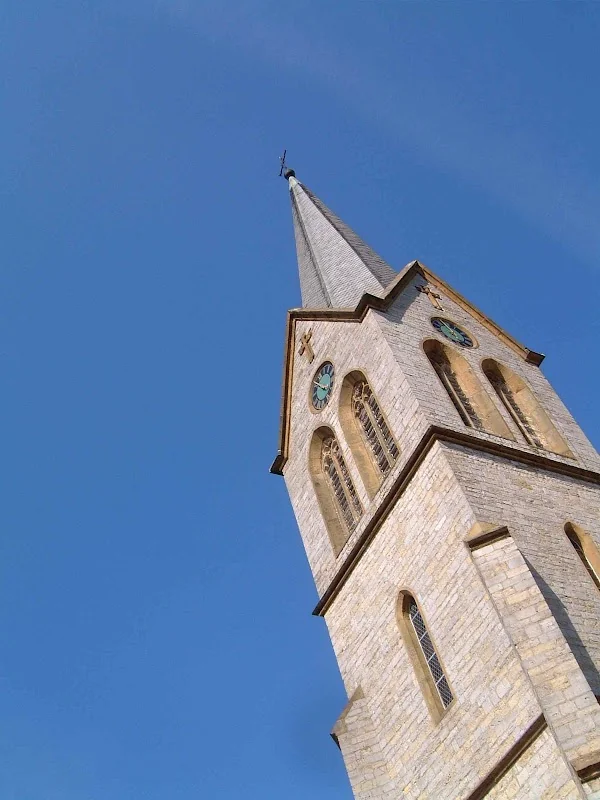
The history of Stiftskirche Schildesche begins very early. According to the community, it dates back to the foundation of a women's monastery by Marswidis in 939; in 960, the church was consecrated to John the Baptist and Mary. The current cruciform floor plan was created in the mid-13th century after a fire, and the church was further expanded in the 15th century. The tower from that time collapsed in 1811, and the current neo-Gothic tower dates from 1869. These construction layers make the church a multi-layered monument, where urban, church, and art history can be read directly. ([stift-schildesche.de](https://www.stift-schildesche.de/ueber-uns/stiftskirche?utm_source=openai))
Particularly impressive is the late Gothic wing altar, which was created in 1501 in Braunschweig and made by the so-called Braunschweig Madonna Master. It depicts scenes from the life of John the Baptist on the left side, scenes from the life of Jesus on the right, and in the center, the crucifixion with the two crucified alongside. The predella below contains eight female saints and in the middle, a crowning of Mary by God the Father and Christ. The backs of the wings bear damaged panel paintings. Those interested in the Stiftskirche Schildesche altar will find one of the most important works of art in the church space, which thematically illustrates the connection between the Baptist, Christ, and Marian devotion. ([stift-schildesche.de](https://www.stift-schildesche.de/ueber-uns/stiftskirche/der-altar-der-stiftskirche))
The tour through the church reveals further details that make the space extraordinary. These include an epitaph from the 17th century that commemorates the Stiftsdamen Margareta von Calenberg and Foenna von Oeynhausen, a fresco painting of Saint Christopher around 1400, a Gothic sacrament house around 1500, and stone tablets in the chancel. In the vault of the crossing, John the Baptist is depicted with the founder Marswidis and the first abbess Emma. These details are more than decoration: they tell of religious transitions, the long continuity of the place, and how much the Stiftskirche was shaped by female monastic culture over the centuries. ([stift-schildesche.de](https://www.stift-schildesche.de/ueber-uns/stiftskirche/ein-rundgang-durch-die-stiftskirche?utm_source=openai))
Acoustically, the Stiftskirche also holds a special position. The organ was built in 1962 by the organ building company A. Führer from Wilhelmshaven according to a specification by A. Schönstedt. With 35 registers on three manuals and pedal, it is suitable for both liturgical and concert music. The history of the bells also goes back a long way: a bell from 1461 has been preserved, five new bronze bells were added in 1996, and the earlier iron bells from 1922 are now displayed in the churchyard as a reminder. Together with the organ and the wing altar, this creates a space where art, sound, and history are not separated but reinforce each other. ([stift-schildesche.de](https://www.stift-schildesche.de/ueber-uns/stiftskirche?utm_source=openai))
Community Center, Community Life, and Meeting Points in the Stiftskirchengemeinde
Those searching for the community center Stiftskirche Schildesche will find a modern, yet very locally oriented center at Johannesstraße 13. The community center was opened in spring 2014 and offers three group rooms as well as a large community hall for events. The community cites examples such as community meetings, staff receptions, Easter breakfasts, and cinema in the community center. This is important for visitors because the Stiftskirche plays a strong role not only in the church itself but also in the directly adjacent community life. ([stift-schildesche.de](https://www.stift-schildesche.de/hier-treffen-wir-uns))
The official community overview makes it clear how broad the offering actually is. In addition to the Stiftskirche as a preaching location, three daycare centers, the Huchzermeier-Stift, and a diverse network of groups and circles belong to the community. Additionally, there are dates such as market breakfasts, art in the community center, memory training, English, Latin reading, dance circles, theological workshops, PC courses, or ecumenical discussion circles. This breadth is typical for a community in the historic town center and is also a sign that church work here is not limited to Sunday services. ([stift-schildesche.de](https://www.stift-schildesche.de/ueber-uns?utm_source=openai))
A particular strength lies in the connection between tradition and neighborhood. The community emphasizes its good ecumenical cooperation with the neighboring Catholic parish of St. Johannes Baptist and the Evangelical Methodist community in Bielefeld. It also refers to its close integration into the district: the community center, the community office, and the church are located in the heart of Schildesche, a place where people actually meet. Therefore, those searching for Stiftskirchengemeinde Schildesche will discover not only a classic church site but a vibrant neighborhood center. ([stift-schildesche.de](https://www.stift-schildesche.de/ueber-uns?utm_source=openai))
The community office is also located at Johannesstraße 13. The usual opening hours are Monday, Tuesday, Wednesday, and Friday from 10 a.m. to 12 p.m. and Thursday from 5 p.m. to 6 p.m. This clear accessibility is practical for baptisms, weddings, funerals, certificates, or general inquiries. Together with the open church and the community newsletter, this creates a clear offering for people who are not just looking for an event hall but a religiously and socially anchored address in the Schildesche district. ([stift-schildesche.de](https://www.stift-schildesche.de/ueber-uns/gemeindebuero))
Directions, Church Square, and Parking in the Historic Town Center
The Stiftskirche Schildesche is located at An der Stiftskirche 1, 33611 Bielefeld, in the middle of one of the oldest and most distinctive areas of the Schildesche district. The city of Bielefeld describes Schildesche as a place with one of the most beautiful historic town centers in the city; the current town center already developed from the women's monastery of 939 and the later church and chapter area. This is important for visitors because the church is not located off the beaten path but right in the middle of a developed neighborhood center with a market, residential houses, shops, and historical traces. ([stift-schildesche.de](https://www.stift-schildesche.de/ueber-uns/stiftskirche?utm_source=openai))
Particularly helpful is the view of the church square: The city of Bielefeld explicitly lists the weekly market in Schildesche at the church square at Stiftskirche, on Saturdays from 7 a.m. to 1 p.m. This shows how strongly this place is used as a public space. At the same time, the city refers in various documents to the fact that the area around the church square and the street An der Stiftskirche is traffic-sensitive and that alternative parking should be sought outside the immediate event area. For a visit, this means practically: Those heading to the Stiftskirche should plan some time for travel and not expect a large number of immediate parking spaces right at the entrance. ([bielefeld.de](https://www.bielefeld.de/node/5836))
The historical structure of the town center explains this situation. The church square was formerly a cemetery, and the city refers to the old area around the church as a traditional center of the district. Current city documents also show that measures for bicycle racks and cargo bike parking spaces are planned along the street An der Stiftskirche, which underscores the close and urban use of the area. This is not a weakness but part of the special character: Here, one moves in a dense, lively neighborhood where church, market, community, and traffic closely intersect. ([bielefeld.de](https://www.bielefeld.de/node/3727?utm_source=openai))
For practical purposes: Those wishing to attend services, concerts, or events are best advised to arrive with some buffer time, consciously use the historic town center on foot, and keep an eye on current notices from the community or the city. Especially around Christmas, during the market, or at special concerts, it can get busier. At the same time, this very mix makes the Stiftskirche so attractive: it is not located in an anonymous suburb but in a developed center that can be experienced on foot, where the Stiftskirche immediately becomes visible as a point of orientation. ([bielefeld.de](https://www.bielefeld.de/node/5836))
Sources:
- Ev.-Luth. Kirchengemeinde Schildesche - Stiftskirche
- Ev.-Luth. Kirchengemeinde Schildesche - A Tour Through the Stiftskirche
- Ev.-Luth. Kirchengemeinde Schildesche - Here We Meet
- Ev.-Luth. Kirchengemeinde Schildesche - Service
- City of Bielefeld - Schildesche
- City of Bielefeld - Weekly Market in Schildesche
- City of Bielefeld - Statement on Parking for Cargo Bikes on the Street An der Stiftskirche
Show moreShow less
Stiftskirche Schildesche | Services & Events
The Stiftskirche Schildesche is much more than a historical church in the north of Bielefeld. It is a spiritual center, a cultural meeting point, and a defining landmark of the old town center of Schildesche. Those looking for services, events, concerts, or information about Christmas and Christmas Eve at Stiftskirche Schildesche will find a place where history, community life, and a special atmosphere are closely intertwined to this day. The church belongs to the Evangelical-Lutheran Stiftskirchengemeinde Schildesche, which has around 6,000 members and consciously focuses its work on open encounters, church music, and vibrant community life. ([stift-schildesche.de](https://www.stift-schildesche.de/ueber-uns?utm_source=openai))
Its location in the historic town center is a significant part of its impact: Around the church, an ensemble has developed that has grown over centuries and continues to shape the character of Schildesche today. The Stiftskirche itself is accessible as an Open Church during the day, and the website features sermon plans, information about services, and details about special formats throughout the year. Especially at Christmas, interest is high, as the community offers several service formats on Christmas Eve and the holidays, ranging from family services to musically oriented celebrations. Therefore, those visiting the site experience not just a building, but a church that is actively used in everyday life and whose history remains palpable in daily life. ([stift-schildesche.de](https://www.stift-schildesche.de/))
Services, Sermon Plan, and Christmas at Stiftskirche Schildesche
When people search for Stiftskirche Schildesche today or for services at Stiftskirche Schildesche, they are usually looking for current dates, liturgical offerings, and special holidays. For this purpose, the community maintains its own service section with a sermon plan and archive. The website also accompanies important festive times, especially the Christmas services, which regularly take place in several formats at the Stiftskirche. This shows that the church does not merely exist as a monument, but as an active place of worship where the year is consciously structured liturgically. ([stift-schildesche.de](https://www.stift-schildesche.de/gottesdienst?utm_source=openai))
For Christmas, the community documents several offerings on its service page, such as a Christmas musical, a nativity play, a Christmas service with choir, and a later service with choirs and brass players on Christmas Eve. Additionally, there are services on the 1st and 2nd Christmas holidays. This is important for families, musically interested individuals, and regular members alike, as it becomes clear that the Stiftskirche accommodates different needs during the festive days: quiet devotion, communal singing, choral music, and child-friendly elements. Therefore, those who want to experience Christmas at the Stiftskirche will not find a single standard celebration, but a whole liturgical dramaturgy surrounding Christmas Eve. ([stift-schildesche.de](https://www.stift-schildesche.de/gottesdienst?utm_source=openai))
Throughout the rest of the church year, the Stiftskirche is well integrated. The community points out that the Stiftskirche is the preaching location of the community and that the current sermon plan remains accessible online. The openness of the church is a conscious part of the concept: Visitors can enter the Stiftskirche during the week, take a moment of quiet, let the space affect them, or prepare for the next service. Changes may occur due to vacation times or illness, which is why the community refers to its website and the cooperation of volunteer supervisors. This combination of regular opening, clear service times, and digital information makes the Stiftskirche attractive for spontaneous visits. ([stift-schildesche.de](https://www.stift-schildesche.de/))
In the perception of many people, the Stiftskirche is also strongly associated with services because it has a special presence in the historic center of Schildesche. The community is rooted in the area, and its website mentions not only the church but also the community center, daycare centers, and contact with the community office. Therefore, those searching for Stiftskirchengemeinde Schildesche will find a community that combines classic evangelical life with open communication: worship, pastoral care, music, family work, and festivals are all part of it. The church is thus not merely a place for holidays, but a spiritual center throughout the year. ([stift-schildesche.de](https://www.stift-schildesche.de/ueber-uns?utm_source=openai))
Events, Concerts, and Church Music in Schildesche
The search queries Stiftskirche Schildesche events and Stiftskirche Schildesche concert fit very well with what the community itself says about itself: church music is a characteristic feature. The official page emphasizes that alongside services, concert music is also cultivated, including demanding spiritual works. It is fitting that the community's brass choir was founded as early as 1870, making it one of the oldest in the region. For a church of this size, this is remarkable because music is understood here not as a mere accompaniment but as an identity-forming component of community life. ([stift-schildesche.de](https://www.stift-schildesche.de/ueber-uns?utm_source=openai))
The Stiftskirche itself offers ideal conditions for musical formats with its organ, bells, and acoustic space. The organ was built in 1962, has 35 registers on three manuals and pedal, and is oriented towards the North German Baroque organ type. The bells are also part of the musical identity: a bell from 1461 is considered the oldest in Bielefeld, and in 1996, five new bronze bells were added, replacing the older iron bells. This creates a soundscape that is equally formative for services, concert evenings, and special holidays. ([stift-schildesche.de](https://www.stift-schildesche.de/ueber-uns/stiftskirche?utm_source=openai))
However, the lively event page includes not only classical concerts. The community center at Johannesstraße 13 is used for larger formats, such as community meetings, staff receptions, Easter breakfasts, or cinema in the community center. The website also mentions various groups, circles, and activities such as market breakfasts, art in the community center, ecumenical discussion circles, or the children's and youth area. This makes it clear that the Stiftskirchengemeinde offers a wide program for different age groups and interests. Therefore, those searching for events in Schildesche will find not only church concerts but a whole network of music, education, and encounters. ([stift-schildesche.de](https://www.stift-schildesche.de/hier-treffen-wir-uns))
Another advantage is the connection between tradition and current relevance. The homepage refers to current dates, a newsletter, and social media presence; at the same time, classic community communication with sermon plans, community newsletters, and events remains in the foreground. This makes the Stiftskirche neither museum-like nor arbitrarily modern, but rather a place that takes its historical role seriously and connects it with contemporary formats. Especially for those looking for a concert venue with a spiritual character, this blend of historical space, musical quality, and lived community is a strong argument. ([stift-schildesche.de](https://www.stift-schildesche.de/ueber-uns?utm_source=openai))
History, Architecture, Altar, and Organ
The history of Stiftskirche Schildesche begins very early. According to the community, it dates back to the foundation of a women's monastery by Marswidis in 939; in 960, the church was consecrated to John the Baptist and Mary. The current cruciform floor plan was created in the mid-13th century after a fire, and the church was further expanded in the 15th century. The tower from that time collapsed in 1811, and the current neo-Gothic tower dates from 1869. These construction layers make the church a multi-layered monument, where urban, church, and art history can be read directly. ([stift-schildesche.de](https://www.stift-schildesche.de/ueber-uns/stiftskirche?utm_source=openai))
Particularly impressive is the late Gothic wing altar, which was created in 1501 in Braunschweig and made by the so-called Braunschweig Madonna Master. It depicts scenes from the life of John the Baptist on the left side, scenes from the life of Jesus on the right, and in the center, the crucifixion with the two crucified alongside. The predella below contains eight female saints and in the middle, a crowning of Mary by God the Father and Christ. The backs of the wings bear damaged panel paintings. Those interested in the Stiftskirche Schildesche altar will find one of the most important works of art in the church space, which thematically illustrates the connection between the Baptist, Christ, and Marian devotion. ([stift-schildesche.de](https://www.stift-schildesche.de/ueber-uns/stiftskirche/der-altar-der-stiftskirche))
The tour through the church reveals further details that make the space extraordinary. These include an epitaph from the 17th century that commemorates the Stiftsdamen Margareta von Calenberg and Foenna von Oeynhausen, a fresco painting of Saint Christopher around 1400, a Gothic sacrament house around 1500, and stone tablets in the chancel. In the vault of the crossing, John the Baptist is depicted with the founder Marswidis and the first abbess Emma. These details are more than decoration: they tell of religious transitions, the long continuity of the place, and how much the Stiftskirche was shaped by female monastic culture over the centuries. ([stift-schildesche.de](https://www.stift-schildesche.de/ueber-uns/stiftskirche/ein-rundgang-durch-die-stiftskirche?utm_source=openai))
Acoustically, the Stiftskirche also holds a special position. The organ was built in 1962 by the organ building company A. Führer from Wilhelmshaven according to a specification by A. Schönstedt. With 35 registers on three manuals and pedal, it is suitable for both liturgical and concert music. The history of the bells also goes back a long way: a bell from 1461 has been preserved, five new bronze bells were added in 1996, and the earlier iron bells from 1922 are now displayed in the churchyard as a reminder. Together with the organ and the wing altar, this creates a space where art, sound, and history are not separated but reinforce each other. ([stift-schildesche.de](https://www.stift-schildesche.de/ueber-uns/stiftskirche?utm_source=openai))
Community Center, Community Life, and Meeting Points in the Stiftskirchengemeinde
Those searching for the community center Stiftskirche Schildesche will find a modern, yet very locally oriented center at Johannesstraße 13. The community center was opened in spring 2014 and offers three group rooms as well as a large community hall for events. The community cites examples such as community meetings, staff receptions, Easter breakfasts, and cinema in the community center. This is important for visitors because the Stiftskirche plays a strong role not only in the church itself but also in the directly adjacent community life. ([stift-schildesche.de](https://www.stift-schildesche.de/hier-treffen-wir-uns))
The official community overview makes it clear how broad the offering actually is. In addition to the Stiftskirche as a preaching location, three daycare centers, the Huchzermeier-Stift, and a diverse network of groups and circles belong to the community. Additionally, there are dates such as market breakfasts, art in the community center, memory training, English, Latin reading, dance circles, theological workshops, PC courses, or ecumenical discussion circles. This breadth is typical for a community in the historic town center and is also a sign that church work here is not limited to Sunday services. ([stift-schildesche.de](https://www.stift-schildesche.de/ueber-uns?utm_source=openai))
A particular strength lies in the connection between tradition and neighborhood. The community emphasizes its good ecumenical cooperation with the neighboring Catholic parish of St. Johannes Baptist and the Evangelical Methodist community in Bielefeld. It also refers to its close integration into the district: the community center, the community office, and the church are located in the heart of Schildesche, a place where people actually meet. Therefore, those searching for Stiftskirchengemeinde Schildesche will discover not only a classic church site but a vibrant neighborhood center. ([stift-schildesche.de](https://www.stift-schildesche.de/ueber-uns?utm_source=openai))
The community office is also located at Johannesstraße 13. The usual opening hours are Monday, Tuesday, Wednesday, and Friday from 10 a.m. to 12 p.m. and Thursday from 5 p.m. to 6 p.m. This clear accessibility is practical for baptisms, weddings, funerals, certificates, or general inquiries. Together with the open church and the community newsletter, this creates a clear offering for people who are not just looking for an event hall but a religiously and socially anchored address in the Schildesche district. ([stift-schildesche.de](https://www.stift-schildesche.de/ueber-uns/gemeindebuero))
Directions, Church Square, and Parking in the Historic Town Center
The Stiftskirche Schildesche is located at An der Stiftskirche 1, 33611 Bielefeld, in the middle of one of the oldest and most distinctive areas of the Schildesche district. The city of Bielefeld describes Schildesche as a place with one of the most beautiful historic town centers in the city; the current town center already developed from the women's monastery of 939 and the later church and chapter area. This is important for visitors because the church is not located off the beaten path but right in the middle of a developed neighborhood center with a market, residential houses, shops, and historical traces. ([stift-schildesche.de](https://www.stift-schildesche.de/ueber-uns/stiftskirche?utm_source=openai))
Particularly helpful is the view of the church square: The city of Bielefeld explicitly lists the weekly market in Schildesche at the church square at Stiftskirche, on Saturdays from 7 a.m. to 1 p.m. This shows how strongly this place is used as a public space. At the same time, the city refers in various documents to the fact that the area around the church square and the street An der Stiftskirche is traffic-sensitive and that alternative parking should be sought outside the immediate event area. For a visit, this means practically: Those heading to the Stiftskirche should plan some time for travel and not expect a large number of immediate parking spaces right at the entrance. ([bielefeld.de](https://www.bielefeld.de/node/5836))
The historical structure of the town center explains this situation. The church square was formerly a cemetery, and the city refers to the old area around the church as a traditional center of the district. Current city documents also show that measures for bicycle racks and cargo bike parking spaces are planned along the street An der Stiftskirche, which underscores the close and urban use of the area. This is not a weakness but part of the special character: Here, one moves in a dense, lively neighborhood where church, market, community, and traffic closely intersect. ([bielefeld.de](https://www.bielefeld.de/node/3727?utm_source=openai))
For practical purposes: Those wishing to attend services, concerts, or events are best advised to arrive with some buffer time, consciously use the historic town center on foot, and keep an eye on current notices from the community or the city. Especially around Christmas, during the market, or at special concerts, it can get busier. At the same time, this very mix makes the Stiftskirche so attractive: it is not located in an anonymous suburb but in a developed center that can be experienced on foot, where the Stiftskirche immediately becomes visible as a point of orientation. ([bielefeld.de](https://www.bielefeld.de/node/5836))
Sources:
- Ev.-Luth. Kirchengemeinde Schildesche - Stiftskirche
- Ev.-Luth. Kirchengemeinde Schildesche - A Tour Through the Stiftskirche
- Ev.-Luth. Kirchengemeinde Schildesche - Here We Meet
- Ev.-Luth. Kirchengemeinde Schildesche - Service
- City of Bielefeld - Schildesche
- City of Bielefeld - Weekly Market in Schildesche
- City of Bielefeld - Statement on Parking for Cargo Bikes on the Street An der Stiftskirche
Stiftskirche Schildesche | Services & Events
The Stiftskirche Schildesche is much more than a historical church in the north of Bielefeld. It is a spiritual center, a cultural meeting point, and a defining landmark of the old town center of Schildesche. Those looking for services, events, concerts, or information about Christmas and Christmas Eve at Stiftskirche Schildesche will find a place where history, community life, and a special atmosphere are closely intertwined to this day. The church belongs to the Evangelical-Lutheran Stiftskirchengemeinde Schildesche, which has around 6,000 members and consciously focuses its work on open encounters, church music, and vibrant community life. ([stift-schildesche.de](https://www.stift-schildesche.de/ueber-uns?utm_source=openai))
Its location in the historic town center is a significant part of its impact: Around the church, an ensemble has developed that has grown over centuries and continues to shape the character of Schildesche today. The Stiftskirche itself is accessible as an Open Church during the day, and the website features sermon plans, information about services, and details about special formats throughout the year. Especially at Christmas, interest is high, as the community offers several service formats on Christmas Eve and the holidays, ranging from family services to musically oriented celebrations. Therefore, those visiting the site experience not just a building, but a church that is actively used in everyday life and whose history remains palpable in daily life. ([stift-schildesche.de](https://www.stift-schildesche.de/))
Services, Sermon Plan, and Christmas at Stiftskirche Schildesche
When people search for Stiftskirche Schildesche today or for services at Stiftskirche Schildesche, they are usually looking for current dates, liturgical offerings, and special holidays. For this purpose, the community maintains its own service section with a sermon plan and archive. The website also accompanies important festive times, especially the Christmas services, which regularly take place in several formats at the Stiftskirche. This shows that the church does not merely exist as a monument, but as an active place of worship where the year is consciously structured liturgically. ([stift-schildesche.de](https://www.stift-schildesche.de/gottesdienst?utm_source=openai))
For Christmas, the community documents several offerings on its service page, such as a Christmas musical, a nativity play, a Christmas service with choir, and a later service with choirs and brass players on Christmas Eve. Additionally, there are services on the 1st and 2nd Christmas holidays. This is important for families, musically interested individuals, and regular members alike, as it becomes clear that the Stiftskirche accommodates different needs during the festive days: quiet devotion, communal singing, choral music, and child-friendly elements. Therefore, those who want to experience Christmas at the Stiftskirche will not find a single standard celebration, but a whole liturgical dramaturgy surrounding Christmas Eve. ([stift-schildesche.de](https://www.stift-schildesche.de/gottesdienst?utm_source=openai))
Throughout the rest of the church year, the Stiftskirche is well integrated. The community points out that the Stiftskirche is the preaching location of the community and that the current sermon plan remains accessible online. The openness of the church is a conscious part of the concept: Visitors can enter the Stiftskirche during the week, take a moment of quiet, let the space affect them, or prepare for the next service. Changes may occur due to vacation times or illness, which is why the community refers to its website and the cooperation of volunteer supervisors. This combination of regular opening, clear service times, and digital information makes the Stiftskirche attractive for spontaneous visits. ([stift-schildesche.de](https://www.stift-schildesche.de/))
In the perception of many people, the Stiftskirche is also strongly associated with services because it has a special presence in the historic center of Schildesche. The community is rooted in the area, and its website mentions not only the church but also the community center, daycare centers, and contact with the community office. Therefore, those searching for Stiftskirchengemeinde Schildesche will find a community that combines classic evangelical life with open communication: worship, pastoral care, music, family work, and festivals are all part of it. The church is thus not merely a place for holidays, but a spiritual center throughout the year. ([stift-schildesche.de](https://www.stift-schildesche.de/ueber-uns?utm_source=openai))
Events, Concerts, and Church Music in Schildesche
The search queries Stiftskirche Schildesche events and Stiftskirche Schildesche concert fit very well with what the community itself says about itself: church music is a characteristic feature. The official page emphasizes that alongside services, concert music is also cultivated, including demanding spiritual works. It is fitting that the community's brass choir was founded as early as 1870, making it one of the oldest in the region. For a church of this size, this is remarkable because music is understood here not as a mere accompaniment but as an identity-forming component of community life. ([stift-schildesche.de](https://www.stift-schildesche.de/ueber-uns?utm_source=openai))
The Stiftskirche itself offers ideal conditions for musical formats with its organ, bells, and acoustic space. The organ was built in 1962, has 35 registers on three manuals and pedal, and is oriented towards the North German Baroque organ type. The bells are also part of the musical identity: a bell from 1461 is considered the oldest in Bielefeld, and in 1996, five new bronze bells were added, replacing the older iron bells. This creates a soundscape that is equally formative for services, concert evenings, and special holidays. ([stift-schildesche.de](https://www.stift-schildesche.de/ueber-uns/stiftskirche?utm_source=openai))
However, the lively event page includes not only classical concerts. The community center at Johannesstraße 13 is used for larger formats, such as community meetings, staff receptions, Easter breakfasts, or cinema in the community center. The website also mentions various groups, circles, and activities such as market breakfasts, art in the community center, ecumenical discussion circles, or the children's and youth area. This makes it clear that the Stiftskirchengemeinde offers a wide program for different age groups and interests. Therefore, those searching for events in Schildesche will find not only church concerts but a whole network of music, education, and encounters. ([stift-schildesche.de](https://www.stift-schildesche.de/hier-treffen-wir-uns))
Another advantage is the connection between tradition and current relevance. The homepage refers to current dates, a newsletter, and social media presence; at the same time, classic community communication with sermon plans, community newsletters, and events remains in the foreground. This makes the Stiftskirche neither museum-like nor arbitrarily modern, but rather a place that takes its historical role seriously and connects it with contemporary formats. Especially for those looking for a concert venue with a spiritual character, this blend of historical space, musical quality, and lived community is a strong argument. ([stift-schildesche.de](https://www.stift-schildesche.de/ueber-uns?utm_source=openai))
History, Architecture, Altar, and Organ
The history of Stiftskirche Schildesche begins very early. According to the community, it dates back to the foundation of a women's monastery by Marswidis in 939; in 960, the church was consecrated to John the Baptist and Mary. The current cruciform floor plan was created in the mid-13th century after a fire, and the church was further expanded in the 15th century. The tower from that time collapsed in 1811, and the current neo-Gothic tower dates from 1869. These construction layers make the church a multi-layered monument, where urban, church, and art history can be read directly. ([stift-schildesche.de](https://www.stift-schildesche.de/ueber-uns/stiftskirche?utm_source=openai))
Particularly impressive is the late Gothic wing altar, which was created in 1501 in Braunschweig and made by the so-called Braunschweig Madonna Master. It depicts scenes from the life of John the Baptist on the left side, scenes from the life of Jesus on the right, and in the center, the crucifixion with the two crucified alongside. The predella below contains eight female saints and in the middle, a crowning of Mary by God the Father and Christ. The backs of the wings bear damaged panel paintings. Those interested in the Stiftskirche Schildesche altar will find one of the most important works of art in the church space, which thematically illustrates the connection between the Baptist, Christ, and Marian devotion. ([stift-schildesche.de](https://www.stift-schildesche.de/ueber-uns/stiftskirche/der-altar-der-stiftskirche))
The tour through the church reveals further details that make the space extraordinary. These include an epitaph from the 17th century that commemorates the Stiftsdamen Margareta von Calenberg and Foenna von Oeynhausen, a fresco painting of Saint Christopher around 1400, a Gothic sacrament house around 1500, and stone tablets in the chancel. In the vault of the crossing, John the Baptist is depicted with the founder Marswidis and the first abbess Emma. These details are more than decoration: they tell of religious transitions, the long continuity of the place, and how much the Stiftskirche was shaped by female monastic culture over the centuries. ([stift-schildesche.de](https://www.stift-schildesche.de/ueber-uns/stiftskirche/ein-rundgang-durch-die-stiftskirche?utm_source=openai))
Acoustically, the Stiftskirche also holds a special position. The organ was built in 1962 by the organ building company A. Führer from Wilhelmshaven according to a specification by A. Schönstedt. With 35 registers on three manuals and pedal, it is suitable for both liturgical and concert music. The history of the bells also goes back a long way: a bell from 1461 has been preserved, five new bronze bells were added in 1996, and the earlier iron bells from 1922 are now displayed in the churchyard as a reminder. Together with the organ and the wing altar, this creates a space where art, sound, and history are not separated but reinforce each other. ([stift-schildesche.de](https://www.stift-schildesche.de/ueber-uns/stiftskirche?utm_source=openai))
Community Center, Community Life, and Meeting Points in the Stiftskirchengemeinde
Those searching for the community center Stiftskirche Schildesche will find a modern, yet very locally oriented center at Johannesstraße 13. The community center was opened in spring 2014 and offers three group rooms as well as a large community hall for events. The community cites examples such as community meetings, staff receptions, Easter breakfasts, and cinema in the community center. This is important for visitors because the Stiftskirche plays a strong role not only in the church itself but also in the directly adjacent community life. ([stift-schildesche.de](https://www.stift-schildesche.de/hier-treffen-wir-uns))
The official community overview makes it clear how broad the offering actually is. In addition to the Stiftskirche as a preaching location, three daycare centers, the Huchzermeier-Stift, and a diverse network of groups and circles belong to the community. Additionally, there are dates such as market breakfasts, art in the community center, memory training, English, Latin reading, dance circles, theological workshops, PC courses, or ecumenical discussion circles. This breadth is typical for a community in the historic town center and is also a sign that church work here is not limited to Sunday services. ([stift-schildesche.de](https://www.stift-schildesche.de/ueber-uns?utm_source=openai))
A particular strength lies in the connection between tradition and neighborhood. The community emphasizes its good ecumenical cooperation with the neighboring Catholic parish of St. Johannes Baptist and the Evangelical Methodist community in Bielefeld. It also refers to its close integration into the district: the community center, the community office, and the church are located in the heart of Schildesche, a place where people actually meet. Therefore, those searching for Stiftskirchengemeinde Schildesche will discover not only a classic church site but a vibrant neighborhood center. ([stift-schildesche.de](https://www.stift-schildesche.de/ueber-uns?utm_source=openai))
The community office is also located at Johannesstraße 13. The usual opening hours are Monday, Tuesday, Wednesday, and Friday from 10 a.m. to 12 p.m. and Thursday from 5 p.m. to 6 p.m. This clear accessibility is practical for baptisms, weddings, funerals, certificates, or general inquiries. Together with the open church and the community newsletter, this creates a clear offering for people who are not just looking for an event hall but a religiously and socially anchored address in the Schildesche district. ([stift-schildesche.de](https://www.stift-schildesche.de/ueber-uns/gemeindebuero))
Directions, Church Square, and Parking in the Historic Town Center
The Stiftskirche Schildesche is located at An der Stiftskirche 1, 33611 Bielefeld, in the middle of one of the oldest and most distinctive areas of the Schildesche district. The city of Bielefeld describes Schildesche as a place with one of the most beautiful historic town centers in the city; the current town center already developed from the women's monastery of 939 and the later church and chapter area. This is important for visitors because the church is not located off the beaten path but right in the middle of a developed neighborhood center with a market, residential houses, shops, and historical traces. ([stift-schildesche.de](https://www.stift-schildesche.de/ueber-uns/stiftskirche?utm_source=openai))
Particularly helpful is the view of the church square: The city of Bielefeld explicitly lists the weekly market in Schildesche at the church square at Stiftskirche, on Saturdays from 7 a.m. to 1 p.m. This shows how strongly this place is used as a public space. At the same time, the city refers in various documents to the fact that the area around the church square and the street An der Stiftskirche is traffic-sensitive and that alternative parking should be sought outside the immediate event area. For a visit, this means practically: Those heading to the Stiftskirche should plan some time for travel and not expect a large number of immediate parking spaces right at the entrance. ([bielefeld.de](https://www.bielefeld.de/node/5836))
The historical structure of the town center explains this situation. The church square was formerly a cemetery, and the city refers to the old area around the church as a traditional center of the district. Current city documents also show that measures for bicycle racks and cargo bike parking spaces are planned along the street An der Stiftskirche, which underscores the close and urban use of the area. This is not a weakness but part of the special character: Here, one moves in a dense, lively neighborhood where church, market, community, and traffic closely intersect. ([bielefeld.de](https://www.bielefeld.de/node/3727?utm_source=openai))
For practical purposes: Those wishing to attend services, concerts, or events are best advised to arrive with some buffer time, consciously use the historic town center on foot, and keep an eye on current notices from the community or the city. Especially around Christmas, during the market, or at special concerts, it can get busier. At the same time, this very mix makes the Stiftskirche so attractive: it is not located in an anonymous suburb but in a developed center that can be experienced on foot, where the Stiftskirche immediately becomes visible as a point of orientation. ([bielefeld.de](https://www.bielefeld.de/node/5836))
Sources:
- Ev.-Luth. Kirchengemeinde Schildesche - Stiftskirche
- Ev.-Luth. Kirchengemeinde Schildesche - A Tour Through the Stiftskirche
- Ev.-Luth. Kirchengemeinde Schildesche - Here We Meet
- Ev.-Luth. Kirchengemeinde Schildesche - Service
- City of Bielefeld - Schildesche
- City of Bielefeld - Weekly Market in Schildesche
- City of Bielefeld - Statement on Parking for Cargo Bikes on the Street An der Stiftskirche
Upcoming Events
No events found
Frequently Asked Questions
Reviews
Gustavo Garcia
29. April 2017
Beautiful
Bernd Brinkmann
15. March 2024
The Evangelical Stiftskirche in Schildesche, a district of Bielefeld in North Rhine-Westphalia, Germany, is a fascinating historical building with a rich history. It was built in the 13th century in the Gothic style and is considered a significant example of sacred architecture from that time in the region. Originally, the Stiftskirche was designed as a church for a noble ladies' convent and served as a spiritual center for the residents of the convent as well as a place for prayer and devotion. The convent was an institution where noble women lived and dedicated themselves to prayer, charitable work, and education. Therefore, the Stiftskirche played a central role in the daily lives of the convent ladies and was an important part of their religious practice. Over the centuries, the Stiftskirche underwent various structural changes and expansions, becoming a complex building ensemble. Nevertheless, it has preserved many original Gothic elements to this day, including impressive vaults, pointed windows, and intricate carvings. After the Reformation and the secularization of the convent in the 16th century, the Stiftskirche was taken over by the Protestant community and continued to be used as a house of worship. It remained an important place of religious life and community for the residents of Schildesche. The Stiftskirche is not only a place of religious worship but also a cultural and historical landmark of the region. Its imposing architecture and rich history make it a popular destination for visitors who want to experience the beauty and significance of this historical building. Today, the Evangelical Stiftskirche in Schildesche continues to play an active role in community life by offering regular services, concerts, events, and cultural programs. It is a place of encounter, prayer, and inspiration for people of all ages and faiths.
Marc “Vossie” Vossieck
29. September 2019
Stiftsmarkt very very beautiful, just unfortunately the weather didn't match
der Bielefelder
24. August 2018
Probably the most beautiful church in Bielefeld. The carved altar from around 1502 is magnificent, and the acoustics of the large organ are impressive. The origins of this house of worship date back over 1000 years. A visit is a must for everyone.
Ma honi
10. September 2020
Beautiful large building. Good acoustics for singing. Pastor friendly and helpful. 4 stars because I can't remember what was said.