
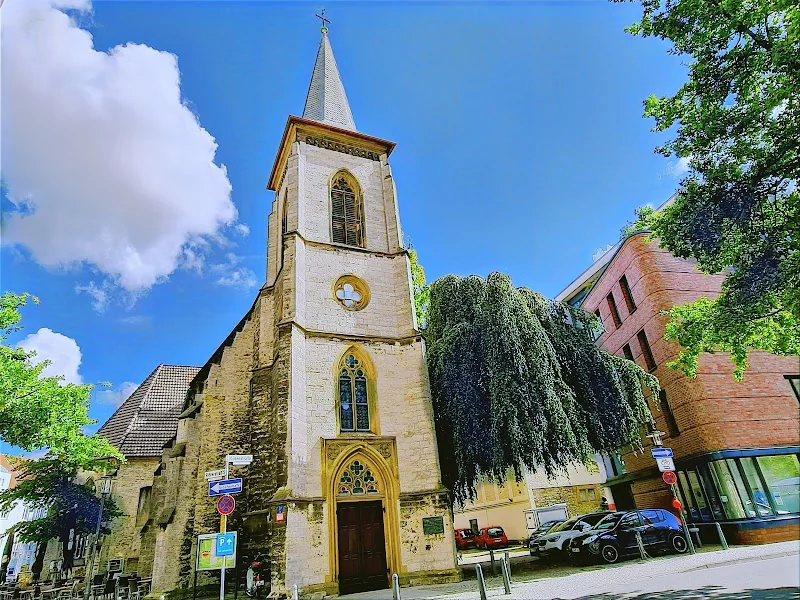
Bielefeld
Güsenstraße 22, 33602 Bielefeld, Deutschland
Süsterkirche Bielefeld | Services & Opening Hours
The Süsterkirche in Bielefeld is one of the defining places of the old town and uniquely combines historical substance, vibrant community work, and cultural openness. Those who visit the church today not only experience a monument with a long history but also a place where worship, music, encounters, and quiet visits naturally belong together. The Evangelical-Reformed Church community describes the Süsterkirche as the spiritual center of its community; at the same time, it is a space where people from all over the city are welcome and where church life connects with culture and the present. The church can also be explored through a virtual 3D tour, which provides a good impression of the atmosphere, architecture, and spatial effect even before the visit. ([kirche-bielefeld.de](https://www.kirche-bielefeld.de/auf-einen-blick/gemeinden/region-mitte/ev-reformierte-kirchengemeinde-bielefeld))
Services in the Süsterkirche Bielefeld
The most important search intention regarding the Süsterkirche for many people concerns the services. This is where the core of the community lies. At the center of community life is the Sunday service at 10:15 AM in the Süsterkirche. The community emphasizes that the interpretation of the Holy Scriptures is focused on questions and references of our time. It is not only about liturgy in the narrower sense but also about collective reflection, questioning, and discussion. This makes the service in the Süsterkirche an open spiritual offering for many visitors, appealing to people from different life situations. Particularly important is the invitation, which is not only directed at community members but explicitly to all who wish to experience an open Reformed service. ([reformierte-gemeinde-bi.de](https://reformierte-gemeinde-bi.de/evangelisch-reformierte-kirchengemeinde-bielefeld/gottesdienste/gottedienste?utm_source=openai))
Around the Sunday service, there are additional formats in the Süsterkirche that profile the place beyond the classic community service. The community points to sermon archives, special series of services, and target group-oriented offerings. These include, for example, Friday afternoon services, special holiday services, or thematic formats that are often connected to the cultural and social life of the city. Projects such as family-oriented services or special action formats are also held in the Süsterkirche or its surroundings. This shows: Those searching for "Süsterkirche Bielefeld services" find not only a time indication but a community with a clear theological and simultaneously open attitude. This openness is visible in community life through church coffee, the open world shop stand, and the conscious invitation to people from all over Bielefeld. ([reformierte-gemeinde-bi.de](https://reformierte-gemeinde-bi.de/evangelisch-reformierte-kirchengemeinde-bielefeld/gottesdienste/gottedienste?utm_source=openai))
Another important point is the connection between worship and cultural perception. In the Süsterkirche, special liturgical and musical accents regularly take place, which expand the classic worship experience. The community links its services with contemporary issues and the realities of life in the city. For this reason, the Süsterkirche is also described as a place where faith does not take place in isolation but in relation to the urban society. This is important for users who search for a "Süsterkirche Bielefeld service" and want to know whether the church is primarily tourist, spiritual, or culturally shaped. The honest answer is: It is all of that at once, but the service remains the center. ([reformierte-gemeinde-bi.de](https://reformierte-gemeinde-bi.de/evangelisch-reformierte-kirchengemeinde-bielefeld/gottesdienste/gottedienste?utm_source=openai))
For practice, this means: If you are planning a Sunday in Bielefeld, you should consider the Süsterkirche as a lively spiritual place. The service at 10:15 AM is a reliable fixed point, but it is also worth taking a look at the community calendar. There you will find additional dates that can range from special devotions to thematic celebration forms. This is particularly important for people who want to get to know a Reformed community, as it can be well observed how Reformed tradition, contemporary language, and urban openness come together at the Süsterkirche. ([reformierte-gemeinde-bi.de](https://reformierte-gemeinde-bi.de/evangelisch-reformierte-kirchengemeinde-bielefeld/gottesdienste/gottedienste?utm_source=openai))
Opening Hours, Open Church, and 3D Tour
Those who wish to visit the Süsterkirche often look for the opening hours or a way to experience the church outside of a service. Here, the situation is clear and pleasantly uncomplicated. The Open Church is managed by community members on a voluntary basis. The Süsterkirche is open on Fridays from 4 PM to 6 PM and on Saturdays from 11 AM to 6 PM. However, the community points out that these times may be canceled if events take place in the church. This is an important note for all those planning a visit and relying on a reliable but not daily guaranteed tour. The opening hours are therefore a good guideline but not a substitute for the current event calendar. ([reformierte-gemeinde-bi.de](https://reformierte-gemeinde-bi.de/evangelisch-reformierte-kirchengemeinde-bielefeld/gottesdienste/offene-kirche-und-kirchencafe))
The Open Church is more than just a window for sightseeing. It represents a consciously maintained invitation concept. The Süsterkirche should not only be perceived as a historical building but as a space of openness, pause, and encounter. This creates an appealing contrast, especially in the hectic city center environment. People who want to stop by briefly can find a moment of peace, while culture-interested visitors can let the atmosphere of the space affect them. The combination of public accessibility and spiritual use is a central feature of the Süsterkirche. This makes it attractive for both tourists and locals looking for a quiet place in the old town. ([reformierte-gemeinde-bi.de](https://reformierte-gemeinde-bi.de/evangelisch-reformierte-kirchengemeinde-bielefeld/gottesdienste/offene-kirche-und-kirchencafe))
Especially helpful for digital preparation is the virtual 3D tour that the community offers on its website. This allows the spatial effect, vault, and interior design to be discovered online. For many users, this is relevant because they search for "Süsterkirche photos" or "Süsterkirche 3D tour" and want to get an impression beforehand. The digital tour is not just a technical extra but a practical tool to prepare for a visit or to see the church with different eyes. Those who know the space can recognize the effect of the Gothic architecture, the later modifications, and the current lighting design more quickly. This is a real added value, especially for architecture enthusiasts. ([reformierte-gemeinde-bi.de](https://reformierte-gemeinde-bi.de/evangelisch-reformierte-kirchengemeinde-bielefeld/gottesdienste/suesterkirche))
The Open Church is also important for groups, choir rehearsals, or cultural events because the opening hours and event usage sometimes overlap. This explains why the community refers to current notices and understands the church not as a rigidly defined place but as a flexible community space. Thus, the Süsterkirche is not a museum with a rigid schedule but a lively place whose accessibility adapts to community practice and event happenings. This makes it interesting for search queries like "Süsterkirche Bielefeld opening hours": You do not receive abstract information but a realistic access to a place that combines cultivated openness with functioning community work. ([reformierte-gemeinde-bi.de](https://reformierte-gemeinde-bi.de/evangelisch-reformierte-kirchengemeinde-bielefeld/gottesdienste/offene-kirche-und-kirchencafe))
History of the Süsterkirche from 1491 to Today
The history of the Süsterkirche goes deep into the city history of Bielefeld. The community website documents the most important milestones in a timeline that clearly shows how the building has developed over centuries. In 1491, the sisterhood was founded in Mariental; between 1491 and 1514, the chapel or hall church was built in the Gothic architectural style. Thus, the Süsterkirche is one of the oldest sacred places in the city. This origin already explains why the church is significant not only religiously but also culturally historically today. The special architectural influence, including the rare net vault, refers to late medieval building culture and the long continuity of the place. ([reformierte-gemeinde-bi.de](https://reformierte-gemeinde-bi.de/evangelisch-reformierte-kirchengemeinde-bielefeld/gottesdienste/suesterkirche))
In the 17th century, the Süsterkirche became a Reformed place. In 1616, the city of Bielefeld took over the monastery; in 1657, the Evangelical-Reformed community was founded by the Great Elector. In 1671, the Great Elector gifted the church to the Evangelical-Reformed community, and in 1682, the official takeover took place. This development is important because it shapes the religious identity of the place to this day. The Süsterkirche is therefore not just any old church but a building whose history is closely linked to the Reformation, urban development, and the Reformed understanding of community. Those searching for "Reformed Süsterkirche" will find here more than just a name: They find a confessional influence that is still lived today. ([reformierte-gemeinde-bi.de](https://reformierte-gemeinde-bi.de/evangelisch-reformierte-kirchengemeinde-bielefeld/gottesdienste/suesterkirche))
In the 18th and 19th centuries, the church was further expanded and technically renewed. In 1702, it received an organ as a gift from King Friedrich I of Prussia. In 1861, the tower was built with a cross and rooster, a new organ and organ gallery, and further adjustments were made to the interior. In 1891/92, the church was structurally expanded, including a transept and choir, complemented by heating and gas lighting. Thus, the building developed from a medieval church space to a more complex house of worship that responded to changing liturgical and urban requirements. These layers of building history are still palpable today and contribute to the charm of the building. ([reformierte-gemeinde-bi.de](https://reformierte-gemeinde-bi.de/evangelisch-reformierte-kirchengemeinde-bielefeld/gottesdienste/suesterkirche))
The 20th century brought severe disruptions but also reconstruction and modernization. In 1944, the Süsterkirche was 72 percent destroyed by a bombing raid. Already in 1948, reconstruction began with a significantly enlarged organ gallery. In 1949/50, a Walcker organ was created using older components; in 1950/51, new church windows followed. Later modernizations included the cladding of the side walls with wood in 1956, a new interior paint job, parquet floor, and new seating in 1971, as well as a new Kleuker organ. In 2006, a major renovation took place with new heating, new flooring, and lighting of the vaults. In 2019, the entrance area was remodeled, and in 2023, a new lighting concept was implemented. This sequence shows: The Süsterkirche is not a static monument but a well-maintained place that is continually reinterpreted. ([reformierte-gemeinde-bi.de](https://reformierte-gemeinde-bi.de/evangelisch-reformierte-kirchengemeinde-bielefeld/gottesdienste/suesterkirche))
For today's perception, this connection between historical origin and ongoing maintenance is crucial. The Süsterkirche is more than an attraction of great age; it is a place where architectural history, community history, and city history overlap. This also explains why visitors search for photos, history, and events at the same time. The appeal lies not only in individual dates but in the tension between medieval chapel, Reformed community church, and modern cultural space. Those who understand the historical development perceive the current space more intensely. ([reformierte-gemeinde-bi.de](https://reformierte-gemeinde-bi.de/evangelisch-reformierte-kirchengemeinde-bielefeld/gottesdienste/suesterkirche))
Directions, Public Transport, and Parking around the Süsterkirche
The Süsterkirche is located very centrally in Bielefeld and can be reached at the address Güsenstraße 22, 33602 Bielefeld. The community website also mentions that the entrance is via Ritterstraße and Güsenstraße. For public transport, the location is very convenient. According to the church district, the stop Notpfortenstraße is about 240 meters away, and the city tram stop Jahnplatz is about 350 meters away. Several bus and city tram lines are also mentioned there. For visitors, this means: The church is clearly connected to the city center and can be easily reached without a car. This is a great advantage, especially for services, concerts, or open visits. ([kirche-bielefeld.de](https://www.kirche-bielefeld.de/auf-einen-blick/kirchen-in-bielefeld/evangelisch-reformierte-suesterkirche-mitte?utm_source=openai))
Regarding parking, the information is also clear and should be taken seriously. There are no parking spaces directly at the Süsterkirche. This information comes from the rehearsal plan of the city cantorship, which explicitly points out the lack of parking options at the church for arrivals and rehearsal logistics. Alternatives include parking at the Neustädter Kirche as well as the parking garages Neues Rathaus and Altstadtcarré. For people arriving with a lot of luggage, instruments, or out-of-town guests, this is a very practical note. Therefore, those attending an event at the Süsterkirche should not hope for a parking space directly in front of the entrance but should consider the city center character of the location and plan for a bit of walking. ([kirche-bielefeld.de](https://www.kirche-bielefeld.de/fileadmin/Dokumente/---Dienste/Stadtkantorat/Probenplaene/Probenplan_Seniorenchor_2025_02-2026-03.pdf))
However, the proximity to the city center is not only a challenge but also an advantage. Because the Süsterkirche is located in a dense urban environment, it can be combined with a visit to the old town, shopping, or a café visit. Those searching for "Süsterkirche directions" usually want to know not only how to get there but also whether the visit can be easily integrated into everyday life. This is precisely the case here. The church is part of a well-developed urban structure with short distances, and even without a car, orientation remains simple. This makes it equally attractive for city walks, tourist discovery tours, and spontaneous visits. ([kirche-bielefeld.de](https://www.kirche-bielefeld.de/auf-einen-blick/kirchen-in-bielefeld/evangelisch-reformierte-suesterkirche-mitte?utm_source=openai))
Logistics is also important for event visitors, as different formats take place in the Süsterkirche, where travel planning can be relevant. Especially for evening events, concerts, or special services, one should plan for the opening hours of parking garages, the walkways from Jahnplatz, and the possible occupancy around the city center. The official church information regarding the lack of parking at the church should therefore not be understood as a disadvantage but as a helpful planning recommendation. Those who arrive in advance experience the Süsterkirche relaxed and without parking stress. ([kirche-bielefeld.de](https://www.kirche-bielefeld.de/fileadmin/Dokumente/---Dienste/Stadtkantorat/Probenplaene/Probenplan_Seniorenchor_2025_02-2026-03.pdf))
Events, Music, and Cultural Venue Süsterkirche
The Süsterkirche is not only a house of worship but also a pronounced cultural venue. The Evangelical-Reformed Church community explicitly describes music, concerts, and cultural events as shaping the face of the community. The church district also points out that special services repeatedly establish connections to the cultural and social life of the city. This makes it clear that the Süsterkirche operates far beyond the classic community framework. It is a place where spiritual formats, public culture, and urban themes are consciously connected. For search queries like "Süsterkirche Bielefeld events," this is the central added value. ([kirche-bielefeld.de](https://www.kirche-bielefeld.de/auf-einen-blick/gemeinden/region-mitte/ev-reformierte-kirchengemeinde-bielefeld))
A good example of this is current and recurring event formats. On official pages and in the urban event context, there are, for example, peace prayers, exhibition themes, special church music, and actions like "Simply get married." A service on World AIDS Day has also been announced in the Süsterkirche, as well as an exhibition during Lent. Such dates show that the church is used as a space for reflection, remembrance, and current social issues. Not every event is permanently part of an annual program, but the principle is constant: The Süsterkirche is open to formats that connect faith, music, art, and the present. ([bielefeld.jetzt](https://www.bielefeld.jetzt/node/1712809?utm_source=openai))
Church music also plays an important role. The Süsterkirche is one of the locations of the Evangelical City Cantorship Bielefeld, which is active in various city center churches. The Süsterkirche is an important sound space for choir work, community music, and special musical programs. The community website describes the church choir, and the church district's website mentions the Detlev-Kleuker organ of the Süsterkirche. For visitors searching for "Süsterkirche photos" or "Süsterkirche cultural venue," these aspects are particularly interesting because they show the interior not only as historical but also as an acoustically vibrant space. ([kirche-bielefeld.de](https://www.kirche-bielefeld.de/kirchenkreis-bielefeld/gemeinsame-dienste/stadtkantorat?utm_source=openai))
Particularly exciting is the balance between spirituality and event character. The Süsterkirche is not a commercial event venue in the narrower sense but a church-shaped space with public outreach. As a result, concerts, readings, exhibitions, and peace prayers often take place in an architecturally and atmospherically strong setting, making them particularly intense. At the same time, the community remains visibly present, for example, through church coffee, open church, and thematic services. This connection makes the Süsterkirche attractive to a wide audience: for people seeking culture as well as for those who need a place of silence or prayer. ([kirche-bielefeld.de](https://www.kirche-bielefeld.de/auf-einen-blick/gemeinden/region-mitte/ev-reformierte-kirchengemeinde-bielefeld))
So, if you are wondering whether the Süsterkirche is just a historical sight, you will quickly get a clear answer: It is an active place with a changing program, musical depth, and social openness. Especially in a city like Bielefeld, where numerous event venues compete for attention, the Süsterkirche remains unique due to its mix of history, music, and spiritual identity. This makes it relevant for culture enthusiasts as well as for those who consciously seek a church framework for special moments. ([kirche-bielefeld.de](https://www.kirche-bielefeld.de/auf-einen-blick/gemeinden/region-mitte/ev-reformierte-kirchengemeinde-bielefeld))
Photos, Architecture, Organ, and Special Impressions
Those searching for photos of the Süsterkirche quickly encounter a space with strong recognition value. Even the official tourism description highlights the rare net vault, which gives the church a special architectural signature. Together with the Gothic architectural style, the later added tower, and the expanded choir, an interior and exterior image emerges that clearly distinguishes itself from modern new buildings. This is precisely why the Süsterkirche is photogenic: It thrives on contrasts between medieval structure, historical layers, and contemporary lighting. The lighting plan realized in 2023 emphasizes this effect even more clearly. ([nrwt.whitelabel.imxplatform.de](https://nrwt.whitelabel.imxplatform.de/1/pois/detail/suesterkirche?utm_source=openai))
Inside, the church is also remarkable. After the destruction of World War II, the space was rebuilt and modernized several times over the decades. New windows, wood paneling, parquet flooring, seating, and organs have repeatedly changed the effect of the space without destroying its historical core. The church windows restored in 2018/19 and the later interventions in the entrance area show how carefully the existing structure has been treated. For visitors, this means: The Süsterkirche tells history not only through dates but through visible spatial traces. Those who look closely can recognize the different building phases and read the space like a living history book. ([reformierte-gemeinde-bi.de](https://reformierte-gemeinde-bi.de/evangelisch-reformierte-kirchengemeinde-bielefeld/gottesdienste/suesterkirche))
Another focal point is the organ. The Süsterkirche has a Detlev-Kleuker organ and has experienced several generations of organs over time. The long church musical tradition significantly contributes to the atmosphere because music here is not decorative but an integral part of the spatial experience. This also explains why the church is used for choir rehearsals, spiritual music, and special concert formats. In combination with the vault, a sound effect is created that is impressive for many visitors and can only be partially captured in photos. Therefore, real visits and the virtual tour are all the more important if one wants to understand the effect of the space. ([kirche-bielefeld.de](https://www.kirche-bielefeld.de/auf-einen-blick/kirchen-in-bielefeld/evangelisch-reformierte-suesterkirche-mitte?utm_source=openai))
During a visit, it is worth paying attention to the details. The Süsterkirche is not only large or old but carefully composed: light, stone, windows, seating, and organ interconnect. Especially in an open church where one can linger in peace, this interior unfolds its particular strength. For all those searching for "Süsterkirche photos," it holds true: The strongest motifs are often not the most spectacular but the quiet details of the space. The net vault, the light guidance, and the visible traces of history make the church a place that looks good in pictures and even more intense in reality. ([nrwt.whitelabel.imxplatform.de](https://nrwt.whitelabel.imxplatform.de/1/pois/detail/suesterkirche?utm_source=openai))
In the end, the Süsterkirche shows itself as a place where architecture, music, and community life do not stand separately next to each other but shape a shared experience. Those who visit the church receive history, present, and atmosphere at the same time. Therefore, it is interesting for both Google searchers and real visitors: as a historical building, as an open worship space, as a cultural venue, and as a photographically appealing destination in the Bielefeld old town. ([kirche-bielefeld.de](https://www.kirche-bielefeld.de/auf-einen-blick/gemeinden/region-mitte/ev-reformierte-kirchengemeinde-bielefeld))
Sources:
- Ev.-Reformed Church Community Bielefeld - Süsterkirche
- Ev.-Reformed Church Community Bielefeld - Open Church
- Evangelical Church District Bielefeld - Süsterkirche Mitte
- Evangelical Church District Bielefeld - Ev.-Reformed Church Community Bielefeld
- Evangelical City Cantorship Bielefeld - Rehearsal Plan Senior Choir PDF
- Bielefeld.JETZT - Süsterkirche
Show moreShow less
Süsterkirche Bielefeld | Services & Opening Hours
The Süsterkirche in Bielefeld is one of the defining places of the old town and uniquely combines historical substance, vibrant community work, and cultural openness. Those who visit the church today not only experience a monument with a long history but also a place where worship, music, encounters, and quiet visits naturally belong together. The Evangelical-Reformed Church community describes the Süsterkirche as the spiritual center of its community; at the same time, it is a space where people from all over the city are welcome and where church life connects with culture and the present. The church can also be explored through a virtual 3D tour, which provides a good impression of the atmosphere, architecture, and spatial effect even before the visit. ([kirche-bielefeld.de](https://www.kirche-bielefeld.de/auf-einen-blick/gemeinden/region-mitte/ev-reformierte-kirchengemeinde-bielefeld))
Services in the Süsterkirche Bielefeld
The most important search intention regarding the Süsterkirche for many people concerns the services. This is where the core of the community lies. At the center of community life is the Sunday service at 10:15 AM in the Süsterkirche. The community emphasizes that the interpretation of the Holy Scriptures is focused on questions and references of our time. It is not only about liturgy in the narrower sense but also about collective reflection, questioning, and discussion. This makes the service in the Süsterkirche an open spiritual offering for many visitors, appealing to people from different life situations. Particularly important is the invitation, which is not only directed at community members but explicitly to all who wish to experience an open Reformed service. ([reformierte-gemeinde-bi.de](https://reformierte-gemeinde-bi.de/evangelisch-reformierte-kirchengemeinde-bielefeld/gottesdienste/gottedienste?utm_source=openai))
Around the Sunday service, there are additional formats in the Süsterkirche that profile the place beyond the classic community service. The community points to sermon archives, special series of services, and target group-oriented offerings. These include, for example, Friday afternoon services, special holiday services, or thematic formats that are often connected to the cultural and social life of the city. Projects such as family-oriented services or special action formats are also held in the Süsterkirche or its surroundings. This shows: Those searching for "Süsterkirche Bielefeld services" find not only a time indication but a community with a clear theological and simultaneously open attitude. This openness is visible in community life through church coffee, the open world shop stand, and the conscious invitation to people from all over Bielefeld. ([reformierte-gemeinde-bi.de](https://reformierte-gemeinde-bi.de/evangelisch-reformierte-kirchengemeinde-bielefeld/gottesdienste/gottedienste?utm_source=openai))
Another important point is the connection between worship and cultural perception. In the Süsterkirche, special liturgical and musical accents regularly take place, which expand the classic worship experience. The community links its services with contemporary issues and the realities of life in the city. For this reason, the Süsterkirche is also described as a place where faith does not take place in isolation but in relation to the urban society. This is important for users who search for a "Süsterkirche Bielefeld service" and want to know whether the church is primarily tourist, spiritual, or culturally shaped. The honest answer is: It is all of that at once, but the service remains the center. ([reformierte-gemeinde-bi.de](https://reformierte-gemeinde-bi.de/evangelisch-reformierte-kirchengemeinde-bielefeld/gottesdienste/gottedienste?utm_source=openai))
For practice, this means: If you are planning a Sunday in Bielefeld, you should consider the Süsterkirche as a lively spiritual place. The service at 10:15 AM is a reliable fixed point, but it is also worth taking a look at the community calendar. There you will find additional dates that can range from special devotions to thematic celebration forms. This is particularly important for people who want to get to know a Reformed community, as it can be well observed how Reformed tradition, contemporary language, and urban openness come together at the Süsterkirche. ([reformierte-gemeinde-bi.de](https://reformierte-gemeinde-bi.de/evangelisch-reformierte-kirchengemeinde-bielefeld/gottesdienste/gottedienste?utm_source=openai))
Opening Hours, Open Church, and 3D Tour
Those who wish to visit the Süsterkirche often look for the opening hours or a way to experience the church outside of a service. Here, the situation is clear and pleasantly uncomplicated. The Open Church is managed by community members on a voluntary basis. The Süsterkirche is open on Fridays from 4 PM to 6 PM and on Saturdays from 11 AM to 6 PM. However, the community points out that these times may be canceled if events take place in the church. This is an important note for all those planning a visit and relying on a reliable but not daily guaranteed tour. The opening hours are therefore a good guideline but not a substitute for the current event calendar. ([reformierte-gemeinde-bi.de](https://reformierte-gemeinde-bi.de/evangelisch-reformierte-kirchengemeinde-bielefeld/gottesdienste/offene-kirche-und-kirchencafe))
The Open Church is more than just a window for sightseeing. It represents a consciously maintained invitation concept. The Süsterkirche should not only be perceived as a historical building but as a space of openness, pause, and encounter. This creates an appealing contrast, especially in the hectic city center environment. People who want to stop by briefly can find a moment of peace, while culture-interested visitors can let the atmosphere of the space affect them. The combination of public accessibility and spiritual use is a central feature of the Süsterkirche. This makes it attractive for both tourists and locals looking for a quiet place in the old town. ([reformierte-gemeinde-bi.de](https://reformierte-gemeinde-bi.de/evangelisch-reformierte-kirchengemeinde-bielefeld/gottesdienste/offene-kirche-und-kirchencafe))
Especially helpful for digital preparation is the virtual 3D tour that the community offers on its website. This allows the spatial effect, vault, and interior design to be discovered online. For many users, this is relevant because they search for "Süsterkirche photos" or "Süsterkirche 3D tour" and want to get an impression beforehand. The digital tour is not just a technical extra but a practical tool to prepare for a visit or to see the church with different eyes. Those who know the space can recognize the effect of the Gothic architecture, the later modifications, and the current lighting design more quickly. This is a real added value, especially for architecture enthusiasts. ([reformierte-gemeinde-bi.de](https://reformierte-gemeinde-bi.de/evangelisch-reformierte-kirchengemeinde-bielefeld/gottesdienste/suesterkirche))
The Open Church is also important for groups, choir rehearsals, or cultural events because the opening hours and event usage sometimes overlap. This explains why the community refers to current notices and understands the church not as a rigidly defined place but as a flexible community space. Thus, the Süsterkirche is not a museum with a rigid schedule but a lively place whose accessibility adapts to community practice and event happenings. This makes it interesting for search queries like "Süsterkirche Bielefeld opening hours": You do not receive abstract information but a realistic access to a place that combines cultivated openness with functioning community work. ([reformierte-gemeinde-bi.de](https://reformierte-gemeinde-bi.de/evangelisch-reformierte-kirchengemeinde-bielefeld/gottesdienste/offene-kirche-und-kirchencafe))
History of the Süsterkirche from 1491 to Today
The history of the Süsterkirche goes deep into the city history of Bielefeld. The community website documents the most important milestones in a timeline that clearly shows how the building has developed over centuries. In 1491, the sisterhood was founded in Mariental; between 1491 and 1514, the chapel or hall church was built in the Gothic architectural style. Thus, the Süsterkirche is one of the oldest sacred places in the city. This origin already explains why the church is significant not only religiously but also culturally historically today. The special architectural influence, including the rare net vault, refers to late medieval building culture and the long continuity of the place. ([reformierte-gemeinde-bi.de](https://reformierte-gemeinde-bi.de/evangelisch-reformierte-kirchengemeinde-bielefeld/gottesdienste/suesterkirche))
In the 17th century, the Süsterkirche became a Reformed place. In 1616, the city of Bielefeld took over the monastery; in 1657, the Evangelical-Reformed community was founded by the Great Elector. In 1671, the Great Elector gifted the church to the Evangelical-Reformed community, and in 1682, the official takeover took place. This development is important because it shapes the religious identity of the place to this day. The Süsterkirche is therefore not just any old church but a building whose history is closely linked to the Reformation, urban development, and the Reformed understanding of community. Those searching for "Reformed Süsterkirche" will find here more than just a name: They find a confessional influence that is still lived today. ([reformierte-gemeinde-bi.de](https://reformierte-gemeinde-bi.de/evangelisch-reformierte-kirchengemeinde-bielefeld/gottesdienste/suesterkirche))
In the 18th and 19th centuries, the church was further expanded and technically renewed. In 1702, it received an organ as a gift from King Friedrich I of Prussia. In 1861, the tower was built with a cross and rooster, a new organ and organ gallery, and further adjustments were made to the interior. In 1891/92, the church was structurally expanded, including a transept and choir, complemented by heating and gas lighting. Thus, the building developed from a medieval church space to a more complex house of worship that responded to changing liturgical and urban requirements. These layers of building history are still palpable today and contribute to the charm of the building. ([reformierte-gemeinde-bi.de](https://reformierte-gemeinde-bi.de/evangelisch-reformierte-kirchengemeinde-bielefeld/gottesdienste/suesterkirche))
The 20th century brought severe disruptions but also reconstruction and modernization. In 1944, the Süsterkirche was 72 percent destroyed by a bombing raid. Already in 1948, reconstruction began with a significantly enlarged organ gallery. In 1949/50, a Walcker organ was created using older components; in 1950/51, new church windows followed. Later modernizations included the cladding of the side walls with wood in 1956, a new interior paint job, parquet floor, and new seating in 1971, as well as a new Kleuker organ. In 2006, a major renovation took place with new heating, new flooring, and lighting of the vaults. In 2019, the entrance area was remodeled, and in 2023, a new lighting concept was implemented. This sequence shows: The Süsterkirche is not a static monument but a well-maintained place that is continually reinterpreted. ([reformierte-gemeinde-bi.de](https://reformierte-gemeinde-bi.de/evangelisch-reformierte-kirchengemeinde-bielefeld/gottesdienste/suesterkirche))
For today's perception, this connection between historical origin and ongoing maintenance is crucial. The Süsterkirche is more than an attraction of great age; it is a place where architectural history, community history, and city history overlap. This also explains why visitors search for photos, history, and events at the same time. The appeal lies not only in individual dates but in the tension between medieval chapel, Reformed community church, and modern cultural space. Those who understand the historical development perceive the current space more intensely. ([reformierte-gemeinde-bi.de](https://reformierte-gemeinde-bi.de/evangelisch-reformierte-kirchengemeinde-bielefeld/gottesdienste/suesterkirche))
Directions, Public Transport, and Parking around the Süsterkirche
The Süsterkirche is located very centrally in Bielefeld and can be reached at the address Güsenstraße 22, 33602 Bielefeld. The community website also mentions that the entrance is via Ritterstraße and Güsenstraße. For public transport, the location is very convenient. According to the church district, the stop Notpfortenstraße is about 240 meters away, and the city tram stop Jahnplatz is about 350 meters away. Several bus and city tram lines are also mentioned there. For visitors, this means: The church is clearly connected to the city center and can be easily reached without a car. This is a great advantage, especially for services, concerts, or open visits. ([kirche-bielefeld.de](https://www.kirche-bielefeld.de/auf-einen-blick/kirchen-in-bielefeld/evangelisch-reformierte-suesterkirche-mitte?utm_source=openai))
Regarding parking, the information is also clear and should be taken seriously. There are no parking spaces directly at the Süsterkirche. This information comes from the rehearsal plan of the city cantorship, which explicitly points out the lack of parking options at the church for arrivals and rehearsal logistics. Alternatives include parking at the Neustädter Kirche as well as the parking garages Neues Rathaus and Altstadtcarré. For people arriving with a lot of luggage, instruments, or out-of-town guests, this is a very practical note. Therefore, those attending an event at the Süsterkirche should not hope for a parking space directly in front of the entrance but should consider the city center character of the location and plan for a bit of walking. ([kirche-bielefeld.de](https://www.kirche-bielefeld.de/fileadmin/Dokumente/---Dienste/Stadtkantorat/Probenplaene/Probenplan_Seniorenchor_2025_02-2026-03.pdf))
However, the proximity to the city center is not only a challenge but also an advantage. Because the Süsterkirche is located in a dense urban environment, it can be combined with a visit to the old town, shopping, or a café visit. Those searching for "Süsterkirche directions" usually want to know not only how to get there but also whether the visit can be easily integrated into everyday life. This is precisely the case here. The church is part of a well-developed urban structure with short distances, and even without a car, orientation remains simple. This makes it equally attractive for city walks, tourist discovery tours, and spontaneous visits. ([kirche-bielefeld.de](https://www.kirche-bielefeld.de/auf-einen-blick/kirchen-in-bielefeld/evangelisch-reformierte-suesterkirche-mitte?utm_source=openai))
Logistics is also important for event visitors, as different formats take place in the Süsterkirche, where travel planning can be relevant. Especially for evening events, concerts, or special services, one should plan for the opening hours of parking garages, the walkways from Jahnplatz, and the possible occupancy around the city center. The official church information regarding the lack of parking at the church should therefore not be understood as a disadvantage but as a helpful planning recommendation. Those who arrive in advance experience the Süsterkirche relaxed and without parking stress. ([kirche-bielefeld.de](https://www.kirche-bielefeld.de/fileadmin/Dokumente/---Dienste/Stadtkantorat/Probenplaene/Probenplan_Seniorenchor_2025_02-2026-03.pdf))
Events, Music, and Cultural Venue Süsterkirche
The Süsterkirche is not only a house of worship but also a pronounced cultural venue. The Evangelical-Reformed Church community explicitly describes music, concerts, and cultural events as shaping the face of the community. The church district also points out that special services repeatedly establish connections to the cultural and social life of the city. This makes it clear that the Süsterkirche operates far beyond the classic community framework. It is a place where spiritual formats, public culture, and urban themes are consciously connected. For search queries like "Süsterkirche Bielefeld events," this is the central added value. ([kirche-bielefeld.de](https://www.kirche-bielefeld.de/auf-einen-blick/gemeinden/region-mitte/ev-reformierte-kirchengemeinde-bielefeld))
A good example of this is current and recurring event formats. On official pages and in the urban event context, there are, for example, peace prayers, exhibition themes, special church music, and actions like "Simply get married." A service on World AIDS Day has also been announced in the Süsterkirche, as well as an exhibition during Lent. Such dates show that the church is used as a space for reflection, remembrance, and current social issues. Not every event is permanently part of an annual program, but the principle is constant: The Süsterkirche is open to formats that connect faith, music, art, and the present. ([bielefeld.jetzt](https://www.bielefeld.jetzt/node/1712809?utm_source=openai))
Church music also plays an important role. The Süsterkirche is one of the locations of the Evangelical City Cantorship Bielefeld, which is active in various city center churches. The Süsterkirche is an important sound space for choir work, community music, and special musical programs. The community website describes the church choir, and the church district's website mentions the Detlev-Kleuker organ of the Süsterkirche. For visitors searching for "Süsterkirche photos" or "Süsterkirche cultural venue," these aspects are particularly interesting because they show the interior not only as historical but also as an acoustically vibrant space. ([kirche-bielefeld.de](https://www.kirche-bielefeld.de/kirchenkreis-bielefeld/gemeinsame-dienste/stadtkantorat?utm_source=openai))
Particularly exciting is the balance between spirituality and event character. The Süsterkirche is not a commercial event venue in the narrower sense but a church-shaped space with public outreach. As a result, concerts, readings, exhibitions, and peace prayers often take place in an architecturally and atmospherically strong setting, making them particularly intense. At the same time, the community remains visibly present, for example, through church coffee, open church, and thematic services. This connection makes the Süsterkirche attractive to a wide audience: for people seeking culture as well as for those who need a place of silence or prayer. ([kirche-bielefeld.de](https://www.kirche-bielefeld.de/auf-einen-blick/gemeinden/region-mitte/ev-reformierte-kirchengemeinde-bielefeld))
So, if you are wondering whether the Süsterkirche is just a historical sight, you will quickly get a clear answer: It is an active place with a changing program, musical depth, and social openness. Especially in a city like Bielefeld, where numerous event venues compete for attention, the Süsterkirche remains unique due to its mix of history, music, and spiritual identity. This makes it relevant for culture enthusiasts as well as for those who consciously seek a church framework for special moments. ([kirche-bielefeld.de](https://www.kirche-bielefeld.de/auf-einen-blick/gemeinden/region-mitte/ev-reformierte-kirchengemeinde-bielefeld))
Photos, Architecture, Organ, and Special Impressions
Those searching for photos of the Süsterkirche quickly encounter a space with strong recognition value. Even the official tourism description highlights the rare net vault, which gives the church a special architectural signature. Together with the Gothic architectural style, the later added tower, and the expanded choir, an interior and exterior image emerges that clearly distinguishes itself from modern new buildings. This is precisely why the Süsterkirche is photogenic: It thrives on contrasts between medieval structure, historical layers, and contemporary lighting. The lighting plan realized in 2023 emphasizes this effect even more clearly. ([nrwt.whitelabel.imxplatform.de](https://nrwt.whitelabel.imxplatform.de/1/pois/detail/suesterkirche?utm_source=openai))
Inside, the church is also remarkable. After the destruction of World War II, the space was rebuilt and modernized several times over the decades. New windows, wood paneling, parquet flooring, seating, and organs have repeatedly changed the effect of the space without destroying its historical core. The church windows restored in 2018/19 and the later interventions in the entrance area show how carefully the existing structure has been treated. For visitors, this means: The Süsterkirche tells history not only through dates but through visible spatial traces. Those who look closely can recognize the different building phases and read the space like a living history book. ([reformierte-gemeinde-bi.de](https://reformierte-gemeinde-bi.de/evangelisch-reformierte-kirchengemeinde-bielefeld/gottesdienste/suesterkirche))
Another focal point is the organ. The Süsterkirche has a Detlev-Kleuker organ and has experienced several generations of organs over time. The long church musical tradition significantly contributes to the atmosphere because music here is not decorative but an integral part of the spatial experience. This also explains why the church is used for choir rehearsals, spiritual music, and special concert formats. In combination with the vault, a sound effect is created that is impressive for many visitors and can only be partially captured in photos. Therefore, real visits and the virtual tour are all the more important if one wants to understand the effect of the space. ([kirche-bielefeld.de](https://www.kirche-bielefeld.de/auf-einen-blick/kirchen-in-bielefeld/evangelisch-reformierte-suesterkirche-mitte?utm_source=openai))
During a visit, it is worth paying attention to the details. The Süsterkirche is not only large or old but carefully composed: light, stone, windows, seating, and organ interconnect. Especially in an open church where one can linger in peace, this interior unfolds its particular strength. For all those searching for "Süsterkirche photos," it holds true: The strongest motifs are often not the most spectacular but the quiet details of the space. The net vault, the light guidance, and the visible traces of history make the church a place that looks good in pictures and even more intense in reality. ([nrwt.whitelabel.imxplatform.de](https://nrwt.whitelabel.imxplatform.de/1/pois/detail/suesterkirche?utm_source=openai))
In the end, the Süsterkirche shows itself as a place where architecture, music, and community life do not stand separately next to each other but shape a shared experience. Those who visit the church receive history, present, and atmosphere at the same time. Therefore, it is interesting for both Google searchers and real visitors: as a historical building, as an open worship space, as a cultural venue, and as a photographically appealing destination in the Bielefeld old town. ([kirche-bielefeld.de](https://www.kirche-bielefeld.de/auf-einen-blick/gemeinden/region-mitte/ev-reformierte-kirchengemeinde-bielefeld))
Sources:
- Ev.-Reformed Church Community Bielefeld - Süsterkirche
- Ev.-Reformed Church Community Bielefeld - Open Church
- Evangelical Church District Bielefeld - Süsterkirche Mitte
- Evangelical Church District Bielefeld - Ev.-Reformed Church Community Bielefeld
- Evangelical City Cantorship Bielefeld - Rehearsal Plan Senior Choir PDF
- Bielefeld.JETZT - Süsterkirche
Süsterkirche Bielefeld | Services & Opening Hours
The Süsterkirche in Bielefeld is one of the defining places of the old town and uniquely combines historical substance, vibrant community work, and cultural openness. Those who visit the church today not only experience a monument with a long history but also a place where worship, music, encounters, and quiet visits naturally belong together. The Evangelical-Reformed Church community describes the Süsterkirche as the spiritual center of its community; at the same time, it is a space where people from all over the city are welcome and where church life connects with culture and the present. The church can also be explored through a virtual 3D tour, which provides a good impression of the atmosphere, architecture, and spatial effect even before the visit. ([kirche-bielefeld.de](https://www.kirche-bielefeld.de/auf-einen-blick/gemeinden/region-mitte/ev-reformierte-kirchengemeinde-bielefeld))
Services in the Süsterkirche Bielefeld
The most important search intention regarding the Süsterkirche for many people concerns the services. This is where the core of the community lies. At the center of community life is the Sunday service at 10:15 AM in the Süsterkirche. The community emphasizes that the interpretation of the Holy Scriptures is focused on questions and references of our time. It is not only about liturgy in the narrower sense but also about collective reflection, questioning, and discussion. This makes the service in the Süsterkirche an open spiritual offering for many visitors, appealing to people from different life situations. Particularly important is the invitation, which is not only directed at community members but explicitly to all who wish to experience an open Reformed service. ([reformierte-gemeinde-bi.de](https://reformierte-gemeinde-bi.de/evangelisch-reformierte-kirchengemeinde-bielefeld/gottesdienste/gottedienste?utm_source=openai))
Around the Sunday service, there are additional formats in the Süsterkirche that profile the place beyond the classic community service. The community points to sermon archives, special series of services, and target group-oriented offerings. These include, for example, Friday afternoon services, special holiday services, or thematic formats that are often connected to the cultural and social life of the city. Projects such as family-oriented services or special action formats are also held in the Süsterkirche or its surroundings. This shows: Those searching for "Süsterkirche Bielefeld services" find not only a time indication but a community with a clear theological and simultaneously open attitude. This openness is visible in community life through church coffee, the open world shop stand, and the conscious invitation to people from all over Bielefeld. ([reformierte-gemeinde-bi.de](https://reformierte-gemeinde-bi.de/evangelisch-reformierte-kirchengemeinde-bielefeld/gottesdienste/gottedienste?utm_source=openai))
Another important point is the connection between worship and cultural perception. In the Süsterkirche, special liturgical and musical accents regularly take place, which expand the classic worship experience. The community links its services with contemporary issues and the realities of life in the city. For this reason, the Süsterkirche is also described as a place where faith does not take place in isolation but in relation to the urban society. This is important for users who search for a "Süsterkirche Bielefeld service" and want to know whether the church is primarily tourist, spiritual, or culturally shaped. The honest answer is: It is all of that at once, but the service remains the center. ([reformierte-gemeinde-bi.de](https://reformierte-gemeinde-bi.de/evangelisch-reformierte-kirchengemeinde-bielefeld/gottesdienste/gottedienste?utm_source=openai))
For practice, this means: If you are planning a Sunday in Bielefeld, you should consider the Süsterkirche as a lively spiritual place. The service at 10:15 AM is a reliable fixed point, but it is also worth taking a look at the community calendar. There you will find additional dates that can range from special devotions to thematic celebration forms. This is particularly important for people who want to get to know a Reformed community, as it can be well observed how Reformed tradition, contemporary language, and urban openness come together at the Süsterkirche. ([reformierte-gemeinde-bi.de](https://reformierte-gemeinde-bi.de/evangelisch-reformierte-kirchengemeinde-bielefeld/gottesdienste/gottedienste?utm_source=openai))
Opening Hours, Open Church, and 3D Tour
Those who wish to visit the Süsterkirche often look for the opening hours or a way to experience the church outside of a service. Here, the situation is clear and pleasantly uncomplicated. The Open Church is managed by community members on a voluntary basis. The Süsterkirche is open on Fridays from 4 PM to 6 PM and on Saturdays from 11 AM to 6 PM. However, the community points out that these times may be canceled if events take place in the church. This is an important note for all those planning a visit and relying on a reliable but not daily guaranteed tour. The opening hours are therefore a good guideline but not a substitute for the current event calendar. ([reformierte-gemeinde-bi.de](https://reformierte-gemeinde-bi.de/evangelisch-reformierte-kirchengemeinde-bielefeld/gottesdienste/offene-kirche-und-kirchencafe))
The Open Church is more than just a window for sightseeing. It represents a consciously maintained invitation concept. The Süsterkirche should not only be perceived as a historical building but as a space of openness, pause, and encounter. This creates an appealing contrast, especially in the hectic city center environment. People who want to stop by briefly can find a moment of peace, while culture-interested visitors can let the atmosphere of the space affect them. The combination of public accessibility and spiritual use is a central feature of the Süsterkirche. This makes it attractive for both tourists and locals looking for a quiet place in the old town. ([reformierte-gemeinde-bi.de](https://reformierte-gemeinde-bi.de/evangelisch-reformierte-kirchengemeinde-bielefeld/gottesdienste/offene-kirche-und-kirchencafe))
Especially helpful for digital preparation is the virtual 3D tour that the community offers on its website. This allows the spatial effect, vault, and interior design to be discovered online. For many users, this is relevant because they search for "Süsterkirche photos" or "Süsterkirche 3D tour" and want to get an impression beforehand. The digital tour is not just a technical extra but a practical tool to prepare for a visit or to see the church with different eyes. Those who know the space can recognize the effect of the Gothic architecture, the later modifications, and the current lighting design more quickly. This is a real added value, especially for architecture enthusiasts. ([reformierte-gemeinde-bi.de](https://reformierte-gemeinde-bi.de/evangelisch-reformierte-kirchengemeinde-bielefeld/gottesdienste/suesterkirche))
The Open Church is also important for groups, choir rehearsals, or cultural events because the opening hours and event usage sometimes overlap. This explains why the community refers to current notices and understands the church not as a rigidly defined place but as a flexible community space. Thus, the Süsterkirche is not a museum with a rigid schedule but a lively place whose accessibility adapts to community practice and event happenings. This makes it interesting for search queries like "Süsterkirche Bielefeld opening hours": You do not receive abstract information but a realistic access to a place that combines cultivated openness with functioning community work. ([reformierte-gemeinde-bi.de](https://reformierte-gemeinde-bi.de/evangelisch-reformierte-kirchengemeinde-bielefeld/gottesdienste/offene-kirche-und-kirchencafe))
History of the Süsterkirche from 1491 to Today
The history of the Süsterkirche goes deep into the city history of Bielefeld. The community website documents the most important milestones in a timeline that clearly shows how the building has developed over centuries. In 1491, the sisterhood was founded in Mariental; between 1491 and 1514, the chapel or hall church was built in the Gothic architectural style. Thus, the Süsterkirche is one of the oldest sacred places in the city. This origin already explains why the church is significant not only religiously but also culturally historically today. The special architectural influence, including the rare net vault, refers to late medieval building culture and the long continuity of the place. ([reformierte-gemeinde-bi.de](https://reformierte-gemeinde-bi.de/evangelisch-reformierte-kirchengemeinde-bielefeld/gottesdienste/suesterkirche))
In the 17th century, the Süsterkirche became a Reformed place. In 1616, the city of Bielefeld took over the monastery; in 1657, the Evangelical-Reformed community was founded by the Great Elector. In 1671, the Great Elector gifted the church to the Evangelical-Reformed community, and in 1682, the official takeover took place. This development is important because it shapes the religious identity of the place to this day. The Süsterkirche is therefore not just any old church but a building whose history is closely linked to the Reformation, urban development, and the Reformed understanding of community. Those searching for "Reformed Süsterkirche" will find here more than just a name: They find a confessional influence that is still lived today. ([reformierte-gemeinde-bi.de](https://reformierte-gemeinde-bi.de/evangelisch-reformierte-kirchengemeinde-bielefeld/gottesdienste/suesterkirche))
In the 18th and 19th centuries, the church was further expanded and technically renewed. In 1702, it received an organ as a gift from King Friedrich I of Prussia. In 1861, the tower was built with a cross and rooster, a new organ and organ gallery, and further adjustments were made to the interior. In 1891/92, the church was structurally expanded, including a transept and choir, complemented by heating and gas lighting. Thus, the building developed from a medieval church space to a more complex house of worship that responded to changing liturgical and urban requirements. These layers of building history are still palpable today and contribute to the charm of the building. ([reformierte-gemeinde-bi.de](https://reformierte-gemeinde-bi.de/evangelisch-reformierte-kirchengemeinde-bielefeld/gottesdienste/suesterkirche))
The 20th century brought severe disruptions but also reconstruction and modernization. In 1944, the Süsterkirche was 72 percent destroyed by a bombing raid. Already in 1948, reconstruction began with a significantly enlarged organ gallery. In 1949/50, a Walcker organ was created using older components; in 1950/51, new church windows followed. Later modernizations included the cladding of the side walls with wood in 1956, a new interior paint job, parquet floor, and new seating in 1971, as well as a new Kleuker organ. In 2006, a major renovation took place with new heating, new flooring, and lighting of the vaults. In 2019, the entrance area was remodeled, and in 2023, a new lighting concept was implemented. This sequence shows: The Süsterkirche is not a static monument but a well-maintained place that is continually reinterpreted. ([reformierte-gemeinde-bi.de](https://reformierte-gemeinde-bi.de/evangelisch-reformierte-kirchengemeinde-bielefeld/gottesdienste/suesterkirche))
For today's perception, this connection between historical origin and ongoing maintenance is crucial. The Süsterkirche is more than an attraction of great age; it is a place where architectural history, community history, and city history overlap. This also explains why visitors search for photos, history, and events at the same time. The appeal lies not only in individual dates but in the tension between medieval chapel, Reformed community church, and modern cultural space. Those who understand the historical development perceive the current space more intensely. ([reformierte-gemeinde-bi.de](https://reformierte-gemeinde-bi.de/evangelisch-reformierte-kirchengemeinde-bielefeld/gottesdienste/suesterkirche))
Directions, Public Transport, and Parking around the Süsterkirche
The Süsterkirche is located very centrally in Bielefeld and can be reached at the address Güsenstraße 22, 33602 Bielefeld. The community website also mentions that the entrance is via Ritterstraße and Güsenstraße. For public transport, the location is very convenient. According to the church district, the stop Notpfortenstraße is about 240 meters away, and the city tram stop Jahnplatz is about 350 meters away. Several bus and city tram lines are also mentioned there. For visitors, this means: The church is clearly connected to the city center and can be easily reached without a car. This is a great advantage, especially for services, concerts, or open visits. ([kirche-bielefeld.de](https://www.kirche-bielefeld.de/auf-einen-blick/kirchen-in-bielefeld/evangelisch-reformierte-suesterkirche-mitte?utm_source=openai))
Regarding parking, the information is also clear and should be taken seriously. There are no parking spaces directly at the Süsterkirche. This information comes from the rehearsal plan of the city cantorship, which explicitly points out the lack of parking options at the church for arrivals and rehearsal logistics. Alternatives include parking at the Neustädter Kirche as well as the parking garages Neues Rathaus and Altstadtcarré. For people arriving with a lot of luggage, instruments, or out-of-town guests, this is a very practical note. Therefore, those attending an event at the Süsterkirche should not hope for a parking space directly in front of the entrance but should consider the city center character of the location and plan for a bit of walking. ([kirche-bielefeld.de](https://www.kirche-bielefeld.de/fileadmin/Dokumente/---Dienste/Stadtkantorat/Probenplaene/Probenplan_Seniorenchor_2025_02-2026-03.pdf))
However, the proximity to the city center is not only a challenge but also an advantage. Because the Süsterkirche is located in a dense urban environment, it can be combined with a visit to the old town, shopping, or a café visit. Those searching for "Süsterkirche directions" usually want to know not only how to get there but also whether the visit can be easily integrated into everyday life. This is precisely the case here. The church is part of a well-developed urban structure with short distances, and even without a car, orientation remains simple. This makes it equally attractive for city walks, tourist discovery tours, and spontaneous visits. ([kirche-bielefeld.de](https://www.kirche-bielefeld.de/auf-einen-blick/kirchen-in-bielefeld/evangelisch-reformierte-suesterkirche-mitte?utm_source=openai))
Logistics is also important for event visitors, as different formats take place in the Süsterkirche, where travel planning can be relevant. Especially for evening events, concerts, or special services, one should plan for the opening hours of parking garages, the walkways from Jahnplatz, and the possible occupancy around the city center. The official church information regarding the lack of parking at the church should therefore not be understood as a disadvantage but as a helpful planning recommendation. Those who arrive in advance experience the Süsterkirche relaxed and without parking stress. ([kirche-bielefeld.de](https://www.kirche-bielefeld.de/fileadmin/Dokumente/---Dienste/Stadtkantorat/Probenplaene/Probenplan_Seniorenchor_2025_02-2026-03.pdf))
Events, Music, and Cultural Venue Süsterkirche
The Süsterkirche is not only a house of worship but also a pronounced cultural venue. The Evangelical-Reformed Church community explicitly describes music, concerts, and cultural events as shaping the face of the community. The church district also points out that special services repeatedly establish connections to the cultural and social life of the city. This makes it clear that the Süsterkirche operates far beyond the classic community framework. It is a place where spiritual formats, public culture, and urban themes are consciously connected. For search queries like "Süsterkirche Bielefeld events," this is the central added value. ([kirche-bielefeld.de](https://www.kirche-bielefeld.de/auf-einen-blick/gemeinden/region-mitte/ev-reformierte-kirchengemeinde-bielefeld))
A good example of this is current and recurring event formats. On official pages and in the urban event context, there are, for example, peace prayers, exhibition themes, special church music, and actions like "Simply get married." A service on World AIDS Day has also been announced in the Süsterkirche, as well as an exhibition during Lent. Such dates show that the church is used as a space for reflection, remembrance, and current social issues. Not every event is permanently part of an annual program, but the principle is constant: The Süsterkirche is open to formats that connect faith, music, art, and the present. ([bielefeld.jetzt](https://www.bielefeld.jetzt/node/1712809?utm_source=openai))
Church music also plays an important role. The Süsterkirche is one of the locations of the Evangelical City Cantorship Bielefeld, which is active in various city center churches. The Süsterkirche is an important sound space for choir work, community music, and special musical programs. The community website describes the church choir, and the church district's website mentions the Detlev-Kleuker organ of the Süsterkirche. For visitors searching for "Süsterkirche photos" or "Süsterkirche cultural venue," these aspects are particularly interesting because they show the interior not only as historical but also as an acoustically vibrant space. ([kirche-bielefeld.de](https://www.kirche-bielefeld.de/kirchenkreis-bielefeld/gemeinsame-dienste/stadtkantorat?utm_source=openai))
Particularly exciting is the balance between spirituality and event character. The Süsterkirche is not a commercial event venue in the narrower sense but a church-shaped space with public outreach. As a result, concerts, readings, exhibitions, and peace prayers often take place in an architecturally and atmospherically strong setting, making them particularly intense. At the same time, the community remains visibly present, for example, through church coffee, open church, and thematic services. This connection makes the Süsterkirche attractive to a wide audience: for people seeking culture as well as for those who need a place of silence or prayer. ([kirche-bielefeld.de](https://www.kirche-bielefeld.de/auf-einen-blick/gemeinden/region-mitte/ev-reformierte-kirchengemeinde-bielefeld))
So, if you are wondering whether the Süsterkirche is just a historical sight, you will quickly get a clear answer: It is an active place with a changing program, musical depth, and social openness. Especially in a city like Bielefeld, where numerous event venues compete for attention, the Süsterkirche remains unique due to its mix of history, music, and spiritual identity. This makes it relevant for culture enthusiasts as well as for those who consciously seek a church framework for special moments. ([kirche-bielefeld.de](https://www.kirche-bielefeld.de/auf-einen-blick/gemeinden/region-mitte/ev-reformierte-kirchengemeinde-bielefeld))
Photos, Architecture, Organ, and Special Impressions
Those searching for photos of the Süsterkirche quickly encounter a space with strong recognition value. Even the official tourism description highlights the rare net vault, which gives the church a special architectural signature. Together with the Gothic architectural style, the later added tower, and the expanded choir, an interior and exterior image emerges that clearly distinguishes itself from modern new buildings. This is precisely why the Süsterkirche is photogenic: It thrives on contrasts between medieval structure, historical layers, and contemporary lighting. The lighting plan realized in 2023 emphasizes this effect even more clearly. ([nrwt.whitelabel.imxplatform.de](https://nrwt.whitelabel.imxplatform.de/1/pois/detail/suesterkirche?utm_source=openai))
Inside, the church is also remarkable. After the destruction of World War II, the space was rebuilt and modernized several times over the decades. New windows, wood paneling, parquet flooring, seating, and organs have repeatedly changed the effect of the space without destroying its historical core. The church windows restored in 2018/19 and the later interventions in the entrance area show how carefully the existing structure has been treated. For visitors, this means: The Süsterkirche tells history not only through dates but through visible spatial traces. Those who look closely can recognize the different building phases and read the space like a living history book. ([reformierte-gemeinde-bi.de](https://reformierte-gemeinde-bi.de/evangelisch-reformierte-kirchengemeinde-bielefeld/gottesdienste/suesterkirche))
Another focal point is the organ. The Süsterkirche has a Detlev-Kleuker organ and has experienced several generations of organs over time. The long church musical tradition significantly contributes to the atmosphere because music here is not decorative but an integral part of the spatial experience. This also explains why the church is used for choir rehearsals, spiritual music, and special concert formats. In combination with the vault, a sound effect is created that is impressive for many visitors and can only be partially captured in photos. Therefore, real visits and the virtual tour are all the more important if one wants to understand the effect of the space. ([kirche-bielefeld.de](https://www.kirche-bielefeld.de/auf-einen-blick/kirchen-in-bielefeld/evangelisch-reformierte-suesterkirche-mitte?utm_source=openai))
During a visit, it is worth paying attention to the details. The Süsterkirche is not only large or old but carefully composed: light, stone, windows, seating, and organ interconnect. Especially in an open church where one can linger in peace, this interior unfolds its particular strength. For all those searching for "Süsterkirche photos," it holds true: The strongest motifs are often not the most spectacular but the quiet details of the space. The net vault, the light guidance, and the visible traces of history make the church a place that looks good in pictures and even more intense in reality. ([nrwt.whitelabel.imxplatform.de](https://nrwt.whitelabel.imxplatform.de/1/pois/detail/suesterkirche?utm_source=openai))
In the end, the Süsterkirche shows itself as a place where architecture, music, and community life do not stand separately next to each other but shape a shared experience. Those who visit the church receive history, present, and atmosphere at the same time. Therefore, it is interesting for both Google searchers and real visitors: as a historical building, as an open worship space, as a cultural venue, and as a photographically appealing destination in the Bielefeld old town. ([kirche-bielefeld.de](https://www.kirche-bielefeld.de/auf-einen-blick/gemeinden/region-mitte/ev-reformierte-kirchengemeinde-bielefeld))
Sources:
- Ev.-Reformed Church Community Bielefeld - Süsterkirche
- Ev.-Reformed Church Community Bielefeld - Open Church
- Evangelical Church District Bielefeld - Süsterkirche Mitte
- Evangelical Church District Bielefeld - Ev.-Reformed Church Community Bielefeld
- Evangelical City Cantorship Bielefeld - Rehearsal Plan Senior Choir PDF
- Bielefeld.JETZT - Süsterkirche
Frequently Asked Questions
Reviews
Jo T
17. July 2024
Ancient building with the lovely tree.
Tohid Alizadeh
10. August 2016
An old, but still functioning church in the center.
Jola B.
13. July 2024
Du willst in Ruhe ein Getränk genießen und die Kirche leitet einfach über 15 Minuten am Stück die Glocken und nervt herum. Das ist doch völlig aus der Zeit gefallen und sollte abgeschafft werden.
Olli Brol
13. July 2024
Man kann nichts schlechtes über die Kirche sagen... Denn der Gesprächspartner versteht eh nichts was man sagt. Dieses unaufhörliche 15 min. Glockengedudel ist unerträglich. Eine Wohltat wenn es aufhört, allah 😏: "Ich wurde geheilt, ich kann wieder reden und hören!" Kommt einem bekannt vor. ZuFaLl? 😅
Dr. Carl-Ludwig Voss
10. October 2024
Die Kirchengemeinde gibt sich viel Mühe, die Kirche nicht zum Museum werden zu lassen. Das merkt man an der Atmosphäre bei Veranstaltungen, nicht nur Gottesdiensten.