
Bielefeld
Kampstraße 132, 33659 Bielefeld-Sennestadt, Deutschland
Animal Protection Association Bielefeld & Surroundings e.V. | Cats & Dogs
The Bielefeld Animal Shelter is the central contact point of the Animal Protection Association Bielefeld & Surroundings e.V. at Kampstraße 132 in Bielefeld-Sennestadt. The association describes itself on its own website as non-profit and states that its core mission is the promotion of animal welfare; lost, surrendered, and confiscated animals are taken in, cared for, and, if possible, placed for adoption. Visitors can find not only contact information and opening hours on the site but also dedicated areas for dogs, cats, rabbits and guinea pigs, ornamental birds, other small animals, as well as several animal welfare projects. This makes the location much more than a classic animal shelter: it is also a care facility, placement center, advisory address, and project site for city pigeons, wild birds, and stray cats. ([tierheim-bielefeld.de](https://www.tierheim-bielefeld.de/))
Opening Hours, Contact, and Visits
The official contact page lists the phone number 05205/9843-0, the fax number 05205/9843-18, and the email info@tierheim-bielefeld.de. For visitors, the opening hours are clearly defined: closed from Monday to Wednesday, open from Thursday to Saturday from 3:00 PM to 5:00 PM, and also closed on Sundays and public holidays. In parallel, there are phone hours from Monday to Friday from 10:30 AM to 1:00 PM and 3:00 PM to 5:00 PM, as well as Saturdays from 3:00 PM to 5:00 PM. For urgent cases and found animals, the website refers to the emergency number on the voicemail. Therefore, those who want to get information at short notice should keep the phone hours in mind instead of just adhering to the visiting hours. This is important because the contact page explicitly distinguishes between public hours and phone availability. ([tierheim-bielefeld.de](https://www.tierheim-bielefeld.de/kontakt/))
Additionally, the association closed the freely accessible dog walking area at the beginning of 2026 to avoid stress reactions in the animals and now offers guided tours instead. Those who want to meet dogs must register their interest with the number of people and desired date by email to Hundehaus@tierheim-bielefeld.de at least one day in advance. This clearly shows how much the association cares about the well-being of the animals: the focus is not on a quick influx of visitors, but rather on a calm setting for encounters, information, and placement. At the same time, the website makes it clear that the animal shelter wants to be understood as an open place where insights remain possible, but in a controlled and animal welfare-compliant manner. ([tierheim-bielefeld.de](https://www.tierheim-bielefeld.de/))
Dog House and Dog Placement
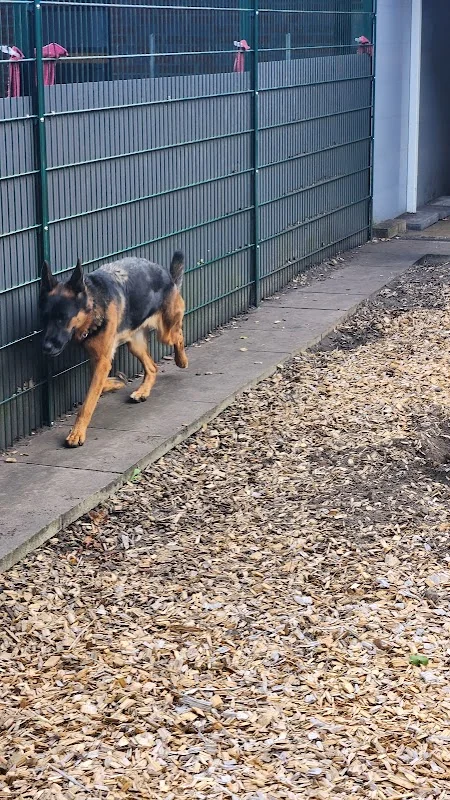
The modern operation of the animal shelter is particularly evident in the dog house. The new dog house was inaugurated in the summer of 2020 after more than two years of construction and replaced part of the old section from 1976. It has 30 rooms accessed by a 2.90-meter-wide central corridor. The rooms measure 2x2 or 2x4 meters depending on the unit and provide space for two to four dogs; some areas are additionally equipped with underfloor heating and cozy sleeping places. For exercise, there are 16 outdoor areas of approximately 40 square meters each, designed with trees, wood chips, and green spaces. In addition, there are two smaller group houses with about 200 square meters of run each, where dogs can learn social communication again. Dog trainers observe the animals and work specifically with them. Thus, the house combines comfort, structure, and training at a level not found everywhere in an animal shelter. ([tierheim-bielefeld.de](https://www.tierheim-bielefeld.de/das-tierheim/unser-gelande-und-die-tierhauser/hundehaus/))
On the dog page, the association publishes individual placement profiles with age, behavior, compatibility, and notes for a suitable home. This is important because the animals in the shelter have very different backgrounds: some are young and need training, while others are old, sensitive, or have health issues. The website also makes it clear that interested parties for dogs should contact the dog house directly; current profiles often include an email address. Therefore, those who want to adopt a dog should not only decide based on sympathy but also consider their living situation, time budget, experience, and the needs of the respective animal. This is where the added value of the house lies: it is not just a waiting room, but a place where dogs are stabilized, observed, and gently prepared for the next step. ([tierheim-bielefeld.de](https://www.tierheim-bielefeld.de/tiere/hunde/))
Cat House, Small Animal House, and Placement Assistance
The cat house is named Erna Kaguss House and was inaugurated in 2009 after the old house became too small due to the steadily increasing number of needy cats. The ground floor features running rooms and larger rooms with individual boxes for adoptable cats, as well as a food kitchen, storage, and workspace. The quarantine station is located on the upper floor, which visitors cannot enter; new cats are initially examined, dewormed, flea-treated, and vaccinated there before moving to group rooms or individual boxes. Two separate hospital wards and a treatment room complement the concept. The official website points out that the cat house is often overcrowded despite its size because every available space is immediately filled by an emergency. This highlights the high pressure of cat protection in Bielefeld. ([tierheim-bielefeld.de](https://www.tierheim-bielefeld.de/das-tierheim/unser-gelande-und-die-tierhauser/katzenhaus/))
In the cat area, the association is not only looking for classic adoption homes but also farms, riding stables, and rural accommodations for groups of cats that cannot be placed in apartment settings. According to the website, 3 to 4 cats are currently waiting for a suitable farm; they must move at least in pairs or small groups and need a secure room or barn for acclimatization, where they can initially be confined. In parallel, there is the small animal house, which was converted from the old cat house starting in 2009 and took in its first residents in October 2010. There, rabbits, guinea pigs, hamsters, degus, rats, fancy mice, chinchillas, birds, and other small animals live in spacious individual or large boxes with feeding troughs, perches, and retreat options. The small animal house has largely been created by volunteers and staff. Therefore, those looking for sustainable placements will find several levels here: direct placements, farm placements, and specialized accommodations. ([tierheim-bielefeld.de](https://www.tierheim-bielefeld.de/tiere/katzen/))
City Pigeons, Wild Birds, and Stray Cats
The animal welfare projects of the association show that the commitment goes well beyond dogs and cats. The history of the pigeon and chicken house dates back to the 1970s: Initially, in 1979, an old construction trailer from the municipal utilities was converted into a pigeon trailer, and in 1991 the animals moved into a new house on the dog meadow. Today, a maximum of 60 pigeons can be accommodated there, usually 40 to 50 animals live there, making the house almost fully occupied throughout the year. On the project page for city pigeons, the association also explains that it operated a pigeon loft in downtown Bielefeld for years to regulate the population in an animal welfare-compliant manner; this project was discontinued by the city in 2025. For people searching for the keyword pigeons, this is important information: Bielefeld's animal welfare work is also city and population management, not just placement. ([tierheim-bielefeld.de](https://www.tierheim-bielefeld.de/das-tierheim/unser-gelande-und-die-tierhauser/tauben-huhnerhaus/))
Since 2018, the animal shelter has also operated a wild bird station. There, injured, sick, or orphaned wild birds and city pigeons are taken in year-round, cared for professionally, and prepared for their return to freedom. The association even refers for further insights to its own external information page and the social media channels of the station. Additionally, the animal shelter works on the stray cat project with neutering, medical care, and subsequent release. The page emphasizes that this not only prevents overpopulation but also protects prey animals such as birds, amphibians, and small mammals. The association also points out that there has been a neutering mandate for free-roaming cats in Bielefeld for several years. Therefore, those searching for “animal protection association Bielefeld pigeons” or “animal protection association Bielefeld cats” will find not only individual animal profiles but a whole system of prevention, care, and return to natural or animal-friendly habitats. ([tierheim-bielefeld.de](https://www.tierheim-bielefeld.de/tierschutzprojekte/wildvogelstation/))
History, Grounds, Photos, Board, and Mourning
The history of the association began in 1952 with a small group of animal lovers who founded the Animal Protection Association Bielefeld and Surroundings. In 1976, after a contract with the city of Bielefeld, the current animal shelter was built; in 1994, a hereditary lease agreement was added, and in 1996 a residential building for the night service was completed. The association's page describes how the grounds have developed over decades under difficult financial and structural conditions, even after storms and severe weather that repeatedly required repairs. Today, the website speaks of several specialized houses on a spacious site: reception, dog house, cat house, small animal house, wild bird station, as well as pigeon and chicken house form a dense, collaborative system. The gallery on the website also shows that the association has been publicly present for many years; there are albums from an open house day, Easter bazaars, Advent bazaars, and a recording for “Animals Looking for a Home.” This also provides a sensible answer to the search interest for photos. ([tierheim-bielefeld.de](https://www.tierheim-bielefeld.de/das-tierheim/unser-gelande-und-die-tierhauser/geschichte/))
The imprint and the statutes make the association's structure transparent: N.N. is named as the chairman, Sascha Grumbach as the 1st deputy chairman, Frank Österwinter as the 2nd deputy chairman, Jens Pohlmann as treasurer, and Jessica Schiebel as deputy treasurer; the statutes also state that board positions are generally held on a voluntary basis. On the homepage, the association published an obituary for the long-serving 1st chairman Helmut Tiekötter on 04.09.2025 and wrote in March 2026 that they are now working with confidence on the future of the association. For search queries such as “death” or “mourning,” this is the factual and respectful classification: the association documents the loss of a formative personality but simultaneously shows that the work continues. Thus, the image of an organization emerges that not only cares for animals but also makes responsibility, history, and continuity visible. ([tierheim-bielefeld.de](https://www.tierheim-bielefeld.de/service/impressum/))
For the search intent of users, the clear navigation logic of the website is particularly helpful. The homepage already shows the most important paths: Home, The Animal Shelter, Animals, Help, Animal Welfare Projects, and Contact/Opening Hours. There are also subpages for dogs, cats, rabbits & guinea pigs, ornamental birds, other small animals, and placement assistance. Therefore, those searching for common autocomplete terms such as opening hours, phone number, photos, dogs, cats, or board will find not only an address but an organized information system with fixed animal areas, project pages, news, and a gallery. This is exactly what makes the presence in the local search environment so strong: it provides a direct answer to the specific search intent and at the same time enough depth for people who are seriously interested in the association, the animals, or working there. ([tierheim-bielefeld.de](https://www.tierheim-bielefeld.de/))
Support options are also clearly divided: donations via bank transfer, PayPal, or through the donation portal, as well as an Amazon wish list for in-kind donations. The homepage also mentions dates such as the annual general meeting on 12.06.2026, the anniversary celebration of 50 years of Bielefeld Animal Shelter on 11.-12.07.2026, and the Advent festival on 28.11.2026. This is important for local SEO because the association is perceived not only as a contact point for animals but also as an active meeting place. Therefore, those searching for photos, events, or donations receive a current, credible, and action-oriented entry. ([tierheim-bielefeld.de](https://www.tierheim-bielefeld.de/))
Sources:
Show moreShow less
Animal Protection Association Bielefeld & Surroundings e.V. | Cats & Dogs
The Bielefeld Animal Shelter is the central contact point of the Animal Protection Association Bielefeld & Surroundings e.V. at Kampstraße 132 in Bielefeld-Sennestadt. The association describes itself on its own website as non-profit and states that its core mission is the promotion of animal welfare; lost, surrendered, and confiscated animals are taken in, cared for, and, if possible, placed for adoption. Visitors can find not only contact information and opening hours on the site but also dedicated areas for dogs, cats, rabbits and guinea pigs, ornamental birds, other small animals, as well as several animal welfare projects. This makes the location much more than a classic animal shelter: it is also a care facility, placement center, advisory address, and project site for city pigeons, wild birds, and stray cats. ([tierheim-bielefeld.de](https://www.tierheim-bielefeld.de/))
Opening Hours, Contact, and Visits
The official contact page lists the phone number 05205/9843-0, the fax number 05205/9843-18, and the email info@tierheim-bielefeld.de. For visitors, the opening hours are clearly defined: closed from Monday to Wednesday, open from Thursday to Saturday from 3:00 PM to 5:00 PM, and also closed on Sundays and public holidays. In parallel, there are phone hours from Monday to Friday from 10:30 AM to 1:00 PM and 3:00 PM to 5:00 PM, as well as Saturdays from 3:00 PM to 5:00 PM. For urgent cases and found animals, the website refers to the emergency number on the voicemail. Therefore, those who want to get information at short notice should keep the phone hours in mind instead of just adhering to the visiting hours. This is important because the contact page explicitly distinguishes between public hours and phone availability. ([tierheim-bielefeld.de](https://www.tierheim-bielefeld.de/kontakt/))
Additionally, the association closed the freely accessible dog walking area at the beginning of 2026 to avoid stress reactions in the animals and now offers guided tours instead. Those who want to meet dogs must register their interest with the number of people and desired date by email to Hundehaus@tierheim-bielefeld.de at least one day in advance. This clearly shows how much the association cares about the well-being of the animals: the focus is not on a quick influx of visitors, but rather on a calm setting for encounters, information, and placement. At the same time, the website makes it clear that the animal shelter wants to be understood as an open place where insights remain possible, but in a controlled and animal welfare-compliant manner. ([tierheim-bielefeld.de](https://www.tierheim-bielefeld.de/))
Dog House and Dog Placement
The modern operation of the animal shelter is particularly evident in the dog house. The new dog house was inaugurated in the summer of 2020 after more than two years of construction and replaced part of the old section from 1976. It has 30 rooms accessed by a 2.90-meter-wide central corridor. The rooms measure 2x2 or 2x4 meters depending on the unit and provide space for two to four dogs; some areas are additionally equipped with underfloor heating and cozy sleeping places. For exercise, there are 16 outdoor areas of approximately 40 square meters each, designed with trees, wood chips, and green spaces. In addition, there are two smaller group houses with about 200 square meters of run each, where dogs can learn social communication again. Dog trainers observe the animals and work specifically with them. Thus, the house combines comfort, structure, and training at a level not found everywhere in an animal shelter. ([tierheim-bielefeld.de](https://www.tierheim-bielefeld.de/das-tierheim/unser-gelande-und-die-tierhauser/hundehaus/))
On the dog page, the association publishes individual placement profiles with age, behavior, compatibility, and notes for a suitable home. This is important because the animals in the shelter have very different backgrounds: some are young and need training, while others are old, sensitive, or have health issues. The website also makes it clear that interested parties for dogs should contact the dog house directly; current profiles often include an email address. Therefore, those who want to adopt a dog should not only decide based on sympathy but also consider their living situation, time budget, experience, and the needs of the respective animal. This is where the added value of the house lies: it is not just a waiting room, but a place where dogs are stabilized, observed, and gently prepared for the next step. ([tierheim-bielefeld.de](https://www.tierheim-bielefeld.de/tiere/hunde/))
Cat House, Small Animal House, and Placement Assistance
The cat house is named Erna Kaguss House and was inaugurated in 2009 after the old house became too small due to the steadily increasing number of needy cats. The ground floor features running rooms and larger rooms with individual boxes for adoptable cats, as well as a food kitchen, storage, and workspace. The quarantine station is located on the upper floor, which visitors cannot enter; new cats are initially examined, dewormed, flea-treated, and vaccinated there before moving to group rooms or individual boxes. Two separate hospital wards and a treatment room complement the concept. The official website points out that the cat house is often overcrowded despite its size because every available space is immediately filled by an emergency. This highlights the high pressure of cat protection in Bielefeld. ([tierheim-bielefeld.de](https://www.tierheim-bielefeld.de/das-tierheim/unser-gelande-und-die-tierhauser/katzenhaus/))
In the cat area, the association is not only looking for classic adoption homes but also farms, riding stables, and rural accommodations for groups of cats that cannot be placed in apartment settings. According to the website, 3 to 4 cats are currently waiting for a suitable farm; they must move at least in pairs or small groups and need a secure room or barn for acclimatization, where they can initially be confined. In parallel, there is the small animal house, which was converted from the old cat house starting in 2009 and took in its first residents in October 2010. There, rabbits, guinea pigs, hamsters, degus, rats, fancy mice, chinchillas, birds, and other small animals live in spacious individual or large boxes with feeding troughs, perches, and retreat options. The small animal house has largely been created by volunteers and staff. Therefore, those looking for sustainable placements will find several levels here: direct placements, farm placements, and specialized accommodations. ([tierheim-bielefeld.de](https://www.tierheim-bielefeld.de/tiere/katzen/))
City Pigeons, Wild Birds, and Stray Cats
The animal welfare projects of the association show that the commitment goes well beyond dogs and cats. The history of the pigeon and chicken house dates back to the 1970s: Initially, in 1979, an old construction trailer from the municipal utilities was converted into a pigeon trailer, and in 1991 the animals moved into a new house on the dog meadow. Today, a maximum of 60 pigeons can be accommodated there, usually 40 to 50 animals live there, making the house almost fully occupied throughout the year. On the project page for city pigeons, the association also explains that it operated a pigeon loft in downtown Bielefeld for years to regulate the population in an animal welfare-compliant manner; this project was discontinued by the city in 2025. For people searching for the keyword pigeons, this is important information: Bielefeld's animal welfare work is also city and population management, not just placement. ([tierheim-bielefeld.de](https://www.tierheim-bielefeld.de/das-tierheim/unser-gelande-und-die-tierhauser/tauben-huhnerhaus/))
Since 2018, the animal shelter has also operated a wild bird station. There, injured, sick, or orphaned wild birds and city pigeons are taken in year-round, cared for professionally, and prepared for their return to freedom. The association even refers for further insights to its own external information page and the social media channels of the station. Additionally, the animal shelter works on the stray cat project with neutering, medical care, and subsequent release. The page emphasizes that this not only prevents overpopulation but also protects prey animals such as birds, amphibians, and small mammals. The association also points out that there has been a neutering mandate for free-roaming cats in Bielefeld for several years. Therefore, those searching for “animal protection association Bielefeld pigeons” or “animal protection association Bielefeld cats” will find not only individual animal profiles but a whole system of prevention, care, and return to natural or animal-friendly habitats. ([tierheim-bielefeld.de](https://www.tierheim-bielefeld.de/tierschutzprojekte/wildvogelstation/))
History, Grounds, Photos, Board, and Mourning
The history of the association began in 1952 with a small group of animal lovers who founded the Animal Protection Association Bielefeld and Surroundings. In 1976, after a contract with the city of Bielefeld, the current animal shelter was built; in 1994, a hereditary lease agreement was added, and in 1996 a residential building for the night service was completed. The association's page describes how the grounds have developed over decades under difficult financial and structural conditions, even after storms and severe weather that repeatedly required repairs. Today, the website speaks of several specialized houses on a spacious site: reception, dog house, cat house, small animal house, wild bird station, as well as pigeon and chicken house form a dense, collaborative system. The gallery on the website also shows that the association has been publicly present for many years; there are albums from an open house day, Easter bazaars, Advent bazaars, and a recording for “Animals Looking for a Home.” This also provides a sensible answer to the search interest for photos. ([tierheim-bielefeld.de](https://www.tierheim-bielefeld.de/das-tierheim/unser-gelande-und-die-tierhauser/geschichte/))
The imprint and the statutes make the association's structure transparent: N.N. is named as the chairman, Sascha Grumbach as the 1st deputy chairman, Frank Österwinter as the 2nd deputy chairman, Jens Pohlmann as treasurer, and Jessica Schiebel as deputy treasurer; the statutes also state that board positions are generally held on a voluntary basis. On the homepage, the association published an obituary for the long-serving 1st chairman Helmut Tiekötter on 04.09.2025 and wrote in March 2026 that they are now working with confidence on the future of the association. For search queries such as “death” or “mourning,” this is the factual and respectful classification: the association documents the loss of a formative personality but simultaneously shows that the work continues. Thus, the image of an organization emerges that not only cares for animals but also makes responsibility, history, and continuity visible. ([tierheim-bielefeld.de](https://www.tierheim-bielefeld.de/service/impressum/))
For the search intent of users, the clear navigation logic of the website is particularly helpful. The homepage already shows the most important paths: Home, The Animal Shelter, Animals, Help, Animal Welfare Projects, and Contact/Opening Hours. There are also subpages for dogs, cats, rabbits & guinea pigs, ornamental birds, other small animals, and placement assistance. Therefore, those searching for common autocomplete terms such as opening hours, phone number, photos, dogs, cats, or board will find not only an address but an organized information system with fixed animal areas, project pages, news, and a gallery. This is exactly what makes the presence in the local search environment so strong: it provides a direct answer to the specific search intent and at the same time enough depth for people who are seriously interested in the association, the animals, or working there. ([tierheim-bielefeld.de](https://www.tierheim-bielefeld.de/))
Support options are also clearly divided: donations via bank transfer, PayPal, or through the donation portal, as well as an Amazon wish list for in-kind donations. The homepage also mentions dates such as the annual general meeting on 12.06.2026, the anniversary celebration of 50 years of Bielefeld Animal Shelter on 11.-12.07.2026, and the Advent festival on 28.11.2026. This is important for local SEO because the association is perceived not only as a contact point for animals but also as an active meeting place. Therefore, those searching for photos, events, or donations receive a current, credible, and action-oriented entry. ([tierheim-bielefeld.de](https://www.tierheim-bielefeld.de/))
Sources:
Animal Protection Association Bielefeld & Surroundings e.V. | Cats & Dogs
The Bielefeld Animal Shelter is the central contact point of the Animal Protection Association Bielefeld & Surroundings e.V. at Kampstraße 132 in Bielefeld-Sennestadt. The association describes itself on its own website as non-profit and states that its core mission is the promotion of animal welfare; lost, surrendered, and confiscated animals are taken in, cared for, and, if possible, placed for adoption. Visitors can find not only contact information and opening hours on the site but also dedicated areas for dogs, cats, rabbits and guinea pigs, ornamental birds, other small animals, as well as several animal welfare projects. This makes the location much more than a classic animal shelter: it is also a care facility, placement center, advisory address, and project site for city pigeons, wild birds, and stray cats. ([tierheim-bielefeld.de](https://www.tierheim-bielefeld.de/))
Opening Hours, Contact, and Visits
The official contact page lists the phone number 05205/9843-0, the fax number 05205/9843-18, and the email info@tierheim-bielefeld.de. For visitors, the opening hours are clearly defined: closed from Monday to Wednesday, open from Thursday to Saturday from 3:00 PM to 5:00 PM, and also closed on Sundays and public holidays. In parallel, there are phone hours from Monday to Friday from 10:30 AM to 1:00 PM and 3:00 PM to 5:00 PM, as well as Saturdays from 3:00 PM to 5:00 PM. For urgent cases and found animals, the website refers to the emergency number on the voicemail. Therefore, those who want to get information at short notice should keep the phone hours in mind instead of just adhering to the visiting hours. This is important because the contact page explicitly distinguishes between public hours and phone availability. ([tierheim-bielefeld.de](https://www.tierheim-bielefeld.de/kontakt/))
Additionally, the association closed the freely accessible dog walking area at the beginning of 2026 to avoid stress reactions in the animals and now offers guided tours instead. Those who want to meet dogs must register their interest with the number of people and desired date by email to Hundehaus@tierheim-bielefeld.de at least one day in advance. This clearly shows how much the association cares about the well-being of the animals: the focus is not on a quick influx of visitors, but rather on a calm setting for encounters, information, and placement. At the same time, the website makes it clear that the animal shelter wants to be understood as an open place where insights remain possible, but in a controlled and animal welfare-compliant manner. ([tierheim-bielefeld.de](https://www.tierheim-bielefeld.de/))
Dog House and Dog Placement
The modern operation of the animal shelter is particularly evident in the dog house. The new dog house was inaugurated in the summer of 2020 after more than two years of construction and replaced part of the old section from 1976. It has 30 rooms accessed by a 2.90-meter-wide central corridor. The rooms measure 2x2 or 2x4 meters depending on the unit and provide space for two to four dogs; some areas are additionally equipped with underfloor heating and cozy sleeping places. For exercise, there are 16 outdoor areas of approximately 40 square meters each, designed with trees, wood chips, and green spaces. In addition, there are two smaller group houses with about 200 square meters of run each, where dogs can learn social communication again. Dog trainers observe the animals and work specifically with them. Thus, the house combines comfort, structure, and training at a level not found everywhere in an animal shelter. ([tierheim-bielefeld.de](https://www.tierheim-bielefeld.de/das-tierheim/unser-gelande-und-die-tierhauser/hundehaus/))
On the dog page, the association publishes individual placement profiles with age, behavior, compatibility, and notes for a suitable home. This is important because the animals in the shelter have very different backgrounds: some are young and need training, while others are old, sensitive, or have health issues. The website also makes it clear that interested parties for dogs should contact the dog house directly; current profiles often include an email address. Therefore, those who want to adopt a dog should not only decide based on sympathy but also consider their living situation, time budget, experience, and the needs of the respective animal. This is where the added value of the house lies: it is not just a waiting room, but a place where dogs are stabilized, observed, and gently prepared for the next step. ([tierheim-bielefeld.de](https://www.tierheim-bielefeld.de/tiere/hunde/))
Cat House, Small Animal House, and Placement Assistance
The cat house is named Erna Kaguss House and was inaugurated in 2009 after the old house became too small due to the steadily increasing number of needy cats. The ground floor features running rooms and larger rooms with individual boxes for adoptable cats, as well as a food kitchen, storage, and workspace. The quarantine station is located on the upper floor, which visitors cannot enter; new cats are initially examined, dewormed, flea-treated, and vaccinated there before moving to group rooms or individual boxes. Two separate hospital wards and a treatment room complement the concept. The official website points out that the cat house is often overcrowded despite its size because every available space is immediately filled by an emergency. This highlights the high pressure of cat protection in Bielefeld. ([tierheim-bielefeld.de](https://www.tierheim-bielefeld.de/das-tierheim/unser-gelande-und-die-tierhauser/katzenhaus/))
In the cat area, the association is not only looking for classic adoption homes but also farms, riding stables, and rural accommodations for groups of cats that cannot be placed in apartment settings. According to the website, 3 to 4 cats are currently waiting for a suitable farm; they must move at least in pairs or small groups and need a secure room or barn for acclimatization, where they can initially be confined. In parallel, there is the small animal house, which was converted from the old cat house starting in 2009 and took in its first residents in October 2010. There, rabbits, guinea pigs, hamsters, degus, rats, fancy mice, chinchillas, birds, and other small animals live in spacious individual or large boxes with feeding troughs, perches, and retreat options. The small animal house has largely been created by volunteers and staff. Therefore, those looking for sustainable placements will find several levels here: direct placements, farm placements, and specialized accommodations. ([tierheim-bielefeld.de](https://www.tierheim-bielefeld.de/tiere/katzen/))
City Pigeons, Wild Birds, and Stray Cats
The animal welfare projects of the association show that the commitment goes well beyond dogs and cats. The history of the pigeon and chicken house dates back to the 1970s: Initially, in 1979, an old construction trailer from the municipal utilities was converted into a pigeon trailer, and in 1991 the animals moved into a new house on the dog meadow. Today, a maximum of 60 pigeons can be accommodated there, usually 40 to 50 animals live there, making the house almost fully occupied throughout the year. On the project page for city pigeons, the association also explains that it operated a pigeon loft in downtown Bielefeld for years to regulate the population in an animal welfare-compliant manner; this project was discontinued by the city in 2025. For people searching for the keyword pigeons, this is important information: Bielefeld's animal welfare work is also city and population management, not just placement. ([tierheim-bielefeld.de](https://www.tierheim-bielefeld.de/das-tierheim/unser-gelande-und-die-tierhauser/tauben-huhnerhaus/))
Since 2018, the animal shelter has also operated a wild bird station. There, injured, sick, or orphaned wild birds and city pigeons are taken in year-round, cared for professionally, and prepared for their return to freedom. The association even refers for further insights to its own external information page and the social media channels of the station. Additionally, the animal shelter works on the stray cat project with neutering, medical care, and subsequent release. The page emphasizes that this not only prevents overpopulation but also protects prey animals such as birds, amphibians, and small mammals. The association also points out that there has been a neutering mandate for free-roaming cats in Bielefeld for several years. Therefore, those searching for “animal protection association Bielefeld pigeons” or “animal protection association Bielefeld cats” will find not only individual animal profiles but a whole system of prevention, care, and return to natural or animal-friendly habitats. ([tierheim-bielefeld.de](https://www.tierheim-bielefeld.de/tierschutzprojekte/wildvogelstation/))
History, Grounds, Photos, Board, and Mourning
The history of the association began in 1952 with a small group of animal lovers who founded the Animal Protection Association Bielefeld and Surroundings. In 1976, after a contract with the city of Bielefeld, the current animal shelter was built; in 1994, a hereditary lease agreement was added, and in 1996 a residential building for the night service was completed. The association's page describes how the grounds have developed over decades under difficult financial and structural conditions, even after storms and severe weather that repeatedly required repairs. Today, the website speaks of several specialized houses on a spacious site: reception, dog house, cat house, small animal house, wild bird station, as well as pigeon and chicken house form a dense, collaborative system. The gallery on the website also shows that the association has been publicly present for many years; there are albums from an open house day, Easter bazaars, Advent bazaars, and a recording for “Animals Looking for a Home.” This also provides a sensible answer to the search interest for photos. ([tierheim-bielefeld.de](https://www.tierheim-bielefeld.de/das-tierheim/unser-gelande-und-die-tierhauser/geschichte/))
The imprint and the statutes make the association's structure transparent: N.N. is named as the chairman, Sascha Grumbach as the 1st deputy chairman, Frank Österwinter as the 2nd deputy chairman, Jens Pohlmann as treasurer, and Jessica Schiebel as deputy treasurer; the statutes also state that board positions are generally held on a voluntary basis. On the homepage, the association published an obituary for the long-serving 1st chairman Helmut Tiekötter on 04.09.2025 and wrote in March 2026 that they are now working with confidence on the future of the association. For search queries such as “death” or “mourning,” this is the factual and respectful classification: the association documents the loss of a formative personality but simultaneously shows that the work continues. Thus, the image of an organization emerges that not only cares for animals but also makes responsibility, history, and continuity visible. ([tierheim-bielefeld.de](https://www.tierheim-bielefeld.de/service/impressum/))
For the search intent of users, the clear navigation logic of the website is particularly helpful. The homepage already shows the most important paths: Home, The Animal Shelter, Animals, Help, Animal Welfare Projects, and Contact/Opening Hours. There are also subpages for dogs, cats, rabbits & guinea pigs, ornamental birds, other small animals, and placement assistance. Therefore, those searching for common autocomplete terms such as opening hours, phone number, photos, dogs, cats, or board will find not only an address but an organized information system with fixed animal areas, project pages, news, and a gallery. This is exactly what makes the presence in the local search environment so strong: it provides a direct answer to the specific search intent and at the same time enough depth for people who are seriously interested in the association, the animals, or working there. ([tierheim-bielefeld.de](https://www.tierheim-bielefeld.de/))
Support options are also clearly divided: donations via bank transfer, PayPal, or through the donation portal, as well as an Amazon wish list for in-kind donations. The homepage also mentions dates such as the annual general meeting on 12.06.2026, the anniversary celebration of 50 years of Bielefeld Animal Shelter on 11.-12.07.2026, and the Advent festival on 28.11.2026. This is important for local SEO because the association is perceived not only as a contact point for animals but also as an active meeting place. Therefore, those searching for photos, events, or donations receive a current, credible, and action-oriented entry. ([tierheim-bielefeld.de](https://www.tierheim-bielefeld.de/))
Sources:
Frequently Asked Questions
Reviews
No reviews found