Discover Readings & Book Festivals in Bielefeld
Readings & Book Festivals in Bielefeld: Find Dates, Understand Formats, Plan Evenings
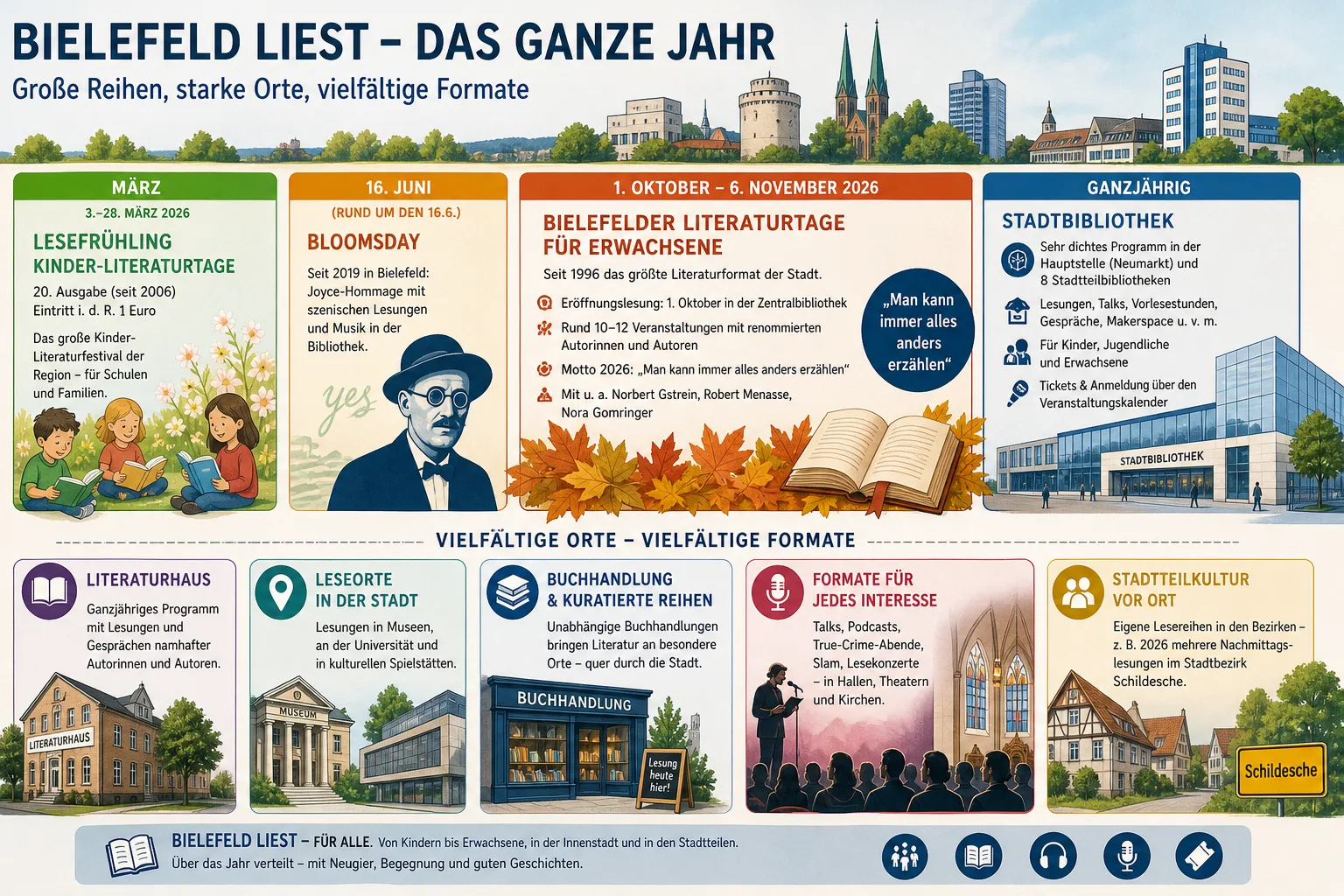
Bielefeld has a vibrant reading scene: from children's programs in the spring to focused literary series in the fall and special formats like Bloomsday, talks, or slams. This overview shows how you can reliably find upcoming events and what to pay attention to when planning, buying tickets, and considering accessibility.
City Library Bielefeld: Calendar, Venues, Formats
A central point of contact for upcoming readings is the City Library Bielefeld. It serves not only as an event venue but also as an information hub: dates, registration modalities, notes on admission or target group, and details about event formats are usually bundled and easy to find there.
What formats are typical in libraries?
- Classic reading (with or without moderation, possibly with signing session)
- Talk / Discussion (e.g., with author, translator, or expert guests)
- Reading aloud for children (often with age indication)
- Workshops (creative writing, media literacy, literary practice)
- Hybrid or digital elements (depending on the date: livestream, recording, or supplementary online content)
Main branch and districts: Why decentralization matters
In addition to the central library, district branches also play a role. For many visitors, this is an advantage: readings thus take place closer to everyday life, travel distances are shorter, and districts get their own cultural meeting points. If you are searching specifically, you should therefore not only check the “big” evenings in the calendar but also smaller dates in the districts.
Literature House, Bookstores & Unusual Venues
The diversity of readings in Bielefeld arises from several players: in addition to municipal institutions, literature initiatives, literature houses, independent cultural venues, and the independent book trade shape the program. Bookstores in particular often organize curated series – sometimes in the store, but often also in external spaces to reach a larger audience or create a special setting.
What you often get at independent series
- Curated focuses (e.g., contemporary literature, political essays, debuts, translations)
- Moderation with context (classification of the book, conversation instead of pure reading passage)
- Changing venues (galleries, museums, university environment, cultural centers – depending on cooperation)
Unusual venues: Church, museum, stage
Readings do not have to be “quiet.” Depending on the organizer, texts can take place in spaces that strongly influence sound and atmosphere: high church naves, foyers, exhibition halls, or stage rooms. This can make a book experienceable in a different way – especially with poetry, performance, or musically framed evenings.
From Bloomsday to Live Podcast: What Formats to Expect
Anyone looking for readings today will usually find more than the classic “author reads from the novel” in Bielefeld. The range is growing because reading habits have changed: many people discover literature through podcasts, social media, stage formats, or themed evenings. Accordingly, new hybrid forms are emerging.
Bloomsday (around June 16): Literature as a city moment
Around June 16, Bloomsday is celebrated in many places as Joyce Day. In Bielefeld, there may also be events during this period that open up literary texts scenically, musically, or dialogically. For the curious, this is a good introduction, as prior knowledge is not necessarily required: moderation, scenes, or music often lead into the text.
Talks, live podcasts, true-crime evenings, slams
- Moderated talks with authors or experts: focus on discussion and classification
- Live podcasts: conversation format with audience atmosphere, often with signing or meet & greet component
- True crime: storytelling and analysis evenings where narration, research, and ethics play a role
- Poetry / science slams: short texts, competitive elements, strong stage energy
If you are looking for a format, pay attention to terms like “talk,” “moderation,” “scenic reading,” “with music,” “slam,” or “live podcast” in the event description – this usually clearly signals what to expect.
Practical Planning: Tickets, Target Groups, Accessibility
This is how you reliably find upcoming dates
- Check the city library calendar: often many dates bundled in one place (including registration links).
- Subscribe to websites & newsletters of literature houses, bookstores, and cultural venues: series are often announced there first.
- Use keywords: “reading,” “literature days,” “book premiere,” “poetry slam,” “Bloomsday,” “children's reading” plus “Bielefeld.”
- Book early: For well-known names or small venues, places are sometimes quickly sold out.
Ticketing & admission: what to watch out for?
- Registration required: Some dates are free, but require reservation (limited seats).
- Target group & time: Morning dates are often for school classes; family formats are more likely in the afternoon.
- Discount: There are often reduced prices (e.g., for pupils/students) – details are usually in the event description.
Accessibility & getting there
If accessibility is important to you (e.g., step-free access, hearing system, need for a seat), check the information in the respective event. Many organizers provide information about this in the event text or on a service page. If unclear, a short contact before buying a ticket is worthwhile.
Note: This article is an editorial overview for orientation and does not replace official event announcements. The information provided by the respective organizers is always binding (program changes possible).
Sources
- City Library Bielefeld (official website) — Event calendar & program information (accessed 2026-11-04)
- City of Bielefeld (official website) — Cultural and event information (accessed 2026-11-04)
- Bloomsday (background) — Term and date classification (accessed 2026-11-04)