Events of the Local Scene & Influencer Meetups in Bielefeld
Events of the Local Scene & Influencer Meetups in Bielefeld: A Plan for Upcoming Meetups (from Fall 2026)
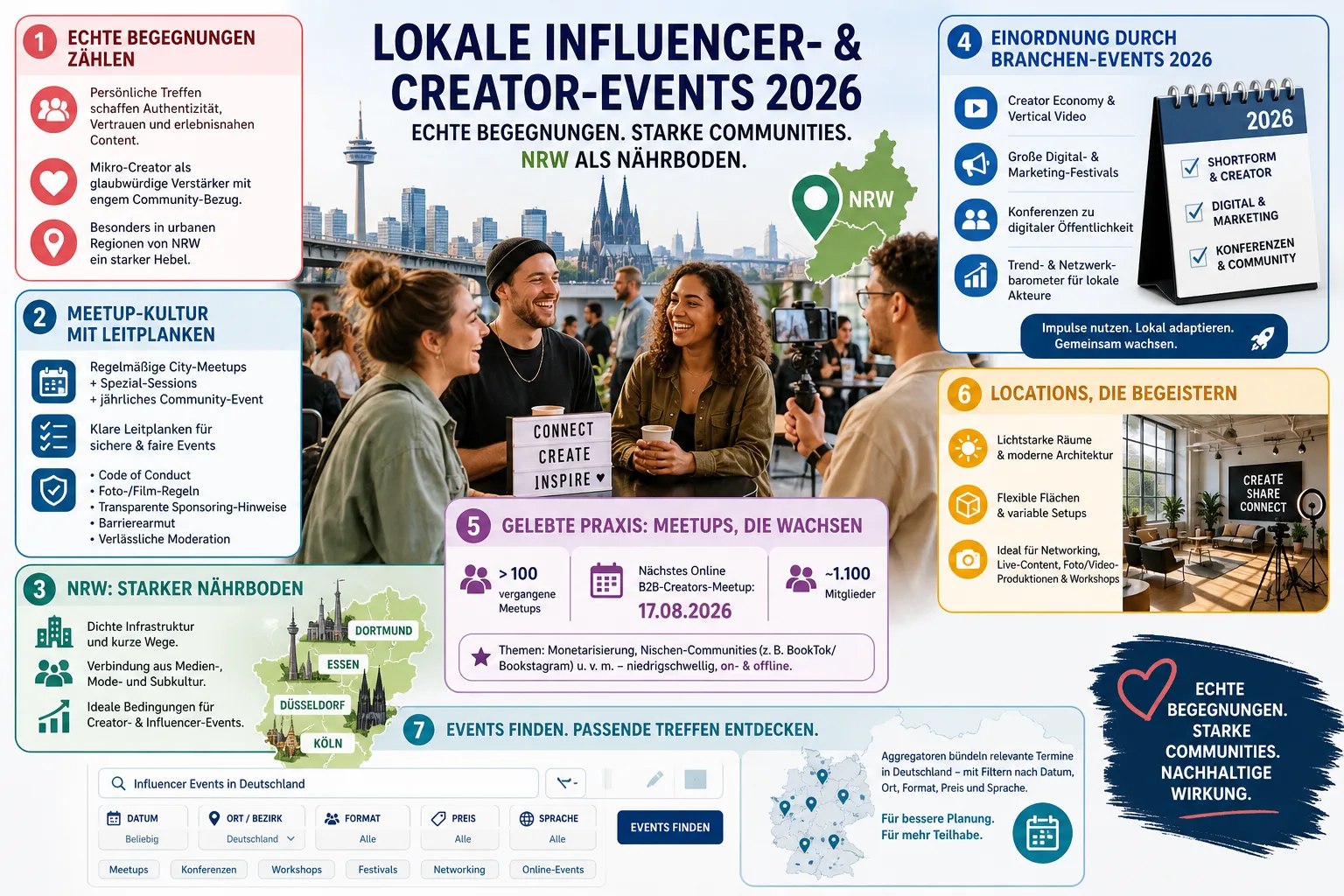
This guide shows how Bielefeld can build a reliable creator and influencer meetup culture in the coming months and years: with recurring formats, clear guardrails (transparency, labeling, data protection, accessibility), and suitable locations.
Modular Kit for Recurring Meetups in Bielefeld
1) Monthly City Meetups (Low-Threshold & Reliable)
City meetups are the foundation: every month the same weekday, same time, clear duration (e.g., 18:30–21:00). The goal is not perfection, but planning reliability.
- Format: Arrival (15 min), 20-min impulse, 60–90 min exchange, optional “Show & Tell” (3 slots of 3 min each).
- Target group: Nano and micro creators, local bloggers, podcasters, photographers, club and cultural communication, social media managers.
- Output: 1 joint topic per evening (e.g., “Bielefeld in 5 Hooks”) and a voluntary mini-task (e.g., a shared story template).
2) Quarterly Special Sessions (Skill Building & Co-Creation)
Every three months, a deep-dive format complements the city meetup. This creates learning curves and ensures that both beginners and advanced participants benefit equally.
- Photo Walk “City Stories”: 90-minute route, 30-minute joint edit, then optional carousel/reel upload (with clear photo rules).
- Podcast Session: Short workshop on setup & legal basics, then live recording in small groups.
- Edit Sprint for Shortform: 2 hours of focused editing, ending with exchange on hook, caption, subtitles.
- Storytelling Workshop: How to tell local topics so they work outside NRW as well (without clickbait).
3) Annual Community Main Event (Visibility for Bielefeld)
Once a year, a larger event can bring the scene together: with panels, mini-workshops, and open slots for local projects. To prevent it from becoming “too big, too fast,” the main event should build on the experiences of the monthly meetups.
- Program: Panels (culture/economy/creator), workshop tracks, “Open Mic” for projects, co-creation stations.
- Quality principle: Short slots, clear moderation, visible transparency in sponsorship and cooperation.
- Community benefit: Integrate new faces, strengthen local talents, enable cooperation between the scene & SMEs.
Example: Program & Calendar Plan (Sep 2026–Jun 2027)
The following calendar is a concrete proposal for a future series. It is deliberately designed to be testable without stress: first regularity, then specialization, then a larger annual format.
Monthly City Meetups (each Thursday, 18:30–21:00)
- 10.09.2026: Kickoff “Bielefeld in 3 Formats: Reel, Carousel, Story”
- 08.10.2026: “Content Without Overload: Editorial Plan for 30 Days”
- 12.11.2026: “Collaborations Locally: From the DM to the Joint Post”
- 10.12.2026: “Year in Review & Outlook: Topics That Will Carry 2027”
- 14.01.2027: “Camera & Light: Quickly Better Results Without New Equipment”
- 11.02.2027: “Community Management: Comments, DMs, Boundaries”
- 11.03.2027: “Local SEO & Social: How Posts Get Found”
- 08.04.2027: “Labeling & Trust: Communicating Advertising Cleanly”
- 13.05.2027: “Hooks, Subtitles, Retention: Shortform Fine-Tuning”
- 10.06.2027: “Half-Year Showcase: Best Practices from Bielefeld”
Quarterly Special Sessions (Saturday, 11:00–15:00)
- 26.09.2026: Photo Walk “City Center & Contrasts” + joint edit
- 23.01.2027: Edit Sprint “Reels/Shorts in 120 Minutes”
- 17.04.2027: Workshop “Local Storytelling: Good Stories Without Clichés”
- 19.06.2027: Podcast Session “Record Live, Publish Cleanly”
So that the dates are perceived as “reliable,” every invitation should contain the same core information: date, time, duration, goal, participation conditions (incl. photo rules), contact person, accessibility notes, and information on labeling cooperations.
Secure Guardrails: Code of Conduct, Photo Rules, Labeling
Creator events only work in the long term if they are safe and predictable for different people. For future meetups in Bielefeld, three areas of rules have proven effective:
1) Code of Conduct (Short, Visible, Enforceable)
- Respectful interaction, no discrimination or harassment.
- Clear consequences for boundary violations (e.g., conversation, warning, exclusion).
- A designated contact person during the event.
2) Photo and Film Rules (Consent & Transparency)
Since filming often takes place at creator meetups, the rules should be clear in advance and on site:
- Opt-in instead of opt-out: Anyone visibly in the picture must consent.
- Clear notice at the entrance: Whether and for what recordings are being made (e.g., social posts, recap video).
- Consideration zones: Area(s) where filming is not allowed.
3) Labeling of Advertising & Sponsorship
As soon as companies contribute drinks, rooms, technology, or program items, this should be communicated transparently. For German social media practice, the labeling principles of the media authorities and the requirements of fair competition law are particularly relevant.
- Clearly name sponsor logos/benefits in the event post.
- Mark speaker slots from partners as “Partner Session.”
- Mark giveaways as “sponsored” or “advertising” if a commercial purpose is present.
Accessibility as a Quality Feature
For upcoming events, it is also worthwhile to consider accessibility as a standard: easily readable invitations, clear directions, information on steps/toilets, understandable agenda, retreat options, and accessible organizer contacts. This increases participation and trust—and reduces misunderstandings.
Location Criteria for Creator Events in Bielefeld
The location determines whether a meetup is experienced as pleasant, productive, and “content-friendly.” For future formats in Bielefeld, these criteria are particularly helpful:
- Light: Daylight or adjustable, flicker-free artificial light (important for video).
- Acoustics: No harsh echo situation; simple microphone solution for talks.
- Wi-Fi & Power: Stable access and enough sockets/power strips.
- Flexible zoning: Area for input, area for networking, corner for quiet work (editing/notes).
- Accessibility: Good public transport connections within Bielefeld and clear instructions for arrivals from the surrounding area.
- Accessibility notes: Transparent information (access, elevator, toilets) already in the invitation.
A good standard for the series is a place that can be “recognized again.” This creates ritual: the community knows where to go, and new participants find it easier to connect.
Networking in NRW: Cooperations Without Big City Bias
Bielefeld can strengthen its creator community without “leaning” on Cologne or Düsseldorf. A cooperative attitude makes sense: invite impulses and guests from NRW, but consistently think content locally.
- Speaker exchange: A local Bielefeld format invites a person from another NRW city—in return, Bielefeld provides a talent for their meetup.
- Topic partnerships: Joint sessions on labeling, accessibility, community moderation, production workflows.
- Calendar logic: Schedule dates so they do not collide with major supraregional industry conferences (plan in advance, clear communication).
This way, the series in Bielefeld remains independent but benefits from fresh perspectives and reliable contacts in NRW.
Organization: Checklist for the Next Dates
This checklist helps to implement the upcoming meetups in a structured way, without over-engineering:
- Event page with recurring pattern (agenda, participation, rules, accessibility notes, contact).
- Code of Conduct as a short, highly visible version (online + on site).
- Photo/film concept: Opt-in, notice at the entrance, consideration zones, clear recap rules.
- Sponsorship transparency: Disclose partner contributions and commercial purposes; clearly label posts.
- Moderation: One person for the schedule, one for onboarding new guests.
- Feedback loop: Short, anonymous form after each event (questions on safety, process, benefit).
- Documentation: A short publicly shareable recap (topics, learnings, next date) without involuntary close-ups.