Arts and Crafts Markets in Bielefeld – Creative & Handmade
Arts and Crafts Markets & Design Markets in Bielefeld (Outlook from Late Summer 2026)
If you want to experience Bielefeld beyond shopping streets, you will find exactly what makes a city approachable at arts and crafts and design markets: direct conversations with makers, materials to touch, and unique pieces with a story. This guide compiles the most important recurring market formats in Bielefeld – with a focus on upcoming dates from the end of August 2026 and practical tips for planning.
Note on scheduling: Many events only publish specific dates a few weeks or months in advance. The time windows mentioned below are based on the usual season (e.g., September/November). Please always check the official event website before traveling.
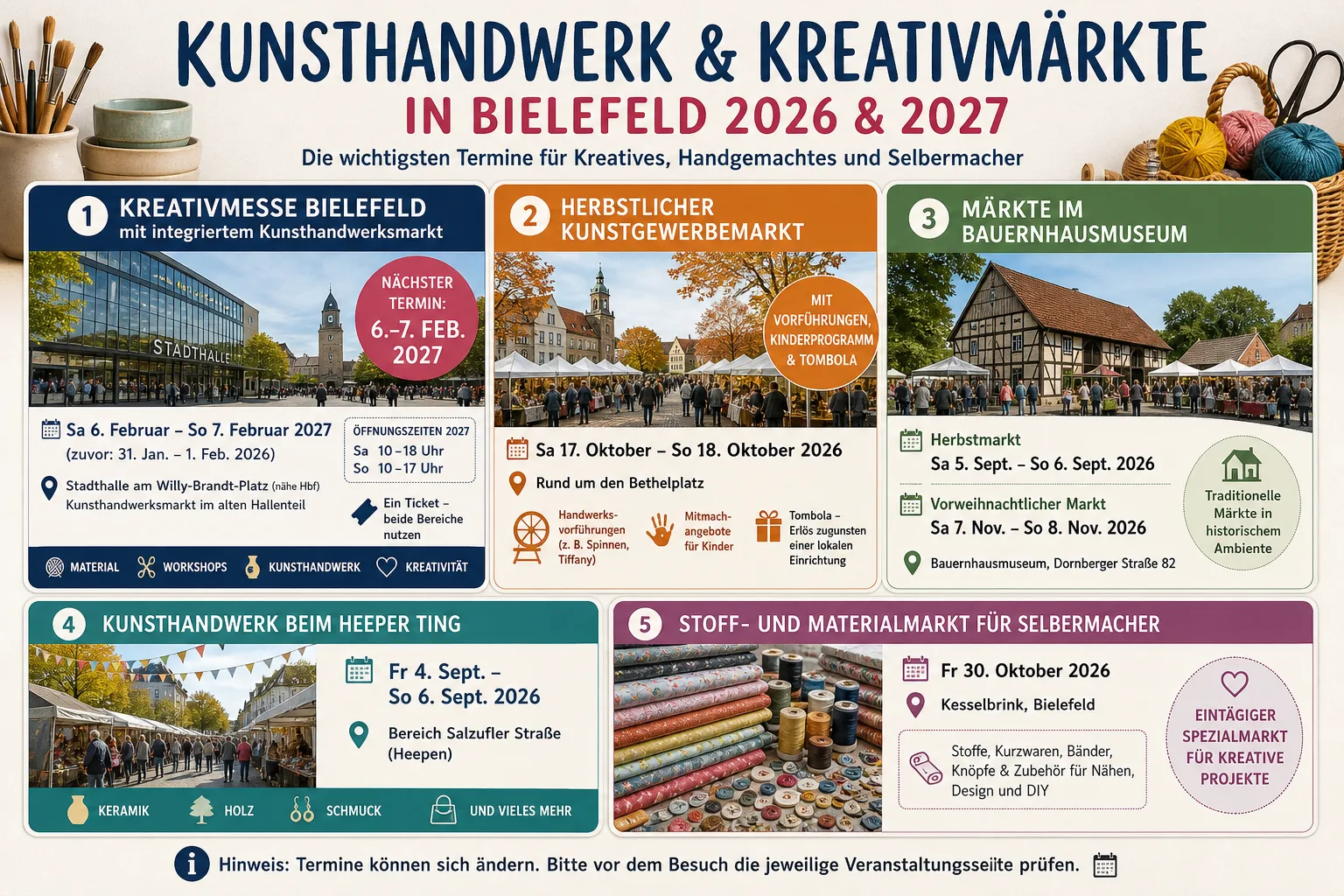
Stadthalle Bielefeld: Creative Fair with Arts and Crafts Section (expected February 2027)
The Stadthalle at Willy-Brandt-Platz (right next to the main train station) is the classic starting point for the creative year: Here, DIY, handicrafts, material stands and an area with finished handmade products are usually bundled together. For visitors, this is practical because you can combine searching for inspiration and shopping (materials + unique pieces) in one place.
What you typically find there
- Material & Tools: Fabrics, yarns, haberdashery, accessories, tools
- Finished unique pieces: Ceramics, jewelry, leather goods, wood and metal works, stationery
- Workshops & demonstrations: depending on the program (registration/time slots often required)
Planning tip: If you are specifically looking for gifts, it is worth heading first to the area with finished products and then buying materials "for later" – this way you prevent your bags and backpack from getting full too early.
Bethelplatz: Autumn Arts and Crafts Market (expected October 2026)
In autumn, many people in Bielefeld turn their attention to Bethelplatz: An arts and crafts market there typically stands for a concentrated range of arts and crafts – often complemented by demonstrations that make craft techniques visible (e.g., textile techniques, woodwork, or glass/jewelry processing, depending on the list of exhibitors).
Why the visit is worthwhile
- Direct contact: You talk to the people who design and make the pieces.
- Good gift season: October is ideal for securing special pieces before the year-end rush.
- Experience the district: The market is a good opportunity to get to know Bethel as a neighborhood.
Accessibility & getting there: At open-air markets, route guidance, curbs, and surfaces are crucial. Check the organizers' notes on the day of the event (e.g., on access, toilets, quiet areas).
Farmhouse Museum: Autumn Market & Pre-Christmas Market (expected September & November 2026)
The Bielefeld Farmhouse Museum offers a special setting: historic buildings and museum grounds create a calm, "handmade" atmosphere in which markets often feel deliberately unhurried. For the season from the end of August 2026, two time windows are particularly interesting:
Autumn Market (expected September 2026)
The autumn market often combines regional products and arts and crafts. You can expect a mix of handmade goods (e.g., textiles, ceramics, basket and woodwork, natural cosmetics – depending on the exhibitors) as well as culinary offerings that match the season.
Pre-Christmas Market (expected November 2026)
If you are looking for an alternative to very crowded city center formats, you will often find a quieter shopping atmosphere in the museum context. The focus is usually on gifts with provenance: small series, unique pieces, and things where material and workmanship take center stage.
Practical: Find out in advance about ticket/admission regulations, site maps, and, if applicable, conditions for bringing things (e.g., dogs, depending on house rules and event regulations).
Heeper Ting: Street Festival with Market Character (expected September 2026)
At Heeper Ting, street festival atmosphere and market stalls come together. For visitors, this means: You get entertainment, gastronomy and a changing selection of handmade products in one place – ideal if you not only want to "shop" but also stroll and discover.
What this format is particularly suitable for
- Spontaneous discoveries: new labels, small manufacturers, first editions
- Feedback directly at the stand: many vendors are open to questions about material, care, customization
- Combined visit: market visit plus program (music/acts) – depending on planning
Planning tip: At festivals with several areas, it is worth taking a quick look at the site map: This way you can find market stalls specifically, even if stage programs and rides are in the foreground.
Kesselbrink: Fabric and Material Market (expected Autumn 2026)
Not every market is about finished products: A fabric and material market at Kesselbrink is aimed primarily at do-it-yourselfers. If you sew, want to quilt, or design textiles, you will typically find a wide range of fabrics, haberdashery, and accessories bundled here.
How to use the material market efficiently
- Bring a project list: measurements, color palette, required quantities (e.g., by the meter)
- Check quality: feel, drape, transparency, stretch directly on site
- Ask about care & origin: washing instructions, material composition, possibly certificates
Throughout the year, this format ideally complements the arts and crafts markets: First inspiration from finished pieces, then sourcing materials for your own projects.
Planning Tips: How to Get the Most Out of Your Market Visit
1) Pre-check (10 minutes that are worth it)
- Date & times: always double-check on the official event website
- Admission/tickets: price, discounts, online ticket yes/no
- Arrival: public transport, parking, bicycle parking; for major events, possible closures
- List of exhibitors: if available, mark 5–10 stands you definitely want to see
2) On site: Questions that lead to better purchases
- What materials is the piece made of (including alloys/allergy information for jewelry)?
- What does care look like (ceramics/glass/metal/textile)?
- Are there customizations (e.g., ring sizes, color variants, personalization) and how long does it take?
- How does repair or spare parts supply work (e.g., clasps, straps, hangers)?
3) Pay fairly & safely
Many stands now offer card payment, but not all. For open-air markets, it is best to bring a combination of card and some cash. Keep receipts for higher-priced items – especially for custom-made products.