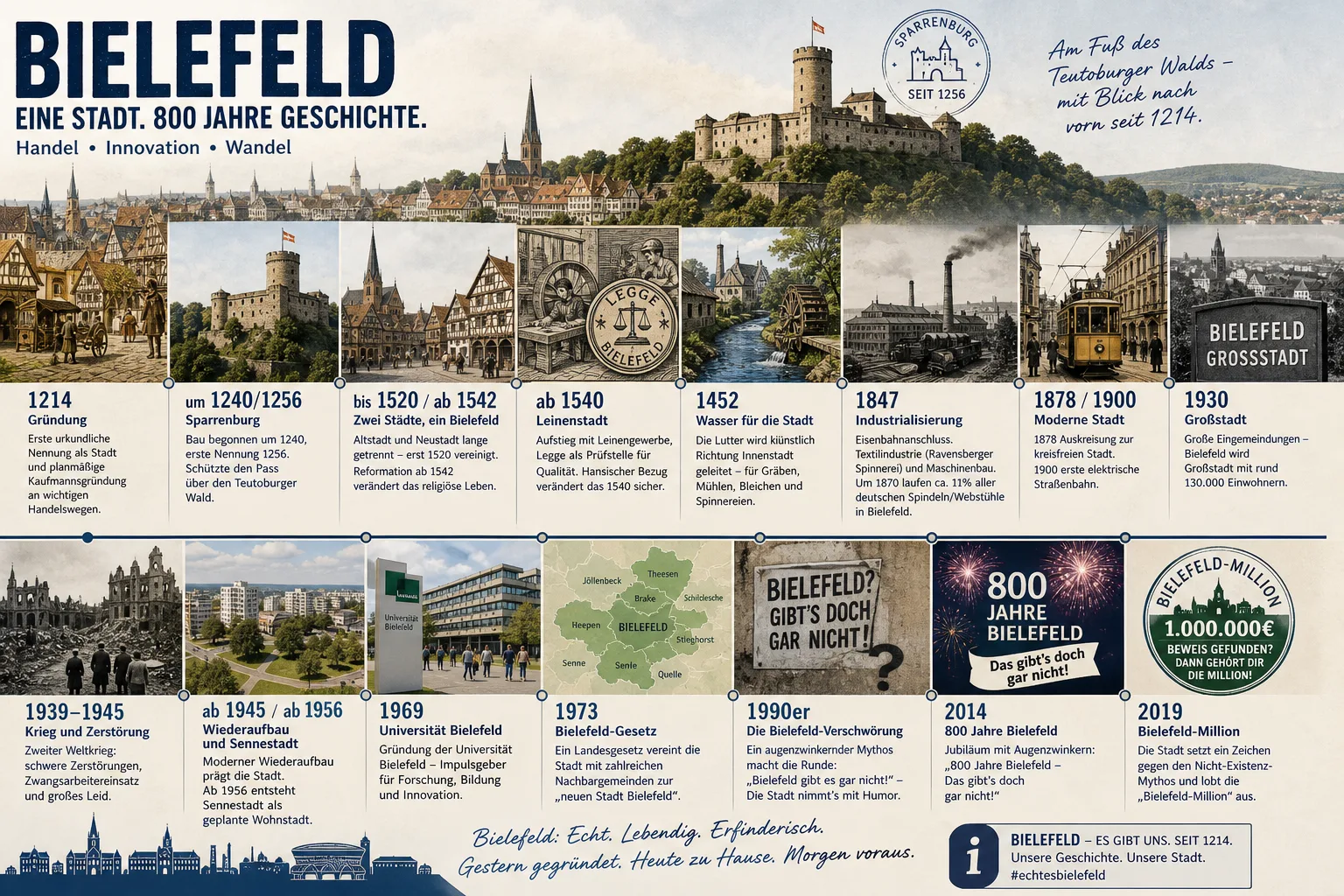
The History of Bielefeld – Short Version
The History of Bielefeld – Planned as a Short and Exciting Future City Walk
Do you want to discover Bielefeld's history not through dates, but as an experience? Then plan your next visit as a route through places where developments, change, and city myths can be particularly well "read": market squares, viewpoints, watercourses, industrial architecture, campus flair, and a wink at the famous "non-existence."
This article is deliberately written as a preview of your upcoming tour: It helps you structure your next city stroll, select suitable stops, and pay targeted attention to details along the way.
How to Plan Your Tour (Duration, Start, Variations)
For your future trip to Bielefeld, two proven approaches work:
- "Short & Central": You mainly stay in the city center and combine market square atmosphere with a viewpoint.
- "Large & Versatile": You additionally include places where you can experience industrial architecture, educational sites, and urban planning on a larger scale.
For your next visit, a centrally located square in the city center is a good starting point, from which you can flexibly shorten or extend the route. If you will be traveling with children or in a group, plan more time for breaks, viewpoints, and photo stops.
Route 1: Short & Central (approx. 60–120 minutes)
Stop 1: Alter Markt – Your Entry into the City’s "Narrative Center"
On your next walk, you will especially feel at the Alter Markt how a city "works" when trade, encounters, and pathways converge at a central point. Pay attention to:
- how walkways and sightlines are oriented towards the square,
- how gastronomy, everyday life, and urban space interact,
- which details on facades and square edges remind you of different construction and renovation phases.
If you want to continue your route later, you can easily branch off in different directions from here.
Stop 2: Water in the City – Use the Lutter as a "Guideline" for Your Path
On your upcoming tour, you will notice: Water often shows you in many cities where work, supply, and urban space are particularly closely intertwined. If you include sections along the Lutter in your route in Bielefeld, use it as a game: Follow the watercourse for a while and observe how the surroundings, sounds, and pace of your walk change.
For your photos and notes, it’s worth paying attention to transitions: Where does it get quieter? Where does it become more urban? Where do you see places where water is deliberately "staged"?
Stop 3: Sparrenburg – View as a "Summary"
If you climb up to the Sparrenburg on your next visit, the view over the city will feel like a short chapter finale: You will recognize connections that are easily hidden at ground level—for example, how green slopes, dense neighborhoods, and traffic axes relate to each other.
- Tip for your visit: Plan your ascent so that you have enough time for the panoramic view at the top.
- Observation task: Pick three points in the cityscape that you want to "collect" again down below afterwards (e.g., a distinctive building, a corridor, a green belt).
Route 2: Large & Versatile (Half a Day)
If you plan more time for your next trip, you can combine city center, industrial architecture, education, and urban planning in a single tour. This route is ideal if you want to experience Bielefeld not only as "beautiful" but also as multi-layered.
Stop 1: Brickwork, Large Spaces, New Uses – Consciously Observe Industrial Architecture
On your future visit, you will often discover the same patterns in areas with striking industrial architecture: large window areas, robust materials, clear rhythms, and lots of space. Take your time on site to pay attention to repurposing—that is, how such buildings function today for culture, work, living, or leisure.
- Which elements seem "preserved"?
- What seems "newly added"?
- How does that change your perception of the neighborhood?
Stop 2: University & Campus Atmosphere – Experience Bielefeld as a Place of Knowledge
If you include the university and its surroundings soon, you will experience a completely different city atmosphere than in the old town: more movement, more languages, more encounters between everyday life and research. Plan a section where you simply observe:
- how people use the space (paths, meeting points, places to stay),
- how architecture and orientation feel,
- which offerings (gastronomy, events, notices) you encounter.
This way, your visit will not only be a walk, but also a snapshot of urban future topics: education, innovation, internationality.
Stop 3: Sennestadt – Urban Planning as an Excursion Idea
If you consciously include a district in your next Bielefeld trip that feels "planned," it can sharpen your view of urban development. In Sennestadt, you will probably pay more attention to structure than in the city center: green belts, path guidance, supply points, distances between buildings.
This approach helps for your excursion: Choose a short round in advance (walk or public transport combination), and note three things along the way that you feel "work well"—and three things you would solve differently.
Myth & Modernity: How to Experience the "Bielefeld Narrative" with Humor
On your next visit, you will very likely encounter the well-known running gag that jokingly "questions" Bielefeld's existence. You can use this as an invitation to actively "prove" the city—not with arguments, but with experiences.
- Take a photo at three very different places on your tour (e.g., market square, viewpoint, quiet green area).
- Write down one sentence per place: What feels unique here?
- Later, retell the mini-route—as your personal "Bielefeld story" instead of a joke.
This way, myth does not become an argument, but a playful framework for your future city day.
Practical Tips for Your Next Visit
- Time planning: If you want to enjoy views, breaks, and spontaneous detours, plan generously.
- Weather option: For your next visit, it’s worth having a "short route" as a backup in case rain or heat make you change plans.
- Barrier-free travel: If you will be traveling with a stroller, walker, or wheelchair, choose a route with less incline and make viewpoints optional.
- Memory effect: Take a simple guiding question with you for your walk, e.g., "Where does Bielefeld feel old to me, where new, where both at once?"