Volkshochschule Bielefeld: Courses, Workshops, vhs@home
Volkshochschule, Workshops & Courses in Bielefeld: How to Learn Something New in the Coming Months
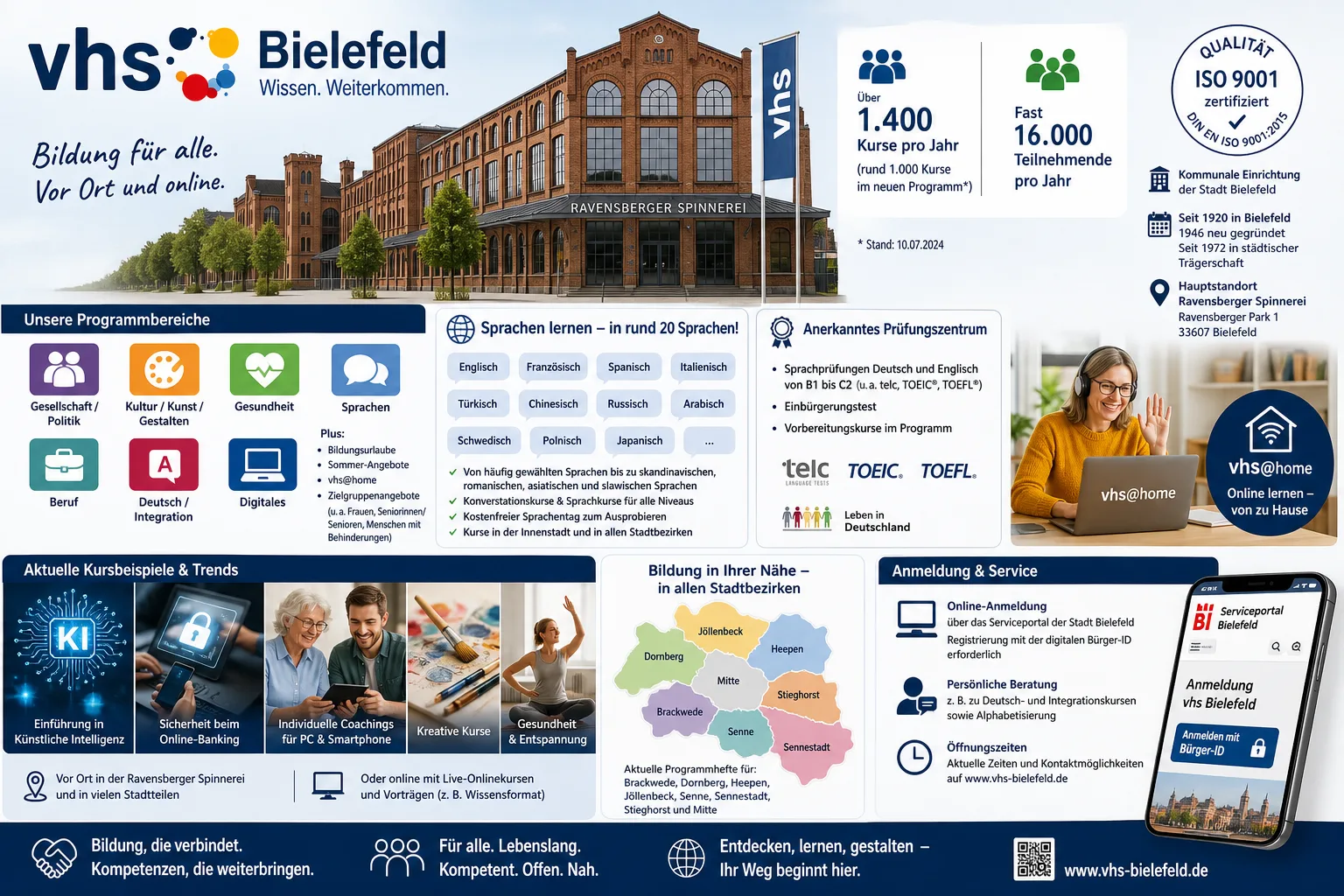
Do you want to try something new soon – start a language, build digital security, become more creative, or develop professionally? In Bielefeld, you can choose from a wide range of courses and workshops in the coming weeks and months: on site (including around Ravensberger Park), in neighborhoods, or live online.
This overview helps you find suitable formats, prepare sensibly, and complete registration smoothly – focusing on offers that will take place in the future.
Why the Volkshochschule (vhs) in Bielefeld is a Sensible Starting Point
The Volkshochschule Bielefeld is a municipal continuing education institution. For you as a participant, this usually means: a public educational offer, transparent course descriptions (content, scope, prerequisites), clearly regulated registration procedures, and reliable organization – whether you are planning a single workshop or want to learn continuously over several months.
Important for course selection: Many vhs offers are designed so that you can start without prior knowledge. For advanced levels (e.g., in languages or software), placement and counseling are common components to help you find a suitable learning pace.
Program Areas That Are Particularly in Demand in the Coming Semesters
Society & Politics: Understanding and Classifying Debates
If you want to engage more with current developments in the coming months, events on democratic participation, media literacy, sustainability, or urban and contemporary history are typical vhs formats. Many dates are planned as lectures, discussion rounds, or compact workshops – ideal if you have little time but are looking for solid input.
Culture, Art & Design: Building a Creative Routine
For anyone who wants to make more room for creativity in the future, drawing, painting, photography, or writing courses are suitable. When choosing, pay attention to the course format (introduction, advanced, workshop), material notes, and whether the course focuses more on technique or supports free projects.
- Beginner-friendly: Basics of perspective, color, image composition, or camera settings
- Practice-oriented: Exercises with feedback, often with small tasks between sessions
- Project-based: Working on a subject or a series over several sessions
Health: Everyday Prevention (Without Promises of Healing)
In the next course rounds, there are often offers on movement, relaxation, and everyday health competence. Such courses can help you establish routines. However, they do not replace individual medical advice or treatment.
Languages: From A1 to Advanced – With Clear Orientation
If you want to start or deepen a language in the foreseeable future, these criteria will help you choose:
- Level: Orientation to CEFR levels (A1–C2) is common; if unsure, a placement is worthwhile.
- Goal: Travel, work, exam preparation, or conversation – depending on the goal, pace and focus differ.
- Format: In-person, live online, or combined (depending on the offer). Check whether the course places strong emphasis on interaction (speaking).
If you are aiming for a recognized exam, check the respective prerequisites, registration deadlines, and the planned exam date early. Details are usually published by the vhs on their website.
Work & Career: Skills for the Next Steps
For the coming period, further training on office applications, project organization, communication, presentation, and application strategies are typical focuses. For your planning, it is crucial:
- Does the course fit your workweek schedule (evening, weekend, compact formats)?
- Are there concrete learning objectives (e.g., "automate tables", "structure presentations")?
- Is a certificate/proof relevant – and is it actually needed?
German & Integration: Course Selection with Counseling and Suitable Certificates
If you want to learn German or prepare for orientation topics in the coming months, a solid placement is especially important. Many programs distinguish between general German courses and integration courses with formal framework conditions. Find out in advance which course type suits your goal (everyday life, work, certificate, exam) and which documents are required for registration.
For legal and organizational basics regarding integration courses and responsibilities, the Federal Office for Migration and Refugees (BAMF) is a central, reliable source of information.
Digital: AI, Security, and Confident Everyday Technology
Digital courses are especially helpful if you set concrete goals for yourself for the next period: safe handling of devices, protection against fraud, or getting started with new tools. Common formats are introductions, practice workshops, and consultation hours.
- Artificial Intelligence (AI): Basics, meaningful use cases, limits and risks in everyday life and work
- IT and Online Security: Recognizing phishing, strong passwords, two-factor authentication, secure updates
- Smartphone/PC Training: Step-by-step exercises, often in small groups
If a course touches on online banking or digital payments, make sure it is about security principles and risk minimization – not about sharing sensitive access data in the course. Serious offers work with general examples and explain protective measures.
Learning Live Online (e.g., vhs@home): What You Should Check Before Starting
If you are planning a live online course in the next few weeks, you can avoid technology becoming a stress factor with a short checklist:
- Device: Laptop or tablet is usually more comfortable than a smartphone; camera and microphone should work.
- Internet: Stable connection (if possible via LAN or good Wi-Fi).
- Environment: A quiet place and headphones help you participate actively.
- Software/Browser: Use an up-to-date browser and, if necessary, install the platform specified by the course in good time.
- Participation: Plan to log in 10 minutes before the course starts to test sound and video.
For you as a learner, it is also important: Live online ideally means interactive. Check in the course description whether questions, exercises, and exchange are planned.
Neighborhood Offers, Compact Formats, and Educational Leave: How to Plan the Next Months
To make continuing education fit into your everyday life, it is worth looking at three types of offers that typically also appear in upcoming programs:
- Decentralized course locations in neighborhoods: Short distances are often crucial if you learn in the evening or coordinate family and appointments.
- Compact courses (weekend/intensive): Useful if you want to complete a topic in a short time.
- Educational leave: If you want to use a recognized course as educational leave, check recognition, period, and your employer's requirements early. The specific rules depend on the federal state and the course.
Registration & Counseling: Finding the Right Course in a Few Steps
To quickly find the right offer in the coming course rounds, it is best to proceed in a structured way:
- Define goal: What should work better after the course (e.g., "B1 conversation", "Excel tables", "stress reduction routine")?
- Check prerequisites: Level, materials, technology, participation requirements.
- Choose format: In-person, neighborhood offer, or live online.
- Use counseling: Especially for languages, German/integration, and professional goals, a short consultation can prevent booking errors.
- Complete registration: Use the official vhs and city portals; read notes on deadlines, fees, and withdrawal carefully.
The Volkshochschule Bielefeld bundles course information, counseling contacts, and current dates on its official website. Many registrations also run via the Bielefeld city service portal.
How to Recognize a Serious Course Offer (Quality & Transparency)
Regardless of the topic, you can usually assess vhs offers in Bielefeld well if these points are clearly stated:
- Concrete learning objectives: What is taught, practiced, and mastered at the end?
- Instructor profile: Professional background, if applicable, focus/methodology
- Framework: Dates, duration, location/online platform, group size (if specified)
- Costs & rules: Fees, discounts (if available), cancellation/withdrawal conditions
- Data protection: For online formats, it should be clear which platform is used and what rules apply
If course information refers to quality management (e.g., ISO standards), this is an additional signal for structured processes. However, what remains decisive is: transparent course details and a comprehensible registration process via official channels.