Further Education in Bielefeld: Kickstart Your Career
Further Education in Bielefeld 2026/2027: Dates, Funding Options, and Next Steps for Mind & Career
Brief overview: Numerous further education courses will start in Bielefeld in 2026/2027 as in-person, hybrid, or online formats. Those who check funding instruments such as education vouchers, advancement BAföG, or state-wide programs can significantly reduce their costs. This guide summarizes which steps make sense in the coming weeks, what to look for in providers, and how to select suitable offers for your goals.
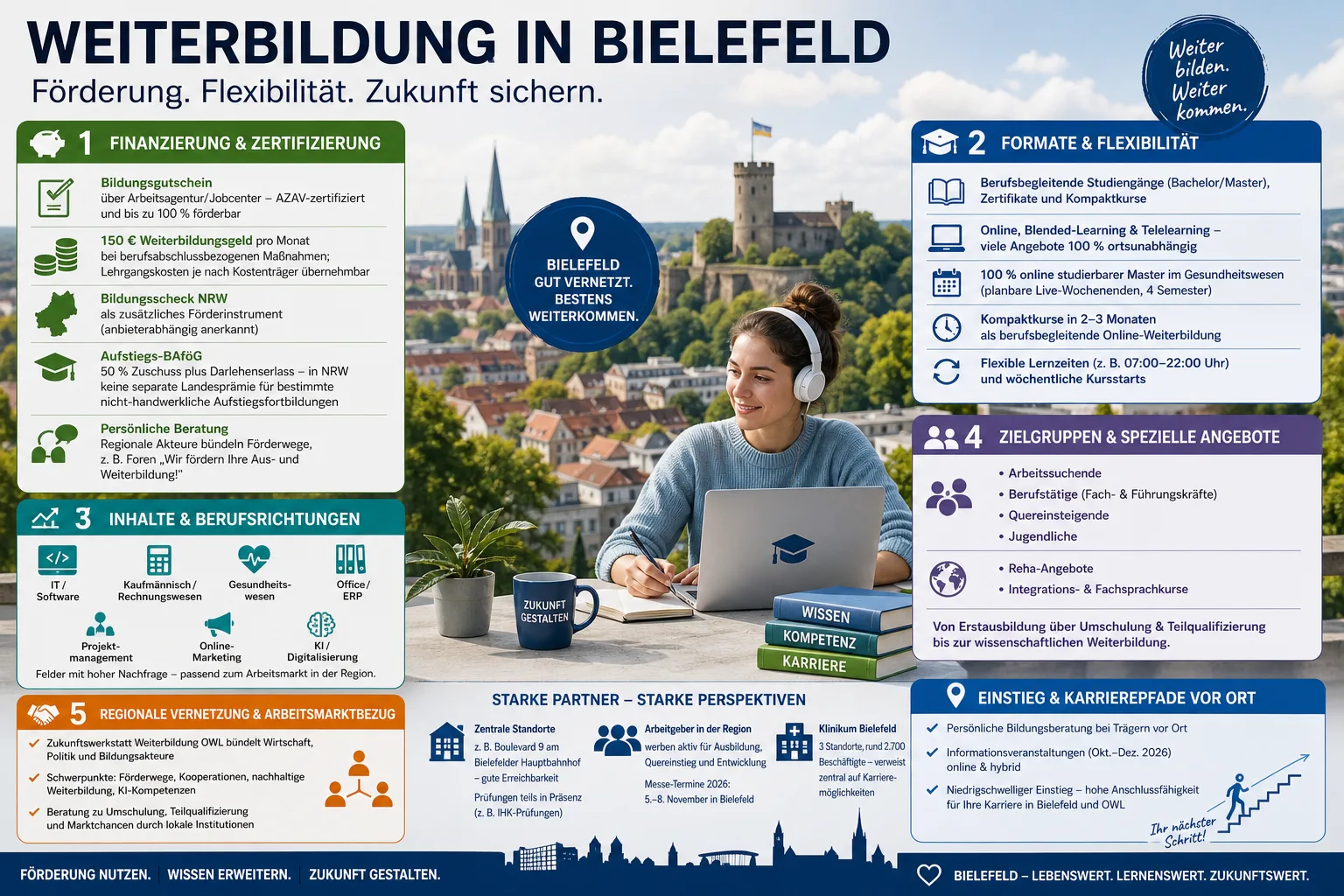
Funding 2026/2027: Education voucher, advancement BAföG & other options
For financing, three main paths will be relevant in 2026/2027: funding via the Employment Agency/Job Center (e.g., education voucher), funding for professional advancement (advancement BAföG), and regional or state-wide programs. Whether and to what extent funding is granted always depends on your personal requirements, the educational goal, and the respective program status.
1) Education voucher (Employment Agency/Job Center) & AZAV
If you are planning a labor market-oriented qualification in 2026/2027 (e.g., retraining, partial qualification, certified further education), an education voucher will be the central lever for many participants. In practice, counseling sessions regularly check whether:
- the measure is suitable for your integration goal,
- a certified provider and a certified measure are available (often regulated via AZAV),
- the expected job prospects justify the further education.
Important for your planning 2026/2027: Have the funding framework (e.g., duration, content, target qualification, any additional costs) confirmed as concretely as possible and compare several offers before signing.
2) Advancement BAföG (advanced training at master/specialist level)
If you are aiming for advanced training in 2026/2027 (e.g., master craftsman, business administrator, technician, or comparable according to training regulations), advancement BAföG will be the most important financing option for many employees. Depending on the situation, grants and loan components are combined; details will result from the current regulations.
For good preparation, it is advisable to plan the application early (documents, course confirmation, cost plan), as course starts are often tied to fixed deadlines.
3) State/regional components (e.g., programs in NRW)
In NRW, programs to support professional further education are also expected to remain under discussion in 2026/2027. Since program names, budgets, and access requirements can change, it will be crucial for you to check the currently valid conditions with official bodies before booking a course.
Formats: Online, hybrid, part-time – how you will remain flexible
Further education in Bielefeld will typically start in three formats in 2026/2027. The choice of format will determine how well you can combine study time, exam phases, and everyday life.
Online (live online / virtual classroom)
- Suitable for: Employees, parents, commuters, people with clear time windows.
- What to look for: fixed live times, technical requirements, exam modalities, support (tutors, learning platform, feedback).
Hybrid (mix of online and in-person)
- Suitable for: Learners who want structure but will not always be on site.
- What to look for: number and location of in-person days, travel times, mandatory attendance requirements.
Part-time (evening/weekend/part-time)
- Suitable for: People who want to stay in their job and systematically advance.
- What to look for: realistic weekly hours, exam phases, support from employer (leave, study time, cost sharing).
If you are aiming for a qualification or a recognized certificate in 2026/2027, you will also check whether the further education matches your target positions (e.g., IHK-related certificates, recognized training regulations, university certificates).
Topics with prospects: IT, commercial, health, project management
In Bielefeld, further education courses that are directly related to business practice will likely be in particularly high demand in 2026/2027. The following subject areas are typically classified as "close to the labor market" and will therefore often appear in course catalogs.
IT & Digitalization
- Basics and advanced topics in programming, databases, web technologies
- IT administration, networks, IT security
- Data analysis, AI-supported workflows, automation in office routines
For 2026/2027, it will make sense not only to learn tools, but also to plan verifiable results (portfolio, project work, practice-oriented case studies), as application processes in IT often prefer concrete work samples.
Commercial qualification
- Accounting, controlling, cost accounting
- ERP and process understanding (e.g., inventory management, purchasing, sales)
- Office and data skills (e.g., spreadsheets, reporting)
If you start in this area in 2026/2027, you will particularly benefit if you tailor your profile clearly (e.g., "accounting + digital reporting" or "purchasing + process management").
Health & Social Services
- Management and organizational skills in a healthcare context
- Qualification for administration, billing, documentation
- Communication, team coordination, process quality
Since requirements in regulated professions will strongly depend on framework specifications, in 2026/2027 the recognition/classification of further education (target group, requirements, compatibility) will be particularly important.
Project Management & Digital Marketing
- Classic and agile project management (methods, roles, control)
- Digital marketing (SEO/SEA basics, content, analytics, campaign planning)
- Data protection and compliance basics for digital projects
For a realistic impact on the labor market in 2026/2027, you will make sure that learning content not only provides an "overview" but is measurably applied in exercises (project plan, reporting, evaluation, presentation).
Target groups & suitable entry points in Bielefeld
Job seekers & career changers
If you are planning a career restart in 2026/2027, funded further education (e.g., via education voucher, if approved) will be a typical entry point. In preparation, you will clarify three main points:
- which job realistically fits your profile and the region,
- which qualification enables the fastest, most sustainable entry,
- which provider demonstrably offers good support, structure, and completion rates (verifiable via counseling documents, participation conditions, transparent course information).
Employees, professionals & managers
For employees, part-time certificates, advanced training, and (depending on life situation) study programs will often be relevant in 2026/2027. Your greatest success factor will be a reliable schedule: study hours per week, buffer for exam phases, and clear coordination with your employer.
Youth, integration, rehabilitation & technical language
Special educational paths will also be provided in 2026/2027, for example for vocational orientation, language qualification, or professional reintegration. Those who fall into these target groups will pay particular attention to accompanying offers: learning coaching, practical components, socio-educational support, and clear transitions into internships or follow-up qualifications.
Practical roadmap: Your next 14–30 days
If you want to start in Bielefeld in 2026/2027, a structured process in the coming weeks will significantly increase your success rate. The following roadmap is designed to work regardless of the specific provider.
Step 1 (Day 1–3): Define goal & framework
- Define a clear goal: job change, advancement, specialization, or re-entry.
- Set hard limits: available weekly hours, start window, budget, learning format.
- Note 3–5 job profiles that you will realistically pursue in 2026/2027.
Step 2 (Day 4–10): Clarify funding and requirements
- Arrange counseling appointments with the relevant bodies (Employment Agency/Job Center, advanced training counseling, if applicable advancement BAföG counseling).
- Check in writing: eligibility for funding, necessary documents, time commitments.
- Decide only after clarity about costs and commitments.
Step 3 (Day 11–20): Compare providers (quality, transparency, fit)
- Compare at least 2–3 offers with the same goal (e.g., "retraining/further education in area X").
- Pay attention to: learning objectives, support ratio, practical projects, exam preparation, dropout and catch-up options.
- Ask for the participation conditions and the schedule (hourly and weekly based).
Step 4 (Day 21–30): Decision & preparation
- Plan your learning environment (technology, quiet workspace, fixed study times).
- Compile documents (CV, certificates, if applicable funding documents).
- Formulate your "why" in two sentences – this will be useful for counseling and applications.