
Bernd Meier (Fußballspieler)
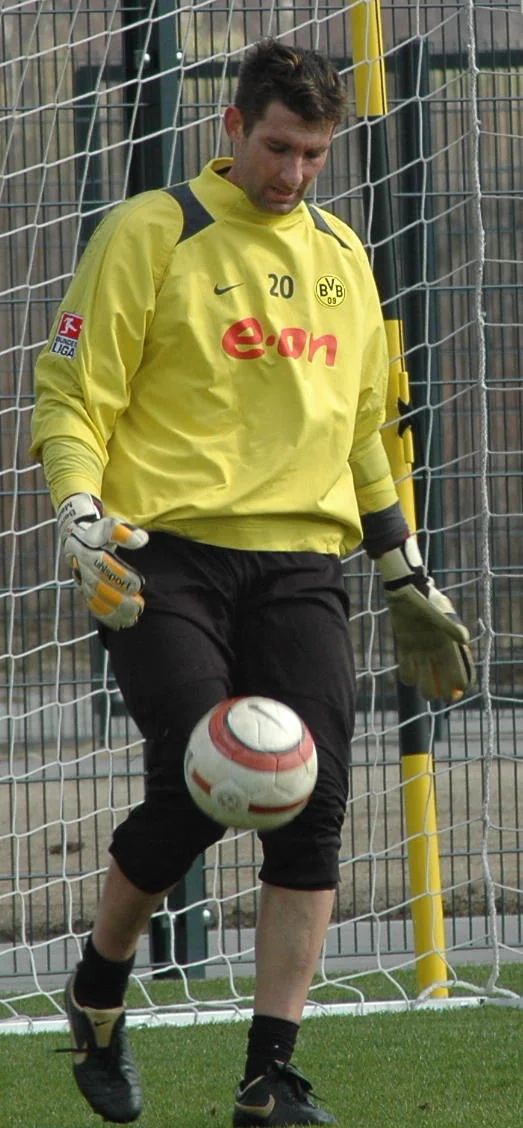
Image from Wikipedia
Image from Wikipedia
Bernd Meier – The stoic goalkeeper who earned respect in the Bundesliga
A goalkeeper from the Bavarian province who left his mark in the Bundesliga
Bernd Meier was born on February 11, 1972, in Rain am Lech and developed from an amateur player in the region into a distinguished German football goalkeeper and later a goalkeeping coach. His career tells a story of patience, resilience, and the uncommon path of a keeper who worked his way up to the Bundesliga and was on the fringes of the national team without much spotlight. He particularly shaped a phase at 1860 Munich, where promotion, survival in the league, and athletic establishment were closely intertwined. ([de.wikipedia.org](https://de.wikipedia.org/wiki/Bernd_Meier_%28Fu%C3%9Fballspieler%29))
Early Years: The path through the amateur ranks
Meier gained his first experiences at TSV Burgheim, TSV 1896 Rain, and TSV Aindling, precisely where football careers are often defined by commitment, reliability, and training enthusiasm. This phase shaped a keeper who was physically present, directed loudly, and developed early on as a stabilizing anchor. His journey into the professional realm began in 1993 with his first contract at TSV 1860 Munich. ([de.wikipedia.org](https://de.wikipedia.org/wiki/Bernd_Meier_%28Fu%C3%9Fballspieler%29))
Even in this early phase, a central theme of his career emerged: Meier was not a spectacular self-promoter, but a goalkeeper who convinced through stability and adaptability. Standing at 1.93 meters tall and weighing 93 kilograms, he had the physical attributes necessary for modern penalty area play. Munzinger also describes him as calm, balanced, and endowed with excellent game sense. ([munzinger.de](https://www.munzinger.de/register/portrait/biographien/meier%20bernd/01/4618))
The breakthrough at 1860 Munich
At 1860 Munich, Meier became a regular starter and experienced the most significant years of his football career in a team that had to grow and assert itself athletically. The club was promoted, maintained its league status, and established itself in the Bundesliga, with Meier playing a crucial role as a goalkeeper in this development. In the second half of the 1994/95 season, he increasingly stepped into the spotlight and was regarded by Munzinger as the Bundesliga goalkeeper discovery of the year in 1995. ([munzinger.de](https://www.munzinger.de/register/portrait/biographien/meier%20bernd/01/4618))
His role extended beyond mere defensive work: Meier organized the defense, communicated extensively with his teammates, and was considered a specialist in saving penalties. This combination of calmness, quick reflexes, and communication made him valuable to coaches and teammates. The statistics from kicker clearly demonstrate his presence in Munich: 106 matches for TSV 1860, including Bundesliga, cup, and European cup appearances. ([munzinger.de](https://www.munzinger.de/register/portrait/biographien/meier%20bernd/01/4618))
The painful turning point: The derby against Bayern Munich
One moment remained permanently associated with his name: the Munich derby against FC Bayern on April 11, 1998. When Meier attempted to clearance the ball from the ground, it was poked away from his foot by Carsten Jancker and rolled into the empty goal. 1860 Munich lost the match 1:3, and for Meier, this was a sporting turning point, as under coach Werner Lorant, he did not play for 1860 again afterward. ([de.wikipedia.org](https://de.wikipedia.org/wiki/Bernd_Meier_%28Fu%C3%9Fballspieler%29))
Such scenes are a part of the harsh reality of professional football: a single mistake can lead to a break, particularly in the goalkeeper position, where any uncertainty is immediately visible. In hindsight, this incident marked not only a bitter derby moment but also the end of his role as the undisputed number one for the Lions. Nevertheless, Meier's overall image was not limited to that one blunder but reflected years of consistent Bundesliga performance. ([de.wikipedia.org](https://de.wikipedia.org/wiki/Bernd_Meier_%28Fu%C3%9Fballspieler%29))
Stints in Gladbach, Ahlen, and Dortmund
After Munich, he transferred to Borussia Mönchengladbach in 1999, where Meier spent more professional years in the Bundesliga. He then joined LR Ahlen in 2002, once again working under coach Werner Lorant, the same coach who had previously removed him from the squad at 1860. The interplay between player and coach illustrates a typical football biography full of reunions, breaks, and new opportunities. ([de.wikipedia.org](https://de.wikipedia.org/wiki/Bernd_Meier_%28Fu%C3%9Fballspieler%29))
His last major professional contract took him to Borussia Dortmund. However, a torn cruciate ligament during one of the last training sessions before the transfer initially prevented his entrance into the first half of the 2005/06 season. After recovery, he played in the amateur team of Borussia Dortmund in 2006/07, before another torn cruciate ligament in an away game at LR Ahlen sealed the end of his career. In total, Meier played 94 Bundesliga matches. ([de.wikipedia.org](https://de.wikipedia.org/wiki/Bernd_Meier_%28Fu%C3%9Fballspieler%29))
Playing style, personality, and goalkeeper profile
Bernd Meier was representative of a goalkeeper type that seems almost classic today: tall, commanding, communicative, and possessing a keen sense of order in the penalty area. Munzinger highlights his calmness and game sense, but also his unmistakable presence on the pitch. This combination of inner tranquility and outer direction is central for a keeper who not only makes saves but also leads a defensive line. ([munzinger.de](https://www.munzinger.de/register/portrait/biographien/meier%20bernd/01/4618))
Interestingly, he was early on regarded as a strong penalty saver. In a position where milliseconds, anticipation, and psychological presence come together, this indicates a high level of game intelligence. At the same time, he was attributed certain limitations, particularly in terms of coming off his line and controlling the penalty area, which makes his career appear all the more human and credible. ([munzinger.de](https://www.munzinger.de/register/portrait/biographien/meier%20bernd/01/4618))
End of career and transition to the sidelines
After injuries blocked his active path, Meier transitioned to the role of goalkeeping coach. Most recently, he worked at Wacker Burghausen and coached the goalkeepers of the German U-17 national team; since September 2011, he also served as a coach at TSV Burgheim. These positions illustrate how much his experience in professional football transitioned into youth and training work. ([de.wikipedia.org](https://de.wikipedia.org/wiki/Bernd_Meier_%28Fu%C3%9Fballspieler%29))
His retirement on July 1, 2007, marked not only the end of an active career but also the beginning of a second footballing identity. The goalkeeping coach thinks in details, in technique, timing, and mental stability — precisely those elements that Meier himself had shaped over the years. His death on August 2, 2012, in Donauwörth, at the age of 40, turned the memories of him into an enduring part of Bavarian football history. ([kicker.de](https://www.kicker.de/bernd-meier/laufbahn))
Discography? No – his record consists of appearances, saves, and Bundesliga experience
Since Bernd Meier was not a musician but a football professional, he does not have a discography in the traditional sense. The sporting “publication list” of his career consists of 94 Bundesliga matches, stints at 1860 Munich, Borussia Mönchengladbach, LR Ahlen, and Borussia Dortmund II, as well as the appearances in which he served as a reliable backbone for his teams. This clarity makes his biography interesting for football historians and fans. ([de.wikipedia.org](https://de.wikipedia.org/wiki/Bernd_Meier_%28Fu%C3%9Fballspieler%29))
Cultural influence and sporting memory
Bernd Meier is mainly remembered as a goalkeeper who consistently made the journey from regional amateur football to the Bundesliga and established himself there over the years. His career exemplifies those players who do not gain influence through media presence but through reliable performance, professional attitude, and tough comebacks. Particularly at 1860 Munich, he is part of the club’s history during a phase in which the team developed sporting maturity. ([de.wikipedia.org](https://de.wikipedia.org/wiki/Bernd_Meier_%28Fu%C3%9Fballspieler%29))
His name continues to appear in retrospective discussions about the Bundesliga discovery in the mid-1990s, about Munich derbies, or the injury resilience of professional football. This is where his cultural value lies: Meier was not a myth of glamour but an honest, hard-working goalkeeper whose career illustrates the entire spectrum of professional football — promotion, recognition, mistakes, setbacks, and the dignity of continuing on. ([de.wikipedia.org](https://de.wikipedia.org/wiki/Bernd_Meier_%28Fu%C3%9Fballspieler%29))
Conclusion: Why Bernd Meier remains intriguing
Bernd Meier is intriguing because his career visibly encapsulates the essence of the goalkeeper profession: responsibility, concentration, and the ability to rise again after mistakes. His years at 1860 Munich, the appearances in Gladbach and Ahlen, the late battles with injuries, and the subsequent transition to coaching create a rich, credible football biography. Anyone wishing to understand German Bundesliga history will find in Meier’s career a precise, human, and very respectable chapter. ([de.wikipedia.org](https://de.wikipedia.org/wiki/Bernd_Meier_%28Fu%C3%9Fballspieler%29))
A live experience in the true sense is no longer possible today, but his sporting presence continues to live on in the memories of clubs, teammates, and fans. For this reason, it is worthwhile to look at his story: It shows how much character can be found in a goalkeeper who never had to be loud to be noticed. ([de.wikipedia.org](https://de.wikipedia.org/wiki/Bernd_Meier_%28Fu%C3%9Fballspieler%29))
Official channels of Bernd Meier:
- Instagram: No official profile found
- Facebook: No official profile found
- YouTube: No official profile found
- Spotify: No official profile found
- TikTok: No official profile found
Sources:
- Wikipedia – Bernd Meier (Football Player)
- kicker – Bernd Meier: Career
- DFB Datencenter – Bernd Meier
- Munzinger Biography – Bernd Meier
- Wikipedia: Image and text source