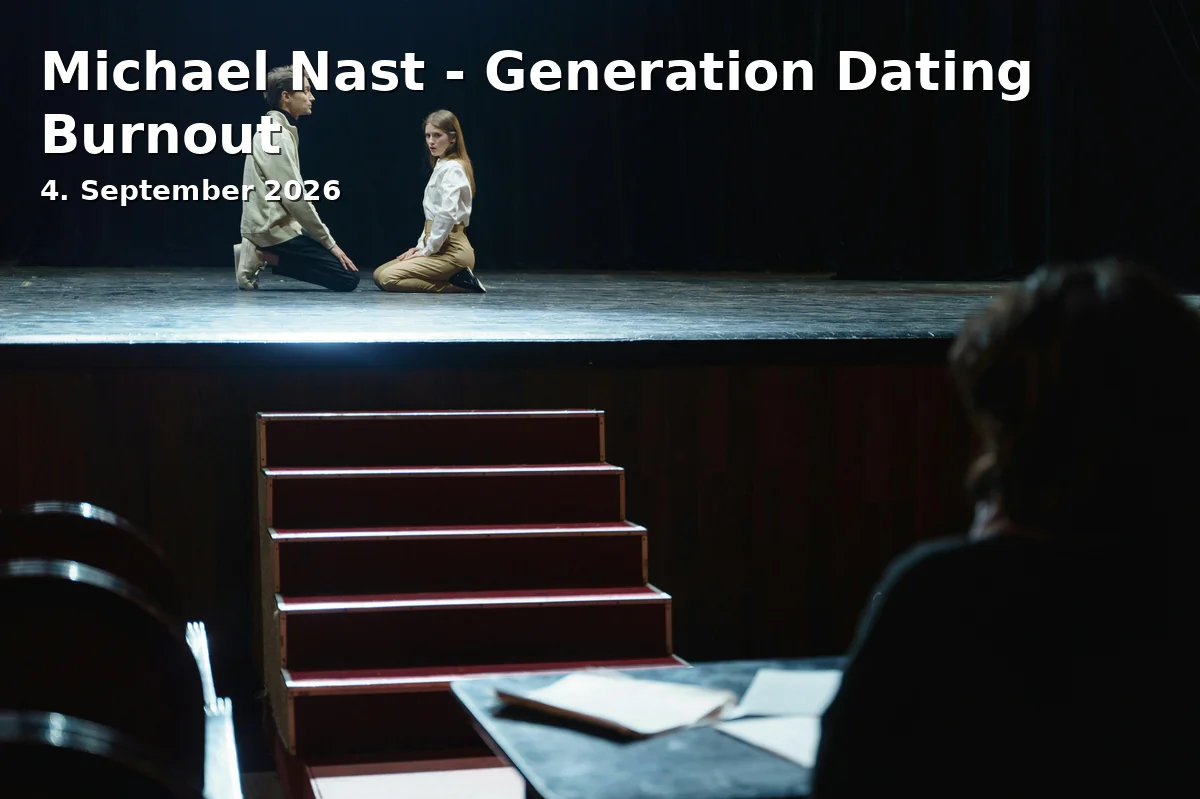
Michael Nast

Image from Wikipedia
Image from Wikipedia
Michael Nast – The Voice of the Metropolis, Relationships, and Digital Selves
An Author Who Dissects the Zeitgeist
Michael Nast, born on February 26, 1975, in Berlin-Köpenick, is a German writer and columnist who sharpens his focus on relationships, urban life, and the crises of modern self-presentation. His work does not belong to the field of music but rather to the art of literary and journalistic observation; this is where his cultural relevance lies. Those who read Michael Nast encounter not just a self-help author but a precise chronicler of the present, transforming private feelings, social patterns, and digital everyday rituals into a distinctive narrative profile. ([de.wikipedia.org](https://de.wikipedia.org/wiki/Michael_Nast))
Biography: From Berlin-Köpenick to Literary Publicity
After completing school and mandatory civil service, Nast founded two record labels before starting an apprenticeship as a bookseller, which he left after six months. He then worked for various advertising agencies and most recently served as an Art Director. These biographical stages shape the tone of his later writings: a sensitivity to pop culture, media surfaces, and the mechanics of attention, condensed in a language that merges everyday experience with observational prowess. ([de.wikipedia.org](https://de.wikipedia.org/wiki/Michael_Nast))
The Entry via the Internet
In 2007, Michael Nast began his urban column blog on Myspace, writing about everyday struggles, relationships, and life in the city. Later, he published texts for the magazine of the Berliner Zeitung and for Freundin; regularly, his columns also appear on freundin.de and imgegenteil.de. Early on, his central theme emerged: the emotional contradictions of a generation that navigates between closeness, distance, self-optimization, and fear of commitment. ([de.wikipedia.org](https://de.wikipedia.org/wiki/Michael_Nast))
The Breakthrough with "Generation Beziehungsunfähig"
Nast achieved a significant breakthrough with Generation Beziehungsunfähig. The column became one of the most successful German online texts of the year in 2015, read by over a million people in its first week, and developed into the title of a book that topped the Spiegel bestseller list for eleven weeks, remained on it for a total of over 46 weeks, and was translated into nine languages. A corresponding reading tour took him through 60 cities, attracting over 40,000 visitors in total. The media effect was considerable: Nast became a spokesperson for a public debate about relationship patterns, self-images, and the alleged incapacity for love among Generation Y. ([de.wikipedia.org](https://de.wikipedia.org/wiki/Michael_Nast))
Career Development: Between Columns, Essays, and Cultural Commentary
After his success, Michael Nast did not stop at a single buzzword, but consistently expanded his profile as an author. In 2014, Ist das Liebe oder kann das weg? was published, followed by Generation Beziehungsunfähig in 2016, later #EGOLAND, Vom Sinn unseres Lebens und andere Missverständnisse zwischen Ost und West, Generation Beziehungsunfähig. Die Lösungen, and in 2024 Weil da irgendetwas fehlt: Von der Liebe, dem Leben und anderen Missverständnissen. These works show a clear development: from a sharp observer of single life to a broader cultural commentator who connects self-doubt, societal acceleration, and emotional exhaustion. ([de.wikipedia.org](https://de.wikipedia.org/wiki/Michael_Nast))
Reading Tours, Resonance, and Film Adaptation
His texts resonated not only online and in bookstores but also on stage. The reading tour for Generation Beziehungsunfähig made him known to a wide audience in many cities and strengthened his reputation as a direct, accessible storyteller. In 2021, the film adaptation of the same name was released; the film rights were held by Pantaleon Films, the production company of Matthias Schweighöfer. This brought Nast's material into popular culture through another medium and confirmed how deeply his theme is rooted in the public consciousness. ([de.wikipedia.org](https://de.wikipedia.org/wiki/Michael_Nast))
Work and Style: Precision, Pace, and High Recognizability
Michael Nast's style thrives on intensity, laconic observation, and a language that balances between irony and vulnerability. His columns revolve around dating, social roles, media usage, desire, and the pressure to lead a “proper” life. Especially in his texts about Instagram, self-presentation, and digital attention, his strength emerges: he describes not just surfaces but uncovers the psychological mechanisms at play behind them. ([michaelnast.com](https://michaelnast.com/2023/04/18/selbstdarsteller/?utm_source=openai))
Themes: Relationship Culture, Metropolis, and Digital Identity
In his contributions, the metropolis, partnership, and self-image become closely intertwined motifs. Nast writes about the desire for closeness and the fear of commitment, about comparison with others, and about the constant feeling of availability on modern platforms. His texts thus strike a chord: they do not come across as theoretical analyses, but rather as condensed observations of everyday life from the heart of the present. ([de.wikipedia.org](https://de.wikipedia.org/wiki/Michael_Nast))
Impact and Cultural Positioning
Michael Nast has established himself as a voice of an urban, media-influenced present. His popularity is fueled by the connection of personal address and societal diagnosis: he writes about individual crises while showing how closely these are intertwined with consumption, social media, and pressure to meet expectations. His ability to initiate a broad debate with a single title demonstrates his authority as a journalistic observer of the emotional zeitgeist. ([de.wikipedia.org](https://de.wikipedia.org/wiki/Michael_Nast))
Personal Background
He lives in Berlin-Friedrichshain. His brother is Jan Nast, the artistic director of the Vienna Symphony. This biographical connection further underscores that Michael Nast operates within a culturally rich environment, even though his own field remains literary contemporary observation rather than music. ([de.wikipedia.org](https://de.wikipedia.org/wiki/Michael_Nast))
Conclusion: Why Michael Nast Remains Fascinating
Michael Nast is fascinating because he does not romanticize the emotional routines of the present but makes them visible with clarity and linguistic precision. His books and columns link personal experience, societal analysis, and high recognizability. Anyone wanting to understand contemporary German-language popular culture will find in his work an author who masters both the language of feelings and the language of the media society. His literary approach remains relevant, worth reading, and close to the questions that move many people today. ([de.wikipedia.org](https://de.wikipedia.org/wiki/Michael_Nast))
Official Channels of Michael Nast:
- Instagram: no official profile found
- Facebook: no official profile found
- YouTube: no official profile found
- Spotify: no official profile found
- TikTok: no official profile found
Sources:
Upcoming Events
Michael Nast – Generation Dating Burnout
Michael Nast - Generation Dating Burnout