
Bielefeld
Altstädter Kirchpark, Altstädter Kirchstraße 6, 33602 Bielefeld, Deutschland
Old Town Church Park | Church Square & Linen Weaver Monument
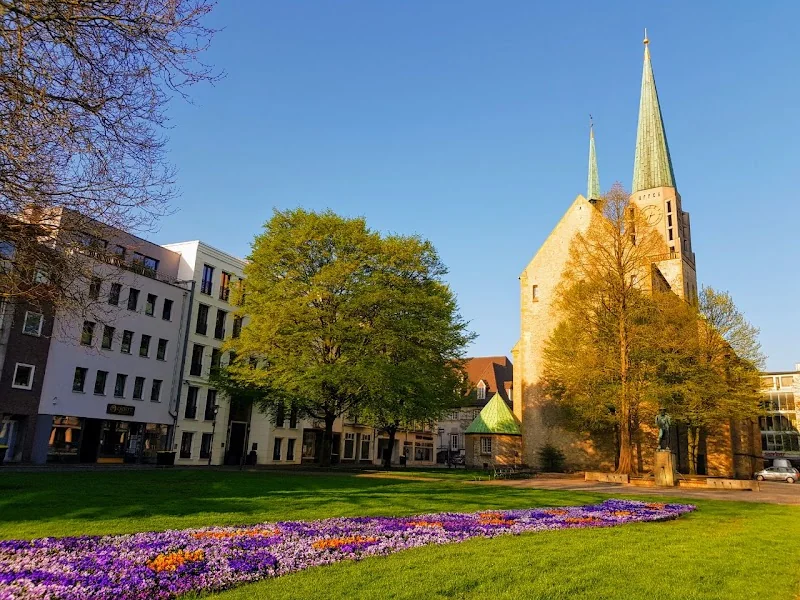
The Old Town Church Park is not just any city park, but a place where Bielefeld's history, identity, and present overlap in a small space. When you arrive here, you stand in the middle of the old town of Bielefeld-Mitte, between the Old Town Nicolaikirche, the Linen Weaver Monument, the Old Market, and the everyday urban life. The city describes the district Mitte as a historical old town core where one walks in the footsteps of history, and mentions the Old Town Nicolaikirche from 1340 as one of the central witnesses of time. At the same time, the Old Town Church Square is, according to city planning, the largest green space in the old town. This very mix is what makes it appealing: the place appears calm and green on one hand, while dense, urban, and full of historical reference points on the other. For visitors, the church park is not just a pause in the cityscape, but a natural entry into the old Bielefeld city center, its churches, its monument, and the paths that have crossed here for generations. ([bielefeld.de](https://www.bielefeld.de/mitte))
Old Town Church Square Bielefeld: Location, Importance, and Orientation
To understand the Old Town Church Park, one should consider it as part of a historical ensemble. The location in the district Mitte is not only geographically central but also symbolically important. Surrounding the park are the Old Town Nicolaikirche, the Old Market, and the Town Hall at a short distance; the city emphasizes that public facilities can be reached centrally and conveniently, and that pedestrian zones and gastronomy invite you to stroll, linger, and enjoy. It is precisely in this environment that the church park unfolds its effect. It forms a green interruption in the dense old town space and creates a place where the facades, paths, and squares of the city center are perceived not just as passageways but as places to stay. The fact that the city describes the Old Town Church Square as the largest green space in the old town as part of old town.space further underscores this role: the park is not a fringe area but a visible part of the inner-city quality. For orientation, this is practical because the paths between the Town Hall, church surroundings, old town, and shopping areas intuitively converge here. Those seeking a first impression of Bielefeld's historical center will find in the church park a particularly dense and simultaneously relaxed entry scene. ([bielefeld.de](https://www.bielefeld.de/mitte))
Even in everyday life, the location has advantages that go beyond the tourist perspective. The Old Town Church Park is situated in an area where historical heritage and current use overlap: advance sales, church institutions, city center functions, and public paths are in close proximity. Among other things, the municipal information also notes the theater advance sale at Old Town Church Street 14, which shows how many central functions are bundled in this environment. This makes the church park a place that is not experienced in isolation but as part of a vibrant city center. It is precisely this proximity to culture, administration, and public space that explains why the square functions not only as a green area but also as a meeting point. Those standing here perceive Bielefeld not just as a shopping city but as a city with historical depth, where the old town remains legible. For a visitor, this is ideal: one can use the park as a point of rest, move from here to the church, the Town Hall, or into the pedestrian zone, and connect the most important motifs of the old town without great detours. ([bielefeld.de](https://www.bielefeld.de/mitte))
Old Town Nicolaikirche: History, Opening Hours, and Cityscape
The Old Town Nicolaikirche is indispensable for understanding the church park because it marks the historical center of the place. The Protestant church is considered Bielefeld's oldest city church. According to the church district, it was elevated to an independent parish church in 1236 by the Bishop of Paderborn, Bernhard; the current historical appearance goes back to a building from the 14th century. In World War II, the old Nicolaikirche was nearly completely destroyed in a bombing raid on September 30, 1944. The current building was constructed between 1954 and 1963 in significantly altered architecture. This is important for the church park because the square derives its character not from a single image but from this layering of medieval origin, war destruction, and post-war reconstruction. It is precisely this long-developed history that gives the environment a special dignity and explains why the green space is perceived not as decorative embellishment but as part of the historical cityscape. According to the church district, the church is located in the middle of the old town, in immediate proximity to the Old Market and Town Hall. Thus, it is not only religiously but also urbanistically a key figure. ([kirche-bielefeld.de](https://www.kirche-bielefeld.de/auf-einen-blick/kirchen-in-bielefeld/evangelische-altstaedter-nicolaikirche-mitte))
For visitors, practical information is also helpful. The Old Town Nicolaikirche is located at Niedernstraße 4 in 33602 Bielefeld and is open daily from 10:00 AM to 6:00 PM as an open church. The city tram can be reached via the Rathaus stop; the walking distance from there is about 260 meters according to the church district, served by lines 1, 2, 3, and 4. Additionally, every Saturday after the 12:00 PM bell, market music takes place, which gives the place a regular cultural note. This is important for the perception of the Old Town Church Park: it is not an enclosed park that exists only as a green space, but part of a vibrant church and urban space where services, visits, music, and everyday paths intertwine. Those who linger here thus experience not only a park facility but an urban center with a clear address, good accessibility, and strong historical weight. This creates the mix of tranquility and urban presence that makes the place so special. ([kirche-bielefeld.de](https://www.kirche-bielefeld.de/auf-einen-blick/kirchen-in-bielefeld/evangelische-altstaedter-nicolaikirche-mitte))
Linen Weaver Monument and Linen Weaver Fountain: The Landmark in the Park
The Linen Weaver Monument is the most visible identity anchor of the Old Town Church Park. It commemorates the time when Bielefeld was widely known as a linen city and bridges the gap between local economic history and public urban space. An official Bielefeld city tour describes the monument as an expression of this linen past; the figure was created in 1909 by the Tyrolean sculptor Hans Perathoner. The Historical RückKlick Bielefeld vividly describes the inauguration on July 16, 1909: the ceremonial unveiling followed a historical city and county celebration, and the location at the Old Town Church Square was deliberately chosen because the dominant church tower formed a characteristic square frame. The sculptor envisioned a monumental overall structure at that time, which was to include not only the figure but also a fountain and architectural effect. For today's perception, it is interesting that the Linen Weaver does not simply stand as an isolated monument but shapes the park as a square figure. The three-meter-high figure, the fountain character, and the historical memory of Bielefeld's linen make the place one of the city's most important landmarks. ([historischer-rueckklick-bielefeld.com](https://historischer-rueckklick-bielefeld.com/2009/07/01/01072009/))
The history of the monument also reflects the eventful development of the place. The Historical RückKlick describes the Old Town Church Square as an early popular meeting point and relaxation area. However, after the destruction of the Old Town Nicolaikirche and many adjacent houses in 1944, the small park area lost significance and increasingly fell into disrepair. It was not until 1960 that the decision was made for a redesigned park area behind the Old Town Church, where the Linen Weaver Monument was re-erected. This re-erection is more than an aesthetic decision: it shows how strong the identification of the Bielefeld population with the monument and its location was. Especially in the post-war period, the old square was felt to be right again because it most convincingly established the connection between city history, public space, and landscape design. Today, those passing by the monument see not only a bronze figure or a historical fountain but a kind of urban memory in the open air. This also explains why the park is significant far beyond its size: it bundles memory, symbolism, and quality of stay in a place that has remained central to Bielefeld's self-understanding. ([historischer-rueckklick-bielefeld.com](https://historischer-rueckklick-bielefeld.com/2009/07/01/01072009/))
Old Town.space: More Green, Paths, Water, and Quality of Stay
The city plans for the Old Town Church Square clearly show where the area is to develop. In the measure old town.space, the square is described as the largest green space in the old town; an expansion with additional lawn area is planned to increase the green share and loosen the existing structure. Diverse perennial and bulb plantings are to be added, while separating elements such as hedges, streets, or parking lots will be eliminated. This is relevant from an urban planning perspective because the place can thus be perceived more strongly as a cohesive open space. The planning not only pursues ecological goals but also clear qualities of stay: it is about climate adaptation, more biodiversity, better drainage of rainwater, and a friendlier design of urban space. This gives the church park a dual role. It remains a historical stage while simultaneously becoming a contemporary green space that addresses current demands for heat prevention, rainwater management, and quality of stay. For visitors, this means more shade, more greenery, more visual calm, and better use of the space even on warm days. ([anwendungen.bielefeld.de](https://anwendungen.bielefeld.de/bi/getfile.asp?id=826067&type=do&utm_source=openai))
Especially attractive is that the planning continues to envision the area around the church as a place for events and outdoor gastronomy. The Linen Weaver Fountain is to be complemented by a water feature for children, additional play equipment is planned for the grassy areas, and the paths are to be executed as water-bound surfaces. In addition, the city mentions bicycle parking facilities, parking spaces for e-scooters and cargo bikes, generous longitudinal and round benches, as well as a rainwater concept with infiltration basins. Motor vehicle through traffic is also to be excluded. All of this shows: the Old Town Church Park is to become not only more beautiful but also a real space to stay, where different uses come together. Those traveling with strollers, bicycles, or on foot benefit from these measures just as much as people who simply want to sit on a bench and observe the city. The planning thus connects monument protection, open space design, and modern urban development. For an old town, this is particularly valuable because it not only shapes space but also rebalances the relationship between historical buildings, quality of stay, and climatic resilience. ([anwendungen.bielefeld.de](https://anwendungen.bielefeld.de/bi/getfile.asp?id=826067&type=do&utm_source=openai))
Access, Public Transport, and Parking around the Old Town Church Park
The Old Town Church Park is very centrally accessible, making it interesting for city visits and short stops alike. The most important public transport orientation is provided by the Old Town Nicolaikirche itself: the nearest tram connection is the Rathaus stop, which is about 260 meters away according to the church district and is served by lines 1, 2, 3, and 4. Additionally, a mobility station is being created at Niederwall between Old Town Church Square and Körnerstraße in front of the RadHaus. According to the city, it offers covered and secured bicycle parking facilities as well as additional offers such as car-sharing, MeinSiggi bikes, and Dott e-scooters; digital columns also provide information about departure times at the Jahnplatz and Rathaus stops. For people moving on foot or by bike in the city center, this is a clear advantage: the area is not only accessible but also well connected to the further urban everyday life. This networking makes the church park an uncomplicated destination in the middle of the city. Those wanting to experience the old town can easily incorporate it into a tour without having to plan a complicated journey first. ([kirche-bielefeld.de](https://www.kirche-bielefeld.de/auf-einen-blick/kirchen-in-bielefeld/evangelische-altstaedter-nicolaikirche-mitte))
Parking is also urban and well integrated. The city of Bielefeld lists several parking options for the city center, including the parking garage Ritterstraße with 289 spaces, the underground garage Altstadt-Carré with 415 spaces, and the parking lot Niederwall with 18 spaces. Additionally, the parking area Z, known as the Horseshoe Old Town, is designated for the old town; special rules apply for all-day parking there. For the visitor, this means: those arriving by car will generally find options in the old town but should pay attention to the inner-city parking management. Especially on days with events or during busy times, this is important because the city adjusts traffic management and one-way street regulations in the surrounding streets during major events to keep parking garages and private parking spaces accessible. Thus, the Old Town Church Park is located in an area that is very well developed but also brings the typical conditions of a historical city center. The interplay of parking garages, parking zones, and public transport connections makes the journey flexible. Those who want to travel in an environmentally friendly manner benefit from the good tram and cycling infrastructure; those arriving by car have inner-city alternatives within walking distance. ([bielefeld.de](https://www.bielefeld.de/parken?utm_source=openai))
Around the Church Park: Experience the Old Town between Town Hall, Theater, and Gastronomy
The Old Town Church Park is also attractive because it is located in a lively environment. The city describes the district Mitte as a place where pedestrian zones and diverse gastronomy invite you to stroll, linger, and enjoy. The park environment particularly benefits from this. Those visiting the church park are not far from administration, culture, and historical facades. In the immediate vicinity, according to municipal information, are the stages and orchestras of the city of Bielefeld with the Bielefeld Theater as well as the advance sale at Old Town Church Street 14. The old town thus functions not only as a historical quarter but also as an urban working and cultural space. The park complements this diversity with tranquility and greenery without losing its urban character. This is particularly valuable in a city center: a place that is simultaneously historical, public, and landscape-oriented creates a higher quality of stay than a purely hard square. Therefore, the church park is ideal for a short stop, city observation, or a quiet moment between appointments. ([bielefeld.de](https://www.bielefeld.de/mitte))
The special effect of the place also arises from the long continuity of its use. Historically, the Old Town Church Square was already regarded as a meeting point and relaxation area. Today, this function is preserved in a new form because the green space and urban integration attract people who want not only to observe history but to traverse, experience, and briefly interrupt it. This is an important difference from many other city center locations: here, not only a monument is observed, but an entire space is read that summarizes church, fountain, paths, greenery, and urban culture. Those using the Old Town Church Park as a starting point for a stroll through the old town can easily continue on to the Old Market, the Town Hall, the pedestrian zone, or other sights. It is precisely this connectivity that makes the place so useful in everyday life and so prominent in the cityscape. The church park is thus both a monument space, a recreation area, and a connecting space. For Bielefeld, it is a piece of identity-forming city center, and for visitors, a place where the old town is presented in a condensed form. ([historischer-rueckklick-bielefeld.com](https://historischer-rueckklick-bielefeld.com/2009/07/01/01072009/))
Sources:
- City of Bielefeld - Mitte
- Protestant Church District Bielefeld - Protestant Old Town Nicolaikirche
- Historical RückKlick Bielefeld - The Linen Weaver Fountain is inaugurated
- City of Bielefeld - BIELEFELD OLD TOWN SPACE pulsating.creative.sustainable
- City of Bielefeld - Bielefeld's first mobility station is being created at Niederwall
- City of Bielefeld - Parking Garages & Parking Spaces
Mehr anzeigenWeniger anzeigen
Old Town Church Park | Church Square & Linen Weaver Monument
The Old Town Church Park is not just any city park, but a place where Bielefeld's history, identity, and present overlap in a small space. When you arrive here, you stand in the middle of the old town of Bielefeld-Mitte, between the Old Town Nicolaikirche, the Linen Weaver Monument, the Old Market, and the everyday urban life. The city describes the district Mitte as a historical old town core where one walks in the footsteps of history, and mentions the Old Town Nicolaikirche from 1340 as one of the central witnesses of time. At the same time, the Old Town Church Square is, according to city planning, the largest green space in the old town. This very mix is what makes it appealing: the place appears calm and green on one hand, while dense, urban, and full of historical reference points on the other. For visitors, the church park is not just a pause in the cityscape, but a natural entry into the old Bielefeld city center, its churches, its monument, and the paths that have crossed here for generations. ([bielefeld.de](https://www.bielefeld.de/mitte))
Old Town Church Square Bielefeld: Location, Importance, and Orientation
To understand the Old Town Church Park, one should consider it as part of a historical ensemble. The location in the district Mitte is not only geographically central but also symbolically important. Surrounding the park are the Old Town Nicolaikirche, the Old Market, and the Town Hall at a short distance; the city emphasizes that public facilities can be reached centrally and conveniently, and that pedestrian zones and gastronomy invite you to stroll, linger, and enjoy. It is precisely in this environment that the church park unfolds its effect. It forms a green interruption in the dense old town space and creates a place where the facades, paths, and squares of the city center are perceived not just as passageways but as places to stay. The fact that the city describes the Old Town Church Square as the largest green space in the old town as part of old town.space further underscores this role: the park is not a fringe area but a visible part of the inner-city quality. For orientation, this is practical because the paths between the Town Hall, church surroundings, old town, and shopping areas intuitively converge here. Those seeking a first impression of Bielefeld's historical center will find in the church park a particularly dense and simultaneously relaxed entry scene. ([bielefeld.de](https://www.bielefeld.de/mitte))
Even in everyday life, the location has advantages that go beyond the tourist perspective. The Old Town Church Park is situated in an area where historical heritage and current use overlap: advance sales, church institutions, city center functions, and public paths are in close proximity. Among other things, the municipal information also notes the theater advance sale at Old Town Church Street 14, which shows how many central functions are bundled in this environment. This makes the church park a place that is not experienced in isolation but as part of a vibrant city center. It is precisely this proximity to culture, administration, and public space that explains why the square functions not only as a green area but also as a meeting point. Those standing here perceive Bielefeld not just as a shopping city but as a city with historical depth, where the old town remains legible. For a visitor, this is ideal: one can use the park as a point of rest, move from here to the church, the Town Hall, or into the pedestrian zone, and connect the most important motifs of the old town without great detours. ([bielefeld.de](https://www.bielefeld.de/mitte))
Old Town Nicolaikirche: History, Opening Hours, and Cityscape
The Old Town Nicolaikirche is indispensable for understanding the church park because it marks the historical center of the place. The Protestant church is considered Bielefeld's oldest city church. According to the church district, it was elevated to an independent parish church in 1236 by the Bishop of Paderborn, Bernhard; the current historical appearance goes back to a building from the 14th century. In World War II, the old Nicolaikirche was nearly completely destroyed in a bombing raid on September 30, 1944. The current building was constructed between 1954 and 1963 in significantly altered architecture. This is important for the church park because the square derives its character not from a single image but from this layering of medieval origin, war destruction, and post-war reconstruction. It is precisely this long-developed history that gives the environment a special dignity and explains why the green space is perceived not as decorative embellishment but as part of the historical cityscape. According to the church district, the church is located in the middle of the old town, in immediate proximity to the Old Market and Town Hall. Thus, it is not only religiously but also urbanistically a key figure. ([kirche-bielefeld.de](https://www.kirche-bielefeld.de/auf-einen-blick/kirchen-in-bielefeld/evangelische-altstaedter-nicolaikirche-mitte))
For visitors, practical information is also helpful. The Old Town Nicolaikirche is located at Niedernstraße 4 in 33602 Bielefeld and is open daily from 10:00 AM to 6:00 PM as an open church. The city tram can be reached via the Rathaus stop; the walking distance from there is about 260 meters according to the church district, served by lines 1, 2, 3, and 4. Additionally, every Saturday after the 12:00 PM bell, market music takes place, which gives the place a regular cultural note. This is important for the perception of the Old Town Church Park: it is not an enclosed park that exists only as a green space, but part of a vibrant church and urban space where services, visits, music, and everyday paths intertwine. Those who linger here thus experience not only a park facility but an urban center with a clear address, good accessibility, and strong historical weight. This creates the mix of tranquility and urban presence that makes the place so special. ([kirche-bielefeld.de](https://www.kirche-bielefeld.de/auf-einen-blick/kirchen-in-bielefeld/evangelische-altstaedter-nicolaikirche-mitte))
Linen Weaver Monument and Linen Weaver Fountain: The Landmark in the Park
The Linen Weaver Monument is the most visible identity anchor of the Old Town Church Park. It commemorates the time when Bielefeld was widely known as a linen city and bridges the gap between local economic history and public urban space. An official Bielefeld city tour describes the monument as an expression of this linen past; the figure was created in 1909 by the Tyrolean sculptor Hans Perathoner. The Historical RückKlick Bielefeld vividly describes the inauguration on July 16, 1909: the ceremonial unveiling followed a historical city and county celebration, and the location at the Old Town Church Square was deliberately chosen because the dominant church tower formed a characteristic square frame. The sculptor envisioned a monumental overall structure at that time, which was to include not only the figure but also a fountain and architectural effect. For today's perception, it is interesting that the Linen Weaver does not simply stand as an isolated monument but shapes the park as a square figure. The three-meter-high figure, the fountain character, and the historical memory of Bielefeld's linen make the place one of the city's most important landmarks. ([historischer-rueckklick-bielefeld.com](https://historischer-rueckklick-bielefeld.com/2009/07/01/01072009/))
The history of the monument also reflects the eventful development of the place. The Historical RückKlick describes the Old Town Church Square as an early popular meeting point and relaxation area. However, after the destruction of the Old Town Nicolaikirche and many adjacent houses in 1944, the small park area lost significance and increasingly fell into disrepair. It was not until 1960 that the decision was made for a redesigned park area behind the Old Town Church, where the Linen Weaver Monument was re-erected. This re-erection is more than an aesthetic decision: it shows how strong the identification of the Bielefeld population with the monument and its location was. Especially in the post-war period, the old square was felt to be right again because it most convincingly established the connection between city history, public space, and landscape design. Today, those passing by the monument see not only a bronze figure or a historical fountain but a kind of urban memory in the open air. This also explains why the park is significant far beyond its size: it bundles memory, symbolism, and quality of stay in a place that has remained central to Bielefeld's self-understanding. ([historischer-rueckklick-bielefeld.com](https://historischer-rueckklick-bielefeld.com/2009/07/01/01072009/))
Old Town.space: More Green, Paths, Water, and Quality of Stay
The city plans for the Old Town Church Square clearly show where the area is to develop. In the measure old town.space, the square is described as the largest green space in the old town; an expansion with additional lawn area is planned to increase the green share and loosen the existing structure. Diverse perennial and bulb plantings are to be added, while separating elements such as hedges, streets, or parking lots will be eliminated. This is relevant from an urban planning perspective because the place can thus be perceived more strongly as a cohesive open space. The planning not only pursues ecological goals but also clear qualities of stay: it is about climate adaptation, more biodiversity, better drainage of rainwater, and a friendlier design of urban space. This gives the church park a dual role. It remains a historical stage while simultaneously becoming a contemporary green space that addresses current demands for heat prevention, rainwater management, and quality of stay. For visitors, this means more shade, more greenery, more visual calm, and better use of the space even on warm days. ([anwendungen.bielefeld.de](https://anwendungen.bielefeld.de/bi/getfile.asp?id=826067&type=do&utm_source=openai))
Especially attractive is that the planning continues to envision the area around the church as a place for events and outdoor gastronomy. The Linen Weaver Fountain is to be complemented by a water feature for children, additional play equipment is planned for the grassy areas, and the paths are to be executed as water-bound surfaces. In addition, the city mentions bicycle parking facilities, parking spaces for e-scooters and cargo bikes, generous longitudinal and round benches, as well as a rainwater concept with infiltration basins. Motor vehicle through traffic is also to be excluded. All of this shows: the Old Town Church Park is to become not only more beautiful but also a real space to stay, where different uses come together. Those traveling with strollers, bicycles, or on foot benefit from these measures just as much as people who simply want to sit on a bench and observe the city. The planning thus connects monument protection, open space design, and modern urban development. For an old town, this is particularly valuable because it not only shapes space but also rebalances the relationship between historical buildings, quality of stay, and climatic resilience. ([anwendungen.bielefeld.de](https://anwendungen.bielefeld.de/bi/getfile.asp?id=826067&type=do&utm_source=openai))
Access, Public Transport, and Parking around the Old Town Church Park
The Old Town Church Park is very centrally accessible, making it interesting for city visits and short stops alike. The most important public transport orientation is provided by the Old Town Nicolaikirche itself: the nearest tram connection is the Rathaus stop, which is about 260 meters away according to the church district and is served by lines 1, 2, 3, and 4. Additionally, a mobility station is being created at Niederwall between Old Town Church Square and Körnerstraße in front of the RadHaus. According to the city, it offers covered and secured bicycle parking facilities as well as additional offers such as car-sharing, MeinSiggi bikes, and Dott e-scooters; digital columns also provide information about departure times at the Jahnplatz and Rathaus stops. For people moving on foot or by bike in the city center, this is a clear advantage: the area is not only accessible but also well connected to the further urban everyday life. This networking makes the church park an uncomplicated destination in the middle of the city. Those wanting to experience the old town can easily incorporate it into a tour without having to plan a complicated journey first. ([kirche-bielefeld.de](https://www.kirche-bielefeld.de/auf-einen-blick/kirchen-in-bielefeld/evangelische-altstaedter-nicolaikirche-mitte))
Parking is also urban and well integrated. The city of Bielefeld lists several parking options for the city center, including the parking garage Ritterstraße with 289 spaces, the underground garage Altstadt-Carré with 415 spaces, and the parking lot Niederwall with 18 spaces. Additionally, the parking area Z, known as the Horseshoe Old Town, is designated for the old town; special rules apply for all-day parking there. For the visitor, this means: those arriving by car will generally find options in the old town but should pay attention to the inner-city parking management. Especially on days with events or during busy times, this is important because the city adjusts traffic management and one-way street regulations in the surrounding streets during major events to keep parking garages and private parking spaces accessible. Thus, the Old Town Church Park is located in an area that is very well developed but also brings the typical conditions of a historical city center. The interplay of parking garages, parking zones, and public transport connections makes the journey flexible. Those who want to travel in an environmentally friendly manner benefit from the good tram and cycling infrastructure; those arriving by car have inner-city alternatives within walking distance. ([bielefeld.de](https://www.bielefeld.de/parken?utm_source=openai))
Around the Church Park: Experience the Old Town between Town Hall, Theater, and Gastronomy
The Old Town Church Park is also attractive because it is located in a lively environment. The city describes the district Mitte as a place where pedestrian zones and diverse gastronomy invite you to stroll, linger, and enjoy. The park environment particularly benefits from this. Those visiting the church park are not far from administration, culture, and historical facades. In the immediate vicinity, according to municipal information, are the stages and orchestras of the city of Bielefeld with the Bielefeld Theater as well as the advance sale at Old Town Church Street 14. The old town thus functions not only as a historical quarter but also as an urban working and cultural space. The park complements this diversity with tranquility and greenery without losing its urban character. This is particularly valuable in a city center: a place that is simultaneously historical, public, and landscape-oriented creates a higher quality of stay than a purely hard square. Therefore, the church park is ideal for a short stop, city observation, or a quiet moment between appointments. ([bielefeld.de](https://www.bielefeld.de/mitte))
The special effect of the place also arises from the long continuity of its use. Historically, the Old Town Church Square was already regarded as a meeting point and relaxation area. Today, this function is preserved in a new form because the green space and urban integration attract people who want not only to observe history but to traverse, experience, and briefly interrupt it. This is an important difference from many other city center locations: here, not only a monument is observed, but an entire space is read that summarizes church, fountain, paths, greenery, and urban culture. Those using the Old Town Church Park as a starting point for a stroll through the old town can easily continue on to the Old Market, the Town Hall, the pedestrian zone, or other sights. It is precisely this connectivity that makes the place so useful in everyday life and so prominent in the cityscape. The church park is thus both a monument space, a recreation area, and a connecting space. For Bielefeld, it is a piece of identity-forming city center, and for visitors, a place where the old town is presented in a condensed form. ([historischer-rueckklick-bielefeld.com](https://historischer-rueckklick-bielefeld.com/2009/07/01/01072009/))
Sources:
- City of Bielefeld - Mitte
- Protestant Church District Bielefeld - Protestant Old Town Nicolaikirche
- Historical RückKlick Bielefeld - The Linen Weaver Fountain is inaugurated
- City of Bielefeld - BIELEFELD OLD TOWN SPACE pulsating.creative.sustainable
- City of Bielefeld - Bielefeld's first mobility station is being created at Niederwall
- City of Bielefeld - Parking Garages & Parking Spaces
Old Town Church Park | Church Square & Linen Weaver Monument
The Old Town Church Park is not just any city park, but a place where Bielefeld's history, identity, and present overlap in a small space. When you arrive here, you stand in the middle of the old town of Bielefeld-Mitte, between the Old Town Nicolaikirche, the Linen Weaver Monument, the Old Market, and the everyday urban life. The city describes the district Mitte as a historical old town core where one walks in the footsteps of history, and mentions the Old Town Nicolaikirche from 1340 as one of the central witnesses of time. At the same time, the Old Town Church Square is, according to city planning, the largest green space in the old town. This very mix is what makes it appealing: the place appears calm and green on one hand, while dense, urban, and full of historical reference points on the other. For visitors, the church park is not just a pause in the cityscape, but a natural entry into the old Bielefeld city center, its churches, its monument, and the paths that have crossed here for generations. ([bielefeld.de](https://www.bielefeld.de/mitte))
Old Town Church Square Bielefeld: Location, Importance, and Orientation
To understand the Old Town Church Park, one should consider it as part of a historical ensemble. The location in the district Mitte is not only geographically central but also symbolically important. Surrounding the park are the Old Town Nicolaikirche, the Old Market, and the Town Hall at a short distance; the city emphasizes that public facilities can be reached centrally and conveniently, and that pedestrian zones and gastronomy invite you to stroll, linger, and enjoy. It is precisely in this environment that the church park unfolds its effect. It forms a green interruption in the dense old town space and creates a place where the facades, paths, and squares of the city center are perceived not just as passageways but as places to stay. The fact that the city describes the Old Town Church Square as the largest green space in the old town as part of old town.space further underscores this role: the park is not a fringe area but a visible part of the inner-city quality. For orientation, this is practical because the paths between the Town Hall, church surroundings, old town, and shopping areas intuitively converge here. Those seeking a first impression of Bielefeld's historical center will find in the church park a particularly dense and simultaneously relaxed entry scene. ([bielefeld.de](https://www.bielefeld.de/mitte))
Even in everyday life, the location has advantages that go beyond the tourist perspective. The Old Town Church Park is situated in an area where historical heritage and current use overlap: advance sales, church institutions, city center functions, and public paths are in close proximity. Among other things, the municipal information also notes the theater advance sale at Old Town Church Street 14, which shows how many central functions are bundled in this environment. This makes the church park a place that is not experienced in isolation but as part of a vibrant city center. It is precisely this proximity to culture, administration, and public space that explains why the square functions not only as a green area but also as a meeting point. Those standing here perceive Bielefeld not just as a shopping city but as a city with historical depth, where the old town remains legible. For a visitor, this is ideal: one can use the park as a point of rest, move from here to the church, the Town Hall, or into the pedestrian zone, and connect the most important motifs of the old town without great detours. ([bielefeld.de](https://www.bielefeld.de/mitte))
Old Town Nicolaikirche: History, Opening Hours, and Cityscape
The Old Town Nicolaikirche is indispensable for understanding the church park because it marks the historical center of the place. The Protestant church is considered Bielefeld's oldest city church. According to the church district, it was elevated to an independent parish church in 1236 by the Bishop of Paderborn, Bernhard; the current historical appearance goes back to a building from the 14th century. In World War II, the old Nicolaikirche was nearly completely destroyed in a bombing raid on September 30, 1944. The current building was constructed between 1954 and 1963 in significantly altered architecture. This is important for the church park because the square derives its character not from a single image but from this layering of medieval origin, war destruction, and post-war reconstruction. It is precisely this long-developed history that gives the environment a special dignity and explains why the green space is perceived not as decorative embellishment but as part of the historical cityscape. According to the church district, the church is located in the middle of the old town, in immediate proximity to the Old Market and Town Hall. Thus, it is not only religiously but also urbanistically a key figure. ([kirche-bielefeld.de](https://www.kirche-bielefeld.de/auf-einen-blick/kirchen-in-bielefeld/evangelische-altstaedter-nicolaikirche-mitte))
For visitors, practical information is also helpful. The Old Town Nicolaikirche is located at Niedernstraße 4 in 33602 Bielefeld and is open daily from 10:00 AM to 6:00 PM as an open church. The city tram can be reached via the Rathaus stop; the walking distance from there is about 260 meters according to the church district, served by lines 1, 2, 3, and 4. Additionally, every Saturday after the 12:00 PM bell, market music takes place, which gives the place a regular cultural note. This is important for the perception of the Old Town Church Park: it is not an enclosed park that exists only as a green space, but part of a vibrant church and urban space where services, visits, music, and everyday paths intertwine. Those who linger here thus experience not only a park facility but an urban center with a clear address, good accessibility, and strong historical weight. This creates the mix of tranquility and urban presence that makes the place so special. ([kirche-bielefeld.de](https://www.kirche-bielefeld.de/auf-einen-blick/kirchen-in-bielefeld/evangelische-altstaedter-nicolaikirche-mitte))
Linen Weaver Monument and Linen Weaver Fountain: The Landmark in the Park
The Linen Weaver Monument is the most visible identity anchor of the Old Town Church Park. It commemorates the time when Bielefeld was widely known as a linen city and bridges the gap between local economic history and public urban space. An official Bielefeld city tour describes the monument as an expression of this linen past; the figure was created in 1909 by the Tyrolean sculptor Hans Perathoner. The Historical RückKlick Bielefeld vividly describes the inauguration on July 16, 1909: the ceremonial unveiling followed a historical city and county celebration, and the location at the Old Town Church Square was deliberately chosen because the dominant church tower formed a characteristic square frame. The sculptor envisioned a monumental overall structure at that time, which was to include not only the figure but also a fountain and architectural effect. For today's perception, it is interesting that the Linen Weaver does not simply stand as an isolated monument but shapes the park as a square figure. The three-meter-high figure, the fountain character, and the historical memory of Bielefeld's linen make the place one of the city's most important landmarks. ([historischer-rueckklick-bielefeld.com](https://historischer-rueckklick-bielefeld.com/2009/07/01/01072009/))
The history of the monument also reflects the eventful development of the place. The Historical RückKlick describes the Old Town Church Square as an early popular meeting point and relaxation area. However, after the destruction of the Old Town Nicolaikirche and many adjacent houses in 1944, the small park area lost significance and increasingly fell into disrepair. It was not until 1960 that the decision was made for a redesigned park area behind the Old Town Church, where the Linen Weaver Monument was re-erected. This re-erection is more than an aesthetic decision: it shows how strong the identification of the Bielefeld population with the monument and its location was. Especially in the post-war period, the old square was felt to be right again because it most convincingly established the connection between city history, public space, and landscape design. Today, those passing by the monument see not only a bronze figure or a historical fountain but a kind of urban memory in the open air. This also explains why the park is significant far beyond its size: it bundles memory, symbolism, and quality of stay in a place that has remained central to Bielefeld's self-understanding. ([historischer-rueckklick-bielefeld.com](https://historischer-rueckklick-bielefeld.com/2009/07/01/01072009/))
Old Town.space: More Green, Paths, Water, and Quality of Stay
The city plans for the Old Town Church Square clearly show where the area is to develop. In the measure old town.space, the square is described as the largest green space in the old town; an expansion with additional lawn area is planned to increase the green share and loosen the existing structure. Diverse perennial and bulb plantings are to be added, while separating elements such as hedges, streets, or parking lots will be eliminated. This is relevant from an urban planning perspective because the place can thus be perceived more strongly as a cohesive open space. The planning not only pursues ecological goals but also clear qualities of stay: it is about climate adaptation, more biodiversity, better drainage of rainwater, and a friendlier design of urban space. This gives the church park a dual role. It remains a historical stage while simultaneously becoming a contemporary green space that addresses current demands for heat prevention, rainwater management, and quality of stay. For visitors, this means more shade, more greenery, more visual calm, and better use of the space even on warm days. ([anwendungen.bielefeld.de](https://anwendungen.bielefeld.de/bi/getfile.asp?id=826067&type=do&utm_source=openai))
Especially attractive is that the planning continues to envision the area around the church as a place for events and outdoor gastronomy. The Linen Weaver Fountain is to be complemented by a water feature for children, additional play equipment is planned for the grassy areas, and the paths are to be executed as water-bound surfaces. In addition, the city mentions bicycle parking facilities, parking spaces for e-scooters and cargo bikes, generous longitudinal and round benches, as well as a rainwater concept with infiltration basins. Motor vehicle through traffic is also to be excluded. All of this shows: the Old Town Church Park is to become not only more beautiful but also a real space to stay, where different uses come together. Those traveling with strollers, bicycles, or on foot benefit from these measures just as much as people who simply want to sit on a bench and observe the city. The planning thus connects monument protection, open space design, and modern urban development. For an old town, this is particularly valuable because it not only shapes space but also rebalances the relationship between historical buildings, quality of stay, and climatic resilience. ([anwendungen.bielefeld.de](https://anwendungen.bielefeld.de/bi/getfile.asp?id=826067&type=do&utm_source=openai))
Access, Public Transport, and Parking around the Old Town Church Park
The Old Town Church Park is very centrally accessible, making it interesting for city visits and short stops alike. The most important public transport orientation is provided by the Old Town Nicolaikirche itself: the nearest tram connection is the Rathaus stop, which is about 260 meters away according to the church district and is served by lines 1, 2, 3, and 4. Additionally, a mobility station is being created at Niederwall between Old Town Church Square and Körnerstraße in front of the RadHaus. According to the city, it offers covered and secured bicycle parking facilities as well as additional offers such as car-sharing, MeinSiggi bikes, and Dott e-scooters; digital columns also provide information about departure times at the Jahnplatz and Rathaus stops. For people moving on foot or by bike in the city center, this is a clear advantage: the area is not only accessible but also well connected to the further urban everyday life. This networking makes the church park an uncomplicated destination in the middle of the city. Those wanting to experience the old town can easily incorporate it into a tour without having to plan a complicated journey first. ([kirche-bielefeld.de](https://www.kirche-bielefeld.de/auf-einen-blick/kirchen-in-bielefeld/evangelische-altstaedter-nicolaikirche-mitte))
Parking is also urban and well integrated. The city of Bielefeld lists several parking options for the city center, including the parking garage Ritterstraße with 289 spaces, the underground garage Altstadt-Carré with 415 spaces, and the parking lot Niederwall with 18 spaces. Additionally, the parking area Z, known as the Horseshoe Old Town, is designated for the old town; special rules apply for all-day parking there. For the visitor, this means: those arriving by car will generally find options in the old town but should pay attention to the inner-city parking management. Especially on days with events or during busy times, this is important because the city adjusts traffic management and one-way street regulations in the surrounding streets during major events to keep parking garages and private parking spaces accessible. Thus, the Old Town Church Park is located in an area that is very well developed but also brings the typical conditions of a historical city center. The interplay of parking garages, parking zones, and public transport connections makes the journey flexible. Those who want to travel in an environmentally friendly manner benefit from the good tram and cycling infrastructure; those arriving by car have inner-city alternatives within walking distance. ([bielefeld.de](https://www.bielefeld.de/parken?utm_source=openai))
Around the Church Park: Experience the Old Town between Town Hall, Theater, and Gastronomy
The Old Town Church Park is also attractive because it is located in a lively environment. The city describes the district Mitte as a place where pedestrian zones and diverse gastronomy invite you to stroll, linger, and enjoy. The park environment particularly benefits from this. Those visiting the church park are not far from administration, culture, and historical facades. In the immediate vicinity, according to municipal information, are the stages and orchestras of the city of Bielefeld with the Bielefeld Theater as well as the advance sale at Old Town Church Street 14. The old town thus functions not only as a historical quarter but also as an urban working and cultural space. The park complements this diversity with tranquility and greenery without losing its urban character. This is particularly valuable in a city center: a place that is simultaneously historical, public, and landscape-oriented creates a higher quality of stay than a purely hard square. Therefore, the church park is ideal for a short stop, city observation, or a quiet moment between appointments. ([bielefeld.de](https://www.bielefeld.de/mitte))
The special effect of the place also arises from the long continuity of its use. Historically, the Old Town Church Square was already regarded as a meeting point and relaxation area. Today, this function is preserved in a new form because the green space and urban integration attract people who want not only to observe history but to traverse, experience, and briefly interrupt it. This is an important difference from many other city center locations: here, not only a monument is observed, but an entire space is read that summarizes church, fountain, paths, greenery, and urban culture. Those using the Old Town Church Park as a starting point for a stroll through the old town can easily continue on to the Old Market, the Town Hall, the pedestrian zone, or other sights. It is precisely this connectivity that makes the place so useful in everyday life and so prominent in the cityscape. The church park is thus both a monument space, a recreation area, and a connecting space. For Bielefeld, it is a piece of identity-forming city center, and for visitors, a place where the old town is presented in a condensed form. ([historischer-rueckklick-bielefeld.com](https://historischer-rueckklick-bielefeld.com/2009/07/01/01072009/))
Sources:
- City of Bielefeld - Mitte
- Protestant Church District Bielefeld - Protestant Old Town Nicolaikirche
- Historical RückKlick Bielefeld - The Linen Weaver Fountain is inaugurated
- City of Bielefeld - BIELEFELD OLD TOWN SPACE pulsating.creative.sustainable
- City of Bielefeld - Bielefeld's first mobility station is being created at Niederwall
- City of Bielefeld - Parking Garages & Parking Spaces

Frequently Asked Questions
Reviews
No reviews found