
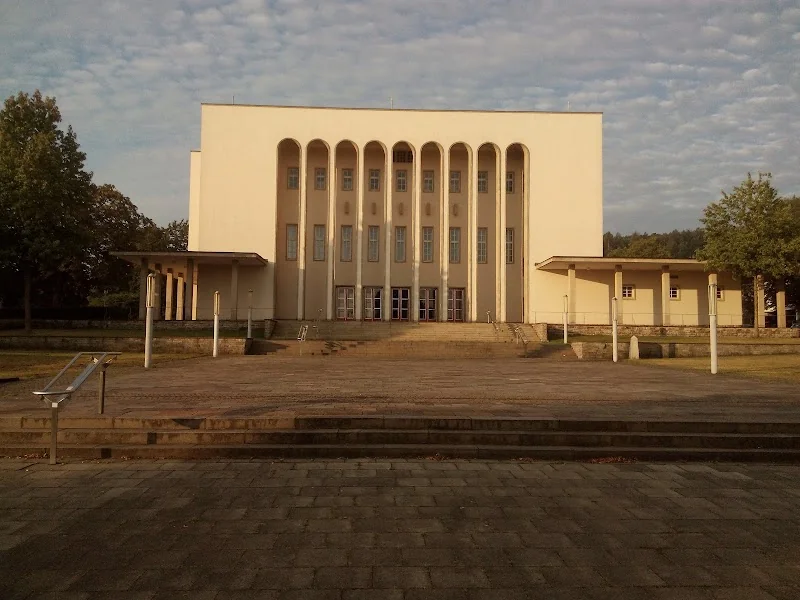
Bielefeld
33615 Bielefeld, Deutschland
Bielefeld, Rudolf-Oetker-Halle | Program & Hall Plan
The Rudolf-Oetker-Halle in Bielefeld is a venue that is not only visited but where sound, history, and urban culture are experienced in close quarters. Located directly at the Bürgerpark, the concert hall has been part of the city of Bielefeld since 2018 and is now managed by the city's stages and orchestras with artistic direction and administration. The Great Hall, the Small Hall, and the modern foyer together create a space where classical repertoire, jazz, dance, special formats, and cultural encounters complement each other meaningfully. The role of the Bielefeld Philharmonic is particularly significant, as they make the musical profile of the venue visible through symphony concerts, chamber music, and special program lines. Therefore, those searching for Rudolf-Oetker-Halle Bielefeld program, events, hall plan, capacity, or parking will find a location that remarkably connects tradition and the present. The venue serves as a concert hall, event location, and a strong cultural point of identity for Bielefeld and the region. ([buo-bielefeld.de](https://www.buo-bielefeld.de/rudolf-oetker-halle))
Program, Events, and Today's Dates
The program of the Rudolf-Oetker-Halle is intentionally diverse and covers much more than just classical symphony concerts. The official site consolidates the hall's own events and the concerts of the Bielefeld Philharmonic, supplemented by series such as ROH Concerts, Jazz in the Concert Hall, Nocturne, Specials, and previews of upcoming seasons. For user intent behind search queries like 'rudolf oetker halle bielefeld today' or 'rudolf oetker halle bielefeld events', this calendar logic is crucial: visitors find not only individual dates but a programmatic overview that well describes the character of the venue. Particularly helpful is that the homepage of the current season already displays the next events, weekend tips, and calendar access. This presents the hall online as a vibrant performance space that is regularly updated and immediately shows what is currently happening in the building. ([rudolf-oetker-halle.de](https://rudolf-oetker-halle.de/fileadmin/Downloads_Drucksachen/24-25/BiPhil_ROH_Konzert_Saisonheft_24-25.pdf))
Content-wise, the Rudolf-Oetker-Halle presents itself as a concert hall with a broad cultural spectrum. The official description emphasizes works of the classical-traditional repertoire as well as virtuosic jazz sessions and progressive formats of innovative musical life. It fits that the Bielefeld Philharmonic, as the resident orchestra, forms the programmatic center, while guest orchestras, ensembles, soloists, and emerging artists expand the spectrum. For the search for 'rudolf oetker halle bielefeld program', it is also relevant that the venue communicates introductions, chamber concerts, and special concerts, thus addressing various target groups. Anyone planning an evening in the Great Hall can expect a culturally rich offering that is by no means one-sided. The hall is therefore not just a venue for individual events but a program center that has grown over the year, sustainably enhancing the cultural visibility of the city of Bielefeld. ([buo-bielefeld.de](https://www.buo-bielefeld.de/rudolf-oetker-halle?utm_source=openai))
Parking and Access to the Rudolf-Oetker-Halle
Public transport plays a central role in accessing the Rudolf-Oetker-Halle. Officially, the city tram line 4 is named to the stop 'Rudolf-Oetker-Halle'; there is also a bus stop of the same name. The hall is located in Bielefeld-Mitte directly at the Bürgerpark, and the barrier-free side entrance is located on Lampingstraße. It is also important for visitors that the ticket for own events is valid as a ticket for city tram and bus lines from moBiel two hours before and two hours after the event in the Bielefeld area. Therefore, those finding the hall through search terms like 'rudolf oetker halle bielefeld access' or 'rudolf oetker halle bielefeld parking' receive immediate practical orientation: The venue is well connected to public transport, and arriving without a car is clearly planned and even actively recommended. ([buo-bielefeld.de](https://www.buo-bielefeld.de/infos-mehr/service/anfahrt))
Parking is a more complex issue. The official access page points out that there is only a limited number of public parking spaces at the Rudolf-Oetker-Halle. Therefore, visitors with cars are directed to parking lots at nearby schools and large parking areas in the university area. The Bielefeld Music Association also names specific alternatives nearby: the parking lot at Lampingstraße 16 with about 53 spaces and two hours of free parking, as well as the city parking spaces at Melanchthonstraße 15 with 160 free spaces, located about seven minutes on foot. For people with mobility impairments, additional information is also important, such as the accessible parking spaces on the HSBI parking lot opposite the side entrance. This combination of public recommendations, specific alternative spaces, and short walking distances makes access manageable for many guests. ([buo-bielefeld.de](https://www.buo-bielefeld.de/infos-mehr/service/anfahrt))
Hall Plan, Great Hall, and Seats
Those searching for 'rudolf oetker halle bielefeld hall plan' are usually interested in the seating structure in the Great Hall. According to the official room overview, the hall accommodates 1,561 people with a balcony and 941 people without a balcony and tiers. The stage or performance area measures 170 m², making the hall suitable for concert formats with varying sizes of ensembles. Additionally, the hall features a four-tier stage, existing music and sound systems, lighting systems, as well as cloakroom and backstage facilities. For practical planning, it is also relevant that there is a barrier-free entrance and accessible restrooms. The hall plan is therefore not just a graphic detail but an expression of a space logic consciously designed for concert experience and visitor comfort. The combination of size, classical concert architecture, and basic technical equipment makes the Great Hall the core of the location. ([kulturamt-bielefeld.de](https://kulturamt-bielefeld.de/kultur-service/raeumlichkeiten/roh-grosser-saal/))
Furthermore, the Rudolf-Oetker-Halle is not limited to a single room type. The official representation points to different rooms, and the website offers 360° views of the foyer, Small Hall, and Great Hall. This is particularly interesting for users who want to get a precise picture of the spatial structure before a visit or are searching for 'rudolf oetker halle bielefeld small hall'. According to program examples, the Small Hall is suitable for chamber concerts and introductions, while the foyer is used for more informal formats and encounters. Thus, the hall plan becomes more than just a seating arrangement: it shows the complexity of the venue and explains why the hall works for both large evenings and more intimate formats. Especially in conjunction with the modernized foyer, it becomes clear that traditional concert culture and flexible use do not contradict each other but complement each other. ([rudolf-oetker-halle.de](https://rudolf-oetker-halle.de/fileadmin/Downloads_Drucksachen/24-25/BiPhil_ROH_Konzert_Saisonheft_24-25.pdf))
Capacity and Equipment
Capacity is one of the central SEO points surrounding the Rudolf-Oetker-Halle, and here the official room overview provides clear facts. The Great Hall can accommodate 1,561 people with a balcony, and 941 people without a balcony and tiers. Additionally, there is a 170 m² performance area, kitchen and bar area, existing backstage facilities, and a generally event-oriented technical environment with power connections, sound, and lighting systems. Organizationally, the venue is also professionally set up: own personnel deployment is not possible, but staff is provided. For organizers, it is also interesting that guest and artist parking options are available. In combination with the indication that music and dance events are possible, a picture emerges of a concert hall that not only sounds beautiful but is also practically and operationally planned. ([kulturamt-bielefeld.de](https://kulturamt-bielefeld.de/kultur-service/raeumlichkeiten/roh-grosser-saal/))
Additionally, the spatial development of the venue in recent years is noteworthy. Since 2018, the Rudolf-Oetker-Halle has been part of the city of Bielefeld; in the same year, the foyer on the ground floor was redesigned and equipped with a new bar and stage. The current website also points to the ROH Garden, which opened in 2024 and adds a new outdoor dining area to the concert hall. These aspects are relevant for visitors as well as event planners because they show that the hall is not a museum relic but a developed cultural venue. The combination of historical architecture, updated quality of stay, modern foyer use, and diverse programming explains why the location performs so well in search queries regarding capacity, equipment, and special highlights. For a concert hall, the interplay of atmosphere, flexibility, and technical reliability is indeed a central quality factor. ([buo-bielefeld.de](https://www.buo-bielefeld.de/infos-mehr/das-sind-wir/ueber-uns))
History and Architectural Features
The history of the Rudolf-Oetker-Halle begins with a clear cultural idea. In 1925, the Oetker family wanted to finance a concert hall in memory of Dr. Rudolf Oetker for their hometown. In 1926, they decided, at the initiative of Mayor Dr. Rudolf Stapenhorst, on the location on the west side of the Bürgerpark. In 1927, the Düsseldorf architects Hans Tietmann and Kurt Haake won the architectural competition, in 1928 the design was optimized to ensure first-class acoustics, and in 1929 construction began. By 1930, the building was completed after only two years of construction and was inaugurated on October 31, 1930, with the City Orchestra as the Rudolf-Oetker-Halle. Even these early stages make it understandable why the hall is still perceived as a cultural landmark today: it was not built by chance but with the explicit goal of creating an appropriate concert hall and a home for the orchestra. ([buo-bielefeld.de](https://www.buo-bielefeld.de/infos-mehr/das-sind-wir/ueber-uns))
The further history shows how closely the hall is connected to urban development. In 1944, the northwestern extension was destroyed by a bombing raid, and in 1945 the reopening took place with Mozart's Requiem. In 1965, the city of Bielefeld erected a bust of Rudolf Oetker in the concert hall, in 1997 the roof structure was renewed, and during the city theater renovation from 2004 to 2006, the Rudolf-Oetker-Halle even served as an alternative venue for the music theater. In 2018, the city of Bielefeld took over the management and artistic direction of the stages and orchestras, and the foyer was redesigned at the same time. In 2024, the outdoor dining area ROH Garden was added. This timeline makes it clear that the hall has preserved its identity while continually adapting to new requirements. This blend of historical continuity and modern use is a key reason why the venue has remained culturally present in Bielefeld. ([buo-bielefeld.de](https://www.buo-bielefeld.de/infos-mehr/das-sind-wir/ueber-uns))
Accessibility, Small Hall, and Service
The Rudolf-Oetker-Halle is largely accessible and thus offers a clear practical strength. According to the official service description, access via the side entrance on Lampingstraße is barrier-free. There is an accessible restroom in the side foyer; from there, one can reach the bar in the main foyer at ground level or via elevator to the hall level. The Great Hall and the Small Hall are accessible, while the tier and balcony in the Great Hall are not accessible for wheelchair users. Additionally, wheelchair spaces are available in all price categories on the right side of the parquet at the edge of the hall. For search queries like 'rudolf oetker halle bielefeld accessibility' or 'rudolf oetker halle bielefeld small hall', these details are crucial as they show how concretely the visit on-site is organized. ([musikverein-bielefeld.de](https://www.musikverein-bielefeld.de/de/kontakt-und-anfahrt/))
Also, regarding service, the venue emphasizes transparency. There is no tactile guidance system, but on-site, one can approach the service staff. Additionally, the Music Association points out a stopping point at the taxi lane, the barrier-free entrance on Lampingstraße, and other accessible parking options. Together with the public transport note that the ticket is valid two hours before and after the event as a ticket, a rounded visitor experience is created for different needs. The Small Hall and the foyer complement the Great Hall meaningfully, as they provide space for chamber music, introductions, and more informal encounters. Thus, the Rudolf-Oetker-Halle is not only a major concert address but also a well-accessible cultural venue with thoughtful processes, clear orientation, and a visiting structure that convinces in practice. ([musikverein-bielefeld.de](https://www.musikverein-bielefeld.de/de/kontakt-und-anfahrt/))
Sources:
- Stages and Orchestras of the City of Bielefeld - About Us
- Stages and Orchestras of the City of Bielefeld - Access
- Stages and Orchestras of the City of Bielefeld - Accessibility
- Rudolf-Oetker-Halle - Official Website
- Cultural Office Bielefeld - Rudolf-Oetker-Halle, Great Hall
- Music Association Bielefeld - Contact and Access
Mehr anzeigenWeniger anzeigen
Bielefeld, Rudolf-Oetker-Halle | Program & Hall Plan
The Rudolf-Oetker-Halle in Bielefeld is a venue that is not only visited but where sound, history, and urban culture are experienced in close quarters. Located directly at the Bürgerpark, the concert hall has been part of the city of Bielefeld since 2018 and is now managed by the city's stages and orchestras with artistic direction and administration. The Great Hall, the Small Hall, and the modern foyer together create a space where classical repertoire, jazz, dance, special formats, and cultural encounters complement each other meaningfully. The role of the Bielefeld Philharmonic is particularly significant, as they make the musical profile of the venue visible through symphony concerts, chamber music, and special program lines. Therefore, those searching for Rudolf-Oetker-Halle Bielefeld program, events, hall plan, capacity, or parking will find a location that remarkably connects tradition and the present. The venue serves as a concert hall, event location, and a strong cultural point of identity for Bielefeld and the region. ([buo-bielefeld.de](https://www.buo-bielefeld.de/rudolf-oetker-halle))
Program, Events, and Today's Dates
The program of the Rudolf-Oetker-Halle is intentionally diverse and covers much more than just classical symphony concerts. The official site consolidates the hall's own events and the concerts of the Bielefeld Philharmonic, supplemented by series such as ROH Concerts, Jazz in the Concert Hall, Nocturne, Specials, and previews of upcoming seasons. For user intent behind search queries like 'rudolf oetker halle bielefeld today' or 'rudolf oetker halle bielefeld events', this calendar logic is crucial: visitors find not only individual dates but a programmatic overview that well describes the character of the venue. Particularly helpful is that the homepage of the current season already displays the next events, weekend tips, and calendar access. This presents the hall online as a vibrant performance space that is regularly updated and immediately shows what is currently happening in the building. ([rudolf-oetker-halle.de](https://rudolf-oetker-halle.de/fileadmin/Downloads_Drucksachen/24-25/BiPhil_ROH_Konzert_Saisonheft_24-25.pdf))
Content-wise, the Rudolf-Oetker-Halle presents itself as a concert hall with a broad cultural spectrum. The official description emphasizes works of the classical-traditional repertoire as well as virtuosic jazz sessions and progressive formats of innovative musical life. It fits that the Bielefeld Philharmonic, as the resident orchestra, forms the programmatic center, while guest orchestras, ensembles, soloists, and emerging artists expand the spectrum. For the search for 'rudolf oetker halle bielefeld program', it is also relevant that the venue communicates introductions, chamber concerts, and special concerts, thus addressing various target groups. Anyone planning an evening in the Great Hall can expect a culturally rich offering that is by no means one-sided. The hall is therefore not just a venue for individual events but a program center that has grown over the year, sustainably enhancing the cultural visibility of the city of Bielefeld. ([buo-bielefeld.de](https://www.buo-bielefeld.de/rudolf-oetker-halle?utm_source=openai))
Parking and Access to the Rudolf-Oetker-Halle
Public transport plays a central role in accessing the Rudolf-Oetker-Halle. Officially, the city tram line 4 is named to the stop 'Rudolf-Oetker-Halle'; there is also a bus stop of the same name. The hall is located in Bielefeld-Mitte directly at the Bürgerpark, and the barrier-free side entrance is located on Lampingstraße. It is also important for visitors that the ticket for own events is valid as a ticket for city tram and bus lines from moBiel two hours before and two hours after the event in the Bielefeld area. Therefore, those finding the hall through search terms like 'rudolf oetker halle bielefeld access' or 'rudolf oetker halle bielefeld parking' receive immediate practical orientation: The venue is well connected to public transport, and arriving without a car is clearly planned and even actively recommended. ([buo-bielefeld.de](https://www.buo-bielefeld.de/infos-mehr/service/anfahrt))
Parking is a more complex issue. The official access page points out that there is only a limited number of public parking spaces at the Rudolf-Oetker-Halle. Therefore, visitors with cars are directed to parking lots at nearby schools and large parking areas in the university area. The Bielefeld Music Association also names specific alternatives nearby: the parking lot at Lampingstraße 16 with about 53 spaces and two hours of free parking, as well as the city parking spaces at Melanchthonstraße 15 with 160 free spaces, located about seven minutes on foot. For people with mobility impairments, additional information is also important, such as the accessible parking spaces on the HSBI parking lot opposite the side entrance. This combination of public recommendations, specific alternative spaces, and short walking distances makes access manageable for many guests. ([buo-bielefeld.de](https://www.buo-bielefeld.de/infos-mehr/service/anfahrt))
Hall Plan, Great Hall, and Seats
Those searching for 'rudolf oetker halle bielefeld hall plan' are usually interested in the seating structure in the Great Hall. According to the official room overview, the hall accommodates 1,561 people with a balcony and 941 people without a balcony and tiers. The stage or performance area measures 170 m², making the hall suitable for concert formats with varying sizes of ensembles. Additionally, the hall features a four-tier stage, existing music and sound systems, lighting systems, as well as cloakroom and backstage facilities. For practical planning, it is also relevant that there is a barrier-free entrance and accessible restrooms. The hall plan is therefore not just a graphic detail but an expression of a space logic consciously designed for concert experience and visitor comfort. The combination of size, classical concert architecture, and basic technical equipment makes the Great Hall the core of the location. ([kulturamt-bielefeld.de](https://kulturamt-bielefeld.de/kultur-service/raeumlichkeiten/roh-grosser-saal/))
Furthermore, the Rudolf-Oetker-Halle is not limited to a single room type. The official representation points to different rooms, and the website offers 360° views of the foyer, Small Hall, and Great Hall. This is particularly interesting for users who want to get a precise picture of the spatial structure before a visit or are searching for 'rudolf oetker halle bielefeld small hall'. According to program examples, the Small Hall is suitable for chamber concerts and introductions, while the foyer is used for more informal formats and encounters. Thus, the hall plan becomes more than just a seating arrangement: it shows the complexity of the venue and explains why the hall works for both large evenings and more intimate formats. Especially in conjunction with the modernized foyer, it becomes clear that traditional concert culture and flexible use do not contradict each other but complement each other. ([rudolf-oetker-halle.de](https://rudolf-oetker-halle.de/fileadmin/Downloads_Drucksachen/24-25/BiPhil_ROH_Konzert_Saisonheft_24-25.pdf))
Capacity and Equipment
Capacity is one of the central SEO points surrounding the Rudolf-Oetker-Halle, and here the official room overview provides clear facts. The Great Hall can accommodate 1,561 people with a balcony, and 941 people without a balcony and tiers. Additionally, there is a 170 m² performance area, kitchen and bar area, existing backstage facilities, and a generally event-oriented technical environment with power connections, sound, and lighting systems. Organizationally, the venue is also professionally set up: own personnel deployment is not possible, but staff is provided. For organizers, it is also interesting that guest and artist parking options are available. In combination with the indication that music and dance events are possible, a picture emerges of a concert hall that not only sounds beautiful but is also practically and operationally planned. ([kulturamt-bielefeld.de](https://kulturamt-bielefeld.de/kultur-service/raeumlichkeiten/roh-grosser-saal/))
Additionally, the spatial development of the venue in recent years is noteworthy. Since 2018, the Rudolf-Oetker-Halle has been part of the city of Bielefeld; in the same year, the foyer on the ground floor was redesigned and equipped with a new bar and stage. The current website also points to the ROH Garden, which opened in 2024 and adds a new outdoor dining area to the concert hall. These aspects are relevant for visitors as well as event planners because they show that the hall is not a museum relic but a developed cultural venue. The combination of historical architecture, updated quality of stay, modern foyer use, and diverse programming explains why the location performs so well in search queries regarding capacity, equipment, and special highlights. For a concert hall, the interplay of atmosphere, flexibility, and technical reliability is indeed a central quality factor. ([buo-bielefeld.de](https://www.buo-bielefeld.de/infos-mehr/das-sind-wir/ueber-uns))
History and Architectural Features
The history of the Rudolf-Oetker-Halle begins with a clear cultural idea. In 1925, the Oetker family wanted to finance a concert hall in memory of Dr. Rudolf Oetker for their hometown. In 1926, they decided, at the initiative of Mayor Dr. Rudolf Stapenhorst, on the location on the west side of the Bürgerpark. In 1927, the Düsseldorf architects Hans Tietmann and Kurt Haake won the architectural competition, in 1928 the design was optimized to ensure first-class acoustics, and in 1929 construction began. By 1930, the building was completed after only two years of construction and was inaugurated on October 31, 1930, with the City Orchestra as the Rudolf-Oetker-Halle. Even these early stages make it understandable why the hall is still perceived as a cultural landmark today: it was not built by chance but with the explicit goal of creating an appropriate concert hall and a home for the orchestra. ([buo-bielefeld.de](https://www.buo-bielefeld.de/infos-mehr/das-sind-wir/ueber-uns))
The further history shows how closely the hall is connected to urban development. In 1944, the northwestern extension was destroyed by a bombing raid, and in 1945 the reopening took place with Mozart's Requiem. In 1965, the city of Bielefeld erected a bust of Rudolf Oetker in the concert hall, in 1997 the roof structure was renewed, and during the city theater renovation from 2004 to 2006, the Rudolf-Oetker-Halle even served as an alternative venue for the music theater. In 2018, the city of Bielefeld took over the management and artistic direction of the stages and orchestras, and the foyer was redesigned at the same time. In 2024, the outdoor dining area ROH Garden was added. This timeline makes it clear that the hall has preserved its identity while continually adapting to new requirements. This blend of historical continuity and modern use is a key reason why the venue has remained culturally present in Bielefeld. ([buo-bielefeld.de](https://www.buo-bielefeld.de/infos-mehr/das-sind-wir/ueber-uns))
Accessibility, Small Hall, and Service
The Rudolf-Oetker-Halle is largely accessible and thus offers a clear practical strength. According to the official service description, access via the side entrance on Lampingstraße is barrier-free. There is an accessible restroom in the side foyer; from there, one can reach the bar in the main foyer at ground level or via elevator to the hall level. The Great Hall and the Small Hall are accessible, while the tier and balcony in the Great Hall are not accessible for wheelchair users. Additionally, wheelchair spaces are available in all price categories on the right side of the parquet at the edge of the hall. For search queries like 'rudolf oetker halle bielefeld accessibility' or 'rudolf oetker halle bielefeld small hall', these details are crucial as they show how concretely the visit on-site is organized. ([musikverein-bielefeld.de](https://www.musikverein-bielefeld.de/de/kontakt-und-anfahrt/))
Also, regarding service, the venue emphasizes transparency. There is no tactile guidance system, but on-site, one can approach the service staff. Additionally, the Music Association points out a stopping point at the taxi lane, the barrier-free entrance on Lampingstraße, and other accessible parking options. Together with the public transport note that the ticket is valid two hours before and after the event as a ticket, a rounded visitor experience is created for different needs. The Small Hall and the foyer complement the Great Hall meaningfully, as they provide space for chamber music, introductions, and more informal encounters. Thus, the Rudolf-Oetker-Halle is not only a major concert address but also a well-accessible cultural venue with thoughtful processes, clear orientation, and a visiting structure that convinces in practice. ([musikverein-bielefeld.de](https://www.musikverein-bielefeld.de/de/kontakt-und-anfahrt/))
Sources:
- Stages and Orchestras of the City of Bielefeld - About Us
- Stages and Orchestras of the City of Bielefeld - Access
- Stages and Orchestras of the City of Bielefeld - Accessibility
- Rudolf-Oetker-Halle - Official Website
- Cultural Office Bielefeld - Rudolf-Oetker-Halle, Great Hall
- Music Association Bielefeld - Contact and Access
Bielefeld, Rudolf-Oetker-Halle | Program & Hall Plan
The Rudolf-Oetker-Halle in Bielefeld is a venue that is not only visited but where sound, history, and urban culture are experienced in close quarters. Located directly at the Bürgerpark, the concert hall has been part of the city of Bielefeld since 2018 and is now managed by the city's stages and orchestras with artistic direction and administration. The Great Hall, the Small Hall, and the modern foyer together create a space where classical repertoire, jazz, dance, special formats, and cultural encounters complement each other meaningfully. The role of the Bielefeld Philharmonic is particularly significant, as they make the musical profile of the venue visible through symphony concerts, chamber music, and special program lines. Therefore, those searching for Rudolf-Oetker-Halle Bielefeld program, events, hall plan, capacity, or parking will find a location that remarkably connects tradition and the present. The venue serves as a concert hall, event location, and a strong cultural point of identity for Bielefeld and the region. ([buo-bielefeld.de](https://www.buo-bielefeld.de/rudolf-oetker-halle))
Program, Events, and Today's Dates
The program of the Rudolf-Oetker-Halle is intentionally diverse and covers much more than just classical symphony concerts. The official site consolidates the hall's own events and the concerts of the Bielefeld Philharmonic, supplemented by series such as ROH Concerts, Jazz in the Concert Hall, Nocturne, Specials, and previews of upcoming seasons. For user intent behind search queries like 'rudolf oetker halle bielefeld today' or 'rudolf oetker halle bielefeld events', this calendar logic is crucial: visitors find not only individual dates but a programmatic overview that well describes the character of the venue. Particularly helpful is that the homepage of the current season already displays the next events, weekend tips, and calendar access. This presents the hall online as a vibrant performance space that is regularly updated and immediately shows what is currently happening in the building. ([rudolf-oetker-halle.de](https://rudolf-oetker-halle.de/fileadmin/Downloads_Drucksachen/24-25/BiPhil_ROH_Konzert_Saisonheft_24-25.pdf))
Content-wise, the Rudolf-Oetker-Halle presents itself as a concert hall with a broad cultural spectrum. The official description emphasizes works of the classical-traditional repertoire as well as virtuosic jazz sessions and progressive formats of innovative musical life. It fits that the Bielefeld Philharmonic, as the resident orchestra, forms the programmatic center, while guest orchestras, ensembles, soloists, and emerging artists expand the spectrum. For the search for 'rudolf oetker halle bielefeld program', it is also relevant that the venue communicates introductions, chamber concerts, and special concerts, thus addressing various target groups. Anyone planning an evening in the Great Hall can expect a culturally rich offering that is by no means one-sided. The hall is therefore not just a venue for individual events but a program center that has grown over the year, sustainably enhancing the cultural visibility of the city of Bielefeld. ([buo-bielefeld.de](https://www.buo-bielefeld.de/rudolf-oetker-halle?utm_source=openai))
Parking and Access to the Rudolf-Oetker-Halle
Public transport plays a central role in accessing the Rudolf-Oetker-Halle. Officially, the city tram line 4 is named to the stop 'Rudolf-Oetker-Halle'; there is also a bus stop of the same name. The hall is located in Bielefeld-Mitte directly at the Bürgerpark, and the barrier-free side entrance is located on Lampingstraße. It is also important for visitors that the ticket for own events is valid as a ticket for city tram and bus lines from moBiel two hours before and two hours after the event in the Bielefeld area. Therefore, those finding the hall through search terms like 'rudolf oetker halle bielefeld access' or 'rudolf oetker halle bielefeld parking' receive immediate practical orientation: The venue is well connected to public transport, and arriving without a car is clearly planned and even actively recommended. ([buo-bielefeld.de](https://www.buo-bielefeld.de/infos-mehr/service/anfahrt))
Parking is a more complex issue. The official access page points out that there is only a limited number of public parking spaces at the Rudolf-Oetker-Halle. Therefore, visitors with cars are directed to parking lots at nearby schools and large parking areas in the university area. The Bielefeld Music Association also names specific alternatives nearby: the parking lot at Lampingstraße 16 with about 53 spaces and two hours of free parking, as well as the city parking spaces at Melanchthonstraße 15 with 160 free spaces, located about seven minutes on foot. For people with mobility impairments, additional information is also important, such as the accessible parking spaces on the HSBI parking lot opposite the side entrance. This combination of public recommendations, specific alternative spaces, and short walking distances makes access manageable for many guests. ([buo-bielefeld.de](https://www.buo-bielefeld.de/infos-mehr/service/anfahrt))
Hall Plan, Great Hall, and Seats
Those searching for 'rudolf oetker halle bielefeld hall plan' are usually interested in the seating structure in the Great Hall. According to the official room overview, the hall accommodates 1,561 people with a balcony and 941 people without a balcony and tiers. The stage or performance area measures 170 m², making the hall suitable for concert formats with varying sizes of ensembles. Additionally, the hall features a four-tier stage, existing music and sound systems, lighting systems, as well as cloakroom and backstage facilities. For practical planning, it is also relevant that there is a barrier-free entrance and accessible restrooms. The hall plan is therefore not just a graphic detail but an expression of a space logic consciously designed for concert experience and visitor comfort. The combination of size, classical concert architecture, and basic technical equipment makes the Great Hall the core of the location. ([kulturamt-bielefeld.de](https://kulturamt-bielefeld.de/kultur-service/raeumlichkeiten/roh-grosser-saal/))
Furthermore, the Rudolf-Oetker-Halle is not limited to a single room type. The official representation points to different rooms, and the website offers 360° views of the foyer, Small Hall, and Great Hall. This is particularly interesting for users who want to get a precise picture of the spatial structure before a visit or are searching for 'rudolf oetker halle bielefeld small hall'. According to program examples, the Small Hall is suitable for chamber concerts and introductions, while the foyer is used for more informal formats and encounters. Thus, the hall plan becomes more than just a seating arrangement: it shows the complexity of the venue and explains why the hall works for both large evenings and more intimate formats. Especially in conjunction with the modernized foyer, it becomes clear that traditional concert culture and flexible use do not contradict each other but complement each other. ([rudolf-oetker-halle.de](https://rudolf-oetker-halle.de/fileadmin/Downloads_Drucksachen/24-25/BiPhil_ROH_Konzert_Saisonheft_24-25.pdf))
Capacity and Equipment
Capacity is one of the central SEO points surrounding the Rudolf-Oetker-Halle, and here the official room overview provides clear facts. The Great Hall can accommodate 1,561 people with a balcony, and 941 people without a balcony and tiers. Additionally, there is a 170 m² performance area, kitchen and bar area, existing backstage facilities, and a generally event-oriented technical environment with power connections, sound, and lighting systems. Organizationally, the venue is also professionally set up: own personnel deployment is not possible, but staff is provided. For organizers, it is also interesting that guest and artist parking options are available. In combination with the indication that music and dance events are possible, a picture emerges of a concert hall that not only sounds beautiful but is also practically and operationally planned. ([kulturamt-bielefeld.de](https://kulturamt-bielefeld.de/kultur-service/raeumlichkeiten/roh-grosser-saal/))
Additionally, the spatial development of the venue in recent years is noteworthy. Since 2018, the Rudolf-Oetker-Halle has been part of the city of Bielefeld; in the same year, the foyer on the ground floor was redesigned and equipped with a new bar and stage. The current website also points to the ROH Garden, which opened in 2024 and adds a new outdoor dining area to the concert hall. These aspects are relevant for visitors as well as event planners because they show that the hall is not a museum relic but a developed cultural venue. The combination of historical architecture, updated quality of stay, modern foyer use, and diverse programming explains why the location performs so well in search queries regarding capacity, equipment, and special highlights. For a concert hall, the interplay of atmosphere, flexibility, and technical reliability is indeed a central quality factor. ([buo-bielefeld.de](https://www.buo-bielefeld.de/infos-mehr/das-sind-wir/ueber-uns))
History and Architectural Features
The history of the Rudolf-Oetker-Halle begins with a clear cultural idea. In 1925, the Oetker family wanted to finance a concert hall in memory of Dr. Rudolf Oetker for their hometown. In 1926, they decided, at the initiative of Mayor Dr. Rudolf Stapenhorst, on the location on the west side of the Bürgerpark. In 1927, the Düsseldorf architects Hans Tietmann and Kurt Haake won the architectural competition, in 1928 the design was optimized to ensure first-class acoustics, and in 1929 construction began. By 1930, the building was completed after only two years of construction and was inaugurated on October 31, 1930, with the City Orchestra as the Rudolf-Oetker-Halle. Even these early stages make it understandable why the hall is still perceived as a cultural landmark today: it was not built by chance but with the explicit goal of creating an appropriate concert hall and a home for the orchestra. ([buo-bielefeld.de](https://www.buo-bielefeld.de/infos-mehr/das-sind-wir/ueber-uns))
The further history shows how closely the hall is connected to urban development. In 1944, the northwestern extension was destroyed by a bombing raid, and in 1945 the reopening took place with Mozart's Requiem. In 1965, the city of Bielefeld erected a bust of Rudolf Oetker in the concert hall, in 1997 the roof structure was renewed, and during the city theater renovation from 2004 to 2006, the Rudolf-Oetker-Halle even served as an alternative venue for the music theater. In 2018, the city of Bielefeld took over the management and artistic direction of the stages and orchestras, and the foyer was redesigned at the same time. In 2024, the outdoor dining area ROH Garden was added. This timeline makes it clear that the hall has preserved its identity while continually adapting to new requirements. This blend of historical continuity and modern use is a key reason why the venue has remained culturally present in Bielefeld. ([buo-bielefeld.de](https://www.buo-bielefeld.de/infos-mehr/das-sind-wir/ueber-uns))
Accessibility, Small Hall, and Service
The Rudolf-Oetker-Halle is largely accessible and thus offers a clear practical strength. According to the official service description, access via the side entrance on Lampingstraße is barrier-free. There is an accessible restroom in the side foyer; from there, one can reach the bar in the main foyer at ground level or via elevator to the hall level. The Great Hall and the Small Hall are accessible, while the tier and balcony in the Great Hall are not accessible for wheelchair users. Additionally, wheelchair spaces are available in all price categories on the right side of the parquet at the edge of the hall. For search queries like 'rudolf oetker halle bielefeld accessibility' or 'rudolf oetker halle bielefeld small hall', these details are crucial as they show how concretely the visit on-site is organized. ([musikverein-bielefeld.de](https://www.musikverein-bielefeld.de/de/kontakt-und-anfahrt/))
Also, regarding service, the venue emphasizes transparency. There is no tactile guidance system, but on-site, one can approach the service staff. Additionally, the Music Association points out a stopping point at the taxi lane, the barrier-free entrance on Lampingstraße, and other accessible parking options. Together with the public transport note that the ticket is valid two hours before and after the event as a ticket, a rounded visitor experience is created for different needs. The Small Hall and the foyer complement the Great Hall meaningfully, as they provide space for chamber music, introductions, and more informal encounters. Thus, the Rudolf-Oetker-Halle is not only a major concert address but also a well-accessible cultural venue with thoughtful processes, clear orientation, and a visiting structure that convinces in practice. ([musikverein-bielefeld.de](https://www.musikverein-bielefeld.de/de/kontakt-und-anfahrt/))
Sources:
- Stages and Orchestras of the City of Bielefeld - About Us
- Stages and Orchestras of the City of Bielefeld - Access
- Stages and Orchestras of the City of Bielefeld - Accessibility
- Rudolf-Oetker-Halle - Official Website
- Cultural Office Bielefeld - Rudolf-Oetker-Halle, Great Hall
- Music Association Bielefeld - Contact and Access
Upcoming Events
No events found
Frequently Asked Questions
Reviews
No reviews found