
Bielefeld
Melanchthonstraße 31a, 33615 Bielefeld, Deutschland
Bielefelder Alm | Tickets & Capacity
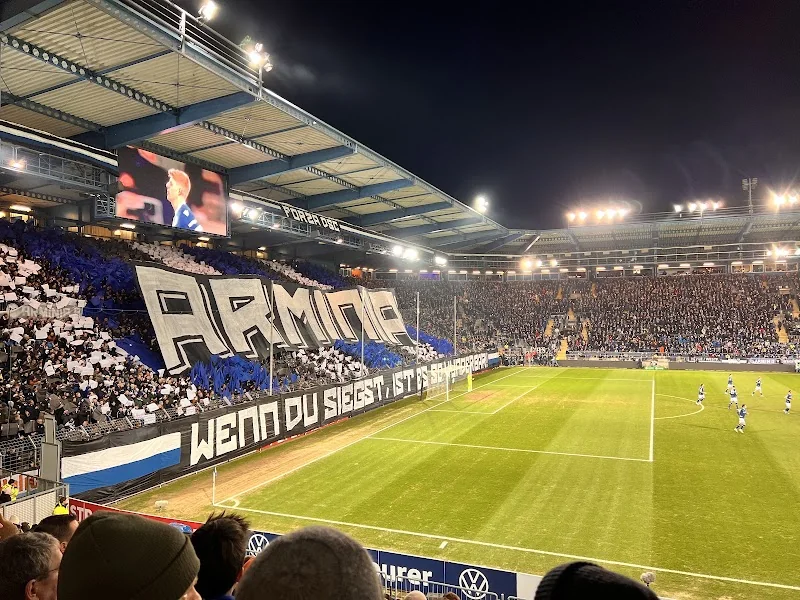
The Bielefelder Alm is one of those places where football is not just played, but lived. Located at Melanchthonstraße 31a in Bielefeld, it is the traditional home ground of DSC Arminia Bielefeld, which is officially called SchücoArena today, but remains simply known as the Alm among fans. With its current capacity of 26,750 seats, including 18,703 seats and 8,047 standing places, it is compact, loud, and identity-forming. The name SchücoArena has been in use since January 2004; the partnership with Schüco is now so closely intertwined with the stadium that it will continue at least until June 30, 2028. This blend of tradition, modernization, and regional anchoring makes the Bielefelder Alm one of the most distinctive football venues in East Westphalia. ([arminia.de](https://www.arminia.de/der-dsc/schueco-arena))
Those looking for Bielefelder Alm tickets, the away block, the best seats, or the history of the stadium are usually searching for not just an address, but an experience. The Alm represents close proximity to the pitch, a clear stadium structure, good accessibility, and a fan culture that has grown over decades. At the same time, the arena today offers modern services for visitors, a comprehensible block division, and spaces that can be used even outside match days. This connection of football romance and contemporary infrastructure runs through the entire stadium history. ([arminia.de](https://www.arminia.de/der-dsc/schueco-arena))
Tickets, Seats, and Capacity of the Bielefelder Alm
For many fans, the first question regarding the Bielefelder Alm is about tickets and seats. The current official stadium capacity is 26,750 spectators. In normal operations, this allocation is divided into 18,703 seats and 8,047 standing places. Therefore, anyone wishing to attend a home game at the SchücoArena will find a classic stadium architecture where standing culture and seating comfort coexist. This is part of the appeal for many Arminia fans: The Alm is large enough for a dense football atmosphere but remains designed so that one perceives the game closely and directly. ([arminia.de](https://www.arminia.de/der-dsc/schueco-arena))
The ticketing also shows that the stadium is aimed at different target groups. Arminia has specific contingents for people with disabilities, including places for wheelchair users, for people with visual impairments, for people with severe disabilities, for deaf fans, and for people with autism. Special pricing and access regulations apply to wheelchair spaces, visually impaired spaces, and other barrier-free offerings. Anyone with questions about tickets can find tickets for these areas in the fan shops or via email inquiry to the club. This connects the Alm's classic stadium atmosphere with a visitor offering that addresses different needs. ([arminia.de](https://www.arminia.de/leichte-sprache/tickets-preise?utm_source=openai))
Practically important for all visitors: The stadium usually opens about 1.5 hours before the match begins. A surcharge applies for day tickets at the box office, so it is worth purchasing in advance through the online fan shop or other official sales channels. For families with small children, there are also so-called lap tickets, which are only available on match days and in limited numbers. Especially for sold-out matches, it is advisable to plan early, as the Bielefelder Alm regularly experiences high demand for games and tickets can sell out quickly depending on the opponent. Those who want to be safe should organize their travel and tickets as early as possible and use the club's official channels. ([arminia.de](https://www.arminia.de/der-dsc/schueco-arena/fragen-und-antworten-zum-stadionbesuch?utm_source=openai))
In summary, the Bielefelder Alm is not only a place with high capacity but also a stadium with a clear spectator concept. Seats, standing areas, and barrier-free zones are clearly defined, the ticket logic is transparent, and even special forms like lap tickets or day ticket surcharges are publicly regulated. This makes the Alm as predictable for guests as it is for season ticket holders, families, and away fans. ([arminia.de](https://www.arminia.de/der-dsc/schueco-arena))
Away Block and Stadium Map in the SchücoArena
The away block is particularly important for many inquiries regarding the Bielefelder Alm because the stadium structure is very clearly organized here. Away fans use blocks A1, A2, and B1 in the SchücoArena. A1 is designated as a standing area, while A2 and B1 are seating areas, and all three areas are located on the north stand. Upon entry for competitive matches, away fans must use the north entrance via Schlosshofstraße. This separation facilitates orientation, ensures clear pathways, and is central to an orderly stadium visit. ([arminia.de](https://www.arminia.de/fans/gaestefans))
There are also clear rules around the away area. Access in opposing fan clothing is not permitted throughout the entire south stand and in blocks I and J. Bags, backpacks, and similar items must generally be deposited at the guest entrance in the away area. At the same time, the club provides catering stands with drinks, sausages, fries, pretzels, and other offerings, although alcohol may be restricted depending on the match. For away fans, the Bielefelder Alm is not only a stadium with a home advantage for Arminia but also a well-structured venue with clear processes. ([arminia.de](https://www.arminia.de/fans/gaestefans))
The official stadium map complements this information sensibly, as it marks the most important points of contact for the stadium visit. According to Arminia, it includes, among other things, medical services, emergency vehicles, and other visitor information, making it easier to orient oneself on-site. Especially in an arena with multiple stands, various entrances, and different spectator areas, this overview is more than just a service detail: it is an important part of a safe and stress-free stadium visit. Therefore, anyone looking for the stadium map of the Bielefelder Alm will find not just a simple graphic but a practical guide for the entire visit day. ([arminia.de](https://www.arminia.de/der-dsc/schueco-arena/stadionplan))
For arriving away fans, there are also additional notes: Parking spaces for cars are not available in the immediate vicinity of the stadium, which is why Arminia recommends the designated parking garage of the university. It is about a 15-minute walk from Bielefeld main station to the stadium, and if a shuttle bus is used on match day, it must be utilized. Combined with the clear block system, this creates a visitor profile that presents the Bielefelder Alm as a modern stadium with proper fan separation and comprehensible pathways. ([arminia.de](https://www.arminia.de/fans/gaestefans))
Directions, Parking, and the Best Route to the Alm
The Bielefelder Alm is surprisingly centrally located for a large stadium. Arminia describes the arena itself as a stadium in the middle of the city or in the heart of Bielefeld's west. This makes a visit on foot particularly attractive, especially for fans from the surrounding area. The walk from Bielefeld main station to the SchücoArena takes about 20 minutes, making the stadium easily accessible without a car. This is an important advantage for home games, as travel can be planned quite relaxed this way, and one can still meet other Arminia fans, pubs, or meeting points along the way. ([arminia.de](https://www.arminia.de/der-dsc/schueco-arena/anfahrt))
With bus, train, and light rail, the Alm is also well connected. Arminia points to light rail line 4 with stops at Rudolf-Oetker-Halle for the south stand and Graf-von-Stauffenberg-Straße for the west and north stands. For the away area, stops including Wittekindstraße and Nordpark are mentioned, as well as bus lines depending on the connection. Additionally, the entry ticket serves as a fare ticket for local public transport, both for day and season tickets in the TeutoOWL network and on certain regional train routes. This makes traveling by public transport not only convenient but also economically interesting in the context of match days. ([arminia.de](https://www.arminia.de/der-dsc/schueco-arena/anfahrt))
Those arriving by bicycle will find several official parking options around the stadium. Arminia mentions, among other things, a bicycle parking area on the gravel lot between the south and east entrances with 310 spaces, as well as another bicycle parking area at Max-Planck-Gymnasium with 240 spaces. Additional public parking options are available in the vicinity of the stadium, such as at Almhalle, Gertrud-Bäumer-Schule, or Rudolf-Oetker-Halle. Especially in a city like Bielefeld, where short distances and a mix of residential area, light rail, and stadium location come together, the bicycle is a very logical option for many visitors. ([arminia.de](https://www.arminia.de/der-dsc/schueco-arena/anfahrt))
For drivers, the club explicitly recommends using P+R areas in the city. Various parking options from different directions are listed, such as Brackwede Bahnhof, Sennestadt Bahnhof, Windelsbleiche, Sieker Stadtbahn, Milse, and other locations. For away fans, there is also a clear message that no parking spaces for cars are available in the immediate vicinity of the stadium. Those who want to remain flexible should therefore use public transport or combine their car with a park-and-ride offer. This keeps the area around the Bielefelder Alm relieved on match days, and the last section to the stadium can be covered by train, shuttle, or on foot. ([arminia.de](https://www.arminia.de/der-dsc/schueco-arena/anfahrt))
The best way to get to the Alm is usually the one that is planned early: on foot for fans from the neighborhood, by light rail or bus for those who want to arrive comfortably without searching for parking, and with P+R for guests who rely on their car. This mix of proximity to the city center, public transport connections, and clear visitor information makes the Bielefelder Alm a very well-readable stadium address. ([arminia.de](https://www.arminia.de/der-dsc/schueco-arena/anfahrt))
Earlier, Name, and 100 Years of Stadium History
The history of the Bielefelder Alm began on May 1, 1926. At that time, the football field at Melanchthonstraße was inaugurated with a friendly match against SC Victoria Hamburg. The site was not yet a modern sports arena at that time, but rather an uneven area without grass, stands, or changing rooms. Fans gathered on hills and earth embankments, and from this improvised playing field, the legendary name Alm developed over decades. The place was thus characterized from the beginning by proximity, simplicity, and the special improvisation that many traditional stadiums embody. ([arminia.de](https://www.arminia.de/neues/schlagzeilen/detail/100-jahre-stadion-an-der-melanchthonstrasse-1))
In the following decades, the facility grew step by step. After World War II, the site was surrounded by rubble, yet even then, up to 20,000 fans came, some with folding chairs. In the 1950s and 1960s, the first provisional stands and spectator areas were built, while the teams still changed in a nearby pub. The stadium gradually transformed from a meadow into a true football venue. The development in the 1970s was particularly significant when Arminia first rose to the Bundesliga: steel tube stands, floodlight masts, and the legendary lion cage made the Alm one of the most uncomfortable yet atmospheric away destinations in German football. ([arminia.de](https://www.arminia.de/neues/schlagzeilen/detail/100-jahre-stadion-an-der-melanchthonstrasse-1))
A highlight of that time was the attendance record of 1978. The Alm was expanded again, the capacity was around 35,000, and during the match against 1. FC Kaiserslautern, around 36,000 people were said to have been in the stadium. The atmosphere was considered dense, loud, and intense because the fans stood very close to the pitch, and the roof over the main stand further amplified the noise. However, in the 1980s, a phase of downsizing followed: after a mass panic at the European Cup final in 1985, security requirements tightened, steel tube stands had to be removed, and the capacity dropped to about 15,000 spectators. These setbacks were painful but simultaneously prepared the later reconstruction on solid ground. ([arminia.de](https://www.arminia.de/neues/schlagzeilen/detail/100-jahre-stadion-an-der-melanchthonstrasse-1))
In the 1990s, the Alm faced the question of whether a new building at a different location or an expansion at the historic site would be the right solution. Arminia opted for the preservation and further development of the home ground. The north and west stands were rebuilt, and the spectator capacity first increased to 22,512 and then to 26,601 seats after further work. With the construction of the west stand, changing rooms, press and VIP areas were added, an electronic scoreboard was installed, and a pitch heating system was integrated. In the summer of 2000, the office was established between the east and south stands, which is still in use today. This transformed the old Alm into a Bundesliga-capable stadium with a modern structure. ([arminia.de](https://www.arminia.de/neues/schlagzeilen/detail/100-jahre-stadion-an-der-melanchthonstrasse-1))
The next major turning point was marked by January 13, 2004: Schüco International KG acquired the naming rights, and the Alm became the SchücoArena. Since then, there has been no other naming sponsor. For many fans, however, the old name remained alive, which is why the club consciously looked back at the history at Melanchthonstraße for the 100th anniversary of the stadium in 2026 and temporarily put the Alm back in the spotlight. The anniversary made it clear how strongly this place is connected to the identity of the club: from the cow pasture to the modern stadium, from provisional earth embankments to the SchücoArena, from a local sports venue to a symbol for generations of Arminia fans. ([arminia.de](https://www.arminia.de/neues/schlagzeilen/detail/100-jahre-stadion-an-der-melanchthonstrasse-1))
Facilities, Events, and Stadium Tours
The Bielefelder Alm is now much more than a place for 90 minutes of football. Arminia explicitly describes the SchücoArena as an event location for conferences, seminars, meetings, and exhibitions. The event spaces offer room for meetings, workshops, and larger corporate events, combined with current technology and a catering partner. This is important for the search intent around the Bielefelder Alm, as many users are not only asking about match operations but also looking for opportunities for events, business appointments, or celebrations in the stadium environment. The arena thus combines sporting tradition with modern usability. ([arminia.de](https://www.arminia.de/der-dsc/schueco-arena/veranstaltung?utm_source=openai))
The hospitality area has also been further expanded in recent years. Arminia points out that the largest VIP area of the SchücoArena, the gastro area in the lower tier of the east stand, covers more than 1,500 square meters. At the same time, stadium spaces are used around match days and beyond for different formats. This ranges from classic home games to youth and women's football to events where the stadium is deliberately staged as a special place. This versatility distinguishes the Alm from many purely football arenas. ([arminia.de](https://www.arminia.de/neues/schlagzeilen/detail/aus-dem-krombacher-stammtisch-wird-der-volksbank-stammtisch?utm_source=openai))
Stadium tours are also very popular. Those who want to take a look behind the scenes at the SchücoArena can book a public stadium tour through the online fan shop. It lasts about 90 minutes and costs 12 euros for adults and 8 euros for children up to and including 14 years. Arminia also offers private tours. During the tour, insights into changing rooms, press areas, player zones, and other areas that normal spectators do not usually see are provided. For many families, groups, and football fans, this is an ideal way to experience the Alm even outside of a home game. ([arminia.de](https://www.arminia.de/der-dsc/schueco-arena/stadionfuehrungen?utm_source=openai))
Another important anchor is the MAFA, the club museum of Arminia. There, you can dive deep into the black-white-blue history on Tuesdays and Thursdays between 2 PM and 6 PM, watch videos, listen to reports, and admire jerseys and other memorabilia. The museum also recalls the development from the Alm to the SchücoArena through a timeline and video. Together with the stadium tours and event spaces, the MAFA shows that the Bielefelder Alm is not just a venue but a cultural and historical site. ([arminia.de](https://www.arminia.de/der-dsc/schueco-arena/mafa?utm_source=openai))
Additionally, Arminia regularly uses the arena for projects beyond league matches, such as training offers from the football school, special actions, or events where the atmosphere of the stadium is deliberately taken along. For visitors, this means: The Bielefelder Alm remains lively, versatile, and approachable, even when there is no competitive match taking place. Therefore, anyone looking for a location with history, identity, modern infrastructure, and genuine stadium soul will find exactly this mix here. ([fussballschule.arminia.de](https://fussballschule.arminia.de/de/portal/events/451-trainieren-auf-dem-heiligen-rasen-der-sch-coarena?utm_source=openai))
Sources:
- DSC Arminia Bielefeld - SchücoArena ([arminia.de](https://www.arminia.de/der-dsc/schueco-arena))
- DSC Arminia Bielefeld - Directions ([arminia.de](https://www.arminia.de/der-dsc/schueco-arena/anfahrt))
- DSC Arminia Bielefeld - Away Fans ([arminia.de](https://www.arminia.de/fans/gaestefans))
- DSC Arminia Bielefeld - 100 Years of Stadium at Melanchthonstraße ([arminia.de](https://www.arminia.de/neues/schlagzeilen/detail/100-jahre-stadion-an-der-melanchthonstrasse-1))
- DSC Arminia Bielefeld - Stadium Tours ([arminia.de](https://www.arminia.de/der-dsc/schueco-arena/stadionfuehrungen?utm_source=openai))
- DSC Arminia Bielefeld - MAFA ([arminia.de](https://www.arminia.de/der-dsc/schueco-arena/mafa?utm_source=openai))
- DSC Arminia Bielefeld - Event Spaces in the SchücoArena ([arminia.de](https://www.arminia.de/der-dsc/schueco-arena/veranstaltung?utm_source=openai))
Mehr anzeigenWeniger anzeigen
Bielefelder Alm | Tickets & Capacity
The Bielefelder Alm is one of those places where football is not just played, but lived. Located at Melanchthonstraße 31a in Bielefeld, it is the traditional home ground of DSC Arminia Bielefeld, which is officially called SchücoArena today, but remains simply known as the Alm among fans. With its current capacity of 26,750 seats, including 18,703 seats and 8,047 standing places, it is compact, loud, and identity-forming. The name SchücoArena has been in use since January 2004; the partnership with Schüco is now so closely intertwined with the stadium that it will continue at least until June 30, 2028. This blend of tradition, modernization, and regional anchoring makes the Bielefelder Alm one of the most distinctive football venues in East Westphalia. ([arminia.de](https://www.arminia.de/der-dsc/schueco-arena))
Those looking for Bielefelder Alm tickets, the away block, the best seats, or the history of the stadium are usually searching for not just an address, but an experience. The Alm represents close proximity to the pitch, a clear stadium structure, good accessibility, and a fan culture that has grown over decades. At the same time, the arena today offers modern services for visitors, a comprehensible block division, and spaces that can be used even outside match days. This connection of football romance and contemporary infrastructure runs through the entire stadium history. ([arminia.de](https://www.arminia.de/der-dsc/schueco-arena))
Tickets, Seats, and Capacity of the Bielefelder Alm
For many fans, the first question regarding the Bielefelder Alm is about tickets and seats. The current official stadium capacity is 26,750 spectators. In normal operations, this allocation is divided into 18,703 seats and 8,047 standing places. Therefore, anyone wishing to attend a home game at the SchücoArena will find a classic stadium architecture where standing culture and seating comfort coexist. This is part of the appeal for many Arminia fans: The Alm is large enough for a dense football atmosphere but remains designed so that one perceives the game closely and directly. ([arminia.de](https://www.arminia.de/der-dsc/schueco-arena))
The ticketing also shows that the stadium is aimed at different target groups. Arminia has specific contingents for people with disabilities, including places for wheelchair users, for people with visual impairments, for people with severe disabilities, for deaf fans, and for people with autism. Special pricing and access regulations apply to wheelchair spaces, visually impaired spaces, and other barrier-free offerings. Anyone with questions about tickets can find tickets for these areas in the fan shops or via email inquiry to the club. This connects the Alm's classic stadium atmosphere with a visitor offering that addresses different needs. ([arminia.de](https://www.arminia.de/leichte-sprache/tickets-preise?utm_source=openai))
Practically important for all visitors: The stadium usually opens about 1.5 hours before the match begins. A surcharge applies for day tickets at the box office, so it is worth purchasing in advance through the online fan shop or other official sales channels. For families with small children, there are also so-called lap tickets, which are only available on match days and in limited numbers. Especially for sold-out matches, it is advisable to plan early, as the Bielefelder Alm regularly experiences high demand for games and tickets can sell out quickly depending on the opponent. Those who want to be safe should organize their travel and tickets as early as possible and use the club's official channels. ([arminia.de](https://www.arminia.de/der-dsc/schueco-arena/fragen-und-antworten-zum-stadionbesuch?utm_source=openai))
In summary, the Bielefelder Alm is not only a place with high capacity but also a stadium with a clear spectator concept. Seats, standing areas, and barrier-free zones are clearly defined, the ticket logic is transparent, and even special forms like lap tickets or day ticket surcharges are publicly regulated. This makes the Alm as predictable for guests as it is for season ticket holders, families, and away fans. ([arminia.de](https://www.arminia.de/der-dsc/schueco-arena))
Away Block and Stadium Map in the SchücoArena
The away block is particularly important for many inquiries regarding the Bielefelder Alm because the stadium structure is very clearly organized here. Away fans use blocks A1, A2, and B1 in the SchücoArena. A1 is designated as a standing area, while A2 and B1 are seating areas, and all three areas are located on the north stand. Upon entry for competitive matches, away fans must use the north entrance via Schlosshofstraße. This separation facilitates orientation, ensures clear pathways, and is central to an orderly stadium visit. ([arminia.de](https://www.arminia.de/fans/gaestefans))
There are also clear rules around the away area. Access in opposing fan clothing is not permitted throughout the entire south stand and in blocks I and J. Bags, backpacks, and similar items must generally be deposited at the guest entrance in the away area. At the same time, the club provides catering stands with drinks, sausages, fries, pretzels, and other offerings, although alcohol may be restricted depending on the match. For away fans, the Bielefelder Alm is not only a stadium with a home advantage for Arminia but also a well-structured venue with clear processes. ([arminia.de](https://www.arminia.de/fans/gaestefans))
The official stadium map complements this information sensibly, as it marks the most important points of contact for the stadium visit. According to Arminia, it includes, among other things, medical services, emergency vehicles, and other visitor information, making it easier to orient oneself on-site. Especially in an arena with multiple stands, various entrances, and different spectator areas, this overview is more than just a service detail: it is an important part of a safe and stress-free stadium visit. Therefore, anyone looking for the stadium map of the Bielefelder Alm will find not just a simple graphic but a practical guide for the entire visit day. ([arminia.de](https://www.arminia.de/der-dsc/schueco-arena/stadionplan))
For arriving away fans, there are also additional notes: Parking spaces for cars are not available in the immediate vicinity of the stadium, which is why Arminia recommends the designated parking garage of the university. It is about a 15-minute walk from Bielefeld main station to the stadium, and if a shuttle bus is used on match day, it must be utilized. Combined with the clear block system, this creates a visitor profile that presents the Bielefelder Alm as a modern stadium with proper fan separation and comprehensible pathways. ([arminia.de](https://www.arminia.de/fans/gaestefans))
Directions, Parking, and the Best Route to the Alm
The Bielefelder Alm is surprisingly centrally located for a large stadium. Arminia describes the arena itself as a stadium in the middle of the city or in the heart of Bielefeld's west. This makes a visit on foot particularly attractive, especially for fans from the surrounding area. The walk from Bielefeld main station to the SchücoArena takes about 20 minutes, making the stadium easily accessible without a car. This is an important advantage for home games, as travel can be planned quite relaxed this way, and one can still meet other Arminia fans, pubs, or meeting points along the way. ([arminia.de](https://www.arminia.de/der-dsc/schueco-arena/anfahrt))
With bus, train, and light rail, the Alm is also well connected. Arminia points to light rail line 4 with stops at Rudolf-Oetker-Halle for the south stand and Graf-von-Stauffenberg-Straße for the west and north stands. For the away area, stops including Wittekindstraße and Nordpark are mentioned, as well as bus lines depending on the connection. Additionally, the entry ticket serves as a fare ticket for local public transport, both for day and season tickets in the TeutoOWL network and on certain regional train routes. This makes traveling by public transport not only convenient but also economically interesting in the context of match days. ([arminia.de](https://www.arminia.de/der-dsc/schueco-arena/anfahrt))
Those arriving by bicycle will find several official parking options around the stadium. Arminia mentions, among other things, a bicycle parking area on the gravel lot between the south and east entrances with 310 spaces, as well as another bicycle parking area at Max-Planck-Gymnasium with 240 spaces. Additional public parking options are available in the vicinity of the stadium, such as at Almhalle, Gertrud-Bäumer-Schule, or Rudolf-Oetker-Halle. Especially in a city like Bielefeld, where short distances and a mix of residential area, light rail, and stadium location come together, the bicycle is a very logical option for many visitors. ([arminia.de](https://www.arminia.de/der-dsc/schueco-arena/anfahrt))
For drivers, the club explicitly recommends using P+R areas in the city. Various parking options from different directions are listed, such as Brackwede Bahnhof, Sennestadt Bahnhof, Windelsbleiche, Sieker Stadtbahn, Milse, and other locations. For away fans, there is also a clear message that no parking spaces for cars are available in the immediate vicinity of the stadium. Those who want to remain flexible should therefore use public transport or combine their car with a park-and-ride offer. This keeps the area around the Bielefelder Alm relieved on match days, and the last section to the stadium can be covered by train, shuttle, or on foot. ([arminia.de](https://www.arminia.de/der-dsc/schueco-arena/anfahrt))
The best way to get to the Alm is usually the one that is planned early: on foot for fans from the neighborhood, by light rail or bus for those who want to arrive comfortably without searching for parking, and with P+R for guests who rely on their car. This mix of proximity to the city center, public transport connections, and clear visitor information makes the Bielefelder Alm a very well-readable stadium address. ([arminia.de](https://www.arminia.de/der-dsc/schueco-arena/anfahrt))
Earlier, Name, and 100 Years of Stadium History
The history of the Bielefelder Alm began on May 1, 1926. At that time, the football field at Melanchthonstraße was inaugurated with a friendly match against SC Victoria Hamburg. The site was not yet a modern sports arena at that time, but rather an uneven area without grass, stands, or changing rooms. Fans gathered on hills and earth embankments, and from this improvised playing field, the legendary name Alm developed over decades. The place was thus characterized from the beginning by proximity, simplicity, and the special improvisation that many traditional stadiums embody. ([arminia.de](https://www.arminia.de/neues/schlagzeilen/detail/100-jahre-stadion-an-der-melanchthonstrasse-1))
In the following decades, the facility grew step by step. After World War II, the site was surrounded by rubble, yet even then, up to 20,000 fans came, some with folding chairs. In the 1950s and 1960s, the first provisional stands and spectator areas were built, while the teams still changed in a nearby pub. The stadium gradually transformed from a meadow into a true football venue. The development in the 1970s was particularly significant when Arminia first rose to the Bundesliga: steel tube stands, floodlight masts, and the legendary lion cage made the Alm one of the most uncomfortable yet atmospheric away destinations in German football. ([arminia.de](https://www.arminia.de/neues/schlagzeilen/detail/100-jahre-stadion-an-der-melanchthonstrasse-1))
A highlight of that time was the attendance record of 1978. The Alm was expanded again, the capacity was around 35,000, and during the match against 1. FC Kaiserslautern, around 36,000 people were said to have been in the stadium. The atmosphere was considered dense, loud, and intense because the fans stood very close to the pitch, and the roof over the main stand further amplified the noise. However, in the 1980s, a phase of downsizing followed: after a mass panic at the European Cup final in 1985, security requirements tightened, steel tube stands had to be removed, and the capacity dropped to about 15,000 spectators. These setbacks were painful but simultaneously prepared the later reconstruction on solid ground. ([arminia.de](https://www.arminia.de/neues/schlagzeilen/detail/100-jahre-stadion-an-der-melanchthonstrasse-1))
In the 1990s, the Alm faced the question of whether a new building at a different location or an expansion at the historic site would be the right solution. Arminia opted for the preservation and further development of the home ground. The north and west stands were rebuilt, and the spectator capacity first increased to 22,512 and then to 26,601 seats after further work. With the construction of the west stand, changing rooms, press and VIP areas were added, an electronic scoreboard was installed, and a pitch heating system was integrated. In the summer of 2000, the office was established between the east and south stands, which is still in use today. This transformed the old Alm into a Bundesliga-capable stadium with a modern structure. ([arminia.de](https://www.arminia.de/neues/schlagzeilen/detail/100-jahre-stadion-an-der-melanchthonstrasse-1))
The next major turning point was marked by January 13, 2004: Schüco International KG acquired the naming rights, and the Alm became the SchücoArena. Since then, there has been no other naming sponsor. For many fans, however, the old name remained alive, which is why the club consciously looked back at the history at Melanchthonstraße for the 100th anniversary of the stadium in 2026 and temporarily put the Alm back in the spotlight. The anniversary made it clear how strongly this place is connected to the identity of the club: from the cow pasture to the modern stadium, from provisional earth embankments to the SchücoArena, from a local sports venue to a symbol for generations of Arminia fans. ([arminia.de](https://www.arminia.de/neues/schlagzeilen/detail/100-jahre-stadion-an-der-melanchthonstrasse-1))
Facilities, Events, and Stadium Tours
The Bielefelder Alm is now much more than a place for 90 minutes of football. Arminia explicitly describes the SchücoArena as an event location for conferences, seminars, meetings, and exhibitions. The event spaces offer room for meetings, workshops, and larger corporate events, combined with current technology and a catering partner. This is important for the search intent around the Bielefelder Alm, as many users are not only asking about match operations but also looking for opportunities for events, business appointments, or celebrations in the stadium environment. The arena thus combines sporting tradition with modern usability. ([arminia.de](https://www.arminia.de/der-dsc/schueco-arena/veranstaltung?utm_source=openai))
The hospitality area has also been further expanded in recent years. Arminia points out that the largest VIP area of the SchücoArena, the gastro area in the lower tier of the east stand, covers more than 1,500 square meters. At the same time, stadium spaces are used around match days and beyond for different formats. This ranges from classic home games to youth and women's football to events where the stadium is deliberately staged as a special place. This versatility distinguishes the Alm from many purely football arenas. ([arminia.de](https://www.arminia.de/neues/schlagzeilen/detail/aus-dem-krombacher-stammtisch-wird-der-volksbank-stammtisch?utm_source=openai))
Stadium tours are also very popular. Those who want to take a look behind the scenes at the SchücoArena can book a public stadium tour through the online fan shop. It lasts about 90 minutes and costs 12 euros for adults and 8 euros for children up to and including 14 years. Arminia also offers private tours. During the tour, insights into changing rooms, press areas, player zones, and other areas that normal spectators do not usually see are provided. For many families, groups, and football fans, this is an ideal way to experience the Alm even outside of a home game. ([arminia.de](https://www.arminia.de/der-dsc/schueco-arena/stadionfuehrungen?utm_source=openai))
Another important anchor is the MAFA, the club museum of Arminia. There, you can dive deep into the black-white-blue history on Tuesdays and Thursdays between 2 PM and 6 PM, watch videos, listen to reports, and admire jerseys and other memorabilia. The museum also recalls the development from the Alm to the SchücoArena through a timeline and video. Together with the stadium tours and event spaces, the MAFA shows that the Bielefelder Alm is not just a venue but a cultural and historical site. ([arminia.de](https://www.arminia.de/der-dsc/schueco-arena/mafa?utm_source=openai))
Additionally, Arminia regularly uses the arena for projects beyond league matches, such as training offers from the football school, special actions, or events where the atmosphere of the stadium is deliberately taken along. For visitors, this means: The Bielefelder Alm remains lively, versatile, and approachable, even when there is no competitive match taking place. Therefore, anyone looking for a location with history, identity, modern infrastructure, and genuine stadium soul will find exactly this mix here. ([fussballschule.arminia.de](https://fussballschule.arminia.de/de/portal/events/451-trainieren-auf-dem-heiligen-rasen-der-sch-coarena?utm_source=openai))
Sources:
- DSC Arminia Bielefeld - SchücoArena ([arminia.de](https://www.arminia.de/der-dsc/schueco-arena))
- DSC Arminia Bielefeld - Directions ([arminia.de](https://www.arminia.de/der-dsc/schueco-arena/anfahrt))
- DSC Arminia Bielefeld - Away Fans ([arminia.de](https://www.arminia.de/fans/gaestefans))
- DSC Arminia Bielefeld - 100 Years of Stadium at Melanchthonstraße ([arminia.de](https://www.arminia.de/neues/schlagzeilen/detail/100-jahre-stadion-an-der-melanchthonstrasse-1))
- DSC Arminia Bielefeld - Stadium Tours ([arminia.de](https://www.arminia.de/der-dsc/schueco-arena/stadionfuehrungen?utm_source=openai))
- DSC Arminia Bielefeld - MAFA ([arminia.de](https://www.arminia.de/der-dsc/schueco-arena/mafa?utm_source=openai))
- DSC Arminia Bielefeld - Event Spaces in the SchücoArena ([arminia.de](https://www.arminia.de/der-dsc/schueco-arena/veranstaltung?utm_source=openai))
Bielefelder Alm | Tickets & Capacity
The Bielefelder Alm is one of those places where football is not just played, but lived. Located at Melanchthonstraße 31a in Bielefeld, it is the traditional home ground of DSC Arminia Bielefeld, which is officially called SchücoArena today, but remains simply known as the Alm among fans. With its current capacity of 26,750 seats, including 18,703 seats and 8,047 standing places, it is compact, loud, and identity-forming. The name SchücoArena has been in use since January 2004; the partnership with Schüco is now so closely intertwined with the stadium that it will continue at least until June 30, 2028. This blend of tradition, modernization, and regional anchoring makes the Bielefelder Alm one of the most distinctive football venues in East Westphalia. ([arminia.de](https://www.arminia.de/der-dsc/schueco-arena))
Those looking for Bielefelder Alm tickets, the away block, the best seats, or the history of the stadium are usually searching for not just an address, but an experience. The Alm represents close proximity to the pitch, a clear stadium structure, good accessibility, and a fan culture that has grown over decades. At the same time, the arena today offers modern services for visitors, a comprehensible block division, and spaces that can be used even outside match days. This connection of football romance and contemporary infrastructure runs through the entire stadium history. ([arminia.de](https://www.arminia.de/der-dsc/schueco-arena))
Tickets, Seats, and Capacity of the Bielefelder Alm
For many fans, the first question regarding the Bielefelder Alm is about tickets and seats. The current official stadium capacity is 26,750 spectators. In normal operations, this allocation is divided into 18,703 seats and 8,047 standing places. Therefore, anyone wishing to attend a home game at the SchücoArena will find a classic stadium architecture where standing culture and seating comfort coexist. This is part of the appeal for many Arminia fans: The Alm is large enough for a dense football atmosphere but remains designed so that one perceives the game closely and directly. ([arminia.de](https://www.arminia.de/der-dsc/schueco-arena))
The ticketing also shows that the stadium is aimed at different target groups. Arminia has specific contingents for people with disabilities, including places for wheelchair users, for people with visual impairments, for people with severe disabilities, for deaf fans, and for people with autism. Special pricing and access regulations apply to wheelchair spaces, visually impaired spaces, and other barrier-free offerings. Anyone with questions about tickets can find tickets for these areas in the fan shops or via email inquiry to the club. This connects the Alm's classic stadium atmosphere with a visitor offering that addresses different needs. ([arminia.de](https://www.arminia.de/leichte-sprache/tickets-preise?utm_source=openai))
Practically important for all visitors: The stadium usually opens about 1.5 hours before the match begins. A surcharge applies for day tickets at the box office, so it is worth purchasing in advance through the online fan shop or other official sales channels. For families with small children, there are also so-called lap tickets, which are only available on match days and in limited numbers. Especially for sold-out matches, it is advisable to plan early, as the Bielefelder Alm regularly experiences high demand for games and tickets can sell out quickly depending on the opponent. Those who want to be safe should organize their travel and tickets as early as possible and use the club's official channels. ([arminia.de](https://www.arminia.de/der-dsc/schueco-arena/fragen-und-antworten-zum-stadionbesuch?utm_source=openai))
In summary, the Bielefelder Alm is not only a place with high capacity but also a stadium with a clear spectator concept. Seats, standing areas, and barrier-free zones are clearly defined, the ticket logic is transparent, and even special forms like lap tickets or day ticket surcharges are publicly regulated. This makes the Alm as predictable for guests as it is for season ticket holders, families, and away fans. ([arminia.de](https://www.arminia.de/der-dsc/schueco-arena))
Away Block and Stadium Map in the SchücoArena
The away block is particularly important for many inquiries regarding the Bielefelder Alm because the stadium structure is very clearly organized here. Away fans use blocks A1, A2, and B1 in the SchücoArena. A1 is designated as a standing area, while A2 and B1 are seating areas, and all three areas are located on the north stand. Upon entry for competitive matches, away fans must use the north entrance via Schlosshofstraße. This separation facilitates orientation, ensures clear pathways, and is central to an orderly stadium visit. ([arminia.de](https://www.arminia.de/fans/gaestefans))
There are also clear rules around the away area. Access in opposing fan clothing is not permitted throughout the entire south stand and in blocks I and J. Bags, backpacks, and similar items must generally be deposited at the guest entrance in the away area. At the same time, the club provides catering stands with drinks, sausages, fries, pretzels, and other offerings, although alcohol may be restricted depending on the match. For away fans, the Bielefelder Alm is not only a stadium with a home advantage for Arminia but also a well-structured venue with clear processes. ([arminia.de](https://www.arminia.de/fans/gaestefans))
The official stadium map complements this information sensibly, as it marks the most important points of contact for the stadium visit. According to Arminia, it includes, among other things, medical services, emergency vehicles, and other visitor information, making it easier to orient oneself on-site. Especially in an arena with multiple stands, various entrances, and different spectator areas, this overview is more than just a service detail: it is an important part of a safe and stress-free stadium visit. Therefore, anyone looking for the stadium map of the Bielefelder Alm will find not just a simple graphic but a practical guide for the entire visit day. ([arminia.de](https://www.arminia.de/der-dsc/schueco-arena/stadionplan))
For arriving away fans, there are also additional notes: Parking spaces for cars are not available in the immediate vicinity of the stadium, which is why Arminia recommends the designated parking garage of the university. It is about a 15-minute walk from Bielefeld main station to the stadium, and if a shuttle bus is used on match day, it must be utilized. Combined with the clear block system, this creates a visitor profile that presents the Bielefelder Alm as a modern stadium with proper fan separation and comprehensible pathways. ([arminia.de](https://www.arminia.de/fans/gaestefans))
Directions, Parking, and the Best Route to the Alm
The Bielefelder Alm is surprisingly centrally located for a large stadium. Arminia describes the arena itself as a stadium in the middle of the city or in the heart of Bielefeld's west. This makes a visit on foot particularly attractive, especially for fans from the surrounding area. The walk from Bielefeld main station to the SchücoArena takes about 20 minutes, making the stadium easily accessible without a car. This is an important advantage for home games, as travel can be planned quite relaxed this way, and one can still meet other Arminia fans, pubs, or meeting points along the way. ([arminia.de](https://www.arminia.de/der-dsc/schueco-arena/anfahrt))
With bus, train, and light rail, the Alm is also well connected. Arminia points to light rail line 4 with stops at Rudolf-Oetker-Halle for the south stand and Graf-von-Stauffenberg-Straße for the west and north stands. For the away area, stops including Wittekindstraße and Nordpark are mentioned, as well as bus lines depending on the connection. Additionally, the entry ticket serves as a fare ticket for local public transport, both for day and season tickets in the TeutoOWL network and on certain regional train routes. This makes traveling by public transport not only convenient but also economically interesting in the context of match days. ([arminia.de](https://www.arminia.de/der-dsc/schueco-arena/anfahrt))
Those arriving by bicycle will find several official parking options around the stadium. Arminia mentions, among other things, a bicycle parking area on the gravel lot between the south and east entrances with 310 spaces, as well as another bicycle parking area at Max-Planck-Gymnasium with 240 spaces. Additional public parking options are available in the vicinity of the stadium, such as at Almhalle, Gertrud-Bäumer-Schule, or Rudolf-Oetker-Halle. Especially in a city like Bielefeld, where short distances and a mix of residential area, light rail, and stadium location come together, the bicycle is a very logical option for many visitors. ([arminia.de](https://www.arminia.de/der-dsc/schueco-arena/anfahrt))
For drivers, the club explicitly recommends using P+R areas in the city. Various parking options from different directions are listed, such as Brackwede Bahnhof, Sennestadt Bahnhof, Windelsbleiche, Sieker Stadtbahn, Milse, and other locations. For away fans, there is also a clear message that no parking spaces for cars are available in the immediate vicinity of the stadium. Those who want to remain flexible should therefore use public transport or combine their car with a park-and-ride offer. This keeps the area around the Bielefelder Alm relieved on match days, and the last section to the stadium can be covered by train, shuttle, or on foot. ([arminia.de](https://www.arminia.de/der-dsc/schueco-arena/anfahrt))
The best way to get to the Alm is usually the one that is planned early: on foot for fans from the neighborhood, by light rail or bus for those who want to arrive comfortably without searching for parking, and with P+R for guests who rely on their car. This mix of proximity to the city center, public transport connections, and clear visitor information makes the Bielefelder Alm a very well-readable stadium address. ([arminia.de](https://www.arminia.de/der-dsc/schueco-arena/anfahrt))
Earlier, Name, and 100 Years of Stadium History
The history of the Bielefelder Alm began on May 1, 1926. At that time, the football field at Melanchthonstraße was inaugurated with a friendly match against SC Victoria Hamburg. The site was not yet a modern sports arena at that time, but rather an uneven area without grass, stands, or changing rooms. Fans gathered on hills and earth embankments, and from this improvised playing field, the legendary name Alm developed over decades. The place was thus characterized from the beginning by proximity, simplicity, and the special improvisation that many traditional stadiums embody. ([arminia.de](https://www.arminia.de/neues/schlagzeilen/detail/100-jahre-stadion-an-der-melanchthonstrasse-1))
In the following decades, the facility grew step by step. After World War II, the site was surrounded by rubble, yet even then, up to 20,000 fans came, some with folding chairs. In the 1950s and 1960s, the first provisional stands and spectator areas were built, while the teams still changed in a nearby pub. The stadium gradually transformed from a meadow into a true football venue. The development in the 1970s was particularly significant when Arminia first rose to the Bundesliga: steel tube stands, floodlight masts, and the legendary lion cage made the Alm one of the most uncomfortable yet atmospheric away destinations in German football. ([arminia.de](https://www.arminia.de/neues/schlagzeilen/detail/100-jahre-stadion-an-der-melanchthonstrasse-1))
A highlight of that time was the attendance record of 1978. The Alm was expanded again, the capacity was around 35,000, and during the match against 1. FC Kaiserslautern, around 36,000 people were said to have been in the stadium. The atmosphere was considered dense, loud, and intense because the fans stood very close to the pitch, and the roof over the main stand further amplified the noise. However, in the 1980s, a phase of downsizing followed: after a mass panic at the European Cup final in 1985, security requirements tightened, steel tube stands had to be removed, and the capacity dropped to about 15,000 spectators. These setbacks were painful but simultaneously prepared the later reconstruction on solid ground. ([arminia.de](https://www.arminia.de/neues/schlagzeilen/detail/100-jahre-stadion-an-der-melanchthonstrasse-1))
In the 1990s, the Alm faced the question of whether a new building at a different location or an expansion at the historic site would be the right solution. Arminia opted for the preservation and further development of the home ground. The north and west stands were rebuilt, and the spectator capacity first increased to 22,512 and then to 26,601 seats after further work. With the construction of the west stand, changing rooms, press and VIP areas were added, an electronic scoreboard was installed, and a pitch heating system was integrated. In the summer of 2000, the office was established between the east and south stands, which is still in use today. This transformed the old Alm into a Bundesliga-capable stadium with a modern structure. ([arminia.de](https://www.arminia.de/neues/schlagzeilen/detail/100-jahre-stadion-an-der-melanchthonstrasse-1))
The next major turning point was marked by January 13, 2004: Schüco International KG acquired the naming rights, and the Alm became the SchücoArena. Since then, there has been no other naming sponsor. For many fans, however, the old name remained alive, which is why the club consciously looked back at the history at Melanchthonstraße for the 100th anniversary of the stadium in 2026 and temporarily put the Alm back in the spotlight. The anniversary made it clear how strongly this place is connected to the identity of the club: from the cow pasture to the modern stadium, from provisional earth embankments to the SchücoArena, from a local sports venue to a symbol for generations of Arminia fans. ([arminia.de](https://www.arminia.de/neues/schlagzeilen/detail/100-jahre-stadion-an-der-melanchthonstrasse-1))
Facilities, Events, and Stadium Tours
The Bielefelder Alm is now much more than a place for 90 minutes of football. Arminia explicitly describes the SchücoArena as an event location for conferences, seminars, meetings, and exhibitions. The event spaces offer room for meetings, workshops, and larger corporate events, combined with current technology and a catering partner. This is important for the search intent around the Bielefelder Alm, as many users are not only asking about match operations but also looking for opportunities for events, business appointments, or celebrations in the stadium environment. The arena thus combines sporting tradition with modern usability. ([arminia.de](https://www.arminia.de/der-dsc/schueco-arena/veranstaltung?utm_source=openai))
The hospitality area has also been further expanded in recent years. Arminia points out that the largest VIP area of the SchücoArena, the gastro area in the lower tier of the east stand, covers more than 1,500 square meters. At the same time, stadium spaces are used around match days and beyond for different formats. This ranges from classic home games to youth and women's football to events where the stadium is deliberately staged as a special place. This versatility distinguishes the Alm from many purely football arenas. ([arminia.de](https://www.arminia.de/neues/schlagzeilen/detail/aus-dem-krombacher-stammtisch-wird-der-volksbank-stammtisch?utm_source=openai))
Stadium tours are also very popular. Those who want to take a look behind the scenes at the SchücoArena can book a public stadium tour through the online fan shop. It lasts about 90 minutes and costs 12 euros for adults and 8 euros for children up to and including 14 years. Arminia also offers private tours. During the tour, insights into changing rooms, press areas, player zones, and other areas that normal spectators do not usually see are provided. For many families, groups, and football fans, this is an ideal way to experience the Alm even outside of a home game. ([arminia.de](https://www.arminia.de/der-dsc/schueco-arena/stadionfuehrungen?utm_source=openai))
Another important anchor is the MAFA, the club museum of Arminia. There, you can dive deep into the black-white-blue history on Tuesdays and Thursdays between 2 PM and 6 PM, watch videos, listen to reports, and admire jerseys and other memorabilia. The museum also recalls the development from the Alm to the SchücoArena through a timeline and video. Together with the stadium tours and event spaces, the MAFA shows that the Bielefelder Alm is not just a venue but a cultural and historical site. ([arminia.de](https://www.arminia.de/der-dsc/schueco-arena/mafa?utm_source=openai))
Additionally, Arminia regularly uses the arena for projects beyond league matches, such as training offers from the football school, special actions, or events where the atmosphere of the stadium is deliberately taken along. For visitors, this means: The Bielefelder Alm remains lively, versatile, and approachable, even when there is no competitive match taking place. Therefore, anyone looking for a location with history, identity, modern infrastructure, and genuine stadium soul will find exactly this mix here. ([fussballschule.arminia.de](https://fussballschule.arminia.de/de/portal/events/451-trainieren-auf-dem-heiligen-rasen-der-sch-coarena?utm_source=openai))
Sources:
- DSC Arminia Bielefeld - SchücoArena ([arminia.de](https://www.arminia.de/der-dsc/schueco-arena))
- DSC Arminia Bielefeld - Directions ([arminia.de](https://www.arminia.de/der-dsc/schueco-arena/anfahrt))
- DSC Arminia Bielefeld - Away Fans ([arminia.de](https://www.arminia.de/fans/gaestefans))
- DSC Arminia Bielefeld - 100 Years of Stadium at Melanchthonstraße ([arminia.de](https://www.arminia.de/neues/schlagzeilen/detail/100-jahre-stadion-an-der-melanchthonstrasse-1))
- DSC Arminia Bielefeld - Stadium Tours ([arminia.de](https://www.arminia.de/der-dsc/schueco-arena/stadionfuehrungen?utm_source=openai))
- DSC Arminia Bielefeld - MAFA ([arminia.de](https://www.arminia.de/der-dsc/schueco-arena/mafa?utm_source=openai))
- DSC Arminia Bielefeld - Event Spaces in the SchücoArena ([arminia.de](https://www.arminia.de/der-dsc/schueco-arena/veranstaltung?utm_source=openai))
Frequently Asked Questions
Reviews
No reviews found