
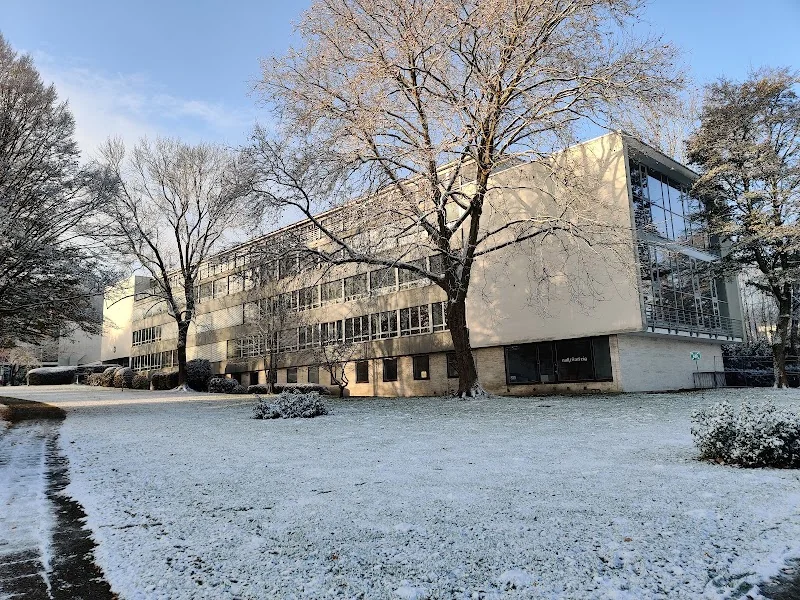
Bielefeld
Lampingstraße 3, 33615 Bielefeld, Deutschland
HSBI Department of Design | Photos & Reviews
The HSBI Department of Design in Bielefeld is more than just a place of study: it is a compact, interdisciplinary campus for design, image, space, and material. At Lampingstraße 3, around 600 students work with 22 professors and lecturers, 17 staff members, and about 30 adjunct instructors on a versatile program that combines artistic and scientific methods. A dedicated library, numerous workshops, laboratories, and studios, as well as regular exhibitions make the location visible and give it a distinctive profile. Those interested in photos, insights, or reviews will find not just an address here, but a clear picture of how concentrated and lively design is practiced in Bielefeld. ([hsbi.de](https://www.hsbi.de/gestaltung/fachbereich))
Photos, Exhibitions, and Current Insights
Those looking for photos from the HSBI Department of Design will find several levels of visual orientation on the official pages. The information day page features a dedicated gallery with images from past information days, documenting not only people and spaces but also making the character of the department tangible. Additionally, numerous images from the ongoing study routine appear on the department's page, such as from workshops, installations, exhibitions, and student projects. This creates a fairly honest impression of how work, discussion, and presentation take place here even before a visit. This is particularly helpful for inquiries about photos, as one does not remain stuck with an abstract description but sees concrete spaces, materials, and situations. ([hsbi.de](https://www.hsbi.de/gestaltung/infotag))
The visual external representation does not end with individual images. The department also refers to the exhibition website and the social media channels of the study programs and the entire department. This includes Instagram, YouTube, Facebook, and TikTok, precisely the places where current works, exhibition situations, and special projects become quickly visible. The final projects of the four study programs are showcased every semester in a three-day exhibition, giving the department a strong public platform. Additionally, there are lectures, workshops, exhibitions, fashion shows, symposia, and the International Week, so the external impact is not artificially inflated but supported by real activities. For those looking for reviews or photos, this is an important indication: the department presents itself not only as a place of education but as an active design platform with public presence. ([hsbi.de](https://www.hsbi.de/gestaltung/fachbereich))
This mix of workspace and exhibition space makes the department photographically exciting. In the images, one does not see an anonymous large structure, but concrete workshops, installations, presentations, and people working on projects. This aligns with the content orientation of the institution, as the university describes the department as an inspiring diversity of themes and working methods, where projects from society, art, and culture are translated into contemporary design. Therefore, anyone wanting to get a first visual impression should not only look for a classic image photo but consider the combination of the information day gallery, exhibition, and the program-specific channels. It is precisely there that one can see how broadly the department works and how strongly practice, reflection, and presentation intertwine. ([hsbi.de](https://www.hsbi.de/gestaltung?path=0))
Directions, Location, and Opening Hours at Lampingstraße 3
The location of the department is at Lampingstraße 3, 33615 Bielefeld, just a few stops from the main train station and close to the Bielefeld campus of the university. For directions, HSBI mentions tram line 4 as well as bus lines 21, 27, 61, and 62 to the Oetker-Halle stop. This makes the department easily accessible by public transport and suitable for prospective students as well as guests of information days, exhibitions, or exhibition openings. The location is not built in isolation but is deliberately embedded in a well-connected university environment. Therefore, anyone searching for directions to HSBI Design or Lampingstraße 3 Bielefeld will receive clear and direct orientation. ([hsbi.de](https://www.hsbi.de/gestaltung/fachbereich))
The opening hours are also practical and clearly regulated. During the lecture period, the location is open from Monday to Friday from 07:00 to 22:00. In the semester break, the hours are Monday to Thursday from 07:30 to 16:00 and Friday from 07:30 to 15:00. Additionally, HSBI provides a location on Google Maps, a campus map, and floor plans of the department, so visitors can get an idea of paths, entrances, and rooms in advance. This is particularly helpful for first visits, as the department does not function like a classic event venue but like a campus with workspaces, consultation areas, and common areas. Those who prepare will experience significantly less orientation costs upon arrival and can focus more on the content. ([hsbi.de](https://www.hsbi.de/gestaltung/bibliothek))
The Four Study Programs: Digital Media and Experiment, Photography and Image Media, Communication Design, and Fashion
Digital Media and Experiment is, according to HSBI, not a fixed area of work but a way of working. The focus is on experimentation, curiosity, and the question of how digital design disciplines can connect with media formats of tomorrow. Among other things, image and video design, storytelling, 3D modeling, motion design for 2D and 3D, CGI, experience design, and interaction design for media space staging are taught. Additionally, programming skills and practical seminars for interactive and immersive media are included. This makes the study program particularly interesting for those who want to not only apply digital design but also think further. The questions regarding augmented, mixed, and virtual reality or new collaboration spaces show how strongly future media and design practice are considered together. ([hsbi.de](https://www.hsbi.de/gestaltung/dmx/inhalte))
Photography and Image Media explicitly understands photography as a cultural technique and artistic medium. The study program responds to a visual culture in which photographic images go far beyond classical journalism and advertising contexts and include moving images, web-based platforms, and hybrid formats through digitization and the internet. Students learn to formulate, refine, and convincingly present their own ideas. The content spectrum ranges from the basics of photography to documentary photography and photojournalism to conceptual and artistic photography, portrait and fashion photography, image editing, moving images, and computer-generated images. Those looking for serious training at the intersection of image, analysis, and design will find a strong mix of theory, craftsmanship, and personal development here. ([hsbi.de](https://www.hsbi.de/gestaltung/fub/inhalte))
Communication Design addresses the daily work with information, channels, and formats. HSBI describes that today we communicate faster, shorter, and on a much larger scale, and that every statement has a form in addition to its content. This is where the study program comes in: from classic print products such as magazines, books, and posters to digital interactive formats like websites, mixed-reality applications, or voice interfaces, conceptual, design, and technical skills are taught. Additionally, language and writing skills as well as reflective abilities are included, which are crucial in an increasingly complex communication environment. In the master's program, a self-chosen project is at the center, which is artistically-design and scientifically-theoretically processed. Thus, communication design is clearly established here as an analytical and at the same time practical discipline. ([hsbi.de](https://www.hsbi.de/gestaltung/kd/inhalte))
Fashion holds a special role at the HSBI Department of Design. The university explicitly states that the engagement with fashion touches on social, cultural-aesthetic, and political questions and that a piece of clothing is always more than the sum of its sewn parts. Fashion here is work on the three-dimensional body, with color, textiles, forms, and cutting techniques. Particularly noteworthy is the indication that this is the only state study location for fashion design in North Rhine-Westphalia. In the bachelor's program, the spectrum ranges from fashion illustration and 3D modeling to 3D draping, material experiments, as well as printing and dyeing techniques to pattern construction and collection design. This is complemented by art, culture, and clothing history as well as textile and merchandise knowledge. The profile is thus practice-oriented but also culturally and historically deeply rooted. ([hsbi.de](https://www.hsbi.de/gestaltung/mode/inhalte))
Workshops, Library & Cafeteria at the Location
The workshop landscape of the department is exceptionally broad and makes the location a true workplace. HSBI operates, among other things, an analog printing workshop, an animation lab, image editing, a bookbinding workshop, computer labs, a data processing center, a digital printing workshop, expanded cinema, photography laboratories, photography workshops, a typesetting workshop, an institute for book design, the interaction design lab, IT services, sewing workshops, an object workshop, a frame storage, screen printing workshops for graphics and fashion, a knitting lab, a video and audio lab, and a drawing room. This density of specialized spaces is crucial for the content breadth of the department because traditional techniques and current digital processes can be used side by side here. Those studying design find not only teaching content but above all infrastructure to materialize, test, and further develop ideas. ([hsbi.de](https://www.hsbi.de/gestaltung?path=0))
The infrastructure also includes the library and cafeteria at the Lampingstraße location. The library is open from Monday to Friday from 8:30 AM to 8:00 PM; there is limited service during lunch and after 5:00 PM. It supports subject literature research, provides access to the HSBI library, the art library, and can also be used by external users. The cafeteria was renovated in 2024 and is an important meeting place at the department. It offers vegetarian and vegan meals and snacks, has 72 seats with differently furnished zones, and can also be used as a lounge outside of meal times. The kitchen is open from Monday to Thursday from 8:00 AM to 4:00 PM and on Fridays from 8:00 AM to 3:00 PM; the room itself is open from Monday to Friday from 7:30 AM to 9:00 PM. This is remarkable for a design location because learning, eating, and exchanging are closely intertwined here. ([hsbi.de](https://www.hsbi.de/gestaltung/bibliothek))
Application, Aptitude Test, and Assessment Procedure
Those interested in the Bachelor of Design must demonstrate a passed aptitude test at HSBI. The bachelor's structure includes four study programs and is supplemented by interdisciplinary modules, creating a versatile and individual study experience. Additionally, the university emphasizes that alongside specific content, artistic and scientific working methods are taught. For the master's program, a different procedure applies: it is generally aimed at individuals with a completed university degree in a design-related field and additionally requires the passed assessment procedure. The master's program is a three-semester full-time course, the primary language of instruction is German, although individual modules may also take place in English, and admission is not restricted. Thus, both formal and content-related requirements are clearly stated. ([hsbi.de](https://www.hsbi.de/gestaltung/fachbereich))
For the application, the department provides a range of orientation aids, including application guidelines, information day details, digital portfolios, brochures, floor plans, and personal contacts. Particularly useful is the interplay of public information and practical advice: those with questions can use the official contact channels of the department, including the secretariat, student service, and specific application addresses. This fits well with the character of the department, as here, initiative, visual curiosity, and the ability to work experimentally are expected. At the same time, the university provides enough material for interested parties to plan the application process in a structured manner. This turns what often seems like a complicated process into a comprehensible sequence of steps leading to the start of studies. ([hsbi.de](https://www.hsbi.de/gestaltung/infotag))
History, Attitude, and Student Life in the Department
The history of the building and the department goes back a long way. The house on Lampingstraße was built in 1956 as a university in the green for the Pedagogical Academy Bielefeld. However, the history of the department itself begins in 1907: the Werkakademie became the Department of Design in 1971 as part of the newly founded University of Applied Sciences Bielefeld, which was renamed Hochschule Bielefeld in 2023. In 1999, the renaming from Department of Design to Department of Design took place to make the conceptual, artistic, and scientific aspects clearer. This development shows that the department did not emerge from nothing but has grown out of a long regional and institutional tradition. ([hsbi.de](https://www.hsbi.de/gestaltung/fachbereich))
Today, the department sees itself as a multidisciplinary, cosmopolitan working, teaching, and research community. It emphasizes diversity, respectful exchange, and adherence to scientific principles as well as the liberal-democratic basic order. At the same time, student life is kept visible through public formats: lectures, exhibitions, workshops, exhibitions, International Week, and collaborations with cultural and economic institutions open the department to the outside. This openness makes the location interesting for inquiries such as HSBI Department of Design Bielefeld, HSBI Design, workshops, or photos, as it is not just about a building but about an active place of thinking, producing, and showing. Those seeking an authentic impression will find in the connection of history, attitude, and current practice a location with a clear identity. ([hsbi.de](https://www.hsbi.de/gestaltung/fachbereich))
Sources:
- HSBI Department of Design - Official Page
- HSBI Department of Design - History and Location
- HSBI Location Lampingstraße - Directions and Opening Hours
- HSBI Department of Design - Information Day and Photos
- HSBI Department of Design - Cafeteria Lampingstraße
- HSBI Department of Design - Library Lampingstraße
- HSBI Digital Media and Experiment - Content
- HSBI Photography and Image Media - Content
- HSBI Communication Design - Content
- HSBI Fashion - Content
- HSBI Aesthetic Theory, Artistic and Curatorial Practice - Content
Mehr anzeigenWeniger anzeigen
HSBI Department of Design | Photos & Reviews
The HSBI Department of Design in Bielefeld is more than just a place of study: it is a compact, interdisciplinary campus for design, image, space, and material. At Lampingstraße 3, around 600 students work with 22 professors and lecturers, 17 staff members, and about 30 adjunct instructors on a versatile program that combines artistic and scientific methods. A dedicated library, numerous workshops, laboratories, and studios, as well as regular exhibitions make the location visible and give it a distinctive profile. Those interested in photos, insights, or reviews will find not just an address here, but a clear picture of how concentrated and lively design is practiced in Bielefeld. ([hsbi.de](https://www.hsbi.de/gestaltung/fachbereich))
Photos, Exhibitions, and Current Insights
Those looking for photos from the HSBI Department of Design will find several levels of visual orientation on the official pages. The information day page features a dedicated gallery with images from past information days, documenting not only people and spaces but also making the character of the department tangible. Additionally, numerous images from the ongoing study routine appear on the department's page, such as from workshops, installations, exhibitions, and student projects. This creates a fairly honest impression of how work, discussion, and presentation take place here even before a visit. This is particularly helpful for inquiries about photos, as one does not remain stuck with an abstract description but sees concrete spaces, materials, and situations. ([hsbi.de](https://www.hsbi.de/gestaltung/infotag))
The visual external representation does not end with individual images. The department also refers to the exhibition website and the social media channels of the study programs and the entire department. This includes Instagram, YouTube, Facebook, and TikTok, precisely the places where current works, exhibition situations, and special projects become quickly visible. The final projects of the four study programs are showcased every semester in a three-day exhibition, giving the department a strong public platform. Additionally, there are lectures, workshops, exhibitions, fashion shows, symposia, and the International Week, so the external impact is not artificially inflated but supported by real activities. For those looking for reviews or photos, this is an important indication: the department presents itself not only as a place of education but as an active design platform with public presence. ([hsbi.de](https://www.hsbi.de/gestaltung/fachbereich))
This mix of workspace and exhibition space makes the department photographically exciting. In the images, one does not see an anonymous large structure, but concrete workshops, installations, presentations, and people working on projects. This aligns with the content orientation of the institution, as the university describes the department as an inspiring diversity of themes and working methods, where projects from society, art, and culture are translated into contemporary design. Therefore, anyone wanting to get a first visual impression should not only look for a classic image photo but consider the combination of the information day gallery, exhibition, and the program-specific channels. It is precisely there that one can see how broadly the department works and how strongly practice, reflection, and presentation intertwine. ([hsbi.de](https://www.hsbi.de/gestaltung?path=0))
Directions, Location, and Opening Hours at Lampingstraße 3
The location of the department is at Lampingstraße 3, 33615 Bielefeld, just a few stops from the main train station and close to the Bielefeld campus of the university. For directions, HSBI mentions tram line 4 as well as bus lines 21, 27, 61, and 62 to the Oetker-Halle stop. This makes the department easily accessible by public transport and suitable for prospective students as well as guests of information days, exhibitions, or exhibition openings. The location is not built in isolation but is deliberately embedded in a well-connected university environment. Therefore, anyone searching for directions to HSBI Design or Lampingstraße 3 Bielefeld will receive clear and direct orientation. ([hsbi.de](https://www.hsbi.de/gestaltung/fachbereich))
The opening hours are also practical and clearly regulated. During the lecture period, the location is open from Monday to Friday from 07:00 to 22:00. In the semester break, the hours are Monday to Thursday from 07:30 to 16:00 and Friday from 07:30 to 15:00. Additionally, HSBI provides a location on Google Maps, a campus map, and floor plans of the department, so visitors can get an idea of paths, entrances, and rooms in advance. This is particularly helpful for first visits, as the department does not function like a classic event venue but like a campus with workspaces, consultation areas, and common areas. Those who prepare will experience significantly less orientation costs upon arrival and can focus more on the content. ([hsbi.de](https://www.hsbi.de/gestaltung/bibliothek))
The Four Study Programs: Digital Media and Experiment, Photography and Image Media, Communication Design, and Fashion
Digital Media and Experiment is, according to HSBI, not a fixed area of work but a way of working. The focus is on experimentation, curiosity, and the question of how digital design disciplines can connect with media formats of tomorrow. Among other things, image and video design, storytelling, 3D modeling, motion design for 2D and 3D, CGI, experience design, and interaction design for media space staging are taught. Additionally, programming skills and practical seminars for interactive and immersive media are included. This makes the study program particularly interesting for those who want to not only apply digital design but also think further. The questions regarding augmented, mixed, and virtual reality or new collaboration spaces show how strongly future media and design practice are considered together. ([hsbi.de](https://www.hsbi.de/gestaltung/dmx/inhalte))
Photography and Image Media explicitly understands photography as a cultural technique and artistic medium. The study program responds to a visual culture in which photographic images go far beyond classical journalism and advertising contexts and include moving images, web-based platforms, and hybrid formats through digitization and the internet. Students learn to formulate, refine, and convincingly present their own ideas. The content spectrum ranges from the basics of photography to documentary photography and photojournalism to conceptual and artistic photography, portrait and fashion photography, image editing, moving images, and computer-generated images. Those looking for serious training at the intersection of image, analysis, and design will find a strong mix of theory, craftsmanship, and personal development here. ([hsbi.de](https://www.hsbi.de/gestaltung/fub/inhalte))
Communication Design addresses the daily work with information, channels, and formats. HSBI describes that today we communicate faster, shorter, and on a much larger scale, and that every statement has a form in addition to its content. This is where the study program comes in: from classic print products such as magazines, books, and posters to digital interactive formats like websites, mixed-reality applications, or voice interfaces, conceptual, design, and technical skills are taught. Additionally, language and writing skills as well as reflective abilities are included, which are crucial in an increasingly complex communication environment. In the master's program, a self-chosen project is at the center, which is artistically-design and scientifically-theoretically processed. Thus, communication design is clearly established here as an analytical and at the same time practical discipline. ([hsbi.de](https://www.hsbi.de/gestaltung/kd/inhalte))
Fashion holds a special role at the HSBI Department of Design. The university explicitly states that the engagement with fashion touches on social, cultural-aesthetic, and political questions and that a piece of clothing is always more than the sum of its sewn parts. Fashion here is work on the three-dimensional body, with color, textiles, forms, and cutting techniques. Particularly noteworthy is the indication that this is the only state study location for fashion design in North Rhine-Westphalia. In the bachelor's program, the spectrum ranges from fashion illustration and 3D modeling to 3D draping, material experiments, as well as printing and dyeing techniques to pattern construction and collection design. This is complemented by art, culture, and clothing history as well as textile and merchandise knowledge. The profile is thus practice-oriented but also culturally and historically deeply rooted. ([hsbi.de](https://www.hsbi.de/gestaltung/mode/inhalte))
Workshops, Library & Cafeteria at the Location
The workshop landscape of the department is exceptionally broad and makes the location a true workplace. HSBI operates, among other things, an analog printing workshop, an animation lab, image editing, a bookbinding workshop, computer labs, a data processing center, a digital printing workshop, expanded cinema, photography laboratories, photography workshops, a typesetting workshop, an institute for book design, the interaction design lab, IT services, sewing workshops, an object workshop, a frame storage, screen printing workshops for graphics and fashion, a knitting lab, a video and audio lab, and a drawing room. This density of specialized spaces is crucial for the content breadth of the department because traditional techniques and current digital processes can be used side by side here. Those studying design find not only teaching content but above all infrastructure to materialize, test, and further develop ideas. ([hsbi.de](https://www.hsbi.de/gestaltung?path=0))
The infrastructure also includes the library and cafeteria at the Lampingstraße location. The library is open from Monday to Friday from 8:30 AM to 8:00 PM; there is limited service during lunch and after 5:00 PM. It supports subject literature research, provides access to the HSBI library, the art library, and can also be used by external users. The cafeteria was renovated in 2024 and is an important meeting place at the department. It offers vegetarian and vegan meals and snacks, has 72 seats with differently furnished zones, and can also be used as a lounge outside of meal times. The kitchen is open from Monday to Thursday from 8:00 AM to 4:00 PM and on Fridays from 8:00 AM to 3:00 PM; the room itself is open from Monday to Friday from 7:30 AM to 9:00 PM. This is remarkable for a design location because learning, eating, and exchanging are closely intertwined here. ([hsbi.de](https://www.hsbi.de/gestaltung/bibliothek))
Application, Aptitude Test, and Assessment Procedure
Those interested in the Bachelor of Design must demonstrate a passed aptitude test at HSBI. The bachelor's structure includes four study programs and is supplemented by interdisciplinary modules, creating a versatile and individual study experience. Additionally, the university emphasizes that alongside specific content, artistic and scientific working methods are taught. For the master's program, a different procedure applies: it is generally aimed at individuals with a completed university degree in a design-related field and additionally requires the passed assessment procedure. The master's program is a three-semester full-time course, the primary language of instruction is German, although individual modules may also take place in English, and admission is not restricted. Thus, both formal and content-related requirements are clearly stated. ([hsbi.de](https://www.hsbi.de/gestaltung/fachbereich))
For the application, the department provides a range of orientation aids, including application guidelines, information day details, digital portfolios, brochures, floor plans, and personal contacts. Particularly useful is the interplay of public information and practical advice: those with questions can use the official contact channels of the department, including the secretariat, student service, and specific application addresses. This fits well with the character of the department, as here, initiative, visual curiosity, and the ability to work experimentally are expected. At the same time, the university provides enough material for interested parties to plan the application process in a structured manner. This turns what often seems like a complicated process into a comprehensible sequence of steps leading to the start of studies. ([hsbi.de](https://www.hsbi.de/gestaltung/infotag))
History, Attitude, and Student Life in the Department
The history of the building and the department goes back a long way. The house on Lampingstraße was built in 1956 as a university in the green for the Pedagogical Academy Bielefeld. However, the history of the department itself begins in 1907: the Werkakademie became the Department of Design in 1971 as part of the newly founded University of Applied Sciences Bielefeld, which was renamed Hochschule Bielefeld in 2023. In 1999, the renaming from Department of Design to Department of Design took place to make the conceptual, artistic, and scientific aspects clearer. This development shows that the department did not emerge from nothing but has grown out of a long regional and institutional tradition. ([hsbi.de](https://www.hsbi.de/gestaltung/fachbereich))
Today, the department sees itself as a multidisciplinary, cosmopolitan working, teaching, and research community. It emphasizes diversity, respectful exchange, and adherence to scientific principles as well as the liberal-democratic basic order. At the same time, student life is kept visible through public formats: lectures, exhibitions, workshops, exhibitions, International Week, and collaborations with cultural and economic institutions open the department to the outside. This openness makes the location interesting for inquiries such as HSBI Department of Design Bielefeld, HSBI Design, workshops, or photos, as it is not just about a building but about an active place of thinking, producing, and showing. Those seeking an authentic impression will find in the connection of history, attitude, and current practice a location with a clear identity. ([hsbi.de](https://www.hsbi.de/gestaltung/fachbereich))
Sources:
- HSBI Department of Design - Official Page
- HSBI Department of Design - History and Location
- HSBI Location Lampingstraße - Directions and Opening Hours
- HSBI Department of Design - Information Day and Photos
- HSBI Department of Design - Cafeteria Lampingstraße
- HSBI Department of Design - Library Lampingstraße
- HSBI Digital Media and Experiment - Content
- HSBI Photography and Image Media - Content
- HSBI Communication Design - Content
- HSBI Fashion - Content
- HSBI Aesthetic Theory, Artistic and Curatorial Practice - Content
HSBI Department of Design | Photos & Reviews
The HSBI Department of Design in Bielefeld is more than just a place of study: it is a compact, interdisciplinary campus for design, image, space, and material. At Lampingstraße 3, around 600 students work with 22 professors and lecturers, 17 staff members, and about 30 adjunct instructors on a versatile program that combines artistic and scientific methods. A dedicated library, numerous workshops, laboratories, and studios, as well as regular exhibitions make the location visible and give it a distinctive profile. Those interested in photos, insights, or reviews will find not just an address here, but a clear picture of how concentrated and lively design is practiced in Bielefeld. ([hsbi.de](https://www.hsbi.de/gestaltung/fachbereich))
Photos, Exhibitions, and Current Insights
Those looking for photos from the HSBI Department of Design will find several levels of visual orientation on the official pages. The information day page features a dedicated gallery with images from past information days, documenting not only people and spaces but also making the character of the department tangible. Additionally, numerous images from the ongoing study routine appear on the department's page, such as from workshops, installations, exhibitions, and student projects. This creates a fairly honest impression of how work, discussion, and presentation take place here even before a visit. This is particularly helpful for inquiries about photos, as one does not remain stuck with an abstract description but sees concrete spaces, materials, and situations. ([hsbi.de](https://www.hsbi.de/gestaltung/infotag))
The visual external representation does not end with individual images. The department also refers to the exhibition website and the social media channels of the study programs and the entire department. This includes Instagram, YouTube, Facebook, and TikTok, precisely the places where current works, exhibition situations, and special projects become quickly visible. The final projects of the four study programs are showcased every semester in a three-day exhibition, giving the department a strong public platform. Additionally, there are lectures, workshops, exhibitions, fashion shows, symposia, and the International Week, so the external impact is not artificially inflated but supported by real activities. For those looking for reviews or photos, this is an important indication: the department presents itself not only as a place of education but as an active design platform with public presence. ([hsbi.de](https://www.hsbi.de/gestaltung/fachbereich))
This mix of workspace and exhibition space makes the department photographically exciting. In the images, one does not see an anonymous large structure, but concrete workshops, installations, presentations, and people working on projects. This aligns with the content orientation of the institution, as the university describes the department as an inspiring diversity of themes and working methods, where projects from society, art, and culture are translated into contemporary design. Therefore, anyone wanting to get a first visual impression should not only look for a classic image photo but consider the combination of the information day gallery, exhibition, and the program-specific channels. It is precisely there that one can see how broadly the department works and how strongly practice, reflection, and presentation intertwine. ([hsbi.de](https://www.hsbi.de/gestaltung?path=0))
Directions, Location, and Opening Hours at Lampingstraße 3
The location of the department is at Lampingstraße 3, 33615 Bielefeld, just a few stops from the main train station and close to the Bielefeld campus of the university. For directions, HSBI mentions tram line 4 as well as bus lines 21, 27, 61, and 62 to the Oetker-Halle stop. This makes the department easily accessible by public transport and suitable for prospective students as well as guests of information days, exhibitions, or exhibition openings. The location is not built in isolation but is deliberately embedded in a well-connected university environment. Therefore, anyone searching for directions to HSBI Design or Lampingstraße 3 Bielefeld will receive clear and direct orientation. ([hsbi.de](https://www.hsbi.de/gestaltung/fachbereich))
The opening hours are also practical and clearly regulated. During the lecture period, the location is open from Monday to Friday from 07:00 to 22:00. In the semester break, the hours are Monday to Thursday from 07:30 to 16:00 and Friday from 07:30 to 15:00. Additionally, HSBI provides a location on Google Maps, a campus map, and floor plans of the department, so visitors can get an idea of paths, entrances, and rooms in advance. This is particularly helpful for first visits, as the department does not function like a classic event venue but like a campus with workspaces, consultation areas, and common areas. Those who prepare will experience significantly less orientation costs upon arrival and can focus more on the content. ([hsbi.de](https://www.hsbi.de/gestaltung/bibliothek))
The Four Study Programs: Digital Media and Experiment, Photography and Image Media, Communication Design, and Fashion
Digital Media and Experiment is, according to HSBI, not a fixed area of work but a way of working. The focus is on experimentation, curiosity, and the question of how digital design disciplines can connect with media formats of tomorrow. Among other things, image and video design, storytelling, 3D modeling, motion design for 2D and 3D, CGI, experience design, and interaction design for media space staging are taught. Additionally, programming skills and practical seminars for interactive and immersive media are included. This makes the study program particularly interesting for those who want to not only apply digital design but also think further. The questions regarding augmented, mixed, and virtual reality or new collaboration spaces show how strongly future media and design practice are considered together. ([hsbi.de](https://www.hsbi.de/gestaltung/dmx/inhalte))
Photography and Image Media explicitly understands photography as a cultural technique and artistic medium. The study program responds to a visual culture in which photographic images go far beyond classical journalism and advertising contexts and include moving images, web-based platforms, and hybrid formats through digitization and the internet. Students learn to formulate, refine, and convincingly present their own ideas. The content spectrum ranges from the basics of photography to documentary photography and photojournalism to conceptual and artistic photography, portrait and fashion photography, image editing, moving images, and computer-generated images. Those looking for serious training at the intersection of image, analysis, and design will find a strong mix of theory, craftsmanship, and personal development here. ([hsbi.de](https://www.hsbi.de/gestaltung/fub/inhalte))
Communication Design addresses the daily work with information, channels, and formats. HSBI describes that today we communicate faster, shorter, and on a much larger scale, and that every statement has a form in addition to its content. This is where the study program comes in: from classic print products such as magazines, books, and posters to digital interactive formats like websites, mixed-reality applications, or voice interfaces, conceptual, design, and technical skills are taught. Additionally, language and writing skills as well as reflective abilities are included, which are crucial in an increasingly complex communication environment. In the master's program, a self-chosen project is at the center, which is artistically-design and scientifically-theoretically processed. Thus, communication design is clearly established here as an analytical and at the same time practical discipline. ([hsbi.de](https://www.hsbi.de/gestaltung/kd/inhalte))
Fashion holds a special role at the HSBI Department of Design. The university explicitly states that the engagement with fashion touches on social, cultural-aesthetic, and political questions and that a piece of clothing is always more than the sum of its sewn parts. Fashion here is work on the three-dimensional body, with color, textiles, forms, and cutting techniques. Particularly noteworthy is the indication that this is the only state study location for fashion design in North Rhine-Westphalia. In the bachelor's program, the spectrum ranges from fashion illustration and 3D modeling to 3D draping, material experiments, as well as printing and dyeing techniques to pattern construction and collection design. This is complemented by art, culture, and clothing history as well as textile and merchandise knowledge. The profile is thus practice-oriented but also culturally and historically deeply rooted. ([hsbi.de](https://www.hsbi.de/gestaltung/mode/inhalte))
Workshops, Library & Cafeteria at the Location
The workshop landscape of the department is exceptionally broad and makes the location a true workplace. HSBI operates, among other things, an analog printing workshop, an animation lab, image editing, a bookbinding workshop, computer labs, a data processing center, a digital printing workshop, expanded cinema, photography laboratories, photography workshops, a typesetting workshop, an institute for book design, the interaction design lab, IT services, sewing workshops, an object workshop, a frame storage, screen printing workshops for graphics and fashion, a knitting lab, a video and audio lab, and a drawing room. This density of specialized spaces is crucial for the content breadth of the department because traditional techniques and current digital processes can be used side by side here. Those studying design find not only teaching content but above all infrastructure to materialize, test, and further develop ideas. ([hsbi.de](https://www.hsbi.de/gestaltung?path=0))
The infrastructure also includes the library and cafeteria at the Lampingstraße location. The library is open from Monday to Friday from 8:30 AM to 8:00 PM; there is limited service during lunch and after 5:00 PM. It supports subject literature research, provides access to the HSBI library, the art library, and can also be used by external users. The cafeteria was renovated in 2024 and is an important meeting place at the department. It offers vegetarian and vegan meals and snacks, has 72 seats with differently furnished zones, and can also be used as a lounge outside of meal times. The kitchen is open from Monday to Thursday from 8:00 AM to 4:00 PM and on Fridays from 8:00 AM to 3:00 PM; the room itself is open from Monday to Friday from 7:30 AM to 9:00 PM. This is remarkable for a design location because learning, eating, and exchanging are closely intertwined here. ([hsbi.de](https://www.hsbi.de/gestaltung/bibliothek))
Application, Aptitude Test, and Assessment Procedure
Those interested in the Bachelor of Design must demonstrate a passed aptitude test at HSBI. The bachelor's structure includes four study programs and is supplemented by interdisciplinary modules, creating a versatile and individual study experience. Additionally, the university emphasizes that alongside specific content, artistic and scientific working methods are taught. For the master's program, a different procedure applies: it is generally aimed at individuals with a completed university degree in a design-related field and additionally requires the passed assessment procedure. The master's program is a three-semester full-time course, the primary language of instruction is German, although individual modules may also take place in English, and admission is not restricted. Thus, both formal and content-related requirements are clearly stated. ([hsbi.de](https://www.hsbi.de/gestaltung/fachbereich))
For the application, the department provides a range of orientation aids, including application guidelines, information day details, digital portfolios, brochures, floor plans, and personal contacts. Particularly useful is the interplay of public information and practical advice: those with questions can use the official contact channels of the department, including the secretariat, student service, and specific application addresses. This fits well with the character of the department, as here, initiative, visual curiosity, and the ability to work experimentally are expected. At the same time, the university provides enough material for interested parties to plan the application process in a structured manner. This turns what often seems like a complicated process into a comprehensible sequence of steps leading to the start of studies. ([hsbi.de](https://www.hsbi.de/gestaltung/infotag))
History, Attitude, and Student Life in the Department
The history of the building and the department goes back a long way. The house on Lampingstraße was built in 1956 as a university in the green for the Pedagogical Academy Bielefeld. However, the history of the department itself begins in 1907: the Werkakademie became the Department of Design in 1971 as part of the newly founded University of Applied Sciences Bielefeld, which was renamed Hochschule Bielefeld in 2023. In 1999, the renaming from Department of Design to Department of Design took place to make the conceptual, artistic, and scientific aspects clearer. This development shows that the department did not emerge from nothing but has grown out of a long regional and institutional tradition. ([hsbi.de](https://www.hsbi.de/gestaltung/fachbereich))
Today, the department sees itself as a multidisciplinary, cosmopolitan working, teaching, and research community. It emphasizes diversity, respectful exchange, and adherence to scientific principles as well as the liberal-democratic basic order. At the same time, student life is kept visible through public formats: lectures, exhibitions, workshops, exhibitions, International Week, and collaborations with cultural and economic institutions open the department to the outside. This openness makes the location interesting for inquiries such as HSBI Department of Design Bielefeld, HSBI Design, workshops, or photos, as it is not just about a building but about an active place of thinking, producing, and showing. Those seeking an authentic impression will find in the connection of history, attitude, and current practice a location with a clear identity. ([hsbi.de](https://www.hsbi.de/gestaltung/fachbereich))
Sources:
- HSBI Department of Design - Official Page
- HSBI Department of Design - History and Location
- HSBI Location Lampingstraße - Directions and Opening Hours
- HSBI Department of Design - Information Day and Photos
- HSBI Department of Design - Cafeteria Lampingstraße
- HSBI Department of Design - Library Lampingstraße
- HSBI Digital Media and Experiment - Content
- HSBI Photography and Image Media - Content
- HSBI Communication Design - Content
- HSBI Fashion - Content
- HSBI Aesthetic Theory, Artistic and Curatorial Practice - Content
Frequently Asked Questions
Reviews
No reviews found